CF in LG air conditioners stands for “Clean Filter.” It’s a smart indicator that alerts you when the air filter needs cleaning or replacement. This feature helps maintain optimal airflow, energy efficiency, and indoor air quality, ensuring your AC runs smoothly and lasts longer.
Key Takeaways
CF means “Clean Filter”: It’s a maintenance alert on LG air conditioners that signals when the filter needs attention.
Improves air quality: A clean filter traps dust, allergens, and pollutants, keeping your indoor air fresh and healthy.
Boosts energy efficiency: Clogged filters force the AC to work harder, increasing energy use and utility bills.
Extends unit lifespan: Regular filter cleaning reduces strain on internal components, preventing premature wear.
Easy to reset: After cleaning, the CF indicator can be reset using the remote or control panel.
Prevents system errors: Ignoring the CF alert may lead to reduced cooling performance or system shutdowns.
Supports smart features: On Wi-Fi-enabled models, the CF alert may appear on your smartphone via the LG ThinQ app.
Quick Answers to Common Questions
What does CF mean in LG air conditioner?
CF stands for “Clean Filter.” It’s a maintenance alert that appears when the air filter needs cleaning or replacement.
How often should I clean the filter on my LG AC?
Check the filter monthly and clean it when the CF indicator appears, typically every 1–3 months depending on usage and environment. For more on this, see our guide on why does my air conditioner only work on.
Can I reset the CF indicator without cleaning the filter?
Technically yes, but it’s not recommended. Ignoring a dirty filter reduces efficiency and can damage the unit over time.
Will a dirty filter increase my electricity bill?
Yes, a clogged filter forces the AC to work harder, increasing energy consumption by up to 15%.
Do all LG air conditioners have a CF indicator?
No, only select models include this feature. Check your user manual or product specifications to confirm.
📑 Table of Contents
- Introduction: Understanding the CF Indicator on Your LG Air Conditioner
- What Does CF Stand For in LG Air Conditioners?
- Why Cleaning the Filter Matters: The Impact of a Dirty Filter
- How to Clean the Filter and Reset the CF Indicator
- When to Replace the Filter Instead of Cleaning
- Smart Features: CF Alerts on the LG ThinQ App
- Common Misconceptions About the CF Indicator
- Conclusion: Keep Your LG AC Running Smoothly
Introduction: Understanding the CF Indicator on Your LG Air Conditioner
Have you ever been enjoying a cool breeze from your LG air conditioner when suddenly a message pops up on the display: “CF”? If you’re like most people, your first reaction might be confusion. What does CF mean? Is it a problem? Should you call a technician right away? For more on this, see our guide on why does my rv air conditioner freeze up.
Don’t panic—this is actually a helpful feature designed to keep your air conditioner running efficiently. The “CF” indicator on LG air conditioners stands for “Clean Filter.” It’s a built-in maintenance reminder that tells you it’s time to clean or replace the air filter. Think of it as your AC’s way of saying, “Hey, I’m working hard, and I need a little TLC!”
LG has long been known for integrating smart, user-friendly features into their appliances, and the CF alert is a perfect example. Instead of guessing when to clean the filter—or worse, forgetting altogether—LG takes the guesswork out of maintenance. This simple yet powerful feature helps homeowners maintain better air quality, save on energy bills, and extend the life of their air conditioning units.
Pro tip: In practice, the CF alert often appears sooner in homes with pets, smokers, or during high-pollen seasons — plan for a quick check whenever household conditions change. For more on this, see our guide on what does seer mean in air conditioning.
What Does CF Stand For in LG Air Conditioners?
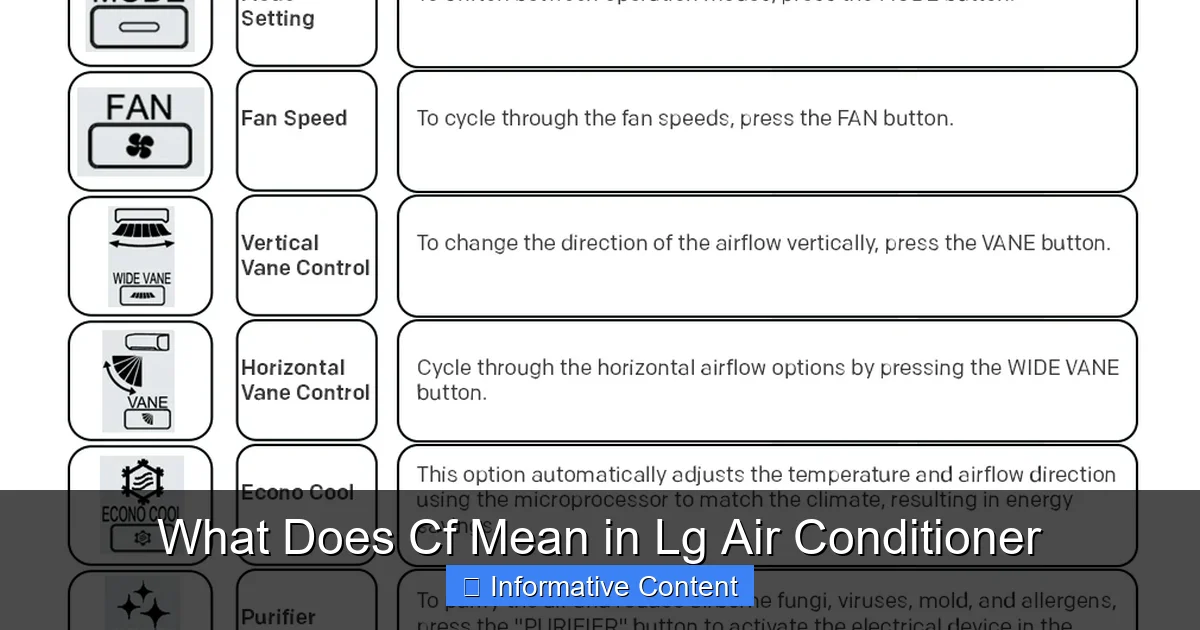
LG air conditioner display showing the CF (Clean Filter) maintenance alert
Image source: globalcoolair.com.au
The acronym “CF” in LG air conditioners stands for Clean Filter . It’s a diagnostic code that appears on the unit’s display panel or remote control when the system detects that the air filter is dirty or clogged. This isn’t a malfunction—it’s a proactive maintenance alert designed to help you keep your AC in top condition.
LG’s air conditioners are equipped with sensors that monitor airflow and filter performance. Over time, dust, pet dander, pollen, and other airborne particles accumulate on the filter. As the filter gets dirtier, it restricts airflow, forcing the AC to work harder to cool your space. The system recognizes this reduced efficiency and triggers the CF indicator to prompt you to take action. For more on this, see our guide on how does hvac air conditioning differ from standard.
It’s important to note that “CF” is not an error code like “E1” or “P1,” which might indicate a serious mechanical issue. Instead, it’s a routine maintenance reminder—similar to the “check engine” light in your car. Ignoring it won’t immediately break your AC, but it can lead to bigger problems down the line.
How the CF Indicator Works
LG air conditioners use a combination of airflow sensors and timer-based algorithms to determine when the filter needs cleaning. Some models rely on a preset time interval—such as every 250 hours of operation—while others use real-time monitoring of airflow resistance. When the system detects reduced airflow or reaches the scheduled maintenance time, the CF message appears.
For example, if you run your AC for 8 hours a day, the CF alert might show up after about a month. But if you live in a dusty area or have pets, the filter may clog faster, and the alert could appear sooner. This adaptive approach ensures that maintenance is based on actual usage and environmental conditions, not just a fixed schedule.
Why LG Includes the CF Feature
LG designed the CF indicator to address a common problem: neglected air filters. Many homeowners forget to clean or replace their AC filters regularly, leading to poor performance and higher energy costs. By adding a visual reminder, LG helps users stay on top of maintenance without needing to remember complex schedules.
This feature is especially valuable for busy families, elderly users, or anyone who doesn’t want to worry about technical upkeep. It’s part of LG’s broader commitment to creating appliances that are not only high-performing but also easy to maintain.
Why Cleaning the Filter Matters: The Impact of a Dirty Filter
You might be wondering: “Is cleaning the filter really that big of a deal?” The short answer is yes—very much so. A dirty air filter doesn’t just reduce comfort; it can significantly impact your health, energy bills, and the longevity of your air conditioner.
Reduced Airflow and Cooling Performance
When the filter is clogged, air struggles to pass through it. This restricts airflow into the evaporator coil, which is responsible for cooling the air. As a result, your AC has to run longer and harder to reach the desired temperature. You might notice that certain rooms aren’t cooling as well, or that the unit seems to be constantly running.
For example, imagine trying to breathe through a straw covered in tissue paper. That’s essentially what your AC is doing when the filter is dirty. The compressor and fan motors work overtime, which can lead to overheating and increased wear.
Higher Energy Consumption
A clogged filter forces your air conditioner to consume more electricity to maintain cooling. Studies have shown that a dirty filter can increase energy usage by up to 15%. Over time, this adds up—especially during hot summer months when the AC runs frequently.
Let’s say your AC normally uses 3,000 watts per hour. With a dirty filter, that could jump to 3,450 watts. If you run it for 8 hours a day, that’s an extra 3.6 kWh per day. At $0.12 per kWh, that’s about $0.43 extra per day—or over $13 per month. Multiply that by the number of units in your home, and the cost adds up quickly.
Poor Indoor Air Quality
Your air conditioner’s filter does more than protect the unit—it also cleans the air you breathe. A clean filter captures dust, mold spores, pet dander, pollen, and other allergens. When the filter is dirty, it can’t trap these particles effectively. In some cases, it may even release trapped contaminants back into the air.
This is especially concerning for people with allergies, asthma, or respiratory conditions. Poor indoor air quality can lead to coughing, sneezing, headaches, and fatigue. Regular filter cleaning helps maintain a healthier living environment for everyone in your home. According to the EPA, indoor air can be 2–5 times more polluted than outdoor air, making filtration critical.
Increased Risk of System Damage
A dirty filter doesn’t just affect performance—it can also cause mechanical damage. Restricted airflow can cause the evaporator coil to freeze up. When ice builds up on the coil, it insulates the surface and prevents heat exchange. This can lead to a complete system shutdown or even damage to the compressor, which is one of the most expensive components to repair or replace.
Additionally, the fan motor may overheat due to increased workload, leading to premature failure. In extreme cases, the system may trigger a safety shutdown to prevent further damage.
Shortened Lifespan of the Unit
All of these issues—reduced efficiency, higher energy use, and component stress—contribute to a shorter lifespan for your air conditioner. Most LG air conditioners are designed to last 10 to 15 years with proper maintenance. But without regular filter cleaning, that lifespan could be cut significantly.
Think of it like a car: if you never change the oil, the engine will eventually fail. The same principle applies to your AC. The CF indicator is your reminder to perform this essential maintenance task.
How to Clean the Filter and Reset the CF Indicator
Now that you understand why the CF alert is important, let’s talk about how to respond. Cleaning the filter and resetting the indicator is a simple process that takes just a few minutes. Here’s a step-by-step guide to help you get it done quickly and correctly.
Step 1: Turn Off the Air Conditioner
Before you begin, make sure the unit is turned off. This is a safety precaution to prevent accidental startup while you’re handling the filter. You can turn it off using the remote control or by switching off the power at the circuit breaker.
Step 2: Locate the Air Filter
The air filter is usually located behind the front panel of the air conditioner. On most LG window or split-type units, you can access it by opening the front grille. Look for a latch or hinge that allows the panel to swing open.
Some models have a slide-out filter tray, while others require you to lift the filter out by hand. Refer to your user manual if you’re unsure—LG provides detailed diagrams for each model.
Step 3: Remove the Filter
Gently pull the filter out of its slot. Be careful not to bend or damage the frame. If the filter is heavily soiled, you may notice a layer of dust and debris on the surface. This is normal—especially if the CF alert has been on for a while.
Step 4: Clean the Filter
There are two main ways to clean the filter:
- Vacuuming: Use a vacuum cleaner with a brush attachment to remove loose dust and debris. This is ideal for light to moderate buildup.
- Washing: If the filter is very dirty, rinse it under lukewarm water. Avoid using hot water, as it can warp the filter material. You can also use a mild detergent if needed, but be sure to rinse thoroughly and let it dry completely before reinstalling.
Never use harsh chemicals, bleach, or high-pressure water, as these can damage the filter. Also, don’t wring or twist the filter—this can tear the mesh.
Step 5: Let the Filter Dry
After washing, place the filter on a clean towel and let it air dry completely. This usually takes 1–2 hours, depending on humidity and airflow. Never reinstall a wet filter, as moisture can promote mold growth and damage the unit.
Step 6: Reinstall the Filter
Once the filter is dry, slide it back into its slot. Make sure it’s properly aligned and seated securely. Close the front panel and ensure it clicks into place.
Step 7: Reset the CF Indicator
Now it’s time to reset the CF alert. The method varies slightly depending on your model, but here’s the general process:
- Turn the air conditioner back on.
- Press and hold the “Filter” or “Clean” button on the remote control for 3–5 seconds. On some models, you may need to press the “Mode” and “Fan” buttons simultaneously.
- The CF message should disappear from the display.
If you’re using an LG ThinQ-enabled model, you can also reset the alert through the app. Open the LG ThinQ app, select your air conditioner, and look for the “Maintenance” or “Filter” section. Tap “Reset Filter Indicator” to clear the message.
Pro Tips for Filter Maintenance
- Check the filter monthly: Even if the CF alert hasn’t appeared, inspect the filter every 30 days, especially during peak usage seasons.
- Use high-quality filters: Consider upgrading to a washable or HEPA filter for better performance and longer life.
- Keep a cleaning schedule: Set a monthly reminder on your phone or calendar to check the filter.
- Replace when necessary: Most filters should be replaced every 6–12 months, depending on usage and environment.
Filter Type Comparison: Which One Fits Your Needs?
| Filter Type | MERV Rating | Washable | Best For | Typical Replacement |
|---|---|---|---|---|
| Standard mesh | 1–4 | Yes | Basic dust protection | 6–12 months |
| Electrostatic | 6–8 | Yes | Pet dander, pollen | 12–18 months |
| HEPA (LG-compatible) | 13–17 | No | Allergies, asthma, smoke | 12 months |
| Activated carbon | 8–10 | No | Odors, VOCs, cooking fumes | 6 months |
Choose a filter that matches your model’s specifications — using the wrong thickness or frame size can bypass the filter track and defeat the CF sensor.
When to Replace the Filter Instead of Cleaning
While cleaning the filter is usually sufficient, there are times when replacement is the better option. Over time, filters can become damaged, warped, or too clogged to clean effectively.
Signs You Need a New Filter
- The filter is torn, frayed, or has holes.
- It’s been in use for over a year.
- Cleaning doesn’t improve airflow or performance.
- The filter material is discolored or smells musty.
Using a damaged filter can reduce efficiency and allow contaminants to bypass the filtration system. Always replace the filter with an LG-approved model to ensure compatibility and performance.
Choosing the Right Replacement Filter
LG offers a range of filters designed for specific models. You can find the correct filter by checking your user manual or visiting the LG website. Enter your model number to see compatible options.
Some popular types include:
- Standard mesh filters: Affordable and effective for basic filtration.
- Washable electrostatic filters: Reusable and capture more particles.
- HEPA filters: High-efficiency options for allergy sufferers.
A common mistake is buying a “universal” filter that almost fits — gaps around the frame let unfiltered air through and can trick the CF sensor into staying on.
Smart Features: CF Alerts on the LG ThinQ App
If you own a Wi-Fi-enabled LG air conditioner, you can take advantage of smart features that make maintenance even easier. The LG ThinQ app allows you to monitor and control your AC from your smartphone, including receiving CF alerts.
How It Works
When the CF indicator is triggered, the app sends a push notification to your phone. You’ll see a message like “Your air conditioner’s filter needs cleaning.” This is especially helpful if you’re away from home or have multiple units to manage.
You can also view filter status, schedule cleaning reminders, and even order replacement filters directly through the app. Some models even provide usage statistics, so you can track how often the filter needs attention.
Benefits of Smart Monitoring
- Convenience: Get alerts no matter where you are.
- Proactive maintenance: Never forget to check the filter.
- Energy savings: Keep your AC running efficiently.
- Peace of mind: Know your system is well-maintained.
To set up the app, download LG ThinQ from the App Store or Google Play, create an account, and follow the on-screen instructions to connect your air conditioner to your home Wi-Fi network.
Common Misconceptions About the CF Indicator
Despite its simplicity, the CF indicator is often misunderstood. Here are a few common myths and the truth behind them.
Myth 1: CF Means There’s a Serious Problem
Truth: CF is a maintenance reminder, not an error code. It doesn’t indicate a mechanical failure—just that the filter needs cleaning.
Myth 2: I Can Ignore It If the AC Is Still Cooling
Truth: Even if the unit seems to be working, a dirty filter reduces efficiency and can lead to long-term damage. Don’t wait for performance to drop.
Myth 3: All Air Conditioners Have a CF Indicator
Truth: Only certain LG models include this feature. Check your user manual or product specifications to confirm.
Myth 4: Resetting the CF Alert Is Complicated
Truth: It’s a simple button press or app command. Most users can do it in under a minute.
Professional vs. DIY Filter Maintenance
Most filter cleaning is a straightforward DIY task, but certain situations call for a technician:
- Persistent CF alerts after thorough cleaning may indicate a sensor fault or airflow restriction deeper in the system.
- Mold or mildew on the evaporator coil (visible when the filter is out) requires professional cleaning to avoid spreading spores.
- Commercial or multi-zone systems often have filters in hard-to-reach plenums — schedule a pro visit annually.
- Warranty concerns: Some LG extended warranties require documented professional maintenance at least once per year.
If you’re already booking a seasonal tune-up, ask the tech to verify the CF sensor calibration — it’s a quick check that prevents false alerts.
Seasonal Maintenance Tips for LG AC Owners
The CF indicator is your primary filter reminder, but pairing it with seasonal habits keeps the whole system healthier:
- Spring (pre-season): Clean or replace the filter, clear debris from the outdoor unit, and test the CF reset before daily use begins.
- Summer (peak): Check the filter every 2–3 weeks if the AC runs continuously; high humidity accelerates dust loading.
- Fall (post-season): Run the unit on fan-only for 30 minutes to dry the coil, then clean the filter one last time before storage or light-duty heating mode.
- Winter (off-season for cooling-only units): Remove and store washable filters in a sealed bag to prevent dust buildup; cover the indoor unit if accessible.
For a printable checklist, see our seasonal air conditioning maintenance tips.
Troubleshooting: CF Indicator Won’t Reset
If the CF message stays on after cleaning and the standard reset:
- Power-cycle the unit: Turn off the breaker for 60 seconds, then restore power and retry the reset sequence.
- Verify filter seating: A slightly misaligned filter can block the sensor tab — remove and reinsert until it clicks.
- Check for a second filter: Some dual-zone or high-capacity models have a secondary filter behind the main one; both must be clean.
- Inspect the sensor window: Dust on the optical or pressure sensor (usually a small slit near the filter track) can trick the logic — blow it out with canned air.
- Firmware update: On ThinQ models, open the app → Device Settings → Firmware Update; a 2024+ patch fixed a known CF reset bug on select 2022–2023 builds.
If none of these steps work, the sensor or control board may need service — contact LG support with your model and serial number ready.
Conclusion: Keep Your LG AC Running Smoothly
The CF indicator on your LG air conditioner is more than just a light on the display—it’s a valuable tool for maintaining performance, efficiency, and air quality. By understanding what CF means and responding promptly, you can save money on energy bills, extend the life of your unit, and enjoy cleaner, cooler air all year long.
Cleaning the filter is one of the easiest and most effective ways to care for your air conditioner. With the help of the CF alert, LG makes it simple to stay on top of this essential task. Whether you’re using a basic model or a smart Wi-Fi unit, regular maintenance ensures your AC works when you need it most.
So the next time you see “CF” on your display, don’t ignore it. Take a few minutes to clean the filter, reset the indicator, and give your air conditioner the care it deserves. Your wallet, your health, and your comfort will thank you.
Next step: Bookmark this guide and set a monthly calendar reminder to check your filter — or let the LG ThinQ app handle the nudges for you.
Frequently Asked Questions
How do I reset the CF indicator on my LG air conditioner?
Turn on the unit, then press and hold the “Filter” or “Clean” button on the remote for 3–5 seconds. The CF message should disappear. On smart models, you can also reset it via the LG ThinQ app.
Can I wash the air filter with soap and water?
Yes, you can use mild detergent and lukewarm water to clean the filter. Rinse thoroughly and let it dry completely before reinstalling.
What happens if I ignore the CF alert?
Ignoring the alert can lead to reduced cooling, higher energy bills, frozen coils, and potential damage to the compressor or fan motor.
Is the CF indicator the same as an error code?
No, CF is a maintenance reminder, not an error code. Error codes like E1 or P1 indicate mechanical issues and require professional attention.
Can I use a third-party filter in my LG air conditioner?
It’s best to use LG-approved filters to ensure proper fit, performance, and warranty coverage. Third-party filters may not meet the same standards.
Does the CF indicator appear on all LG AC models?
No, the CF feature is available on many—but not all—LG air conditioners. Check your model’s user manual or product details to confirm.