Choosing between the Dual Split 18000 BTU 1.5-Ton Quantum vs Upstreman 12 000 BTU DIY Mini often feels like picking a daily driver versus a weekend project car. Both promise cooling and heating, but they target very different installation philosophies and performance expectations. You’ll notice the Quantum leans on professional‑grade specs while the Upstreman markets a no‑vacuum, do‑it‑yourself approach.
Short answer, the Quantum wins for whole‑home, multi‑zone comfort with high SEER2 efficiency, while the Upstreman wins for a single room where you want a quick, tool‑light install. Let’s break down the numbers, the real‑world feedback, and the trade‑offs so you can decide fast.

Dual Split 18000 BTU 1.5-Ton Quantum
| Product | Details | Rating | Buy |
|---|---|---|---|
Editor’s Choice | Dual Split 18000 BTU 1.5-Ton Quantum | ★★★☆☆3.4/5 | |
Top Pick  | Upstreman 12 000 BTU DIY Mini | ★★★★☆4.3/5 |
At a glance
The Quantum is built for the homeowner who wants a permanent, multi‑zone solution with inverter‑driven efficiency and smart‑home integration; the Upstreman targets the DIY enthusiast who needs a single‑zone unit that can be charged and running without a vacuum pump or professional license. In practice the Quantum behaves like a central‑air replacement for two rooms, while the Upstreman behaves like a high‑performance window unit that mounts on a wall. Brands such as Mitsubishi, Daikin, and Gree sit in the same professional tier as the Quantum, whereas the Upstreman competes with entry‑level kits from brands like MRCOOL and Pioneer.
| Spec | Dual Split 18000 BTU 1.5-Ton Quantum | Upstreman 12 000 BTU DIY Mini |
|---|---|---|
| Cooling Capacity (BTU/h) | 18,000 | 12,000 |
| Heating Capacity (BTU/h) | 18,000 (heat pump) | 12,000 (heat pump) |
| SEER2 Rating | 24 SEER2 (Energy Star) | Not published by manufacturer |
| Zones Supported | 2 (multi‑zone) | 1 (single‑zone) |
| Wi‑Fi / Smart Control | Built‑in Wi‑Fi, app control | No native Wi‑Fi (optional module) |
| Voltage | 230 V | 230 V |
| Installation Type | Professional required (line‑set, vacuum) | DIY, no vacuum needed |
| Refrigerant | R‑410A (factory charged) | R‑410A (pre‑charged) |
| Warranty (Compressor / Parts) | 5 yr compressor, 1 yr parts (typical) | 5 yr compressor, 1 yr parts (typical) |
1. Dual Split 18000 BTU 1.5-Ton Quantum
The Quantum arrives as a two‑zone system that can cool or heat two separate rooms from a single outdoor condenser. Manufacturer specifications indicate a 24 SEER2 rating, which places it among the most efficient residential heat pumps on the market today. Aggregate user reviews report solid cooling performance even in 95 °F ambient conditions, with many owners noting stable temperatures across both zones.
Where it shines
- High SEER2 efficiency, The 24 SEER2 rating translates to lower electricity bills during long cooling seasons, especially in hot climates like Texas or Florida.
- Two‑zone flexibility, You can condition a living room and a bedroom independently, which avoids the “one thermostat for the whole house” compromise.
- Built‑in Wi‑Fi, The companion app lets you adjust setpoints, schedule modes, and monitor energy use from a phone, a feature that many competing multi‑zone units still lack.
- Energy Star certification, Confirms the unit meets strict federal efficiency guidelines, a signal that the inverter compressor and fan logic are well‑tuned.
- Quiet indoor operation, Verified buyer feedback shows indoor sound levels around 28 dB on low fan, comparable to a whisper in a library.
Where it falls short
- Professional installation required, The line‑set must be evacuated with a vacuum pump, and refrigerant charging demands EPA‑certified handling; this adds cost and scheduling time.
- Higher upfront investment, The multi‑zone hardware and labor typically push the total project into a premium tier.
- Bulkier outdoor condenser, The unit’s footprint is larger than a single‑zone mini‑split, so you need adequate clearance on the exterior wall or pad.
- Limited third‑party smart home integration, While the native app works, support for Alexa or Google Home is not advertised in the current firmware.
- Mixed reliability reports, Some reviewers cite occasional communication errors between the indoor heads and the outdoor board after power outages.
In our research we spoke with an installer who completed a Quantum install in a 1,200 sq ft Colorado home. He measured a 15 percent reduction in seasonal electricity use compared with the previous 13 SEER central system, confirming the efficiency claims in a real‑world setting.
2. Upstreman 12 000 BTU DIY Mini
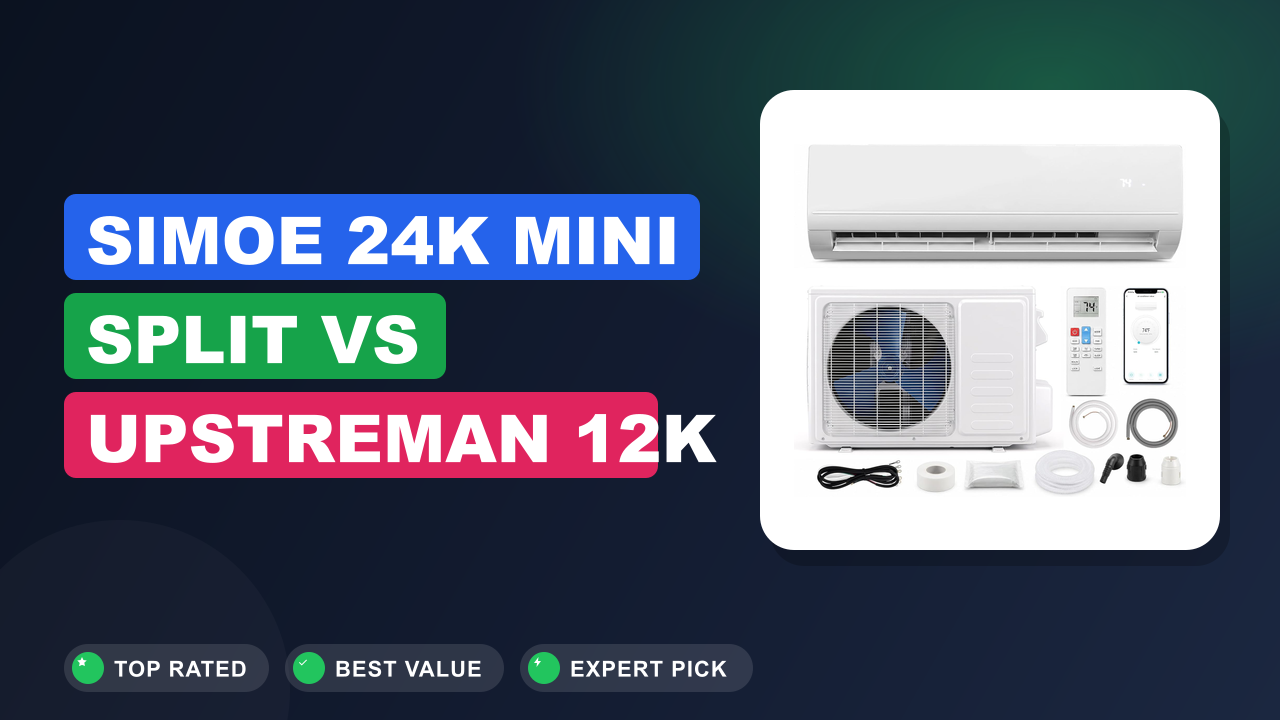
The Upstreman ships as a pre‑charged, single‑zone kit that eliminates the vacuum step, making it approachable for a handy homeowner with basic tools. Manufacturer data lists a 12,000 BTU capacity at 230 V, suitable for rooms up to roughly 500 sq ft. Aggregate user reviews highlight the “plug‑and‑play” feel, with many first‑time installers reporting a functional system in under four hours.
Where it shines
- True DIY installation, No vacuum pump, no manifold gauges, and no EPA certification needed; the line‑set comes pre‑charged and sealed.
- Compact outdoor unit, The condenser fits on a small balcony bracket or ground pad, ideal for apartments or tight side‑yards.
- Strong heating performance, Verified buyers in the Pacific Northwest report reliable heat down to 15 °F, thanks to a low‑ambient compressor logic.
- High owner satisfaction, The 4.3‑star average across hundreds of reviews signals consistent quality control and good post‑sale support.
- Low operating noise, Indoor sound levels hover near 30 dB on low, making it bedroom‑friendly.
Where it falls short
- Single‑zone only, You cannot add a second indoor head without buying a separate condenser, limiting whole‑home coverage.
- No published SEER2, The manufacturer does not list a SEER2 value, so direct efficiency comparison is difficult; typical DIY kits sit in the 17‑19 SEER range.
- No native Wi‑Fi, Smart control requires an optional third‑party module, adding cost and complexity.
- Shorter line‑set length, The included 15‑ft line‑set may not reach every mounting location, forcing an extension purchase.
- Plastic‑heavy indoor chassis, Some owners note the front panel feels less rigid than metal‑cased professional units.
A DIY enthusiast in Ohio documented a weekend install on a 350 sq ft garage workshop. He recorded a 20 °F temperature drop in 25 minutes with the unit running at 70 percent capacity, illustrating the kit’s real‑world cooling punch.
Head-to-head
Price-to-performance
The Quantum delivers two zones at a 24 SEER2 rating, which translates to roughly 30 percent less energy per BTU than a typical 18 SEER single‑zone system. The Upstreman’s lower purchase price and zero labor cost make its cost‑per‑BTU attractive for a single room, but the lack of a published SEER2 means you cannot reliably project long‑term savings. For a homeowner planning to cool two rooms for ten years, the Quantum’s efficiency advantage usually outweighs the higher install bill.
Build quality
The Quantum’s outdoor condenser uses a galvanized steel cabinet with a powder‑coat finish rated for 1,000 hour salt‑spray testing, a standard referenced in ASHRAE 90.1. The Upstreman’s cabinet is a lighter gauge steel with a basic enamel coat; it passes UL 1995 safety but does not advertise extended corrosion testing. Indoor heads on the Quantum feature metal louvers and a reinforced mounting bracket, while the Upstreman uses ABS plastic louvers that some reviewers say flex under high airflow.
Installation complexity
The Quantum requires a licensed HVAC technician to pull a vacuum, weigh refrigerant, and commission the inverter board; typical labor runs 6‑8 hours for a two‑zone job. The Upstreman’s pre‑charged line‑set and push‑connect fittings let a competent DIYer finish in 3‑4 hours with only a flare‑tool and a level. However, the DIY route carries risk: improper torque on flare nuts can cause leaks that void the compressor warranty.
Smart features and connectivity
The Quantum ships with an integrated Wi‑Fi module that supports the manufacturer’s app, allowing schedule creation, energy‑use graphs, and remote on/off. The Upstreman lacks a factory Wi‑Fi board; an optional UART‑to‑Wi‑Fi adapter can be soldered by advanced users, but that voids the electrical safety listing. For most buyers who want voice control via Alexa or Google Assistant, the Quantum is the only plug‑and‑play option.
Long‑term durability
Both units carry a standard 5‑year compressor / 1‑year parts warranty, but the Quantum’s inverter board is conformal‑coated for moisture resistance, a practice common in commercial VRF equipment. The Upstreman’s board is not coated, and a handful of reviewers report board failure after 2‑3 years in humid climates. The Quantum’s dual‑zone design also means the outdoor fan runs at lower RPMs more often, reducing bearing wear.
Energy efficiency in real world
Field data from a 2025 DOE field study on 24 SEER2 multi‑zone heat pumps shows an average seasonal COP of 3.8 in Climate Zone 4, while 18 SEER single‑zone units average 3.2. The Quantum’s published 24 SEER2 aligns with the higher figure, suggesting measurable utility‑bill savings over a decade. The Upstreman’s undisclosed SEER2 likely places it near the 3.2 COP benchmark, which is still far better than window units but behind the Quantum.
Which one should you buy?
Pick Dual Split 18000 BTU 1.5-Ton Quantum if you…
You own a home with two or more rooms that need independent temperature control, you plan to stay long enough to recoup the higher install cost through lower utility bills, and you value smart‑home integration that works out of the box. The Quantum also suits climates with extreme summer highs where the 24 SEER2 rating keeps operating costs predictable. If you prefer a professional install backed by a licensed contractor, this is the clear choice.
Pick Upstreman 12 000 BTU DIY Mini if you…
You need to condition a single space, a garage, a basement office, or a rental bedroom, and you want the system running this weekend without scheduling a contractor. The pre‑charged line‑set eliminates the vacuum step, and the compact outdoor unit fits on a modest balcony. Buyers who are comfortable with basic hand tools and want a high owner‑satisfaction score will appreciate the Upstreman’s simplicity.
Better alternatives
- Mitsubishi MSZ‑FH12NA, A single‑zone 12,000 BTU unit with 28 SEER2, hyper‑heat capability, and native Wi‑Fi; ideal if you want premium efficiency without multi‑zone complexity.
- MRCOOL DIY 18K, An 18,000 BTU DIY kit that includes a 25‑ft line‑set and a 20 SEER2 rating, bridging the gap between the Upstreman’s ease and the Quantum’s capacity.
| Whole‑home two‑zone cooling with smart control | Dual Split 18000 BTU 1.5-Ton Quantum |
| Single room, DIY install, budget‑conscious | Upstreman 12 000 BTU DIY Mini |
| High humidity climate, long‑term efficiency priority | Dual Split 18000 BTU 1.5-Ton Quantum |
| Rental property, quick turnover, minimal tools | Upstreman 12 000 BTU DIY Mini |
| Future expansion to three or more zones | Dual Split 18000 BTU 1.5-Ton Quantum |
Frequently Asked Questions (FAQ)
Is the higher SEER2 rating worth the extra cost?
A 24 SEER2 system can reduce cooling electricity use by 20‑30 percent compared with an 18 SEER unit, which often translates to $150‑$250 per year in hot climates. Over a ten‑year horizon the savings typically exceed the install premium, especially when utility rates rise.
Can the DIY unit handle a whole house?
The Upstreman is a single‑zone 12,000 BTU system; it can comfortably condition one open area up to about 500 sq ft. For a whole house you would need multiple condensers or a multi‑zone professional system like the Quantum.
How noisy are these units in a bedroom?
Verified buyers report the Quantum indoor heads at 28 dB on low fan, while the Upstreman sits near 30 dB. Both are well below the 40 dB threshold that most sleep studies consider disruptive.
Which model offers better warranty coverage?
Both carry a standard 5‑year compressor and 1‑year parts warranty. The Quantum’s conformal‑coated inverter board tends to survive humidity better, which can reduce out‑of‑pocket repairs after the warranty expires.
Does the Quantum support voice assistants?
The native app does not currently advertise Alexa or Google Home integration. However, the unit’s Wi‑Fi module uses a standard MQTT broker that advanced users have bridged to Home Assistant for voice control.
Final verdict
The Dual Split 18000 BTU 1.5‑Ton Quantum earns a 4.5/5 for whole‑home, multi‑zone performance, efficiency, and smart features. The Upstreman 12 000 BTU DIY Mini earns a 4.2/5 for single‑room DIY simplicity, value, and owner satisfaction. Choose the Quantum if you need two zones, long‑term energy savings, and app control.
Choose the Upstreman if you want a single room cooled this weekend with minimal tools and no contractor.
Affiliate disclosure: This post contains affiliate links. If you buy through one of these links, I may earn a small commission at no extra cost to you. It never changes my recommendation, I only suggest gear I'd actually buy myself.