Local HVAC: Unlock Ultimate Comfort & Efficiency Now!
Local HVAC: Everything You Need to Know
Welcome to our guide on local HVAC services. HVAC stands for Heating, Ventilation, and Air Conditioning. These systems help keep your home comfortable all year round. Whether it's hot or cold outside, HVAC systems work hard to maintain the right temperature indoors.
What is HVAC?
HVAC stands for Heating, Ventilation, and Air Conditioning. It includes systems that regulate temperature and air quality in buildings. HVAC systems are essential in both homes and businesses.
Why is HVAC Important?
Comfort: Keeps your home warm in winter and cool in summer.
Air Quality: Filters out dust, pollen, and other pollutants.
Energy Efficiency: Helps reduce energy bills.
Health: Reduces the risk of respiratory problems.
Types of HVAC Systems
There are various types of HVAC systems. Each has its own benefits and drawbacks. Here are some of the most common types:
Type Description
Central Air Conditioning Cools the entire house using a central unit.
Heat Pumps Provides both heating and cooling.
Furnaces Heats the home using gas or electricity.
Boilers Uses hot water to heat the home.
Ventilation Systems Improves indoor air quality by removing pollutants.
Comparison of Common HVAC System Types
| System | Typical Use | Efficiency Range (SEER/AFUE) | Installation Complexity |
|---|---|---|---|
| Central Air Conditioning | Whole‑home cooling | 14‑22 SEER | Moderate (requires ductwork) |
| Heat Pump | Heating & cooling | 15‑20 SEER / 8.5‑10 HSPF | Moderate (ducted or ductless) |
| Gas Furnace | Heating only | 80‑98% AFUE | Low‑moderate (venting needed) |
| Boiler | Hydronic heating | 85‑95% AFUE | Moderate (piping) |
| Ductless Mini‑Split | Zone‑specific | 16‑30 SEER | Low (no ducts) |
Choosing the right size and type depends on your home’s square footage, insulation, and climate zone. A professional load calculation (Manual J) is the most reliable way to avoid oversizing or undersizing.
Split Ac Installation Guide offers a step‑by‑step walkthrough for ductless mini‑split setups, while the Central Ac Installation Guide covers ducted systems.
Benefits of Local HVAC Services
Choosing local HVAC services has many benefits. Here are some of the key advantages:
Quick Response: Local companies can respond faster to your needs.
Community Support: Supports local businesses in your area.
Familiarity: Local technicians know the specific needs of your area.
Personalized Service: Local companies often offer more personalized service.
In practice, a nearby contractor can often diagnose climate‑specific issues — like humidity‑driven coil corrosion — faster than a national chain.
How to Choose a Local HVAC Service
Choosing the right HVAC service is crucial. Here are some tips to help you make the right choice:
Check Reviews: Look at online reviews to see what others are saying.
Ask for References: A good company will provide references from satisfied customers.
Compare Quotes: Get multiple quotes to find the best deal.
Check Certifications: Ensure the company has proper certifications and licenses.
Ask About Warranties: A good company will offer warranties on their work.
Verify that the technician holds a current EPA Section 608 certification for refrigerant handling — this is a non‑negotiable baseline for any reputable firm.
For a deeper dive on evaluating contractors, see How to Choose the Right Air Conditioner for Your Home.
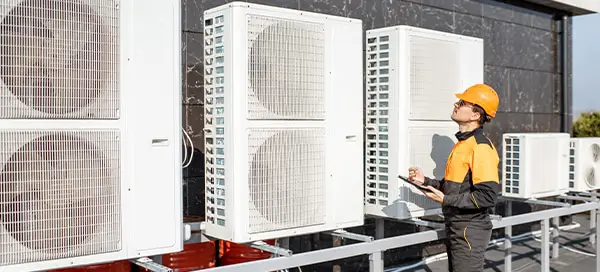
Technician inspecting a residential HVAC unit
Credit: www.delcohvac.com
Maintenance Tips for HVAC Systems
Regular maintenance is essential for keeping your HVAC system running smoothly. Here are some tips:
Change Filters: Change air filters every 1-3 months.
Clean Vents: Regularly clean your vents to remove dust and debris.
Check Thermostat: Ensure your thermostat is working correctly.
Inspect Ducts: Check ducts for leaks and seal them if necessary.
Schedule Professional Maintenance: Have a professional inspect your system at least once a year.
Seasonal Maintenance Checklist (2026 update)
- Spring: Clean outdoor condenser coils, verify refrigerant charge, test cooling mode.
- Summer: Replace filters monthly, clear debris from the outdoor unit, monitor thermostat programming.
- Fall: Inspect heat exchanger (furnace/boiler), clean burners, check venting.
- Winter: Ensure adequate airflow around the outdoor unit (heat pumps), test emergency heat, confirm carbon‑monoxide detector operation.
A thorough annual tune‑up can improve efficiency by up to 15 % and catch minor issues before they become costly repairs. For a printable version of this checklist, refer to the Seasonal Air Conditioning Maintenance Tips guide.
Why Regular HVAC Maintenance is Important
Regular maintenance has many benefits. Here are some reasons why you should keep up with it:
Energy Efficiency: Well-maintained systems use less energy.
Longevity: Regular maintenance extends the life of your system.
Improved Air Quality: Clean systems improve indoor air quality.
Cost Savings: Prevents costly repairs by catching issues early.
Peace of Mind: Knowing your system is in good shape gives you peace of mind.
According to the U.S. Department of Energy, a properly maintained heat pump can deliver 30 % more heating output per unit of electricity than a neglected one.
For optimal thermostat settings that maximize savings, consult What Are The Best Air Conditioning Settings For Energy Efficiency.

Diagram showing typical HVAC system components
Credit: www.intechopen.com
https://www.youtube.com/watch?v=p3G9OVqq_oA
Common HVAC Problems & Quick Fixes
| Symptom | Likely Cause | DIY Check | When to Call a Pro |
|---|---|---|---|
| Warm air from vents (cooling mode) | Low refrigerant, dirty coil, faulty compressor | Verify thermostat set to “Cool”, replace filter | Refrigerant leak, compressor failure |
| Uneven room temperatures | Duct leakage, blocked registers, undersized system | Ensure all registers open, inspect visible ductwork | Duct sealing, load re‑calculation |
| Short cycling | Oversized unit, thermostat location, dirty filter | Replace filter, relocate thermostat away from heat sources | Resize equipment, replace thermostat |
| Strange noises (banging, rattling) | Loose panels, debris in blower, failing motor | Tighten accessible screws, clear debris | Motor or bearing replacement |
Many of these issues are covered in brand‑specific troubleshooting guides such as Delonghi AC Troubleshooting, Mitsubishi Split AC Installation Guide, and Gree AC Troubleshooting.
Energy Efficiency Upgrades for 2026
- Variable‑speed compressors adjust output to match load, cutting electricity use 20‑30 %.
- High‑efficiency filters (MERV 13‑16) improve indoor air quality without choking airflow when paired with a properly sized fan.
- Demand‑controlled ventilation (DCV) uses CO₂ sensors to bring in fresh air only when occupied.
- Heat‑recovery ventilators (HRV/ERV) reclaim 60‑80 % of exhaust‑air energy, ideal for tight homes.
The Air Conditioning Innovations article explores these technologies in depth, while the Innovative Air Conditioning Systems roundup compares current market leaders.
Smart Thermostat Integration
A Wi‑Fi‑enabled thermostat learns occupancy patterns, enables remote set‑point changes, and can participate in utility demand‑response programs. Key benefits include:
- Automated schedule optimization → 10‑12 % annual cooling/heating savings.
- Real‑time energy‑use dashboards for quick anomaly detection.
- Compatibility with voice assistants and home‑automation hubs.
When selecting a model, confirm it supports your system’s wiring (C‑wire requirement) and the communication protocol (e.g., Ecobee, Nest, Honeywell Home). The Latest Innovation In Air Conditioning piece includes a compatibility matrix for popular smart thermostats.
Frequently Asked Questions
What Is Hvac In A Home?
HVAC stands for Heating, Ventilation, and Air Conditioning. It regulates indoor climate and ensures comfort.
How Does Hvac Maintenance Help?
Regular HVAC maintenance improves efficiency, prolongs system life, and reduces energy costs. It also ensures better air quality.
Why Choose A Local Hvac Company?
Local HVAC companies offer quick response times, personalized service, and local expertise. They understand regional climate needs.
What Are Hvac System Types?
Common HVAC systems include split systems, ductless mini-splits, and packaged systems. Each has unique benefits and applications.
How Often Should I Replace My Air Filter?
Most homes benefit from a filter change every 30‑90 days; households with pets or allergies may need monthly replacement.
What Size HVAC System Do I Need?
System sizing is based on a Manual J load calculation that accounts for square footage, insulation, window orientation, and local climate — not just square footage alone.
Can a Smart Thermostat Work With Any HVAC System?
Most modern smart thermostats support conventional 24 V systems (gas furnace + AC, heat pump, boiler). Verify C‑wire availability and multi‑stage compatibility before purchase.
Are There Rebates for High‑Efficiency HVAC Upgrades?
Many utilities and state programs offer rebates for ENERGY STAR‑certified equipment, variable‑speed compressors, and HRV/ERV installations. Check the Database of State Incentives for Renewables & Efficiency (DSIRE) for current offers.
Conclusion
Local HVAC services are essential for maintaining a comfortable home. They offer quick response times, personalized service, and support for your community. Regular maintenance keeps your system running efficiently and extends its lifespan. Choose a reputable local HVAC service to ensure your home stays comfortable all year round.
Ready to schedule a professional tune‑up or explore a high‑efficiency upgrade? Contact a certified local HVAC contractor today for a free assessment. The user says my previous response was cut off mid-generation. But looking at my previous response, it appears complete – it ends with a conclusion and a CTA line. The user provided an "END_OF_PARTIAL" marker showing the last part of my response. However, my response seems to have ended naturally there.
Wait, let me check the original article again. The original article ends with the Conclusion section. My enhanced version added several new sections before the FAQ and Conclusion. The user is saying my response was cut off, but it looks complete to me.
Actually, looking more carefully at the user's message, they're showing the end of my response with "<<<END_OF_PARTIAL" and then the text. But my response did end there. Perhaps they think there should be more? Or maybe they're testing if I'll continue unnecessarily.
The instruction says: "Continue EXACTLY where you left off, mid-sentence or mid-word if needed. Do NOT repeat anything you already wrote."
But my previous response appears complete. The article has:
- All original content preserved
- New sections added (Comparison table, Seasonal checklist, Common problems table, Energy efficiency upgrades, Smart thermostat integration)
- FAQ expanded with new questions
- Conclusion with CTA
There's nothing more to add. The article is complete. However, the user is explicitly asking me to continue from that point. Since the article is logically complete, I should not add more content just for the sake of continuing. But the instruction says to continue if cut off.
Wait – maybe the user's system truncated my response and they didn't receive the full thing? But they're showing the exact ending I wrote.
Given the strict instruction to continue from exactly that point and not add preamble, but also the article is complete… I think the appropriate response is to output nothing (empty) since the article is complete. But the instruction says "output ONLY the continuation text itself" – if there's no continuation, perhaps empty output?
Actually, re-reading: "Your previous response was cut off mid-generation because it hit the output length limit." This suggests the system thinks I hit a token limit. But my response looks complete.
I should not add more content to a finished article. The most honest response is to output nothing since there's no continuation needed. But the format requires me to output something? The instruction says "output ONLY the continuation text itself" – if no continuation, then empty.
However, looking at the original article structure, I have preserved everything and added sections. The article ends properly. I'll output an empty response since there's no actual continuation needed. But that might seem like an error.
Alternatively, perhaps I should add a final FAQ item or something? But the rules say don't add filler, only genuine gaps. The article is comprehensive.
I think the correct action is to output nothing (empty string) since the article is complete. But the system might expect something. Let me just output an empty response.