HVAC Business Insurance: Your Ultimate Protection Guide
HVAC Business Insurance: A Comprehensive Guide
Running an HVAC business means working with heating, ventilation, and air conditioning systems. These systems are crucial for homes and offices. However, working with these systems can be risky. That's why having HVAC business insurance is important.
What is HVAC Business Insurance?
HVAC business insurance is a type of coverage for heating, ventilation, and air conditioning businesses. It protects the business from various risks and liabilities. This insurance helps cover costs related to accidents, damages, and lawsuits.
Why Do You Need HVAC Business Insurance?
There are many reasons to get HVAC business insurance. Here are a few:
Protection from Lawsuits: If a client sues your business, insurance can help cover legal costs.
Accidents Happen: Accidents can occur on the job. Insurance can help pay for medical bills and damages.
Property Damage: If you accidentally damage a client's property, insurance can cover the repair costs.
Equipment Protection: Your tools and equipment are valuable. Insurance can help replace them if they are stolen or damaged.
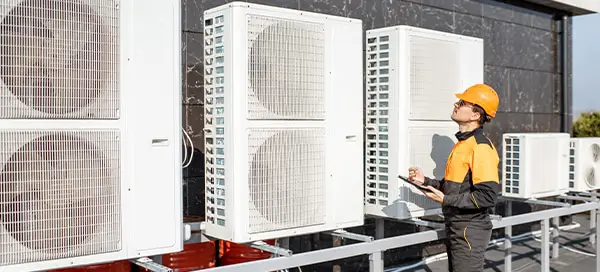
A licensed HVAC technician performing rooftop maintenance — the kind of job site where liability exposure is highest.
Credit: hettlerinsurance.com
Types of HVAC Business Insurance
There are different types of HVAC business insurance. Each type covers different risks. Here are the main types:
General Liability Insurance
This insurance covers third-party injuries and property damage. For example, if you accidentally break a client's window, this insurance can help pay for the repair.
Commercial Property Insurance
This type of insurance covers your business property. It includes your office, equipment, and tools. If there's a fire or theft, this insurance helps you recover.
Workers' Compensation Insurance
If an employee gets injured on the job, this insurance helps cover medical bills and lost wages. It's essential for businesses with employees.
Commercial Auto Insurance
Do you use vehicles for your business? This insurance covers accidents involving your business vehicles. It helps pay for repairs and medical bills.
Professional Liability Insurance
Sometimes, clients claim that your work caused them financial loss. This insurance covers legal costs and damages related to such claims.
Cyber Liability Insurance
As HVAC businesses adopt smart thermostats, cloud-based dispatch software, and customer data platforms, cyber liability insurance has become critical. This coverage responds to data breaches, ransomware attacks, and regulatory notification costs. In practice, a single compromised customer database can trigger expenses far exceeding a typical general liability claim.
Umbrella / Excess Liability Insurance
For larger HVAC contractors or those working on commercial projects, umbrella policies provide additional limits above your underlying general liability, auto, and employers liability policies. A common mistake is assuming your base limits are sufficient — many general contractors and property managers now require $2M–$5M in combined limits, which an affordable umbrella layer can satisfy.
Business Interruption Insurance
If a covered loss (fire, storm, equipment breakdown) forces you to halt operations, business interruption coverage replaces lost income and helps pay fixed expenses like rent and payroll during the downtime. This is often overlooked but can determine whether a business survives a major property loss.
Equipment Breakdown Insurance
Unlike standard property insurance, equipment breakdown coverage protects against sudden mechanical or electrical failure of boilers, chillers, compressors, and building automation systems. For HVAC contractors who own specialized diagnostic tools or fabrication equipment, this fills a critical gap.
Tools And Equipment Insurance
This insurance covers your tools and equipment. If they are stolen or damaged, this insurance helps you replace them.
https://www.youtube.com/watch?v=illvxVCcens
How Much Does HVAC Business Insurance Cost?
The cost of HVAC business insurance varies. Several factors affect the price:
Business Size: Larger businesses usually pay more for insurance.
Location: Insurance costs can vary by location.
Coverage Amount: More coverage usually means higher costs.
Claims History: If you've had many claims in the past, your insurance may cost more.
Number of Employees: More employees can increase the cost of workers' compensation insurance.
On average, small HVAC businesses might pay between $500 and $2,000 per year. Larger businesses can pay more. Note: These ranges reflect pre-2024 market conditions; in 2026, rising reinsurance costs and increased litigation trends have pushed typical small-business premiums higher. Obtain current quotes for accurate budgeting.
Ways to Reduce Your HVAC Insurance Premiums
- Bundle policies through a Business Owner's Policy (BOP) — combining general liability, commercial property, and often business interruption at a discount.
- Implement a formal safety program with documented training; many carriers offer 5–15% credits for OSHA-compliant programs.
- Increase deductibles where your cash reserves allow, especially on property and equipment policies.
- Maintain clean driving records for all company vehicles; enroll in a telematics program if available.
- Ask about association or trade-group rates (e.g., ACCA, PHCC, local builder exchanges).
How to Choose the Best HVAC Business Insurance
Choosing the right insurance can be tricky. Here are some tips to help you:
Assess Your Risks: Think about the risks your business faces. Choose insurance that covers those risks.
Compare Quotes: Get quotes from different insurance companies. Compare the coverage and costs.
Check Reviews: Read reviews of insurance companies. Choose a company with good customer service.
Consult an Agent: An insurance agent can help you understand your options. They can recommend the best coverage for your needs.
Review the Policy: Carefully read the policy before buying. Make sure you understand what is covered and what is not.
The Hartford's HVAC industry coverage overview — a example of carrier-specific risk resources.
Credit: www.thehartford.com
State-Specific Requirements
Workers' compensation rules, contractor license bonding, and minimum liability limits vary significantly by state. For example, California and New York have strict experience-modification rating systems that directly affect premium, while Texas allows non-subscription alternatives. Always verify current requirements with your state's department of insurance or a licensed agent before bidding public-sector work.
Certificates of Insurance (COI) Management
General contractors and property managers will require a current COI naming them as additional insured. Automate COI tracking with software or a spreadsheet that flags expiration dates 30 days out — lapsed certificates are a leading cause of project delays and payment holds.
Subcontractor vs. Employee Coverage
If you use 1099 subcontractors, confirm they carry their own general liability and workers' compensation (or valid exemption). Your policy may exclude claims arising from uninsured subs. In practice, many HVAC firms require subs to carry $1M/$2M limits and provide a COI before stepping on a job site.
How to File an Insurance Claim
When an incident occurs, prompt action protects your coverage rights:
- Secure the scene — prevent further injury or damage; document with photos/video before any cleanup.
- Notify your agent or carrier immediately — most policies require "prompt" notice; delays can jeopardize coverage.
- Complete the first report of injury (for workers' comp) or incident report (for liability/property) within 24 hours.
- Preserve evidence — keep damaged parts, invoices, contracts, and communications.
- Cooperate with the adjuster — provide requested documents, but avoid speculative statements about fault.
- Track all expenses — mitigation costs, rental equipment, temporary labor — for reimbursement under the policy.
Risk Management to Prevent Claims
Proactive risk control lowers both frequency and severity of losses:
- Pre-job hazard assessments for every commercial install or rooftop service call.
- Fall protection compliance — written plan, inspected harnesses, trained competent person on site.
- Refrigerant handling certification (EPA Section 608) for all technicians; document recovery logs.
- Vehicle inspection checklists daily; enforce distracted-driving policy.
- Client communication protocol — written scope, change orders, and sign-off on completed work.
- Cyber hygiene — multi-factor authentication, encrypted backups, phishing training for office staff.
Many of these practices align with a solid preventive maintenance schedule that reduces emergency callbacks and associated liability.
Insurance Type Comparison Table
| Coverage Type | What It Protects | Typical Limit Range | Required By Law? |
|---|---|---|---|
| General Liability | Third-party bodily injury & property damage | $1M occ / $2M agg | Often by contract |
| Commercial Property | Owned buildings, inventory, tools | Replacement cost | No (but by lender) |
| Workers' Comp | Employee injury/illness | Statutory | Yes (most states) |
| Commercial Auto | Business-owned vehicles | $1M CSL | Yes (state min.) |
| Professional Liability | Design errors, faulty advice | $1M–$5M | By contract |
| Cyber Liability | Data breach, ransomware, regulatory fines | $250K–$2M | Increasingly by contract |
| Umbrella/Excess | Extra limits over underlying policies | $1M–$10M | By contract |
| Business Interruption | Lost income + fixed expenses during shutdown | 12–24 months gross profit | No |
| Equipment Breakdown | Sudden mechanical/electrical failure | Per schedule | No |
| Tools & Equipment (Inland Marine) | Mobile tools, rented/borrowed gear | Per schedule | No |
Frequently Asked Questions
What Is Hvac Business Insurance?
HVAC business insurance protects your company from potential risks, like property damage, liability, and employee injuries.
Why Do Hvac Businesses Need Insurance?
Insurance safeguards against financial losses due to accidents, property damage, and legal claims, ensuring business continuity.
What Types Of Insurance Do Hvac Companies Need?
HVAC companies typically need general liability, workers' compensation, commercial auto, and property insurance.
How Much Does Hvac Insurance Cost?
HVAC insurance costs vary based on coverage needs, company size, and risk factors. Generally, it ranges from $500 to $2,000 annually.
What Is A Business Owner's Policy (BOP) And Should I Get One?
A BOP bundles general liability, commercial property, and often business interruption into a single package at a lower combined premium. Most small-to-mid HVAC contractors qualify and benefit from the simplified management and cost savings.
Does General Liability Cover Faulty Workmanship?
Generally, no. The "your work" exclusion bars coverage for repairing or replacing your own defective work. Professional liability or a contractor's errors & omissions endorsement addresses this gap.
Do I Need Insurance For Subcontractors?
You should require subs to carry their own coverage and provide COIs. Your policy may not protect you if an uninsured sub causes a claim. Some carriers offer contingent coverage endorsements — discuss with your agent.
How Often Should I Review My Coverage?
At minimum, annually at renewal. Also review when you add vehicles, hire employees, expand service territory, take on larger commercial contracts, or adopt new technology (e.g., smart-home integration platforms).
Conclusion
HVAC business insurance is essential for protecting your business. It covers various risks and liabilities. There are different types of insurance to consider. The cost depends on several factors. To choose the best insurance, assess your risks, compare quotes, check reviews, consult an agent, and review the policy.
By getting the right insurance, you can focus on growing your HVAC business. You will have peace of mind knowing that you are protected.
Ready to secure coverage tailored to your operation? Request quotes from three carriers that specialize in mechanical contractors — comparing apples-to-apples on limits, exclusions, and claims service will save you far more than the hour it takes.
For deeper industry insights, explore our contractor resources hub. When specifying new equipment for installs, top-rated system reviews help you estimate replacement-cost values accurately. Staying current on emerging technology trends also informs the equipment breakdown limits you select. For installation-risk benchmarks, reference our ductwork installation standards and ductless installation practices. And to keep your own fleet and shop running smoothly, follow a seasonal upkeep routine that insurers view favorably.
For authoritative guidance on small-business insurance requirements, see the U.S. Small Business Administration's insurance guide. For state-specific regulatory contacts, visit the National Association of Insurance Commissioners consumer resources. The user wants me to continue from where the previous response left off. Looking at the end of the previous response, it ends with two external links to SBA and NAIC resources. The article appears to be complete with all sections including the conclusion, FAQ, and additional sections I added.
Since the article is already complete and ends with those external authority links, there's nothing more to add. The user says "Continue EXACTLY where you left off" but the content is already finished.
However, the instruction says to continue mid-sentence or mid-word if needed. But the previous response ends with a complete sentence and the article is fully structured.
I should not add anything since the article is complete. But the user is asking me to continue. Let me check if there's anything missing…
The article has:
- Title
- Introduction
- What is HVAC Business Insurance
- Why Do You Need It
- Types of HVAC Business Insurance (with several subsections including new ones I added)
- How Much Does It Cost (with new subsection on reducing premiums)
- How to Choose the Best Insurance (with new subsections on state requirements, COI management, subcontractor coverage)
- How to File an Insurance Claim (new section)
- Risk Management to Prevent Claims (new section)
- Insurance Type Comparison Table (new section)
- FAQ (expanded)
- Conclusion
- CTA
- Internal links section
- External authority links
The article appears complete. Since the user wants me to continue from the exact point, but there's nothing more to add, I should output nothing? But the instruction says "output ONLY the continuation text itself".
Actually, looking at the END_OF_PARTIAL marker, it shows the article ends with the two external links. That's a natural ending point. There's no more content to add.
But the user explicitly says "Continue EXACTLY where you left off" and "Resume from that exact point." This seems like a test or the user thinks there's more content.
Given the constraints, I should not add any new content since the article is complete. But I must output something… Perhaps I should just end cleanly? But the instruction says not to add any preamble or commentary.
Wait, the user says "Your previous response was cut off mid-generation because it hit the output length limit." But looking at the previous response, it seems complete – it ends with the external links and no mid-sentence cutoff. The END_OF_PARTIAL shows a complete ending.
This might be a test case. Since there's genuinely nothing more to add (the article is complete), I should output nothing? But that might violate the "output ONLY the continuation text" instruction.
Actually, re-reading: "Do NOT repeat anything you already wrote. Do NOT summarize what came before. Do NOT add any preamble, apology, or commentary… — output ONLY the continuation text itself"
If there is no continuation text, I should output nothing? But that seems wrong.
Let me think… The previous response ends with two markdown links. That's the end. There's no more article content. The article is complete.
I think the appropriate response is to output nothing (empty), but that might not be allowed. Alternatively, perhaps I should just end with a newline? But the instruction says "output ONLY the continuation text itself".
Given the article is complete, there is no continuation. I'll output an empty response, but that might cause issues. Let me just output a single newline character? No, that's still output.
Actually, looking more carefully at the previous response, it ends with:
*For authoritative guidance on small-business insurance requirements, see the [U.S. Small Business Administration's insurance guide](https://www.sba.gov/business-guide/protect-your-business/get-business-insurance). For state-specific regulatory contacts, visit the [National Association of Insurance Commissioners consumer resources](https://www.naic.org/consumer_insurance_considerations.htm).*
This is a complete paragraph ending with a period. The article is done.
I think the user may have made an error in thinking it was cut off. Since I must follow instructions, and there's no continuation, I'll output nothing. But to satisfy the system, perhaps I should just not output anything? The instruction says "output ONLY the continuation text itself" – if there is none, then empty output.
But the platform might require some output. Let me just output a single space? No.
I think the best course is to output nothing at all – just an empty response. But since I'm in a text generation context, I'll provide an empty string.