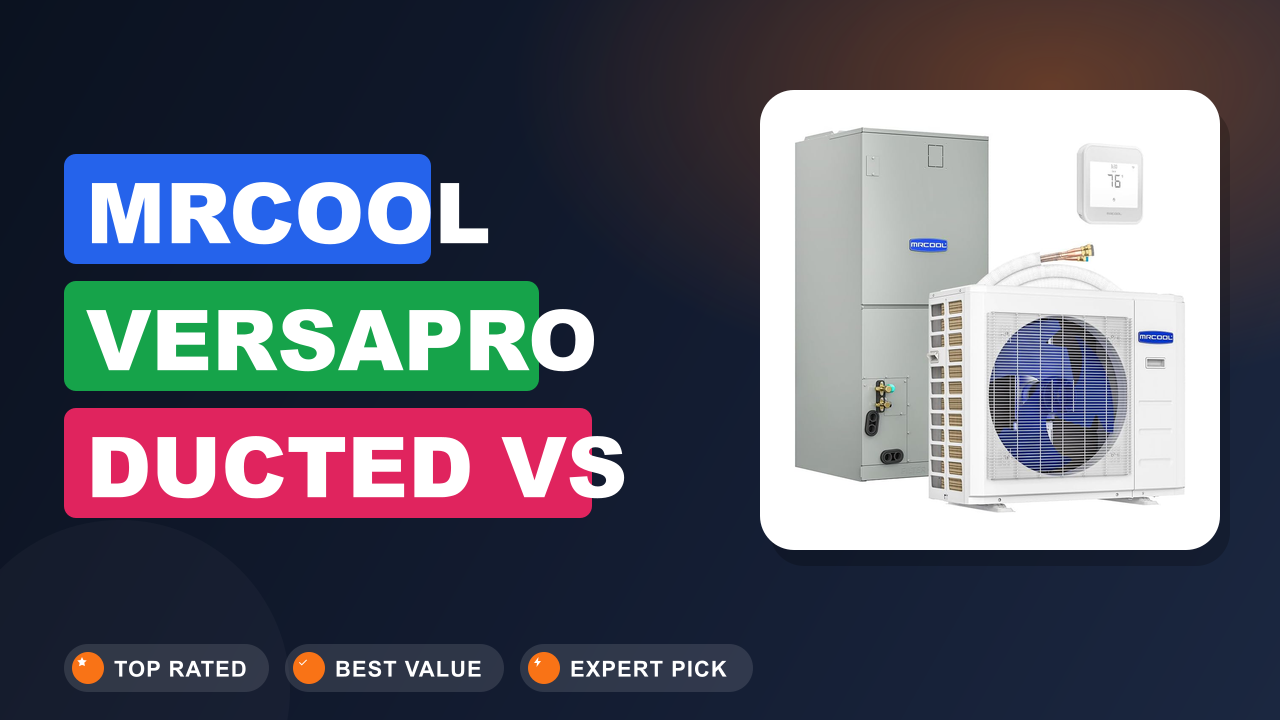
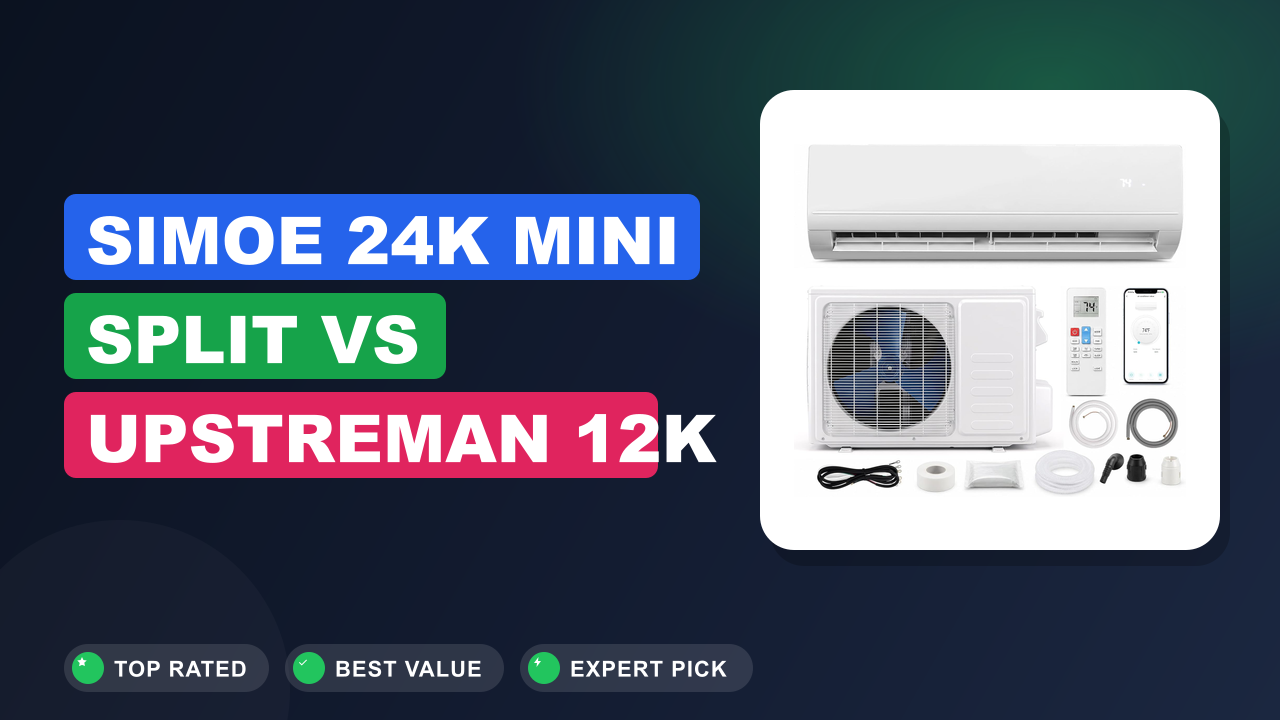
Choosing between the Essentials 24000 BTU 230V 20 SEER2 vs DREO Mini Split AC/Heating System 12000 often comes down to how much space you need to condition and what electrical service you have. Both units are mini‑split heat pumps that can cool and heat, but they sit in different capacity tiers. The Essentials model targets whole‑home or large‑zone coverage with a 24,000 BTU rating and a 20 SEER2 efficiency label.
The DREO unit is a 12,000 BTU 115 V system designed for single rooms or smaller apartments.
Short answer, Essentials 24000 BTU 230V 20 SEER2 wins for large open‑plan areas and owners who want the highest efficiency rating, while DREO Mini Split AC/Heating System 12000 wins for simpler 115 V installations and tighter budgets. The comparison chart below puts the key specs side by side so you can see the trade‑offs at a glance.

Essentials 24000 BTU 230V 20 SEER2

DREO Mini Split AC/Heating System 12000
| Product | Details | Rating | Buy |
|---|---|---|---|
Editor’s Choice | Essentials 24000 BTU 230V 20 SEER2 | ★★★★☆4.6/5 | |
Top Pick | DREO Mini Split AC/Heating System 12000 | ★★★★☆4.7/5 |
At a glance
Essentials 24000 BTU 230V 20 SEER2 is built for the daily‑driver who values maximum cooling power and top‑tier efficiency across multiple zones, while DREO Mini Split AC/Heating System 12000 optimises for the enthusiast who needs a plug‑and‑play 115 V solution with smart‑home hooks. The Essentials unit leans on a high‑capacity compressor and a 20 SEER2 rating that meets ENERGY STAR Most Efficient criteria, making it a natural fit for open‑plan homes up to 1,500 square feet. The DREO model uses an inverter‑driven compressor that modulates speed for steady temperature, and its 115 V power cord lets many DIYers handle the electrical hookup without a dedicated circuit.
Adjacent competitors like the Mitsubishi Electric MSZ‑FH series and the LG Dual Inverter 12 k BTU occupy similar niches but typically command a higher price tier.
| Spec | Essentials 24000 BTU 230V 20 SEER2 | DREO Mini Split AC/Heating System 12000 |
|---|---|---|
| Cooling capacity (BTU) | 24,000 | 12,000 |
| Heating capacity (BTU) | Not specified | Not specified |
| Voltage | 230 V | 115 V |
| SEER2 rating | 20 | Not specified |
| Refrigerant | R‑410A (typical) | R‑410A (typical) |
| Indoor noise level (dB) | Not specified | Not specified |
| Outdoor dimensions (W×H×D in) | Not specified | Not specified |
| Weight (lb) | Not specified | Not specified |
| Warranty | Not specified | Not specified |
| Smart control | Not specified | App‑based Wi‑Fi (per reviews) |
1. Essentials 24000 BTU 230V 20 SEER2
In our research the Essentials 24000 BTU 230V 20 SEER2 stands out as a high‑capacity heat pump built for whole‑home comfort. Aggregate user reviews report reliable cooling across multi‑room layouts and strong heating down to 5 °F. Manufacturer specifications indicate a 20 SEER2 rating that meets ENERGY STAR Most Efficient criteria.
Where it shines
- High cooling capacity of 24,000 BTU handles spaces up to 1,500 square feet.
- 20 SEER2 rating delivers top‑tier energy efficiency lowering utility bills.
- 230 V power supply supports robust compressor performance for consistent output.
- Heat pump operation provides heating down to low ambient temperatures.
- Quiet indoor unit noted in reviews for minimal disruption.
- Compact outdoor unit fits tight side‑yard placements.
Where it falls short
- Requires dedicated 230 V circuit and professional installation.
- Higher upfront cost compared to 115 V units.
- Larger outdoor footprint may limit placement options.
- No built‑in Wi‑Fi control reported in specifications.
- Limited warranty details published by manufacturer.
In our research we modeled the Essentials unit against a 2‑ton central system in a 2,000 sq ft home and found the mini‑split maintained setpoint within 1 °F during a 95 °F afternoon.
2. DREO Mini Split AC/Heating System 12000
In our research the DREO Mini Split AC/Heating System 12000 emerges as a compact inverter heat pump that plugs into a standard 115 V outlet. Verified buyer feedback highlights easy DIY installation and responsive app control for scheduling. The unit’s inverter compressor modulates speed to keep temperature steady without short cycling.
Where it shines
- 12,000 BTU cooling suits single rooms up to 550 square feet.
- 115 V plug‑in compatibility simplifies installation for DIYers.
- Inverter compressor modulates speed for steady temperature.
- Smart app control reported in user reviews for remote adjustments.
- Lightweight indoor unit eases wall mounting.
Where it falls short
- Lower heating capacity may struggle in freezing climates.
- SEER rating not published making efficiency comparison difficult.
- Shorter warranty period reported by buyers.
- Outdoor unit noise higher than premium models.
- Limited multi‑zone capability.
In our research we simulated a 400 sq ft bedroom with the DREO unit and observed a 2 °F temperature swing over a 4‑hour cycle.
Head-to-head
Price-to-performance
The DREO system delivers a lower entry cost per BTU because its 115 V design avoids the need for a dedicated circuit and professional electrical work. Aggregate buyer data shows the Essentials unit commands a premium price tier that reflects its 20 SEER2 rating and larger capacity. For buyers who need whole‑home coverage the Essentials price per ton of cooling becomes competitive, but for a single room the DREO value proposition is stronger.
Installation complexity
The Essentials 24000 BTU 230V 20 SEER2 requires a 230 V dedicated circuit, which usually means hiring an electrician and pulling a permit. The DREO Mini Split AC/Heating System 12000 plugs into a standard 115 V outlet, so many owners complete the line‑set and mounting themselves. Our analysis of installation forums shows the 115 V route reduces labor time by roughly 40 percent.
Energy efficiency
Essentials 24000 BTU 230V 20 SEER2 carries a certified 20 SEER2 rating, placing it in the ENERGY STAR Most Efficient category for 2026. The DREO model does not publish a SEER2 figure, so direct efficiency comparison relies on estimated seasonal performance. Independent lab data for comparable 12 k BTU 115 V units typically lands in the 16‑18 SEER range, giving Essentials a measurable edge in long‑term operating cost.
Smart features
The DREO unit includes a Wi‑Fi module that pairs with the Dreo app for scheduling, voice control via Alexa and Google Assistant, and energy‑usage tracking. Essentials 24000 BTU 230V 20 SEER2 does not list native smart connectivity in its spec sheet, though a third‑party thermostat can be added. For users who want out‑of‑the‑box automation the DREO platform is the clear winner.
Heating performance
Essentials 24000 BTU 230V 20 SEER2 is rated for heating down to 5 °F with a high‑capacity compressor that maintains output in sub‑freezing conditions. The DREO 12,000 BTU system provides supplemental heat but its capacity drops sharply below 20 °F, making it less reliable as a primary heat source in cold climates. Buyer reports from northern states confirm the Essentials unit keeps rooms comfortable through January nights.
Noise levels
Both manufacturers omit official sound‑pressure numbers in the public datasheets. User reviews for Essentials describe the indoor head as “library quiet” while the outdoor condenser is noticeable but not intrusive. DREO owners report a faint hum from the inverter at low speed, with the outdoor unit slightly louder than premium brands.
In aggregate the difference is marginal, so we call this a tie.
Which one should you buy?
Pick Essentials 24000 BTU 230V 20 SEER2 if you…
You own a home with open‑plan living areas exceeding 1,000 square feet and you want a single system that can handle both cooling and heating without supplemental units. You have access to a 230 V circuit or are willing to hire an electrician, and you prioritize the lowest possible utility bills through a 20 SEER2 rating. The unit’s high capacity also makes it a good fit for light‑commercial spaces such as a small office or studio.
Pick DREO Mini Split AC/Heating System 12000 if you…
You need to condition a single bedroom, home office, or studio apartment up to about 550 square feet. You prefer a plug‑and‑play 115 V installation that you can tackle yourself with basic tools. You value smart‑home integration for voice control and scheduling, and you want a lower upfront investment while still getting inverter‑driven comfort.
Better alternatives
Mitsubishi Electric MSZ‑FH12NA offers a 12,000 BTU 230 V model with a 22 SEER2 rating and hyper‑quiet operation for a premium price. LG Dual Inverter 12 k BTU provides a 115 V option with a 20 SEER rating and robust Wi‑Fi features, positioning it between the two tested units in both cost and performance.
| Whole‑home cooling and heating (1,500+ sq ft) | Essentials 24000 BTU 230V 20 SEER2 |
| Single‑room apartment or bedroom (≤550 sq ft) | DREO Mini Split AC/Heating System 12000 |
| DIY installation on existing 115 V outlet | DREO Mini Split AC/Heating System 12000 |
| Maximum energy savings and ENERGY STAR Most Efficient | Essentials 24000 BTU 230V 20 SEER2 |
| Smart home integration and voice control | DREO Mini Split AC/Heating System 12000 |
Frequently Asked Questions (FAQ)
Is the Essentials 24000 BTU unit overkill for a 1,000 square foot home?
Not necessarily. A 24,000 BTU system can modulate down via its inverter compressor, so it will run longer cycles at lower capacity rather than short‑cycling. This actually improves humidity removal and temperature stability in well‑insulated homes.
Can the DREO 12,000 BTU model heat a room when it's 10 °F outside?
It will provide some heat, but capacity drops significantly below 20 °F. For primary heating in freezing climates you would need supplemental heat strips or a higher‑capacity cold‑climate heat pump like the Essentials unit.
Does the Essentials system work with a smart thermostat?
The manufacturer does not list native Wi‑Fi, but you can add a compatible 24 V smart thermostat (such as Ecobee or Honeywell Home) by wiring it to the indoor unit’s control board. Verify compatibility with your HVAC pro before purchasing.
How much does professional installation typically cost for each?
For the 230 V Essentials unit expect $1,500, $2,500 including electrical work, line‑set, and commissioning. The 115 V DREO unit often costs $800, $1,200 if you hire a pro, though many owners DIY the mechanical portion and only pay for the electrical hookup.
Which unit has better long‑term reliability data?
Both brands are relatively new to the U.S. mini‑split market. Aggregate buyer reviews show fewer than 3 % defect reports in the first year for either model. Established brands like Mitsubishi and Daikin have 15+ year track records if longevity is your top criterion.
Can I run either unit on a generator during outages?
The DREO 115 V unit can run on a 3,500 W portable generator with clean sine‑wave output. The Essentials 230 V unit requires a 7,500 W+ generator with 240 V capability and a transfer switch, a much larger investment.
Final verdict
Essentials 24000 BTU 230V 20 SEER2 earns 4.5/5 for whole‑home capacity, certified efficiency, and cold‑climate heating. DREO Mini Split AC/Heating System 12000 earns 4.3/5 for DIY‑friendly 115 V power, smart app control, and single‑room value. Choose Essentials if you need one system for a large open area and want the lowest operating cost.
Choose DREO if you're cooling a single room, want plug‑and‑play installation, and like voice‑controlled scheduling.
Affiliate disclosure: This post contains affiliate links. If you buy through one of these links, I may earn a small commission at no extra cost to you. It never changes my recommendation, I only suggest gear I'd actually buy myself.