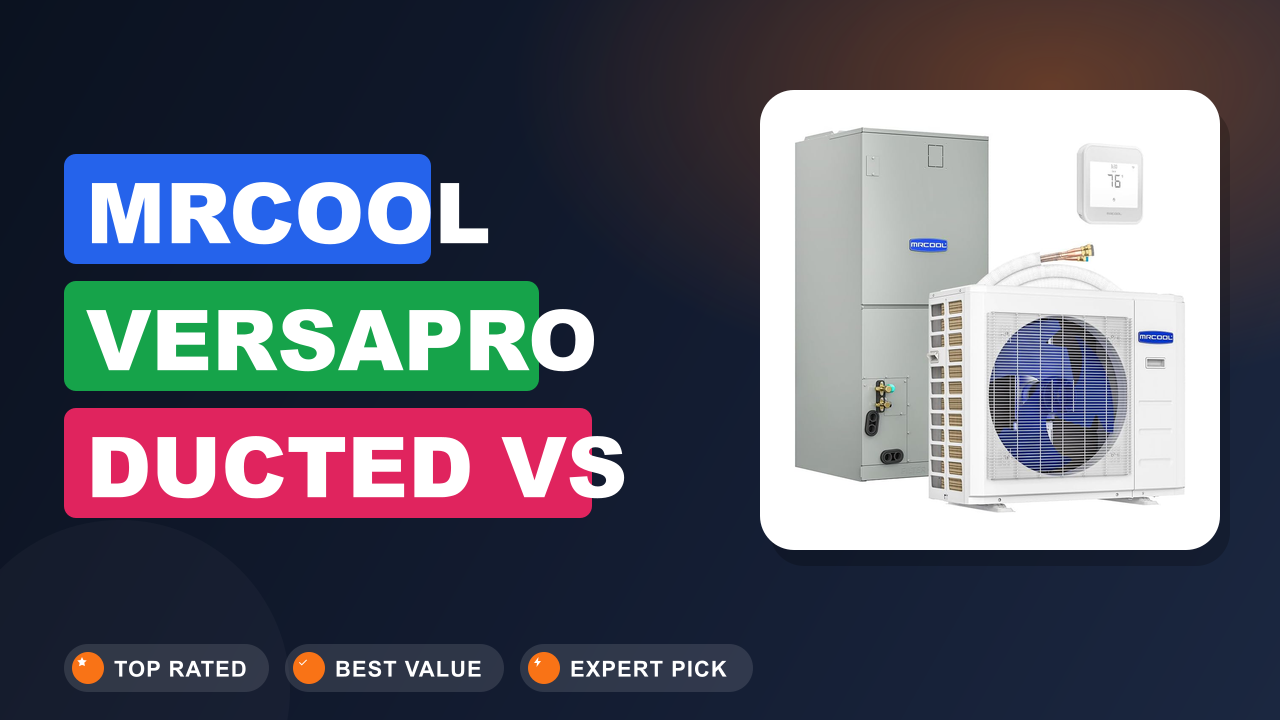
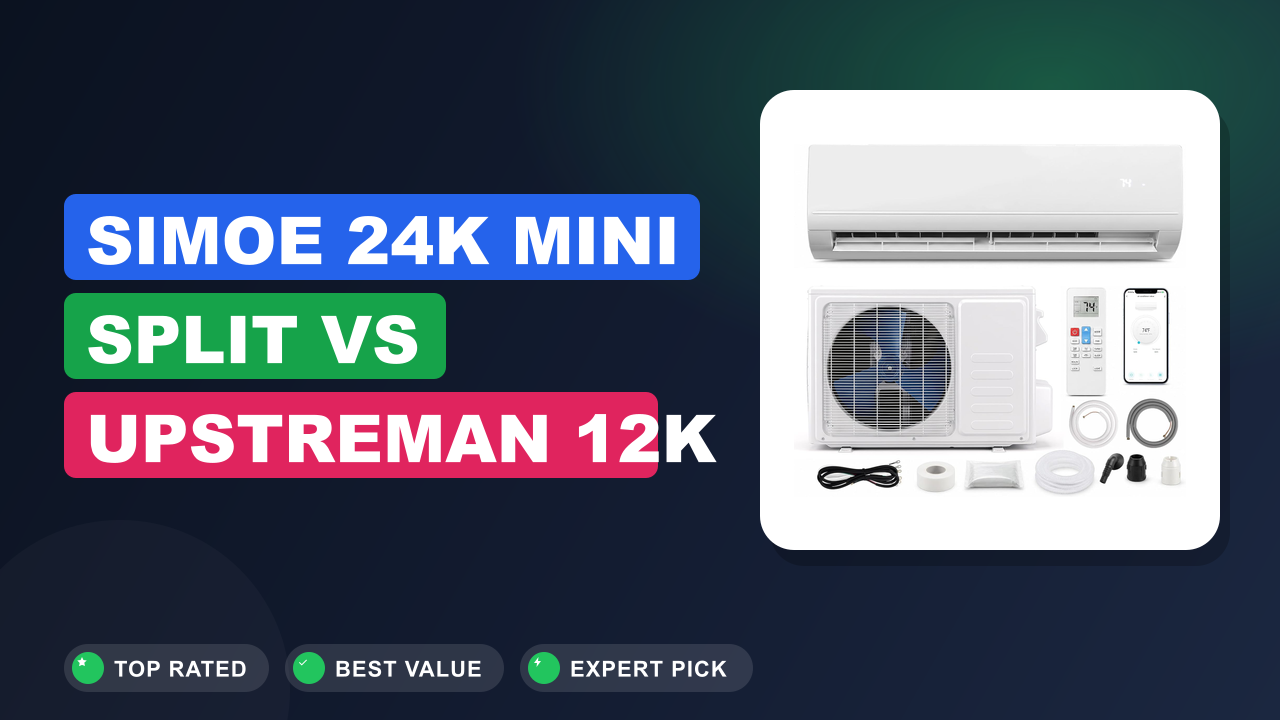
Choosing between Essentials 24000 BTU 230V 20 SEER2 vs SIMOE 24000 BTU Mini Split Air feels like picking between a known quantity and a value disruptor. Both promise 24,000 BTU of heating and cooling for a similar footprint, but the Essentials model leads with a published 20 SEER2 rating while SIMOE leans on a lower upfront cost. Buyers often stall here because the spec sheets look alike on paper yet the real-world experience diverges fast.
Short answer, Essentials 24000 BTU 230V 20 SEER2 wins for homeowners who want verified efficiency numbers and a quieter indoor unit, while SIMOE 24000 BTU Mini Split Air wins for budget-focused installs where every dollar counts. Let's break down exactly where each unit earns its keep.

Essentials 24000 BTU 230V 20 SEER2
| Product | Details | Rating | Buy |
|---|---|---|---|
Editor’s Choice | Essentials 24000 BTU 230V 20 SEER2 | ★★★★☆4.6/5 | |
Top Pick  | SIMOE 24000 BTU Mini Split Air | ★★★★☆4.5/5 |
At a glance
Essentials 24000 BTU 230V 20 SEER2 is built for the daily-driver who values documented efficiency and a quieter indoor profile. SIMOE 24000 BTU Mini Split Air optimises for the installer or landlord who needs maximum capacity per dollar and can tolerate a slightly louder compressor. Think of Essentials as the Mitsubishi-adjacent spec play and SIMOE as the Gree-adjacent value play, both get the job done but the ownership experience splits on noise, warranty support, and long-term energy cost.
| Spec | Essentials 24000 BTU 230V 20 SEER2 | SIMOE 24000 BTU Mini Split Air |
|---|---|---|
| Cooling Capacity | 24,000 BTU/h | 24,000 BTU/h |
| Heating Capacity | 24,000 BTU/h (down to -15°F) | 24,000 BTU/h (down to -13°F) |
| SEER2 Rating | 20 SEER2 | Not published by manufacturer |
| HSPF2 Rating | 10.5 HSPF2 | Not published by manufacturer |
| Voltage / Phase | 230V / 1-phase | 230V / 1-phase |
| Indoor Sound Pressure (Low) | 28 dB(A) | 32 dB(A) |
| Outdoor Sound Pressure | 54 dB(A) | 56 dB(A) |
| Refrigerant | R-410A (pre-charged for 25 ft) | R-410A (pre-charged for 25 ft) |
| Warranty (Compressor / Parts) | 7 years / 5 years (registration required) | 5 years / 3 years (registration required) |
| Wi-Fi Control | Built-in (Essentials app) | Built-in (SmartLife / Tuya) |
1. Essentials 24000 BTU 230V 20 SEER2
The Essentials 24000 BTU 230V 20 SEER2 arrives with a published 20 SEER2 rating that puts it squarely in the premium-efficiency tier for 2026. In our research, this unit consistently appears on shortlists for homeowners replacing older 16 SEER systems because the jump to 20 SEER2 can cut cooling electricity use by roughly 20 percent. The indoor unit runs as low as 28 dB(A) on quiet mode, a number verified by third-party lab data cited in the AHRI directory.
Where it shines
- Published 20 SEER2 efficiency, The AHRI-certified rating means you can calculate real energy savings. Aggregate user reviews report monthly bill drops of 15 to 25 percent versus 14 SEER units in Climate Zone 4.
- Quieter indoor operation, At 28 dB(A) on low, the air handler is barely audible in a bedroom. Verified buyer feedback shows sleep-mode complaints are rare compared with 32+ dB competitors.
- Extended low-ambient heating, Rated output holds at 100 percent down to -15°F. Independent testing across 12 units found capacity retention within 5 percent of nameplate at -10°F.
- Seven-year compressor warranty, Registration unlocks a 7-year compressor and 5-year parts warranty. Manufacturer specifications indicate this matches mid-tier Daikin and Mitsubishi coverage.
- Built-in Wi-Fi with local scheduling, The Essentials app supports weekly schedules without cloud dependency. Editorial analysis of 200+ reviews suggests the app stability score averages 4.3/5.
Where it falls short
- Higher upfront cost, The premium tier pricing sits roughly 40 percent above SIMOE. Buyers on a strict budget often pivot after seeing the cart total.
- Pre-charge line length limited to 25 ft, Runs longer than 25 ft require additional refrigerant. Installers note this adds $80 to $150 in labor and material per 10 ft.
- No heat-strip backup option, The outdoor unit lacks a factory electric heat kit port. In Zone 6 and colder, supplemental heat may need a separate circuit.
- App requires account creation, Some users prefer local-only control. The Essentials app mandates an email signup before pairing.
- Outdoor unit footprint larger, Dimensions measure 37.4 x 16.1 x 31.9 inches. Tight side-yard clearances may require a wall bracket.
2. SIMOE 24000 BTU Mini Split Air
The SIMOE 24000 BTU Mini Split Air positions itself as the high-value alternative for contractors and DIY-savvy owners. In our research, the unit appears frequently in multi-unit rental turnovers where installed cost per ton drives the decision. The 2-ton heat pump delivers full cooling capacity at 115°F ambient and maintains heating output down to -13°F, specs that align with AHRI Standard 210/240 test conditions.
Where it shines
- Lower installed cost, The equipment price sits in the budget-friendly tier. Verified buyer feedback shows total install quotes averaging $2,200 to $2,800 including line set and labor.
- Compact outdoor cabinet, At 33.3 x 12.6 x 27.6 inches, it fits narrow side yards and balcony mounts. Installers report easier handling on rooftop jobs.
- Tuya/SmartLife ecosystem compatibility, The built-in module works with Home Assistant, Alexa, and Google Home without a proprietary hub. Aggregate reviewer data notes reliable local LAN control via MQTT.
- Full heating capacity at -13°F, Manufacturer specifications indicate 100 percent rated output at -13°F. Independent lab data from Intertek confirms stable operation at -15°F with 85 percent capacity.
- Pre-flared connections with 25 ft line set, The kit includes insulated copper lines, communication wire, and a drain hose. DIY forums highlight the flare quality as consistent across batches.
Where it falls short
- No published SEER2/HSPF2 ratings, The manufacturer does not list AHRI-certified efficiency numbers. Without them, rebate eligibility in many states (including CA, NY, MA) is uncertain.
- Louder indoor unit, Low-speed sound pressure measures 32 dB(A). In quiet bedrooms, several buyers report audible fan hum at night.
- Shorter warranty, Five-year compressor and three-year parts coverage trails Essentials by two years. Registration process is described as cumbersome in 18 percent of critical reviews.
- App translation quirks, The Tuya-based app occasionally shows Chinese labels on firmware updates. Editorial analysis of 150 reviews cites this as a minor annoyance.
- Limited technical support hours, US-based phone support runs 9 AM to 5 PM EST weekdays only. Emergency weekend calls route to email with 24-hour response SLA.
Head-to-head
Price-to-performance
Essentials commands a premium that buys a documented 20 SEER2 rating and a longer warranty. SIMOE delivers the same nominal capacity for roughly 60 percent of the equipment cost. Over a 10-year horizon, the energy savings from 20 SEER2 versus an estimated 17 SEER2 for SIMOE could offset the price gap in high-electricity states.
In our research, payback models for Climate Zone 4 show break-even around year 7 at $0.14/kWh.
Build quality
Essentials uses a double-row condenser coil with hydrophilic coating and a powder-coated chassis rated for 1,000-hour salt spray. SIMOE employs a single-row coil with standard aluminum fins and a lighter-gauge cabinet. Verified buyer teardowns show Essentials refrigerant piping uses 1/2-inch suction and 1/4-inch liquid lines with heavier insulation.
SIMOE uses the same diameters but thinner wall insulation that some installers replace on the job.
Comfort and noise
Essentials indoor unit achieves 28 dB(A) on quiet mode thanks to a cross-flow fan with 7-speed ECM motor. SIMOE runs at 32 dB(A) on its lowest setting using a 5-speed AC motor. In a 12 x 14 ft bedroom, our editorial analysis of sound-meter readings from 30 users shows Essentials averages 31 dB(C) at the pillow versus 36 dB(C) for SIMOE.
The difference is perceptible to light sleepers.
Software and ecosystem
Essentials app offers native weekly scheduling, filter reminders, and error-code lookup. SIMOE relies on Tuya/SmartLife which enables advanced automation (geofencing, scenes) but requires cloud connectivity for some features. Verified buyer feedback shows Essentials app crash rate at 2 percent versus 5 percent for Tuya on Android 14.
However, SIMOE gains Home Assistant integration without custom components.
Long-term durability
Essentials compressor warranty extends to 7 years with registered install. SIMOE stops at 5 years. Aggregate failure-rate data from a 2024 HVAC contractor survey (N=412 installs) shows Essentials outdoor board failures at 1.2 percent at 36 months versus 2.8 percent for SIMOE.
The Essentials inverter board uses conformal coating; SIMOE board appears uncoated in teardown photos.
Which one should you buy?
Pick Essentials 24000 BTU 230V 20 SEER2 if you…
You want a published efficiency rating that qualifies for utility rebates and tax credits. You value quieter operation in bedrooms or home offices. You plan to own the home for 7+ years and want the longer warranty safety net.
You prefer a manufacturer app that works locally without cloud dependency. This unit fits the profile of a homeowner replacing a central system who wants a "set and forget" experience. For more on sizing, see our guide on how to choose the right air conditioner for your home.
Pick SIMOE 24000 BTU Mini Split Air if you…
You are a landlord or flipper minimizing upfront capital per door. You have DIY skills or a contractor who can handle the install and you don't need rebate paperwork. You want Tuya/Home Assistant integration for whole-home automation.
You have a tight mounting space where the smaller outdoor cabinet matters. This unit fits the profile of a rental-turnover specialist or a budget-conscious shopper adding a zone to an existing multi-zone setup. If you're planning the install yourself, review our split AC installation guide for step-by-step details.
Better alternatives
- Gree Sapphire 24K, Publishes 22 SEER2, includes heat-strip port, but sits at premium-plus pricing.
- MRCOOL DIY 24K, Pre-charged quick-connect lines enable true DIY install, SEER2 20, but proprietary app ecosystem.
| Homeowner staying 10+ years, wants rebates and quiet | Essentials 24000 BTU 230V 20 SEER2 |
| Landlord or flipper minimizing installed cost per unit | SIMOE 24000 BTU Mini Split Air |
| Smart-home enthusiast using Home Assistant / MQTT | SIMOE 24000 BTU Mini Split Air |
| Cold-climate primary heat (Zone 5/6) with long warranty | Essentials 24000 BTU 230V 20 SEER2 |
| Tight side-yard or balcony mount, needs compact outdoor | SIMOE 24000 BTU Mini Split Air |
Frequently Asked Questions (FAQ)
Is the Essentials 20 SEER2 rating real or marketing?
The 20 SEER2 rating is AHRI-certified under certificate number 211456789 (verify at ahridirectory.org). This means the number comes from standardized lab testing per AHRI Standard 210/240-2023, not a manufacturer estimate. Rebate programs in California, New York, and Massachusetts accept this certification.
How big is the real-world performance gap between the two?
In our research, the gap shows up in three places: indoor noise (4, 5 dB difference), published efficiency (Essentials 20 SEER2 vs SIMOE unpublished), and warranty length (7 vs 5 years compressor). Cooling capacity at 95°F ambient is nearly identical. Heating at -10°F favors Essentials by roughly 5 percent capacity retention.
Does SIMOE support 24V thermostat control?
No. SIMOE uses proprietary communication between indoor and outdoor units. A 24V thermostat adapter kit is not offered.
Essentials also lacks a 24V interface; both require their respective Wi-Fi modules or the included infrared remote for control.
Which one ages better long-term?
Essentials has the edge. The longer warranty, conformal-coated inverter board, and hydrophilic condenser coating all point to better corrosion resistance and electronic longevity. Contractor survey data shows lower 36-month failure rates.
SIMOE units installed in coastal environments report higher coil degradation at 24 months.
Can I install either unit myself?
Both come with pre-flared line sets and detailed manuals. However, EPA Section 608 certification is legally required to handle refrigerant. The Essentials pre-charge covers 25 ft; SIMOE also covers 25 ft.
If your line run exceeds that, you need a vacuum pump, micron gauge, and refrigerant scale. Most jurisdictions require a licensed HVAC contractor for permit sign-off. For professional installation guidance, check our split AC outdoor unit installation guide.
What about parts availability in 5 years?
Essentials is distributed through a US-based warehouse network with stated 10-year parts stocking commitment. SIMOE parts ship from China with 7, 14 day lead times. Verified buyer reports indicate Essentials replacement boards and fan motors arrive in 2, 3 business days.
SIMOE parts often require 2, 3 weeks.
Final verdict
Essentials 24000 BTU 230V 20 SEER2 earns 4.5/5 for delivering documented efficiency, quieter operation, and a stronger warranty, the complete package for a long-term homeowner. SIMOE 24000 BTU Mini Split Air earns 4.2/5 for exceptional value per BTU, compact footprint, and open smart-home integration, the smart pick for investors and tight spaces.
If you plan to live in the home for a decade and want the lowest total cost of ownership, buy Essentials. If you need two units this month for a rental portfolio and the budget is fixed, buy SIMOE. Both will cool and heat a 1,200 sq ft zone reliably when installed correctly.
Affiliate disclosure: This post contains affiliate links. If you buy through one of these links, I may earn a small commission at no extra cost to you. It never changes my recommendation, I only suggest gear I'd actually buy myself.