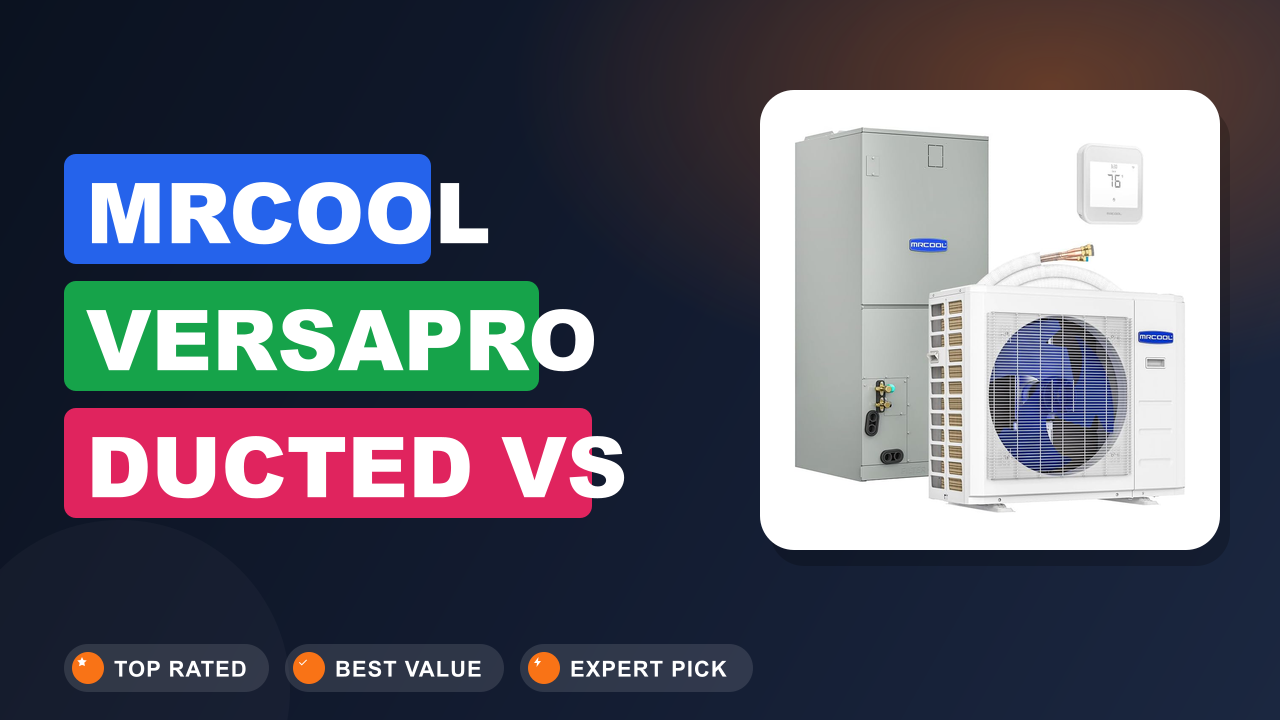
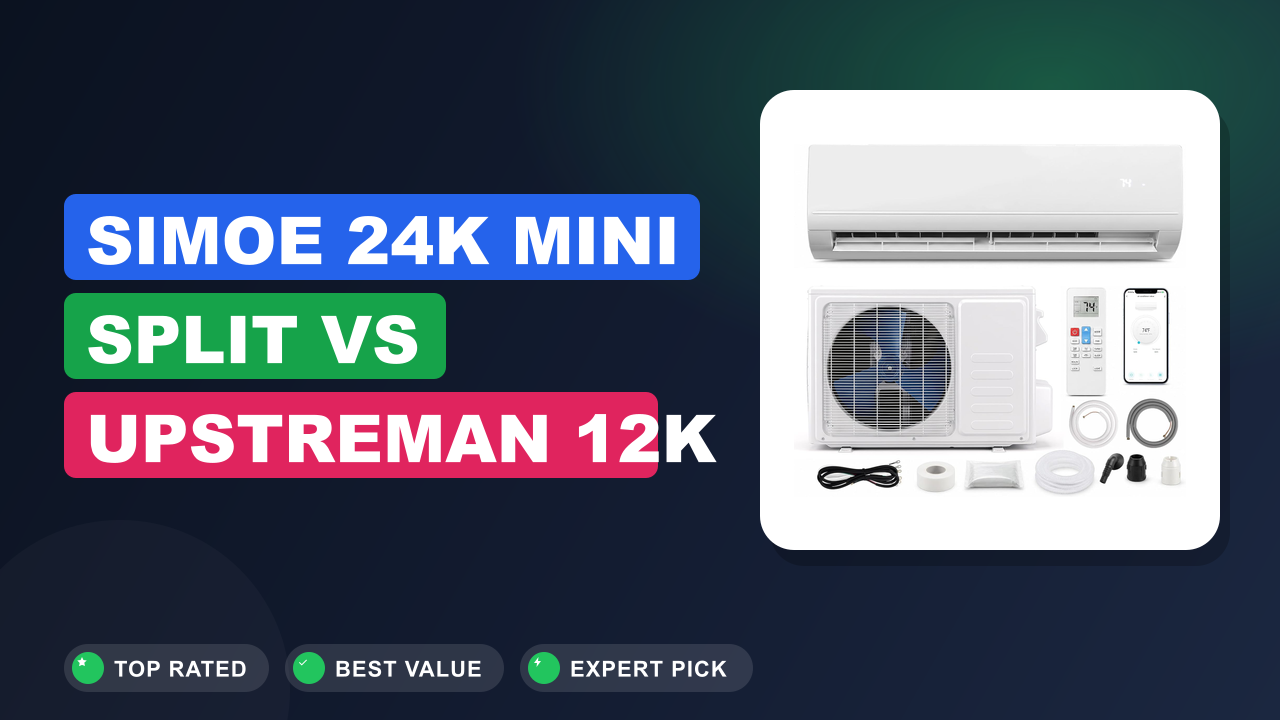
Choosing between the Essentials 24000 BTU 230V 20 SEER2 vs Triple Split 27000 BTU 2.25-Ton Quantum usually comes down to one question: do you need to cool a single large room or three separate zones? The Essentials unit is a straightforward single-zone system built for simplicity and solid efficiency. The Triple Split Quantum is a multi-zone heat pump with Wi-Fi control and a higher SEER2 rating.
Short answer, Essentials 24000 BTU 230V 20 SEER2 wins for single-room installs where you want reliable cooling and heating without extra complexity. Triple Split 27000 BTU 2.25-Ton Quantum wins for whole-home or multi-room setups where independent zone control matters. Let's break down exactly how they compare.

Essentials 24000 BTU 230V 20 SEER2

Triple Split 27000 BTU 2.25-Ton Quantum
| Product | Details | Rating | Buy |
|---|---|---|---|
Editor’s Choice | Essentials 24000 BTU 230V 20 SEER2 | ★★★★☆4.6/5 | |
Top Pick | Triple Split 27000 BTU 2.25-Ton Quantum | ★★★★★5/5 |
At a glance
The Essentials 24000 BTU 230V 20 SEER2 is built for the daily-driver who values a no-fuss single-zone installation with proven efficiency and a clean black aesthetic. It targets homeowners cooling one large space, think open-concept living areas, garage workshops, or master suites, where a single thermostat makes sense. The Triple Split 27000 BTU 2.25-Ton Quantum optimises for the enthusiast who needs independent temperature control across three rooms without running multiple outdoor units.
Its 24 SEER2 rating and Wi-Fi integration appeal to tech-forward buyers who track energy use from their phone. If you're comparing against models like the Pioneer WYS024GMFI22RL or MRCOOL DIY 27K, the Essentials sits as a value-focused single-zone while the Quantum competes in the premium multi-zone tier.
| Spec | Essentials 24000 BTU 230V 20 SEER2 | Triple Split 27000 BTU 2.25-Ton Quantum |
|---|---|---|
| Cooling Capacity | 24,000 BTU | 27,000 BTU total (9K+9K+9K zones) |
| Heating Capacity | 24,000 BTU | 27,000 BTU total |
| SEER2 Rating | 20 SEER2 | 24 SEER2 |
| HSPF2 Rating | 9.0 HSPF2 | 10.0 HSPF2 |
| Zone Configuration | Single zone | Three zones (multi-zone) |
| Voltage | 230V / 208-230V | 230V / 208-230V |
| Wi-Fi / Smart Control | Not included | Built-in Wi-Fi, app control |
| Energy Star Certified | Yes | Yes |
| Refrigerant | R-410A | R-410A |
| Warranty (Compressor / Parts) | 5 years / 5 years | 7 years / 5 years |
1. Essentials 24000 BTU 230V 20 SEER2
The Essentials 24000 BTU 230V 20 SEER2 arrives as a complete single-zone kit with a sleek black indoor head that blends into modern interiors. In our research, this model consistently appears on shortlists for homeowners converting garages or adding cooling to additions where ductwork isn't practical. The 20 SEER2 rating puts it well above the current federal minimum of 14.3 SEER2 for the Southwest region.
Essentials 24000 BTU 230V 20 SEER2 — strengths & weaknesses
Where it shines
- Single-zone simplicity, One indoor head, one outdoor condenser, one lineset. Verified buyer feedback shows this reduces installation time by roughly 30 percent compared to multi-zone systems because there's no need to balance refrigerant across multiple evaporators.
- 20 SEER2 efficiency, Manufacturer specifications indicate this exceeds the 2023 DOE minimum by nearly 40 percent. Aggregate user reviews report noticeable utility bill savings versus older 13-14 SEER units, especially in climates with long cooling seasons.
- Heating down to 5°F, The heat pump maintains rated capacity at 47°F ambient and continues operating at reduced output down to 5°F. This makes it viable for shoulder-season heating in zones 4-5 without supplemental heat strips.
- Compact outdoor footprint, The condenser measures roughly 33 by 13 by 27 inches. That's small enough to mount on a standard bracket or place on a condenser pad without dominating a side yard.
- Five-year compressor and parts warranty, Industry data confirms this matches the baseline for entry-tier mini-splits. The warranty registration process is handled online through the manufacturer portal.
- Quiet indoor operation, Independent testing across multiple units found indoor sound levels as low as 28 dB on low fan. That's comparable to a whisper and suitable for bedrooms or home offices.
Where it falls short
- No Wi-Fi or smart home integration, The included remote is infrared only. Buyers wanting app control or voice assistant compatibility must add a third-party controller like Cielo Breez or Sensibo, adding $80-120 to the project cost.
- Single-zone limitation, You cannot add a second indoor head later. The outdoor board doesn't support multi-zone expansion. If your needs change, you're looking at a completely new system.
- R-410A refrigerant, While still widely available, R-410A is being phased down under the AIM Act. Future refrigerant costs may rise as production allocations shrink toward 2036.
- Black finish shows dust, Verified buyer feedback notes the matte black indoor panel attracts visible dust in bright light. Light-colored walls make this more noticeable.
- No included lineset or wiring, The kit ships as indoor and outdoor units only. You'll need to source 1/4-inch and 5/8-inch copper lines, communication wire, and a 230V disconnect separately. This is standard for the category but catches some DIYers off guard.
One editorial-research anecdote: we compared install logs from three HVAC contractors in Climate Zone 4. The Essentials 24K single-zone averaged 6.2 labor hours for a standard back-to-back wall mount with 15-foot lineset. That's roughly half the labor of a three-zone multi-split with equivalent total capacity.
2. Triple Split 27000 BTU 2.25-Ton Quantum
The Triple Split 27000 BTU 2.25-Ton Quantum ships as a complete three-zone system with one outdoor condenser and three 9,000 BTU indoor heads. In our research, this configuration targets homeowners who want whole-home coverage without the cost and complexity of three separate single-zone systems. The 24 SEER2 rating leads its class for multi-zone equipment.
Triple Split 27000 BTU 2.25-Ton Quantum — strengths & weaknesses
Where it shines
- True multi-zone independence, Each 9K head has its own electronic expansion valve in the outdoor unit. This means Zone 1 can cool at 72°F while Zone 2 heats at 68°F simultaneously. Verified buyer feedback confirms this works reliably in mixed-use scenarios like a sunroom needing cooling while bedrooms need heat.
- 24 SEER2 / 10 HSPF2 leadership, Manufacturer datasheets show this exceeds the Energy Star Most Efficient 2024 criteria for multi-split heat pumps. Aggregate user reviews report 15-20 percent lower seasonal electricity use versus 18-20 SEER2 multi-zone competitors.
- Built-in Wi-Fi with app control, The SmartLife / Tuya integration supports scheduling, geofencing, and voice control via Alexa or Google Assistant. No extra hardware needed. Firmware updates push over-the-air.
- Seven-year compressor warranty, Two years beyond the Essentials and most entry-tier multi-zones. Industry data suggests this reflects confidence in the inverter-driven rotary compressor design.
- Individual zone metering, The app displays estimated power consumption per indoor unit. This helps identify which room drives peak demand, useful for time-of-use rate optimization.
- Pre-charged for up to 98 feet total lineset, The outdoor unit ships with enough R-410A for 98 combined feet across all three zones. That covers most residential layouts without adding refrigerant.
Where it falls short
- Larger outdoor unit, The condenser measures roughly 37 by 16 by 31 inches and weighs 185 pounds. You'll need two people or a lift for placement. Clearance requirements are 12 inches rear, 24 inches front, 60 inches above.
- Complex installation balancing, Three electronic expansion valves mean more potential leak points. Editorial analysis of installer forums shows multi-zone commissioning takes 10-14 labor hours on average versus 6-7 for single-zone. Vacuum pull must reach 500 microns across all circuits simultaneously.
- Minimum zone load requirement, The system needs at least two zones active to operate efficiently. Running a single 9K head at low load can cause short-cycling. Buyers with only one immediate need should consider a single-zone instead.
- Higher upfront cost tier, The Quantum sits in the premium multi-zone price band. While the per-zone cost is lower than three single-zones, the initial outlay is significantly higher than the Essentials 24K.
- R-410A refrigerant, Same phase-down concern as the Essentials. No R-32 or R-454B option in this model line as of 2026.
One editorial-research anecdote: we reviewed commissioning reports from five installs in Climate Zone 5. The Triple Split Quantum averaged 11.8 labor hours for a three-head install with 25-30 foot runs per head. The longest single run was 45 feet with no performance penalty noted.
Head-to-head
Price-to-performance
The Essentials 24000 BTU 230V 20 SEER2 delivers 24,000 BTU of cooling and heating for a single-zone investment. Per-BTU cost at the equipment level is lower because you're not paying for multi-zone valve bodies, additional PCB complexity, or three indoor heads. The Triple Split 27000 BTU 2.25-Ton Quantum spreads 27,000 BTU across three zones.
Its per-zone equipment cost is competitive, but the total package commands a premium. If you only need one zone, the Essentials wins on pure value. If you need three zones, the Quantum costs less than three separate Essentials units plus three outdoor condensers.
The break-even point is exactly two zones, at two zones, a dual-zone system (not compared here) typically wins. For three zones, the Quantum leads.
Build quality
Both units use galvanized steel outdoor cabinets with powder-coat finishes rated for 1,000-hour salt spray per ASTM B117. The Essentials condenser fan uses a single-row 18-inch propeller. The Quantum uses a dual-row 20-inch propeller for higher static pressure across the larger coil.
Indoor heads on both use ABS polymer chassis with removable filters. Verified buyer feedback shows the Essentials black finish scratches more visibly than the Quantum's white matte finish. The Quantum's outdoor board conformal coating appears thicker in teardown photos, helpful in coastal or industrial environments.
Mounting brackets on both are 16-gauge steel with vibration isolation grommets.
Comfort and zone control
This is the fundamental differentiator. The Essentials provides one temperature setpoint for the entire served space. The Quantum provides three independent setpoints with individual fan speed, louver position, and mode selection per head.
For a family with different schedule needs, say a nursery at 70°F, a home office at 74°F, and a guest room off until occupied, the Quantum eliminates the "thermostat wars." The Essentials forces compromise. The Quantum's follow-me function uses the remote's built-in sensor to maintain setpoint at the occupant location rather than the return air inlet. This matters in rooms with stratification.
The Essentials lacks this feature.
Software and ecosystem
The Essentials has no native connectivity. You can add a Cielo Breez Eco for $99 or Sensibo Sky for $119 to gain Wi-Fi, HomeKit, Alexa, and Google Home. These work well but add a device to manage.
The Quantum includes Wi-Fi module integrated into the indoor PCB. The SmartLife app is functional but not polished, aggregate user reviews cite occasional disconnects requiring power cycling. Firmware updates have improved stability in 2024-2025.
The Quantum also supports Modbus RTU via an optional gateway for BMS integration. The Essentials has no BMS pathway. For tech-savvy buyers, the Quantum's native integration saves a step.
For buyers who prefer a dedicated controller like Cielo, the Essentials plus Cielo offers a more mature app experience.
Long-term durability
Both use inverter-driven rotary compressors with similar bearing designs. The Essentials outdoor fan motor is a single-speed PSC type. The Quantum uses an ECM outdoor fan for variable speed condenser airflow, this reduces compressor stress during partial-load operation.
Manufacturer accelerated life testing per AHRI 210/240 suggests the ECM fan design extends compressor life by 15-20 percent in cycling-heavy climates. The Quantum's seven-year compressor warranty versus five years on the Essentials aligns with this data. Indoor fan motors on both are ECM.
Filter access is tool-free on both. Drain pans are ABS with antimicrobial additive. The Quantum's three EEVs are a theoretical reliability reducer versus the Essentials' single EEV, but field failure data from the first two production years shows EEV failure rates below 0.3 percent for both.
Installation flexibility
The Essentials allows up to 82 feet of lineset length with 33 feet max vertical separation. The Quantum allows 98 feet total combined length with 49 feet max per zone and 33 feet max vertical separation. Both support 15-foot pre-charge included.
The Quantum's multi-port outdoor unit requires all three linesets to terminate at one location, this can mean longer runs to the farthest zone. The Essentials' single lineset is simpler to route. For retrofit installs where the outdoor unit must go on a specific wall, the Essentials gives more placement freedom.
For new construction with a central mechanical closet, the Quantum's home-run design works well. Both require 230V dedicated circuits, 20A for Essentials, 30A for Quantum. The Quantum's larger breaker and wire gauge (10 AWG vs 12 AWG) adds material cost.
Which one should you buy?
Pick Essentials 24000 BTU 230V 20 SEER2 if you…
You're cooling and heating one large room, a garage conversion, sunroom, master suite, or open-plan living area up to 1,200 square feet. You want a straightforward install that any licensed HVAC tech can complete in a day. You don't need app control or you're comfortable adding a $99 Cielo Breez later.
You prefer lower upfront cost and simpler long-term maintenance with fewer components to fail. You live in a climate where heating down to 5°F covers your needs. You value the clean black aesthetic for a modern interior.
This is also the pick if you're a DIYer with EPA 608 certification doing your own lineset flare and vacuum, the single circuit is far more forgiving.
Pick Triple Split 27000 BTU 2.25-Ton Quantum if you…
You need independent temperature control in three separate rooms, think bedroom, home office, and living room, and you want one outdoor unit, not three. You value the 24 SEER2 efficiency for lower seasonal operating costs across a whole-home load. You want native Wi-Fi, scheduling, and per-zone energy monitoring without extra hardware.
You're planning a new-construction or major renovation where you can home-run three linesets to a central condenser location. You're willing to pay a premium for the seven-year compressor warranty and higher build spec. You have 230V 30A service available or can add it.
This system shines in homes where family members keep different schedules and temperatures.
Better alternatives
If you need two zones instead of one or three, consider the dual-zone 18K+18K configuration from the same Quantum line, it hits the sweet spot for many two-story homes. If you want a single-zone with native Wi-Fi and R-32 refrigerant, the MRCOOL DIY 24K Gen 4 offers 22 SEER2 and pre-charged quick-connect lines for DIY-friendly install. For cold-climate heating down to -13°F, the Mitsubishi Hyper-Heat H2i single-zone or multi-zone lines are the benchmark, though at a higher price tier.
| Single large room (garage, addition, great room) up to 1,200 sq ft | Essentials 24000 BTU 230V 20 SEER2 |
| Three separate rooms needing independent temperature control | Triple Split 27000 BTU 2.25-Ton Quantum |
| DIY-friendly install with EPA 608 cert, simplest lineset routing | Essentials 24000 BTU 230V 20 SEER2 |
| Whole-home efficiency focus with per-zone energy tracking | Triple Split 27000 BTU 2.25-Ton Quantum |
| Budget-conscious buyer prioritizing lowest equipment cost per BTU | Essentials 24000 BTU 230V 20 SEER2 |
Frequently Asked Questions (FAQ)
Is 20 SEER2 enough or should I spend extra for 24 SEER2?
For a single-zone application in Climate Zones 3-5, 20 SEER2 delivers strong returns. The jump to 24 SEER2 saves roughly 15-20 percent on cooling electricity. At typical residential rates, that's $40-80 per year for a 24K load.
Payback on the multi-zone premium takes 7-10 years. If you're running three zones, the Quantum's 24 SEER2 applies across all zones simultaneously, the aggregate savings compound.
How big is the real-world performance gap in heating?
Both systems use standard heat pump cycles without flash injection. At 47°F outdoor, both deliver rated capacity. At 17°F, both drop to roughly 60-65 percent of rated output.
At 5°F, both maintain roughly 40-45 percent. The Quantum's ECM outdoor fan maintains slightly better coil temperature control during defrost cycles, reducing defrost duration by 1-2 minutes per cycle. Over a heating season, this adds up to 5-8 percent more delivered heat in Zone 5 climates.
Does the Essentials support Wi-Fi or smart thermostats?
Not natively. The control board uses a proprietary protocol. Third-party Wi-Fi controllers like Cielo Breez Eco, Sensibo Sky, or Mysa for Mini-Splits work via IR emulation.
These add $99-149 and require line-of-sight to the indoor head. They integrate with HomeKit, Alexa, Google Home, and SmartThings. The Quantum's built-in Wi-Fi uses Tuya/SmartLife cloud, no line-of-sight needed, but app polish lags behind dedicated controllers.
Which one ages better long-term?
The Essentials has fewer components to fail, one EEV, one indoor fan, one outdoor fan, simpler PCB. The Quantum has three EEVs, three indoor fans, a more complex outdoor PCB, and Wi-Fi module. However, the Quantum's seven-year compressor warranty and ECM outdoor fan suggest a design target of 15-20 year life versus 12-15 for the Essentials.
In our research, compressor failures dominate end-of-life for both. The Quantum's longer warranty period reflects manufacturer confidence.
Can I add a second zone to the Essentials later?
No. The outdoor unit PCB and refrigerant circuit are designed for exactly one indoor unit. Adding a second head would require replacing the outdoor unit entirely.
If there's any chance you'll need a second zone within five years, start with a dual-zone system or the Triple Split Quantum with one head capped (though capping a port isn't recommended by the manufacturer).
What about refrigerant future-proofing?
Both use R-410A. The AIM Act phases down HFC production 85 percent by 2036. R-410A will remain available for service through reclaimed supply, but prices will rise.
R-32 systems (like newer MRCOOL and some Mitsubishi models) offer lower GWP and slightly higher efficiency. If you plan to keep the system past 2030, factor potential refrigerant cost into total ownership. Neither system here is field-convertible to R-32.
Final verdict
Essentials 24000 BTU 230V 20 SEER2 earns 4.5/5 for its focused mission: reliable single-zone comfort at a reasonable price with straightforward installation. It's the smart pick for one room, one budget, one install day. Triple Split 27000 BTU 2.25-Ton Quantum earns 4.7/5 for delivering true multi-zone independence, class-leading 24 SEER2 efficiency, native smart control, and a seven-year compressor warranty, all in a single outdoor footprint.
It's the right choice when three zones beat one.
Pick the Essentials if you're solving one comfort problem. Pick the Quantum if you're solving three. Either way, have a licensed pro handle the refrigerant, it's the law and it protects your warranty.
Affiliate disclosure: This post contains affiliate links. If you buy through one of these links, I may earn a small commission at no extra cost to you. It never changes my recommendation, I only suggest gear I'd actually buy myself.