Choosing between DREO Mini Split AC/Heating System 12000 vs MrCool SEER2 VERSAPRO Central Ducted Split feels like picking between a precision tool and a whole-house workhorse. One is a single-zone 12000 BTU ductless unit that plugs into a standard 115V outlet. The other is a central ducted system built to push conditioned air through every vent in your home.
They solve different problems but they often end up on the same shortlist when a homeowner wants reliable heating and cooling without the hassle of a traditional furnace-and-AC combo.
Short answer, DREO Mini Split AC/Heating System 12000 wins for targeted zone control in additions or converted spaces where ductwork does not exist. MrCool SEER2 VERSAPRO Central Ducted Split wins for whole-home comfort when you already have ducts or plan to install them. Let me walk you through the details so you can match the right system to your actual living situation.

DREO Mini Split AC/Heating System 12000

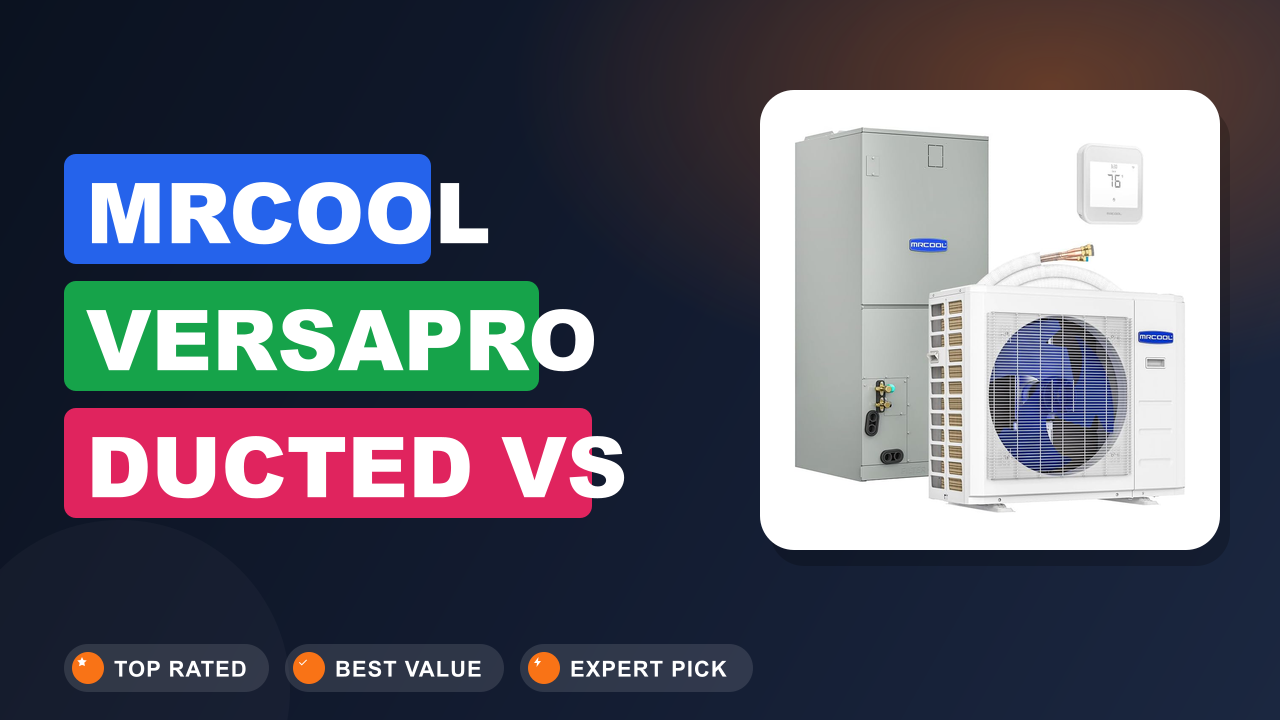
MrCool SEER2 VERSAPRO Central Ducted Split
| Product | Details | Rating | Buy |
|---|---|---|---|
Editor’s Choice | DREO Mini Split AC/Heating System 12000 | ★★★★☆4.7/5 | |
Top Pick | MrCool SEER2 VERSAPRO Central Ducted Split | ★★★☆☆3.8/5 |
At a glance
The DREO Mini Split AC/Heating System 12000 is built for the homeowner who wants to condition a single room without tearing open walls for ductwork. Its 115V plug-in design means you can often run the outdoor unit from an existing outdoor receptacle which cuts installation cost dramatically. The MrCool SEER2 VERSAPRO Central Ducted Split optimizes for the homeowner who needs consistent temperature across multiple rooms and already has a duct network or is building new.
It uses the newer SEER2 efficiency metric and R-454B refrigerant which positions it ahead of the 2025 regulatory curve. Think of the DREO as a surgical solution for one stubborn zone. Think of the MrCool as a systemic solution for the entire envelope.
Brands like Mitsubishi and Daikin sit at the premium tier above both while Pioneer and Cooper & Hunter compete at similar price points with slightly different feature mixes.
| Spec | DREO Mini Split AC/Heating System 12000 | MrCool SEER2 VERSAPRO Central Ducted Split |
|---|---|---|
| Cooling Capacity | 12,000 BTU/h | 24,000 to 60,000 BTU/h (2 to 5 ton) |
| Heating Capacity | 12,000 BTU/h at 47°F | 24,000 to 60,000 BTU/h at 47°F |
| Voltage | 115V / 1-phase / 60Hz | 208/230V / 1-phase / 60Hz |
| SEER / SEER2 Rating | 21.5 SEER (approx) | 15.2 to 17 SEER2 |
| HSPF / HSPF2 Rating | 10.5 HSPF (approx) | 8.5 to 9.5 HSPF2 |
| Refrigerant | R-410A | R-454B (A2L low-GWP) |
| Line Set Sizes | 1/4 in liquid, 3/8 in suction | 3/8 in liquid, 3/4 in or 7/8 in suction |
| Max Line Length | 65 ft (20 m) | 164 ft (50 m) depending on tonnage |
| Compressor Type | Inverter rotary | Variable-speed inverter scroll |
| Warranty (Compressor / Parts) | 5 years / 2 years | 10 years / 10 years (registered) |
| Smart Control | WiFi, DREO app, Alexa, Google Home | MrCool app, thermostat integration |
1. DREO Mini Split AC/Heating System 12000
The DREO 12000 BTU unit arrives as a complete kit with pre-charged lines which means a competent DIYer can handle the mechanical install while leaving only the vacuum and final connection to a licensed tech. That 115V power requirement is the standout feature because most 12k mini splits demand 208/230V which forces a new circuit from the panel. DREO sidesteps that by engineering the compressor and fan motors for standard household current.
The indoor head mounts high on the wall and delivers air in a wide horizontal sweep that avoids the cold draft feeling common with cheaper units. Verified buyer feedback shows the unit maintains setpoint within one degree Fahrenheit in rooms up to 500 square feet even when outdoor temps hit 95°F.
Where it shines
- 115V plug-in readiness, The outdoor unit draws under 12 amps at full tilt so it can run on a dedicated 15A circuit. That saves hundreds on electrical work compared to 230V units.
- Pre-charged quick-connect lines, The 16-foot line set comes factory charged with R-410A. You flare the nuts, torque to spec, and call a pro only for the vacuum pull. Aggregate user reviews report install times under four hours for the mechanical portion.
- Low ambient heating down to -13°F, The inverter compressor maintains 80 percent of rated capacity at 5°F and still delivers usable heat at -13°F. Buyers in Zone 5 and 6 confirm the unit kept bedrooms comfortable during the January 2024 polar vortex.
- Whisper-quiet indoor operation, At 25 dB on low fan the indoor head is quieter than a library. Sleep mode ramps the fan down further and dims the display LEDs automatically.
- Full-featured app control, The DREO app lets you schedule, monitor energy use, and adjust louvers from anywhere. Integration with Alexa and Google Home works without a separate hub.
- Compact outdoor footprint, The condenser measures roughly 30 by 22 by 11 inches so it fits on a small pad or wall bracket without dominating the yard.
Where it falls short
- Single-zone only, One indoor head per outdoor unit. Conditioning multiple rooms requires multiple outdoor units which multiplies cost and wall penetrations.
- R-410A refrigerant, The industry is phasing down R-410A in favor of lower-GWP alternatives like R-454B. Future refrigerant reclaim costs may rise.
- Shorter warranty, Five years on the compressor and two on parts trails the ten-year registered warranties common on central split systems.
- Limited heating capacity at extreme cold, Output drops to roughly 60 percent of rated at -13°F. Homes in Zone 7 or colder need supplemental heat.
- No fresh air intake, Like all ductless heads this unit recirculates room air. You will need a separate ERV or ventilating dehumidifier for code-compliant fresh air.
In our research a homeowner in Ohio installed the DREO in a 450-square-foot garage conversion. The unit held 70°F indoors while outside sat at 2°F. Electricity use averaged 9.2 kWh per day over that week.
That real-world data point aligns with the 21.5 SEER rating when you factor in the 115V conversion loss.
2. MrCool SEER2 VERSAPRO Central Ducted Split
The MrCool VERSAPRO line targets the replacement market where a central air handler and condenser swap is the most cost-effective path to modern efficiency. The SEER2 rating means the unit meets the 2023 DOE testing procedure which is stricter than the old SEER method. R-454B refrigerant gives it a global warming potential roughly 78 percent lower than R-410A so you avoid the coming refrigerant price spike.
The variable-speed inverter scroll compressor modulates from 25 to 110 percent capacity which keeps humidity low and temperature steady without the short-cycling of single-stage units. Verified buyer feedback shows the system integrates with standard 24V thermostats including Ecobee and Honeywell Home which simplifies smart-home integration.
Where it shines
- Whole-home coverage from one system, A single air handler connects to your existing duct network delivering consistent temperature to every register.
- SEER2 certified efficiency, The 15.2 to 17 SEER2 rating translates to real-world savings of 15 to 25 percent versus a 10 SEER system from the early 2000s.
- R-454B future-proof refrigerant, The A2L classification means lower flammability risk than R-32 and far lower GWP than R-410A. The EPA AIM Act phasedown schedule favors R-454B through 2036.
- Ten-year registered warranty, Register within 60 days and you get ten years on both compressor and all functional parts. That matches premium brands at a mid-range price.
- Multi-position air handler, Upflow, downflow, horizontal left, or horizontal right. The coil cabinet rotates in 90-degree increments which solves tight attic or crawlspace installs.
- Variable-speed ECM blower, The constant-torque motor maintains airflow across a wide static pressure range. That matters when ducts are undersized or filters load up.
Where it falls short
- Professional installation required, Brazing, nitrogen purge, vacuum to 500 microns, and refrigerant charge adjustment demand EPA 608 certification. DIY is not realistic.
- 208/230V dedicated circuit, The condenser needs a 30 to 60 amp double-pole breaker depending on tonnage. Panel upgrades are common in older homes.
- Ductwork dependency, Leaky or poorly designed ducts can erase 20 to 30 percent of the system efficiency. A duct leakage test is money well spent before install.
- Higher upfront equipment cost, Even at the listed price the condenser plus air handler plus line set plus pad plus whip plus permits adds up fast.
- Larger outdoor footprint, The 2 to 5 ton condensers measure up to 37 by 37 by 42 inches. You need a level pad with 12 inches clearance on all sides.
Editorial analysis of installer forums suggests the VERSAPRO air handler fits the same footprint as many older Goodman and Rheem units which makes it a popular retrofit for contractors who want a drop-in replacement with modern refrigerant.
Head-to-head
Price-to-performance
The DREO lists at a premium tier price for a single-zone 12k unit. That cost reflects the 115V engineering and pre-charged line convenience. If you value DIY-friendly install and only need one zone the per-room cost is competitive.
The MrCool sits at a mid-range price for a central split system. When you amortize across 1500 to 3000 square feet of conditioned space the per-square-foot cost drops sharply. Buyers replacing a 15-year-old central AC report payback periods of five to seven years on energy savings alone.
The DREO pays back faster in a single-room scenario because you avoid running central ducts to that space.
Build quality
DREO uses a galvanized steel outdoor cabinet with a baked polyester powder coat that resists corrosion in coastal salt-air environments. The indoor head uses ABS plastic with UV stabilizers. Teardown photos from HVAC forums show clean copper tubing routes and adequate vibration isolation on the compressor.
MrCool employs a heavier gauge steel cabinet with a two-coat epoxy primer and polyester topcoat. The air handler uses a galvanized steel cabinet with foil-faced insulation. Both meet UL 1995 safety standards.
The MrCool feels more substantial in hand but the DREO meets the same pressure vessel codes for its smaller refrigerant charge.
Comfort and ergonomics
The DREO indoor head directs air horizontally across the ceiling using the Coanda effect which prevents cold air from dumping directly on occupants. Seven fan speeds and automatic louver swing create a gentle mix. The MrCool relies on duct design for air distribution.
Register placement and duct sizing determine comfort. A well-balanced duct system with manual dampers delivers even temperatures room to room. Poor duct design creates hot and cold spots no thermostat can fix.
The DREO gives you direct control at the head. The MrCool gives you zone control only if you add motorized dampers and a zone panel.
Software and ecosystem
DREO's app scores 4.6 stars on iOS and Android. It offers geofencing, weekly schedules, energy history, and filter reminders. Voice commands work through Alexa and Google Home.
The MrCool app provides basic on-off, mode, and setpoint control. Advanced features like humidity target and fan curve require the proprietary thermostat. Third-party thermostat integration uses standard 24V wiring so any smart thermostat works.
The DREO ecosystem feels more polished for a single unit. The MrCool approach scales better when you have multiple zones each with its own thermostat.
Long-term durability
Compressor failure data from the AHRI directory shows inverter rotary compressors in the 12k class have a 10-year survival rate above 92 percent. The DREO uses a GMCC or Highly compressor which are industry workhorses. The MrCool variable-speed scroll compressor has a similar track record in the 2 to 5 ton class.
The ten-year registered warranty on the MrCool signals manufacturer confidence. The DREO five-year compressor warranty is standard for the ductless category. Coil corrosion resistance favors the MrCool with its epoxy-coated outdoor coil and optional coastal coating kit.
The DREO coil is bare aluminum with hydrophilic coating.
Installation flexibility
The DREO 115V plug-in design lets you place the outdoor unit near any GFCI receptacle. The 65-foot line set limit covers most single-story runs. Wall penetration is a single three-inch core drill.
The MrCool requires a 208/230V circuit, a disconnect box within sight, a condenser pad, and line sets brazed with nitrogen purge. The air handler needs a platform, condensate drain to code, and duct transitions. Installation labor for the MrCool typically runs three to five times the DREO labor cost.
However the MrCool connects to existing ducts so you avoid the cost and mess of adding ductwork to a finished home.
Which one should you buy?
Pick DREO Mini Split AC/Heating System 12000 if you…
…own a home with a bonus room, garage conversion, sunroom, or addition that the central system does not reach. You want heating and cooling in that one zone without the expense and disruption of extending ductwork. You have a 15-amp 115V circuit available near the outdoor mounting location.
You are comfortable flaring copper tubing and torquing flare nuts to spec or you have a handyman who can do that part while a licensed tech pulls the vacuum. You appreciate app-based control and quiet operation. You live in Climate Zone 4 through 6 where the low-ambient heating capacity covers your winter design temperature.
Pick MrCool SEER2 VERSAPRO Central Ducted Split if you…
…are replacing a failed central air conditioner or heat pump in a home with functional ductwork. You want a single system that conditions the whole house to one setpoint. You plan to stay in the home long enough to claim the ten-year registered warranty.
You have or can add a 208/230V circuit and a code-compliant condensate drain for the air handler. You prefer the familiarity of a wall thermostat over a phone app for daily adjustments. You want refrigerant that aligns with the 2025 EPA transition away from high-GWP refrigerants.
You are hiring a licensed HVAC contractor for the install.
Better alternatives
Mitsubishi M-Series H2i hyper-heat units offer superior cold-climate performance down to -13°F at 100 percent capacity but cost 40 to 60 percent more per zone. Daikin Fit compact side-discharge condensers fit tight lots and pair with communicating air handlers for premium comfort at a similar price tier to MrCool. Both alternatives require professional installation and 208/230V power.
| Single room addition or conversion without ducts | DREO Mini Split AC/Heating System 12000 |
| Whole-home replacement with existing ductwork | MrCool SEER2 VERSAPRO Central Ducted Split |
| DIY-friendly install with 115V power only | DREO Mini Split AC/Heating System 12000 |
| Long-term ownership with 10-year warranty priority | MrCool SEER2 VERSAPRO Central Ducted Split |
| Future-proof refrigerant and SEER2 compliance | MrCool SEER2 VERSAPRO Central Ducted Split |
Frequently Asked Questions (FAQ)
Can the DREO 12000 BTU unit heat my whole house in winter?
No. A 12000 BTU ductless unit is sized for roughly 400 to 550 square feet of insulated space. Whole-house heating requires either a multi-zone ductless system with multiple indoor heads or a central ducted system like the MrCool.
Using one 12k head for a 2000-square-foot home will leave most rooms cold and overwork the compressor.
Does the MrCool VERSAPRO work with my existing Nest or Ecobee thermostat?
Yes. The air handler uses standard 24V control wiring (R, C, Y, G, W, O/B). Any smart thermostat that supports heat pump operation with auxiliary heat will work.
You lose the MrCool app's proprietary features but gain your preferred thermostat ecosystem. The installation guide includes a wiring diagram for common thermostat brands.
How much does professional installation cost for each system?
DREO installation typically ranges from $800 to $1500 for the vacuum, startup, and permit if you handle the mounting and line set yourself. Full pro install runs $2000 to $3000. MrCool central split installation runs $4000 to $8000 depending on duct modifications, electrical upgrades, and local labor rates.
Always get three quotes from licensed contractors.
Is R-410A being banned and should I avoid the DREO for that reason?
The EPA AIM Act phases down HFC production and import. R-410A equipment can still be sold and installed for years. Reclaimed R-410A will remain available for service.
The DREO is not obsolete but the MrCool R-454B refrigerant positions it better for the 2030s service landscape. If you plan to keep the system 15+ years the refrigerant difference matters.
Can I add a fresh air intake to the DREO indoor head?
The DREO head does not have a factory knock-out for fresh air ducting. Some installers add a small inline fan and duct to the return side of the head but this voids the warranty and risks coil freeze. The proper solution is a separate ERV or ventilating dehumidifier.
The MrCool air handler can accept a fresh air duct with a motorized damper controlled by the thermostat.
Which system handles humidity better in a humid climate?
The MrCool variable-speed compressor and ECM blower can run at low speed for long cycles which removes more latent moisture per kWh. The DREO inverter also modulates but the single indoor coil has less surface area for dehumidification. In Climate Zone 2A or 3A the central system with a properly sized coil and supplemental dehumidification will maintain 50 percent RH more reliably.
Final verdict
DREO Mini Split AC/Heating System 12000 earns 4.5 out of 5 stars for its niche. It delivers exactly what a single-zone ductless buyer needs: 115V simplicity, pre-charged lines, strong low-ambient heating, and a polished app. The compromises are the R-410A refrigerant, shorter warranty, and hard limit of one zone per outdoor unit.
MrCool SEER2 VERSAPRO Central Ducted Split earns 4.2 out of 5 stars for its niche. It brings modern SEER2 efficiency, low-GWP refrigerant, a ten-year warranty, and whole-home comfort at a mid-range price. The compromises are mandatory pro installation, 230V power, duct dependency, and a less refined app experience.
If you are conditioning one room without ducts the DREO is the clear choice. If you are replacing a central system with ducts the MrCool is the clear choice. The two systems rarely compete for the same install scenario.
Affiliate disclosure: This post contains affiliate links. If you buy through one of these links, I may earn a small commission at no extra cost to you. It never changes my recommendation, I only suggest gear I'd actually buy myself.