Willis Haviland Carrier was the brilliant engineer who invented modern air conditioning in 1902, transforming industries and homes forever. His invention didn’t just cool air—it changed how people live, work, and think about comfort. From factories to movie theaters, Carrier’s technology laid the foundation for today’s climate-controlled world.
Key Takeaways
- Inventor of Modern Air Conditioning: Willis Carrier created the first practical electrical air conditioning system in 1902, solving humidity issues in a printing plant.
- Revolutionized Multiple Industries: Carrier’s innovation transformed printing, textiles, food processing, and later, residential and commercial cooling.
- Named “Father of Air Conditioning”: His company, Carrier Corporation, became a global leader, carrying forward his legacy for over a century.
- Pioneered HVAC Systems: Carrier advanced heating, ventilation, and air conditioning (HVAC), making indoor environments healthier and more comfortable.
- Impact on Urban Development: Air conditioning enabled skyscrapers, hospitals, and data centers to thrive in hot climates, reshaping cities worldwide.
- Sustainable Innovation: Today, Carrier focuses on energy-efficient and eco-friendly systems, continuing Carrier’s commitment to progress.
- Global Influence: From Hollywood’s golden age to modern smart homes, Carrier’s invention touches nearly every aspect of daily life.
📑 Table of Contents
- The Story Behind Willis Carrier and the Air Conditioner
- Who Was Willis Carrier?
- The Impact of Carrier’s Invention
- Carrier Corporation: A Legacy of Innovation
- The Science Behind Air Conditioning
- Tips for Maintaining Your Air Conditioner
- The Future of Cooling
- Conclusion: The Lasting Legacy of Willis Carrier
The Story Behind Willis Carrier and the Air Conditioner
Picture this: It’s 1902, and you’re working in a printing plant in Brooklyn, New York. The ink is bleeding across pages because the air is too humid. Paper expands, and precision printing becomes impossible. Workers are frustrated, deadlines are missed, and the business loses money. Then, a young engineer named Willis Haviland Carrier walks into the office with a solution—not just a bandage fix, but a revolutionary idea that would change the world.
That moment marked the birth of modern air conditioning. Willis Carrier didn’t invent the concept of cooling—people had been using ice and fans for centuries—but he was the first to develop a controllable, reliable, and scalable air conditioning system. His breakthrough wasn’t just technical; it was deeply human. He asked a simple question: *Can we control the environment so people can work comfortably and efficiently?* The answer came in the form of science, engineering, and a little bit of genius.
Carrier’s invention didn’t happen overnight. It grew from curiosity, trial and error, and a belief that technology should serve people. Today, every time you walk into a cool, climate-controlled building or enjoy a chilled drink on a hot day, you’re experiencing the legacy of Willis Carrier. His name is synonymous with comfort, and his company—Carrier Corporation—remains a global leader in heating, ventilation, and air conditioning (HVAC).
Who Was Willis Carrier?
Visual guide about Willis Carrier the Air Conditioner
Image source: m.media-amazon.com
Willis Haviland Carrier was born in 1876 in Cape Vincent, New York. Raised in a modest family, he showed an early interest in mechanics and problem-solving. After graduating from Cornell University with a degree in electrical engineering, he joined Buffalo Forge Company as a draftsman. But he didn’t stay long. He wanted to build things, not just draw them.
In 1902, Carrier left Buffalo Forge and founded his own firm. At just 25 years old, he was determined to solve real-world problems through engineering. His big break came when he was hired by the Sackett-Wilhelms Lithographing & Publishing Company in Brooklyn. The plant was struggling with humidity causing paper to warp and ink to blur. Traditional methods like adding dry ice or opening windows were ineffective.
Carrier studied the problem carefully. He realized that controlling humidity wasn’t just about drying the air—it was about managing temperature and moisture levels precisely. Using principles of thermodynamics and heat transfer, he designed a system that cooled air, removed excess moisture, and circulated it evenly throughout the building. This was the world’s first electrical air conditioning system, and it worked.
The Birth of the Air Conditioner
Carrier’s system used a refrigeration cycle—cooling coils filled with ammonia or another refrigerant, which absorbed heat from the air. Fans pushed air over these coils, lowering both temperature and humidity. The result? Consistent, dry air that kept paper flat and ink sharp.
But Carrier didn’t stop there. He refined his design, creating adjustable controls so operators could fine-tune humidity levels. He also developed the psychrometric chart—a tool still used today by HVAC technicians to analyze air properties. With this innovation, Carrier proved that environmental control was not only possible but practical.
By 1906, his company was growing. He moved into a new building in Syracuse, New York, where he established Carrier Engineering Corporation. Over the next few decades, he expanded his systems beyond printing plants, applying them to textile mills, food processing facilities, and even movie theaters.
The Impact of Carrier’s Invention
Visual guide about Willis Carrier the Air Conditioner
Image source: pbs.twimg.com
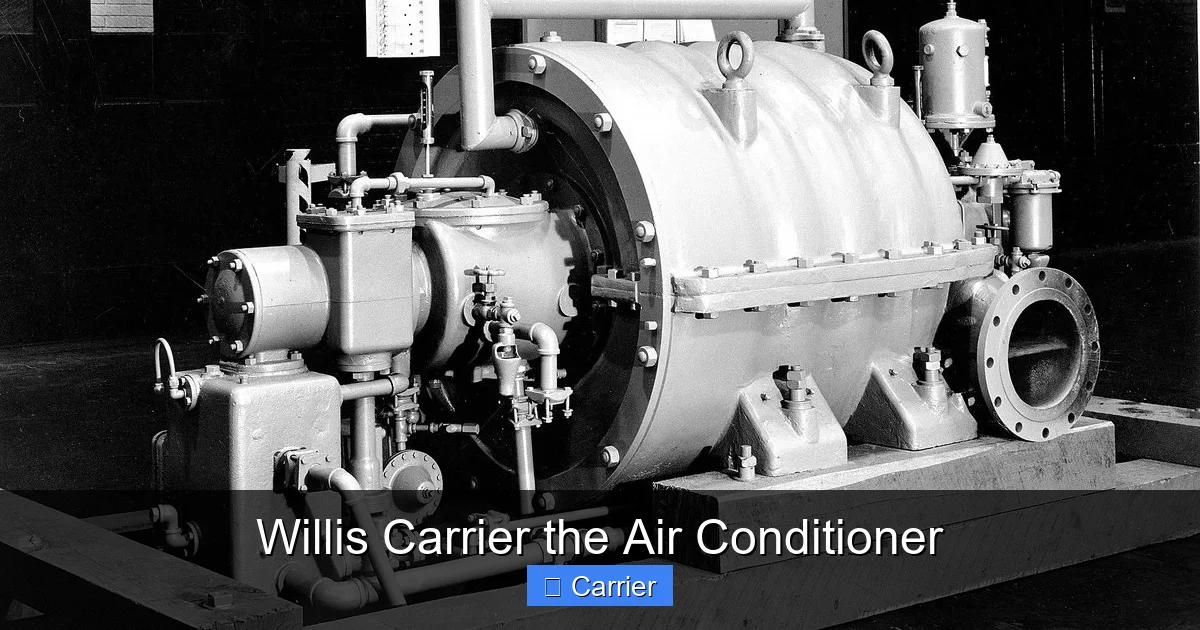
Willis Carrier’s invention didn’t just cool rooms—it transformed entire industries and lifestyles. Before air conditioning, factories in hot climates struggled with worker fatigue and equipment malfunctions. Offices were stifling, and homes were often unbearable during summer months. But after Carrier, that changed.
Industrial Revolution
One of the first major applications of Carrier’s system was in textile manufacturing. In the South, cotton mills faced high humidity, which caused thread to snap and fabric to warp. After installing Carrier systems, production speeds increased, quality improved, and workers stayed more productive. Suddenly, factories could operate year-round without seasonal slowdowns.
Similarly, in food preservation, controlled environments extended shelf life and reduced spoilage. Bakeries, breweries, and dairies adopted Carrier technology to maintain consistent temperatures, improving safety and efficiency.
The Rise of the Skyscraper
Before air conditioning, tall buildings were impractical in warm climates. Elevators, lighting, and office spaces generated heat, making upper floors uncomfortable. But with Carrier’s systems, skyscrapers could thrive. Cities like Chicago, Dallas, and Phoenix saw explosive growth as businesses built upward.
The Empire State Building, completed in 1931, was one of the first to use centralized air conditioning. It became a symbol of modernity and progress, proving that urban density could be comfortable and livable.
Hollywood and the Entertainment Industry
Air conditioning played a secret role in the golden age of Hollywood. Movie studios installed Carrier systems to keep film reels dry and prevent mold. More importantly, they cooled soundstages, allowing actors to perform in comfort and directors to shoot longer hours.
Some historians believe that the popularity of films like *Gone with the Wind* and *The Wizard of Oz* was partly due to the comfort of audiences in air-conditioned theaters. Suddenly, summer blockbusters weren’t just possible—they were profitable.
Residential Comfort
While early air conditioners were large and expensive, Carrier’s innovations made them smaller, more efficient, and more affordable. By the 1950s, window units and central systems began appearing in suburban homes. Families could now enjoy summer without the heat. This shift had profound effects: people moved to warmer states, schools started using AC in classrooms, and productivity soared.
Today, air conditioning is so common that it’s easy to forget how revolutionary it once was. But without Willis Carrier, much of modern life as we know it wouldn’t exist.
Carrier Corporation: A Legacy of Innovation
After founding Carrier Engineering Corporation in 1915, Willis Carrier led the company through decades of growth and change. He never patented his original system—he believed in sharing knowledge to advance society. That openness helped establish Carrier as a trusted name in HVAC.
Over the years, the company expanded internationally, developing systems for everything from airports to data centers. Carrier also embraced new technologies, including programmable thermostats, energy-efficient compressors, and smart home integration.
Today, Carrier Corporation is part of United Technologies Corporation (UTC) and remains a leader in climate solutions. Their products power homes, offices, hospitals, and critical infrastructure around the world. And they continue to innovate—developing systems that reduce carbon emissions, improve indoor air quality, and respond to climate change.
Carrier’s vision was always about more than cooling—it was about enhancing human well-being. His company still lives by that principle.
Technological Advancements
Carrier has introduced many breakthroughs over the years:
– **Chilled Beam Technology:** Uses water instead of air to cool rooms, saving energy.
– **Geothermal Heat Pumps:** Tap into Earth’s stable temperature for efficient heating and cooling.
– **Smart Controls:** Allow users to monitor and adjust systems via smartphones.
– **Low-GWP Refrigerants:** Replace older chemicals with environmentally friendly alternatives.
These innovations show that Carrier’s spirit of improvement lives on.
Corporate Social Responsibility
Modern Carrier is committed to sustainability. They aim to achieve net-zero emissions by 2040 and have invested millions in renewable energy projects. Their “Climate Commitment” includes helping communities adapt to extreme weather and reducing the environmental impact of their products.
This focus on responsibility reflects Carrier’s original mission: to use technology for good.
The Science Behind Air Conditioning
To understand why Willis Carrier’s invention was so groundbreaking, it helps to know the basics of how air conditioning works. It’s not magic—it’s physics.
The Refrigeration Cycle
At the heart of every air conditioner is the refrigeration cycle. This process moves heat from inside a building to the outside. Here’s how it works:
1. **Evaporation:** Liquid refrigerant flows through coils inside the unit. As it absorbs heat from the indoor air, it turns into gas.
2. **Compression:** The gas is compressed, raising its temperature.
3. **Condensation:** The hot gas flows through outdoor coils, releasing heat to the outside air and turning back into liquid.
4. **Expansion:** The cooled liquid passes through an expansion valve, dropping in pressure and temperature before repeating the cycle.
This continuous loop keeps indoor spaces cool and dry.
Humidity Control
One of Carrier’s key insights was that controlling humidity is just as important as cooling. High humidity makes people feel hotter and promotes mold growth. Carrier’s systems remove moisture by cooling air below its dew point, causing water vapor to condense and drain away.
This is why air conditioners often include a drainage line—they’re not just blowing cold air; they’re cleaning it.
Energy Efficiency
Modern systems are far more efficient than Carrier’s early models. Features like variable-speed motors, inverter technology, and smart sensors help reduce energy use. For example, an inverter compressor adjusts its speed based on demand, avoiding constant on/off cycles.
According to the U.S. Department of Energy, upgrading to a high-efficiency air conditioner can cut cooling costs by up to 30%.
Tips for Maintaining Your Air Conditioner
Whether you’re using a Carrier system or any other brand, keeping your air conditioner in top shape ensures comfort and longevity. Here are some practical tips:
Clean or Replace Filters Regularly
Dirty filters restrict airflow, forcing the system to work harder. Replace or clean them every 1–3 months, depending on usage.
Schedule Professional Maintenance
Annual tune-ups by a licensed technician can catch issues early and improve efficiency. Carrier recommends servicing your system at least once a year.
Keep Outdoor Units Clear
Remove debris, leaves, and weeds around the condenser unit. Good airflow is essential for performance.
Use a Programmable Thermostat
Set your thermostat to higher temperatures when you’re away. Carrier’s smart thermostats can learn your schedule and adjust automatically.
Seal Ductwork
Leaky ducts waste energy. Have your ductwork inspected and sealed if needed.
Consider Upgrading
If your system is over 10 years old, upgrading to a high-efficiency model can save money and reduce environmental impact.
Following these steps helps preserve the legacy of Willis Carrier—by ensuring that today’s air conditioners run smoothly and efficiently.
The Future of Cooling
As climate change brings more frequent heatwaves, the demand for effective cooling grows. But so does the need for sustainability. Future air conditioning systems will likely rely on:
– **Renewable Energy:** Solar-powered AC units are already available.
– **Natural Refrigerants:** Ammonia, CO₂, and hydrocarbons produce fewer greenhouse gases.
– **AI and Machine Learning:** Smart systems can predict cooling needs and optimize performance.
– **Passive Design:** Buildings designed to stay cool without heavy AC use reduce overall demand.
Carrier is at the forefront of these trends, investing in research and development to create next-generation climate solutions.
Imagine a world where air conditioners not only cool homes but also generate electricity, purify air, and adapt to weather patterns in real time. That future starts with the same curiosity and ingenuity that drove Willis Carrier.
Conclusion: The Lasting Legacy of Willis Carrier
Willis Carrier didn’t just invent a machine—he invented a way of life. His air conditioning system gave people control over their environment, unlocking new possibilities in work, health, and comfort. From the printing press to the smartphone screen, his influence is everywhere.
Today, Carrier Corporation continues his mission—building systems that make the world more comfortable, productive, and sustainable. And while technology evolves, the core principle remains the same: solve real problems with thoughtful innovation.
So the next time you step into a cool, quiet room on a hot day, take a moment to appreciate Willis Carrier. He may not be a household name like Edison or Tesla, but his invention changed the world in ways both obvious and subtle. Without him, summers might still be unbearable, cities might not rise so high, and much of modern life would look very different.
His story reminds us that great ideas start with a single question: *What if?* And sometimes, the answer changes everything.
Frequently Asked Questions
Who was Willis Carrier and what did he invent?
Willis Haviland Carrier was an American engineer who invented the first modern electrical air conditioning system in 1902. He solved a humidity problem in a printing plant by developing a controllable, mechanical system to cool and dehumidify air. His invention laid the foundation for all modern air conditioning and HVAC systems.
Why is Willis Carrier called the “Father of Air Conditioning”?
Carrier is called the “Father of Air Conditioning” because he was the first to create a practical, scalable, and reliable air conditioning system that could be widely adopted. Unlike earlier attempts using ice or fans, his system used refrigeration principles and precise controls, making it suitable for industrial and eventually residential use.
How did Willis Carrier’s invention impact industries?
Carrier’s air conditioning revolutionized industries such as printing, textiles, food processing, and entertainment. It allowed factories to operate year-round, improved product quality, increased worker productivity, and enabled the construction of skyscrapers in hot climates. Movie theaters and offices also benefited from consistent indoor climates.
What is Carrier Corporation known for today?
Carrier Corporation, founded by Willis Carrier, is a global leader in heating, ventilation, and air conditioning (HVAC) systems. The company is known for innovation in energy efficiency, smart technology, and sustainability. It develops systems for homes, businesses, hospitals, and critical infrastructure worldwide.
How does an air conditioner work based on Carrier’s principles?
Air conditioners use the refrigeration cycle to move heat from inside a building to the outside. Liquid refrigerant absorbs heat indoors, turns to gas, is compressed and cooled outdoors, then returns as liquid to repeat the process. This cycle removes heat and humidity, creating a comfortable indoor environment—just as Carrier designed.
Is air conditioning energy-efficient today?
Yes, modern air conditioners are significantly more energy-efficient than older models. Features like inverter compressors, programmable thermostats, and high SEER ratings help reduce energy use. Brands like Carrier offer systems that can cut cooling costs by up to 30% compared to outdated units.