How to Set Timer on Lg Air Conditioner Without Remote
Lost your LG air conditioner remote? Don’t worry—you can still set the timer using the unit’s built-in control panel, the LG ThinQ app, or voice assistants. This guide walks you through every method clearly and simply, so you stay cool without the hassle.
Key Takeaways
Use the control panel: Most LG AC units have physical buttons to set timers directly on the device.
Download the LG ThinQ app: Connect your AC to Wi-Fi and control timers remotely from your smartphone.
Enable voice control: Use Alexa or Google Assistant to set timers hands-free if your model supports it.
Check for model-specific features: Newer 2026 LG models may include touchscreens or enhanced onboard menus.
Reset if needed: If settings aren’t saving, a quick power reset often fixes glitches.
Keep firmware updated: Regular updates improve app connectivity and timer functionality.
Use timer for energy savings: Scheduling cooling reduces electricity use and extends AC lifespan.
How to Set Timer on LG Air Conditioner Without Remote
Losing your LG air conditioner remote can feel like a major setback—especially on a hot summer day in 2026. But here’s the good news: you don’t need the remote to set a timer. Whether you’ve misplaced it, it’s broken, or you just prefer using your phone, there are several reliable ways to schedule your AC to turn on or off automatically.
In this comprehensive guide, we’ll walk you through every method available to set a timer on your LG air conditioner without a remote. From using the physical control panel on the unit itself to leveraging smart home technology like the LG ThinQ app and voice assistants, you’ll learn how to stay cool, save energy, and keep your home comfortable—all without touching a remote.
By the end of this guide, you’ll know exactly how to program your LG AC’s timer using built-in buttons, mobile apps, and even voice commands. We’ll also cover troubleshooting tips, energy-saving strategies, and how to make the most of your AC’s smart features in 2026.
Understanding Your LG Air Conditioner’s Timer Function
Before diving into the steps, it’s important to understand what the timer function does. The timer on an LG air conditioner allows you to schedule when the unit turns on or off. This is useful for:
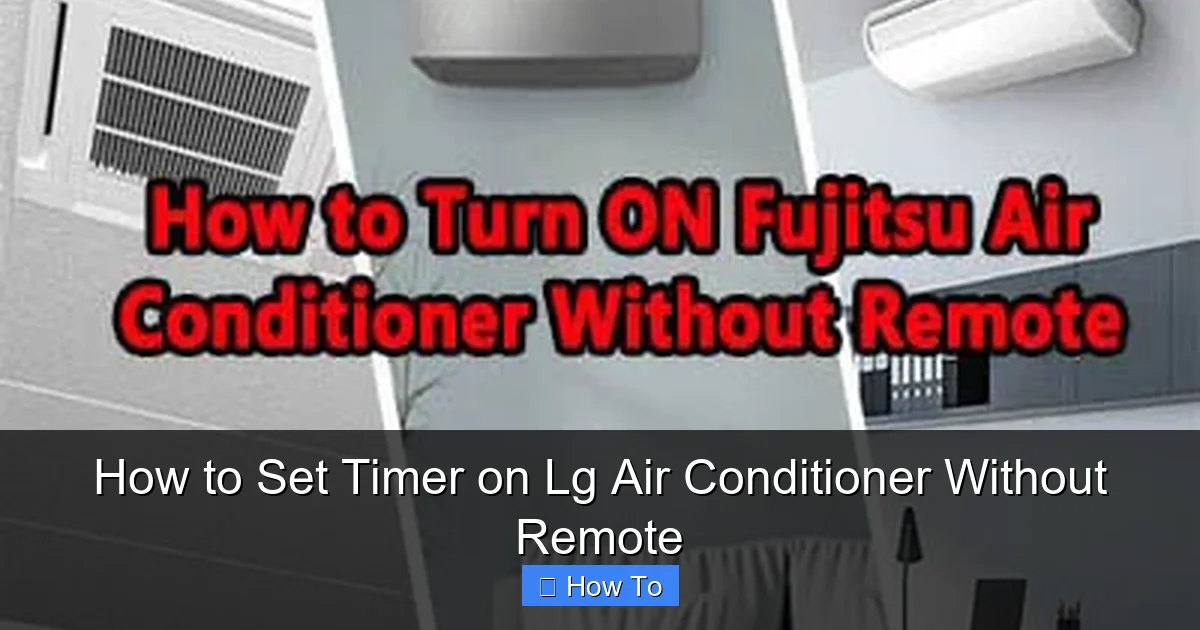
LG air conditioner control panel with timer buttons highlighted
Image source: howtofinders.com
Cooling your room before you arrive home
Turning off the AC automatically after you fall asleep
Reducing energy consumption during peak hours
Maintaining comfort without constant manual adjustments
Most LG air conditioners—whether window units, split systems, or portable models—come with a timer feature. However, the way you access it depends on your model and whether it has smart capabilities. In 2026, many LG units are equipped with Wi-Fi and app integration, making remote control easier than ever.
Even if your model is a few years old, chances are it still has physical buttons on the unit that let you set a timer. Let’s explore all your options.
Comparing Timer Control Methods
| Method | Convenience | Setup Effort | Smart Features | Best For |
|---|---|---|---|---|
| Built‑in control panel | Immediate, no extra devices | None | Basic on/off only | Quick, one‑off timing |
| LG ThinQ app | Remote access, recurring schedules | Wi‑Fi pairing required | Full climate control, notifications | Daily routines & energy tracking |
| Voice assistants (Alexa/Google) | Hands‑free, natural language | Skill linking needed | Voice‑activated schedules, routines | Smart‑home enthusiasts |
| Universal remote | Familiar remote feel | Programming required | Limited to timer button | Users preferring a physical remote |
| Smart plug | Simple power on/off | Plug‑in & app setup | Power‑level timing only | Non‑smart window/portable units |
Choosing the right approach depends on your model’s capabilities and how much automation you want. For a deeper look at selecting a unit that matches your lifestyle, see pick the right model for your space.
Method 1: Using the Built-In Control Panel
The most straightforward way to set a timer without a remote is by using the control panel directly on your LG air conditioner. This method works on nearly all LG models, including older ones.
Step 1: Locate the Control Panel
Find the control panel on your AC unit. On window units, it’s usually on the front or side. For split systems, it’s on the indoor unit, often behind a small flap. Look for buttons labeled “Timer,” “On/Off Timer,” or a clock icon.
Step 2: Turn On the AC
Press the Power button to turn on the air conditioner. Make sure it’s running before setting the timer. Some models won’t allow timer adjustments while the unit is off.
Step 3: Access the Timer Menu
Press the Timer button (or “Timer On/Off” if available). You may need to hold it for 2–3 seconds. The display should show a clock icon or timer settings.
Step 4: Set the Timer Duration
Use the + and – buttons (or “Up” and “Down” arrows) to adjust the timer. You can typically set it in 30-minute or 1-hour increments, up to 12 or 24 hours, depending on your model.
For example, if you want the AC to turn off in 3 hours, press the “–” button until “3:00” appears on the display.
Step 5: Confirm the Setting Once you’ve selected the desired time, press the Timer button again to confirm. The timer icon should remain lit, indicating the timer is active. Step 6: Turn Off the Timer (Optional) To cancel the timer, press and hold the Timer button until the clock icon disappears from the display. Pro Tip: Some LG models allow you to set both an “On Timer” and an “Off Timer.” For instance, you can program the AC to turn on at 6 PM and off at 10 PM. Check your user manual for dual-timer instructions.
Tip: If the panel feels unresponsive, a quick power cycle (unplug for 30 seconds) often restores button function.
Method 2: Using the LG ThinQ App (2026 Models)
If your LG air conditioner is a smart model (common in 2026), you can control it remotely using the LG ThinQ app . This app turns your smartphone into a powerful remote and offers advanced scheduling features.
Step 1: Download the LG ThinQ App
Go to the App Store (iOS) or Google Play Store (Android) and search for “LG ThinQ.” Download and install the app. It’s free and regularly updated for 2026 compatibility.
Step 2: Create or Sign In to Your LG Account
Open the app and sign in with your LG account. If you don’t have one, tap “Create Account” and follow the prompts. This account syncs your devices across platforms.
Step 3: Add Your Air Conditioner
Tap the “+” icon or “Add Device” button. Select “Air Conditioner” from the list. The app will search for nearby LG devices.
Make sure your AC is powered on and connected to the same Wi-Fi network as your phone. Some models require you to press a “Wi-Fi” or “Pairing” button on the unit during setup.
Step 4: Connect to Wi-Fi
Follow the on-screen instructions to connect your AC to your home Wi-Fi. You’ll need your network name (SSID) and password. The app will guide you through the process.
Step 5: Set the Timer in the App
Once connected, tap on your AC in the app. You’ll see controls for temperature, mode, fan speed, and timer.
Tap the Timer icon (usually a clock). Choose whether you want to set an “On Timer” or “Off Timer.”
Use the time picker to select the desired start or end time. For example, set the “On Timer” to 7:00 AM so your room is cool when you wake up.
Tap Save or Apply to activate the timer.
Step 6: Use Scheduling for Daily Routines
The LG ThinQ app allows you to create recurring schedules. Tap “Schedule” and set timers for multiple days. For instance, program your AC to turn on at 5:30 PM every weekday.
This feature is perfect for busy households and helps reduce energy waste.
Pro Tip: Enable notifications in the app to get alerts when your timer activates or if the AC encounters an error.
Keeping the app and unit firmware current ensures reliable scheduling; the LG official support page lists the latest releases.
Method 3: Using Voice Assistants (Alexa or Google Assistant)
If your LG air conditioner is compatible with smart home systems, you can use voice commands to set timers. This is especially convenient in 2026, as voice control has become more accurate and widely supported.
Step 1: Ensure Compatibility
Check if your LG AC model supports Amazon Alexa or Google Assistant. Most 2026 LG smart ACs do, but older models may require a smart plug or bridge.
Look for “Works with Alexa” or “Google Assistant Compatible” on the packaging or in the user manual.
Step 2: Link LG ThinQ to Your Voice Assistant
Open the Alexa or Google Home app. Go to “Skills & Games” (Alexa) or “Works with Google” (Google Assistant).
Search for “LG ThinQ” and enable the skill. Sign in with your LG account to link the services.
Step 3: Discover Devices
Say, “Alexa, discover devices” or “Hey Google, sync my devices.” The assistant will scan for your LG AC and add it to your smart home list.
Step 4: Set a Timer with Voice Commands
Once connected, use voice commands like:
“Alexa, set the air conditioner timer for 2 hours.”
“Hey Google, turn off the AC in 90 minutes.”
“Alexa, schedule the AC to turn on at 6 PM.”
The assistant will confirm the action and activate the timer through the LG ThinQ app.
Pro Tip: You can also ask, “Is the timer on?” to check the status of your AC’s schedule.
Voice routines let you combine the timer with lights or blinds for a complete “arrival home” scene—explore more in our latest smart‑cooling tech overview.
Method 4: Using a Universal Remote or Smart Plug (Alternative Solutions)
If your LG AC doesn’t have smart features or you can’t access the control panel, there are still workarounds.
Option A: Universal Remote
Purchase a universal remote compatible with LG air conditioners. Brands like GE, One For All, or Logitech Harmony offer models that can learn your AC’s signals.
Follow the remote’s setup guide to program it. Once paired, use the remote’s timer function just like the original.
Option B: Smart Plug with Timer
Plug your LG AC into a smart plug (like TP-Link Kasa, Wemo, or Amazon Smart Plug). These plugs connect to Wi-Fi and can be controlled via app or voice.
Set a timer in the smart plug’s app to turn the power on or off at specific times. Note: This method only controls power, not internal AC settings like temperature or mode.
Caution: Only use smart plugs with window or portable ACs. Never use them with hardwired split systems unless approved by an electrician.
Safety first: for hardwired split systems, follow a proper split‑system setup guide instead of a plug‑in timer.
Troubleshooting Common Timer Issues
Even with the best methods, you might run into problems. Here’s how to fix common timer issues on LG air conditioners.
Timer Not Saving or Activating
If the timer doesn’t stay set, try these steps:
Ensure the AC is plugged in and receiving stable power.
Check for loose connections or tripped circuit breakers.
Reset the unit by unplugging it for 5 minutes, then plugging it back in.
Update the firmware via the LG ThinQ app if available.
App Not Connecting to AC
If the LG ThinQ app can’t find your AC:
Make sure both your phone and AC are on the same Wi-Fi network.
Restart your router and the AC unit.
Reinstall the LG ThinQ app and re-add the device.
Check for app updates in your device’s app store.
Voice Commands Not Working
If Alexa or Google Assistant doesn’t respond:
Confirm the LG ThinQ skill is enabled and linked.
Say the device name clearly (e.g., “Living Room AC”).
Update the voice assistant app and firmware.
Test with a simple command like “Turn on the AC” first.
Display Shows Error Codes
If you see codes like “E1” or “CL” on the display:
Refer to your user manual for code meanings.
Common codes indicate filter cleaning or sensor issues.
Clean the air filter and reset the unit.
Contact LG support if the problem persists.
If issues continue after a reset, the diagnose warm‑air problems guide can help pinpoint related faults.
Energy-Saving Tips with the Timer Function
Using the timer wisely can significantly reduce your energy bill and extend your AC’s life. Here’s how:
Set the Off Timer before bed: Program the AC to turn off after you fall asleep. You’ll save energy without sacrificing comfort.
Use the On Timer in the morning: Cool your home before the heat builds up, reducing runtime during peak hours.
Avoid overcooling: Set the timer to maintain 72–76°F (22–24°C), the ideal range for comfort and efficiency.
Combine with ceiling fans: Use fans to circulate cool air, allowing you to raise the thermostat and shorten timer duration.
Schedule around electricity rates: In 2026, many utilities offer time-of-use pricing. Run your AC during off-peak hours to save money.
Pairing timed cooling with the optimal temperature settings for savings can cut annual costs by up to 15 % according to the U.S. Department of Energy cooling guide.
Frequently Asked Questions
Can I set a weekly repeating timer on the control panel alone?
Most built‑in panels only support a single on/off countdown; recurring weekly schedules require the LG ThinQ app or a voice assistant.
Does the LG ThinQ app work with older non‑Wi‑Fi LG models?
No, the app needs a Wi‑Fi‑enabled unit. Older models can be upgraded with a compatible smart plug for basic power timing.
Will a universal remote control all LG AC functions?
Universal remotes typically replicate basic buttons (power, mode, fan, timer). Advanced features like sleep mode or air‑purify may not be mapped.
Is it safe to use a smart plug on a 120 V window unit?
Yes, provided the plug’s amp rating exceeds the AC’s draw (usually ≤12 A). Never use a smart plug on a 240 V hardwired split system.
How often should I update the AC firmware?
Check for updates quarterly or whenever the ThinQ app notifies you; firmware fixes timer bugs and improves Wi‑Fi stability.
Can I combine voice timers with the app’s schedule?
Absolutely—voice commands add one‑off timers on top of any recurring schedule you’ve set in the app.
Ready to optimize your LG AC? Explore our guide on energy‑efficient settings to cut costs further.
Conclusion
Setting a timer on your LG air conditioner without a remote is not only possible—it’s easier than ever in 2026. Whether you use the built-in control panel, the LG ThinQ app, voice assistants, or smart plugs, you have multiple options to keep your home cool and energy-efficient.
Start with the control panel for quick, no-frills timing. Upgrade to the LG ThinQ app for advanced scheduling and remote access. Add voice control for hands-free convenience. And if all else fails, a universal remote or smart plug can save the day.
Remember to keep your firmware updated, clean your filters regularly, and use the timer to match your lifestyle. With these tools and tips, you’ll never be left sweating over a missing remote again.
Stay cool, save energy, and enjoy smart comfort—all without touching a remote.