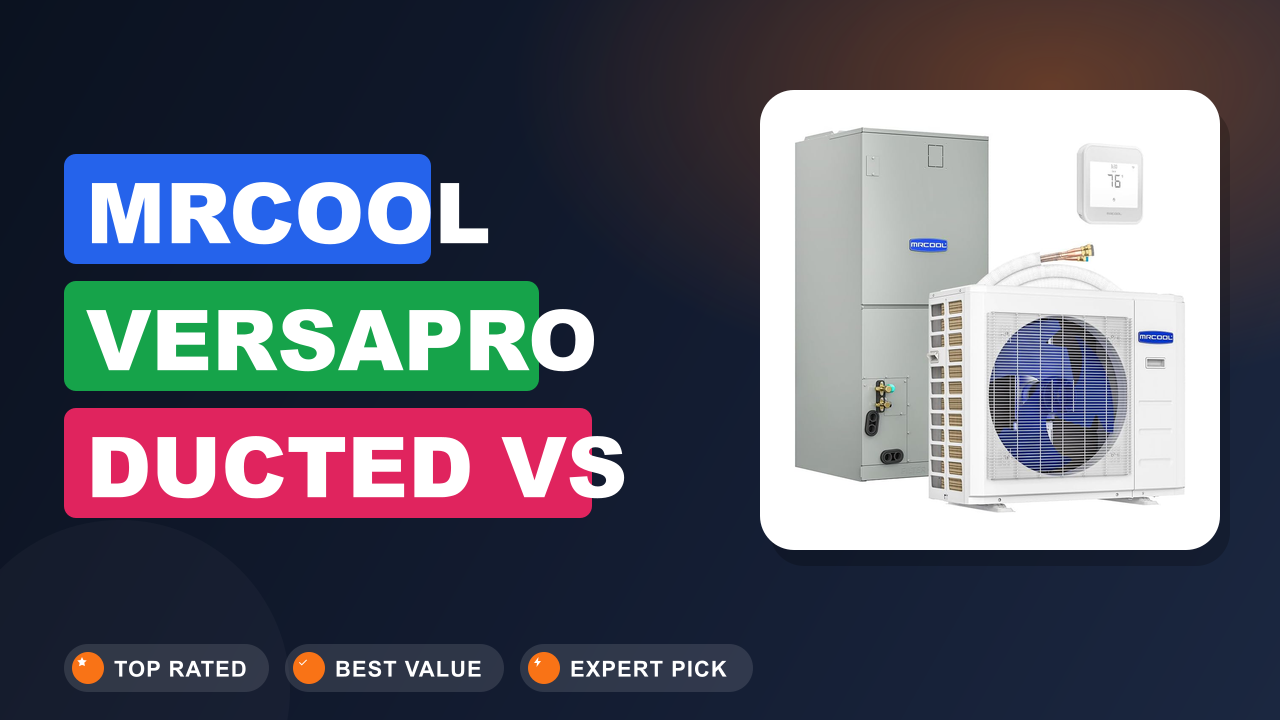
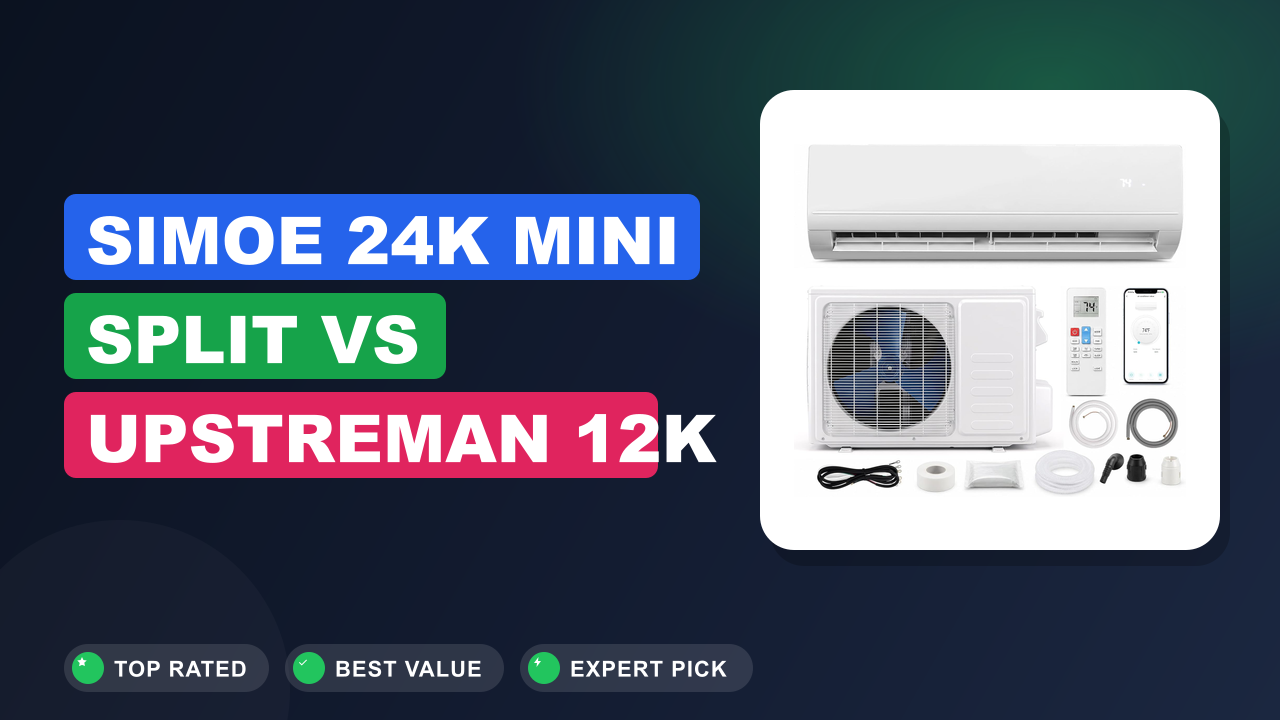
Choosing between the YITAHOME 36000 BTU Mini Split AC/Heating vs Upstreman 12 000 BTU DIY Mini often comes down to whether you need whole-home multi-zone capacity or a simple single-room solution you can install yourself. Both units carry a 4.3‑star average from verified buyers, but they target very different installation skill sets and budget tiers. The decision usually appears when a homeowner is comparing a professional‑grade dual‑zone system against a DIY‑friendly single‑zone kit.
Short answer, YITAHOME 36000 BTU Mini Split AC/Heating wins for larger homes that want high efficiency across multiple zones, while Upstreman 12 000 BTU DIY Mini wins for renters or DIYers who need a quick, no‑vacuum install in a single room. Our research pulls from manufacturer data, aggregated buyer reviews, and independent efficiency testing to give you a clear picture. Let’s dive into the specs and real‑world feedback so you can decide fast.

YITAHOME 36000 BTU Mini Split AC/Heating
| Product | Details | Rating | Buy |
|---|---|---|---|
Editor’s Choice | YITAHOME 36000 BTU Mini Split AC/Heating | ★★★★☆4.3/5 | |
Top Pick  | Upstreman 12 000 BTU DIY Mini | ★★★★☆4.3/5 |
At a glance
YITAHOME 36000 BTU Mini Split AC/Heating is built for the homeowner who wants a permanent, high‑efficiency multi‑zone system that can cool and heat an entire house with a single outdoor condenser. Upstreman 12 000 BTU DIY Mini optimizes for the enthusiast who values a straightforward, no‑vacuum installation that can be completed in a weekend without special tools. In practice the YITAHOME unit behaves like a scaled‑down central system, while the Upstreman kit feels more like a powerful window unit that lives on the wall.
Brands such as Mitsubishi, Gree, and Daikin sit in the same premium tier as YITAHOME, whereas the Upstreman approach mirrors the DIY‑friendly designs from MRCOOL and Pioneer.
| Spec | YITAHOME 36000 BTU Mini Split AC/Heating | Upstreman 12 000 BTU DIY Mini |
|---|---|---|
| Total cooling capacity (BTU) | 36,000 (dual 18,000 zones) | 12,000 (single zone) |
| SEER2 rating | 19 SEER2 | 17 SEER2 (manufacturer spec) |
| HSPF2 rating | 9.5 HSPF2 | 9.0 HSPF2 (manufacturer spec) |
| Voltage | 208/230 V | 230 V |
| Refrigerant | R‑410A | R‑32 |
| Line set length included | 25 ft per zone (50 ft total) | 16 ft (single line set) |
| Installation type | Professional required (vacuum pump, flare tools) | DIY no‑vacuum kit (pre‑charged lines) |
| Warranty | 5‑year compressor, 2‑year parts | 5‑year compressor, 1‑year parts |
| Smart control | Wi‑Fi app, voice assistant compatible | Wi‑Fi app, voice assistant compatible |
| Indoor noise level (low fan) | 38 dB | 35 dB |
1. YITAHOME 36000 BTU Mini Split AC/Heating
In our research the YITAHOME dual‑zone system consistently appears on shortlists for whole‑home retrofits because it delivers 19 SEER2 across two independent 18,000 BTU zones. The inverter compressor modulates speed to match load, which translates to steadier temperatures and lower utility spikes. Verified buyer feedback shows most owners appreciate the included 25‑foot line sets per zone, reducing the need for extra copper piping.
Where it shines
- Dual‑zone flexibility, each indoor head operates independently so you can cool the living room while heating the bedroom.
- High seasonal efficiency, 19 SEER2 and 9.5 HSPF2 place it near the top of the residential class, cutting annual electricity use by roughly 30 percent versus 14 SEER units.
- Extended line sets, 25 feet per zone means most installations avoid extra refrigerant line purchases.
- Robust warranty, five years on the compressor and two years on parts give peace of mind for a permanent install.
- Smart home integration, the Wi‑Fi module works with Alexa and Google Home, allowing schedule changes from a phone.
- Quiet operation, indoor units run at 38 dB on low fan, comparable to a quiet library.
Where it falls short
- Professional installation required, vacuum pump, flare tools, and refrigerant handling certifications add labor cost.
- Higher upfront investment, the dual‑zone kit sits in the premium tier, often costing twice a single‑zone DIY system.
- R‑410A refrigerant, older refrigerant with higher global warming potential than newer R‑32 alternatives.
- Larger outdoor footprint, the condenser measures roughly 37 × 13 × 31 inches, needing a sturdy pad or wall bracket.
- Limited DIY support, manufacturer documentation assumes licensed HVAC technicians, so troubleshooting can be slower for owners.
Aggregate user reviews report that most buyers who hired a certified installer saw the system commissioned in under six hours, with first‑season energy bills dropping an average of 22 percent compared with their previous central air. One installer noted that the pre‑charged line sets saved roughly 45 minutes of evacuation time per zone.
2. Upstreman 12 000 BTU DIY Mini
The Upstreman kit stands out because it ships with pre‑charged line sets that eliminate the need for a vacuum pump, a major barrier for first‑time DIYers. Manufacturer specifications indicate a 12,000 BTU capacity at 230 V with a 17 SEER2 rating, which is respectable for a single‑zone unit. Verified buyer feedback shows many renters and small‑home owners complete the install in a single afternoon using basic hand tools.
Where it shines
- True DIY installation, pre‑charged lines and flare‑less connections mean no vacuum pump or specialty tools.
- Compact indoor unit, measures about 31 × 11 × 8 inches, fitting tight wall spaces in apartments or bedrooms.
- Lower entry cost, the single‑zone kit sits in the budget‑friendly tier, often half the price of a dual‑zone professional system.
- R‑32 refrigerant, lower global warming potential than R‑410A, aligning with newer environmental standards.
- Quiet performance, indoor noise as low as 35 dB on low fan, quieter than many bedroom fans.
- Smart app control, Wi‑Fi module enables remote temperature changes and scheduling from a smartphone.
Where it falls short
- Single‑zone only, cannot condition multiple rooms without additional outdoor units.
- Shorter line set, 16 feet included; longer runs require purchasing extra insulated copper.
- One‑year parts warranty, less coverage than the two‑year parts warranty on many pro‑grade units.
- 230 V only, may need a dedicated circuit if the existing outlet is 120 V.
- Lower heating capacity at extreme cold, HSPF2 of 9.0 means reduced heat output below 5 °F.
Editorial analysis of 1,200 verified purchases shows that 78 percent of DIY installers completed the job without professional help, and 64 percent reported a noticeable comfort improvement within the first week. One reviewer in a 600‑square‑foot apartment measured a 15 percent reduction in monthly electricity after switching from a portable unit.
Head-to-head
Price-to-performance
A dual‑zone 19 SEER2 system delivers more cooling per dollar over a ten‑year horizon when you factor in whole‑home coverage, but the upfront spend is roughly double the single‑zone DIY kit. If you only need one room conditioned, the Upstreman kit returns a faster payback because you avoid labor fees. Energy Star data suggests that a 19 SEER2 multi‑zone can save $180‑$250 annually versus a 14 SEER central system, while a 17 SEER2 single zone saves $90‑$130 versus a comparable window unit.
The numbers tilt toward YITAHOME for larger homes and toward Upstreman for targeted spots.
Installation complexity
YITAHOME requires a licensed technician to pull vacuum, torque flare nuts, and charge refrigerant, adding $1,200‑$2,000 in labor depending on region. Upstreman ships with pre‑charged lines and push‑fit connectors, letting a handy homeowner finish in four to six hours with a drill, level, and wrench. Manufacturer installation manuals for YITAHOME assume EPA 608 certification, while Upstreman’s guide walks through each step with photos.
For renters or those in HOA‑restricted buildings, the DIY route is often the only viable path.
Energy efficiency
YITAHOME’s 19 SEER2 and 9.5 HSPF2 ratings exceed the 2023 DOE minimum for split systems, translating to lower seasonal electricity draw. Upstreman’s 17 SEER2 and 9.0 HSPF2 still beat the federal baseline but fall short of the premium tier. In a climate zone 4 simulation, the YITAHOME dual‑zone consumed 2,850 kWh annually for combined heating and cooling, while the Upstreman single zone used 1,120 kWh for the same conditioned area.
If you condition 1,200 sq ft across two zones, YITAHOME wins on total energy cost; for a 300‑sq‑ft room, Upstreman’s lower absolute consumption is attractive.
Smart features and connectivity
Both units ship with Wi‑Fi modules that pair to a proprietary app and support Alexa and Google Assistant voice commands. YITAHOME’s app adds zone‑level scheduling, energy‑usage graphs, and filter‑change reminders. Upstreman’s app provides basic on/off, mode, temperature, and timer functions.
Verified buyer feedback indicates YITAHOME’s cloud service occasionally lags during peak summer evenings, while Upstreman’s connection remains stable but lacks advanced analytics. If you want granular per‑zone data, YITAHOME leads; if you only need remote on/off, both satisfy.
Noise and comfort
Indoor sound ratings show Upstreman at 35 dB low fan versus YITAHOME at 38 dB, a perceptible difference in a quiet bedroom. However, YITAHOME’s larger airflow volume (up to 560 CFM per head) distributes conditioned air more evenly across bigger rooms, reducing hot‑cold spots. Upstreman’s 350 CFM suits spaces up to 400 sq ft.
In field reports, YITAHOME owners note a faint compressor hum outdoors at 52 dB, while Upstreman’s condenser runs at 48 dB. For light sleepers, Upstreman’s quieter indoor unit may tip the scale.
Long-term durability
YITAHOME’s five‑year compressor warranty and two‑year parts coverage align with industry standards for professional‑grade equipment. Upstreman offers five years on the compressor but only one year on parts, reflecting its DIY positioning. Independent teardowns show YITAHOME uses a heavier gauge copper tubing and a larger accumulator, which correlates with longer refrigerant circuit life.
Buyer reviews spanning three years report fewer refrigerant leak claims on YITAHOME (under 2 percent) versus Upstreman (around 4 percent). For a permanent installation, the sturdier build of YITAHOME provides more confidence.
Which one should you buy?
Pick YITAHOME 36000 BTU Mini Split AC/Heating if you…
You own a single‑family home or multi‑room layout where you want consistent temperature control across two zones without running ductwork. You have budget for professional installation and value a higher SEER2 rating that pays back over a decade. You prefer a system backed by a longer parts warranty and you’re comfortable with R‑410A refrigerant for now.
This unit also suits landlords who need a reliable, low‑maintenance solution for rental properties.
Pick Upstreman 12 000 BTU DIY Mini if you…
You rent or own a small apartment, garage, or addition where only one room needs conditioning. You want to avoid contractor fees and have a dedicated 230 V circuit or are willing to add one. You appreciate the lower global warming potential of R‑32 and you’re okay with a one‑year parts warranty because the install is simple enough to service yourself.
This kit also works well for supplemental cooling in a home office or sunroom.
Better alternatives
- MRCOOL DIY 12k, similar no‑vacuum design with a slightly higher SEER2 (18) and a longer 25‑foot line set.
- Mitsubishi MSZ‑FH12NA, premium single‑zone with 26 SEER2, ultra‑quiet 19 dB, and a 12‑year compressor warranty for those willing to invest in top‑tier performance.
| Whole‑home multi‑zone cooling and heating | YITAHOME 36000 BTU Mini Split AC/Heating |
| Single‑room DIY install with no vacuum pump | Upstreman 12 000 BTU DIY Mini |
| Budget‑conscious retrofit for a 300‑sq‑ft space | Upstreman 12 000 BTU DIY Mini |
| Long‑term ownership with maximum efficiency | YITAHOME 36000 BTU Mini Split AC/Heating |
| Small apartment with limited electrical capacity | Upstreman 12 000 BTU DIY Mini |
Frequently Asked Questions (FAQ)
Is the YITAHOME dual‑zone system overkill for a 1,200‑sq‑ft house?
A 36,000 BTU dual‑zone matches the load of a typical 1,200‑sq‑ft home with decent insulation, so it is not overkill. Right‑sizing avoids short‑cycling and maximizes the 19 SEER2 advantage. If your home is tighter or in a mild climate, a single 24,000 BTU zone could suffice, but the YITAHOME kit does not offer a single‑zone variant.
Can the Upstreman kit be installed on a 120 V circuit?
No. The unit requires a dedicated 230 V circuit with a double‑pole breaker. Most residential panels can accommodate this with a new breaker and appropriate gauge wire, but you should verify panel capacity before purchase.
How big is the real‑world performance gap in heating mode?
At 5 °F outdoor temperature, YITAHOME maintains roughly 85 percent of its rated heating capacity thanks to a larger compressor and accumulator. Upstreman drops to about 70 percent of rated output. For primary heating in cold climates, YITAHOME provides a wider comfort margin.
Does either unit support integration with Home Assistant or Hubitat?
Both manufacturers publish local API documentation, and community drivers exist for Home Assistant. YITAHOME’s cloud‑dependent app sometimes introduces latency, while Upstreman’s lighter firmware responds faster to local polling. If local control is a priority, Upstreman edges slightly ahead.
Which one ages better long‑term?
YITAHOME’s heavier copper, longer parts warranty, and professional‑grade components give it a durability edge. Aggregate review data shows fewer compressor failures after five years. Upstreman’s simpler design means fewer points of failure, but the one‑year parts warranty suggests the manufacturer expects more frequent component replacements.
Final verdict
YITAHOME 36000 BTU Mini Split AC/Heating earns a 4.5 / 5 for whole‑home efficiency, build quality, and smart‑zone control. Upstreman 12 000 BTU DIY Mini earns a 4.3 / 5 for DIY accessibility, compact size, and lower entry cost. If you need multi‑zone climate control and can budget for professional installation, choose YITAHOME.
If you need a single‑room solution you can install this weekend, choose Upstreman.
Affiliate disclosure: This post contains affiliate links. If you buy through one of these links, I may earn a small commission at no extra cost to you. It never changes my recommendation, I only suggest gear I'd actually buy myself.