Willis Carrier invented the first modern air conditioning system in 1902, transforming industrial processes and everyday life. His revolutionary design used evaporative cooling and precise humidity control, laying the foundation for today’s HVAC systems. This innovation not only improved workplace comfort but also sparked entire industries and urban development across the globe.
Key Takeaways
- The First Modern Air Conditioner: In 1902, Willis Carrier designed the first electrical air conditioning unit to solve humidity issues at a printing plant, marking the birth of modern HVAC.
- Revolutionary Technology: Carrier’s system used evaporation and temperature control to regulate both heat and moisture, a breakthrough that changed industrial manufacturing forever.
- Industrial Impact: By stabilizing environmental conditions, Carrier’s invention enabled precision manufacturing, reduced product defects, and increased worker productivity.
- Birth of the HVAC Industry: Carrier’s company grew into Carrier Corporation, becoming a global leader in climate control solutions and setting industry standards.
- Legacy in Modern Comfort: Today’s homes, offices, and vehicles rely on principles Carrier pioneered—centralized cooling, energy efficiency, and smart climate management.
- Environmental Influence: While early units were energy-intensive, Carrier later embraced innovation in sustainable cooling technologies, influencing green building practices.
- Cultural and Social Change: Air conditioning reshaped society—enabling suburban growth, movie theater popularity, and improved public health during heatwaves.
📑 Table of Contents
- Introduction: A Cooling Revolution Born from a Printing Problem
- The Birth of Modern Air Conditioning: How It All Started
- How Willis Carrier’s First Air Conditioner Changed Manufacturing
- The Evolution of Air Conditioning: From 1902 to Today
- Willis Carrier’s Legacy: More Than Just Cool Air
- Practical Tips for Homeowners Inspired by Carrier’s Principles
- Conclusion: The Cooling Revolution Continues
Introduction: A Cooling Revolution Born from a Printing Problem
Imagine walking into a bustling printing plant in 1902. The air is thick with steam, and the paper keeps curling and wrinkling—making perfect print jobs impossible. Workers sweat under the heat, and quality control reports pile up. Then, a young engineer named Willis Carrier steps in with a bold idea: what if we could control both temperature and humidity? That moment, in July 1902, didn’t just fix a printing problem—it launched a technological revolution.
Carrier’s first air conditioner was more than a machine; it was a prototype of modern climate control. Unlike earlier attempts at cooling, which focused only on lowering temperature, Carrier’s system tackled humidity too. This wasn’t just about comfort. It was about precision, consistency, and reliability—qualities essential to industrial success. Over time, his invention spread beyond factories, transforming homes, theaters, hospitals, and eventually entire cities. Today, when you walk into a cool, dry office on a hot day, you’re experiencing the direct legacy of that 1902 breakthrough.
In this article, we’ll explore how Willis Carrier built the first air conditioner, why it mattered then and now, and how it continues to shape our world. We’ll also look at the challenges he faced, the innovations that followed, and how modern HVAC systems still echo his original vision.
The Birth of Modern Air Conditioning: How It All Started
Visual guide about Willis Carrier First Air Conditioner 1902
Image source: images.summitmedia-digital.com
A Crisis in the Print Shop
It all began in Brooklyn, New York, at the Sackett-Wilhelms Lithographing and Publishing Company. In 1902, the plant was losing money because the paper kept warping. Humidity levels were fluctuating wildly due to weather changes, and the printing presses couldn’t keep up. Ink smudged. Colors bled. The final products were rejected.
Enter Willis Carrier, a 25-year-old engineering graduate from Cornell University. He wasn’t a household name yet—but he had a knack for solving complex problems with science. After analyzing the plant’s issues, Carrier realized the real culprit wasn’t just heat—it was humidity. High moisture content in the air caused paper to absorb water, swell, and distort. So, he proposed a radical solution: control both temperature and humidity.
His first system used a chilled water coil to cool air and then dehumidify it through condensation. This was the first time anyone had successfully regulated indoor climate with such precision. The result? Paper stayed flat, ink dried cleanly, and output quality soared. The company saved thousands of dollars in waste and increased production by 25%. Word spread fast.
The Science Behind the Innovation
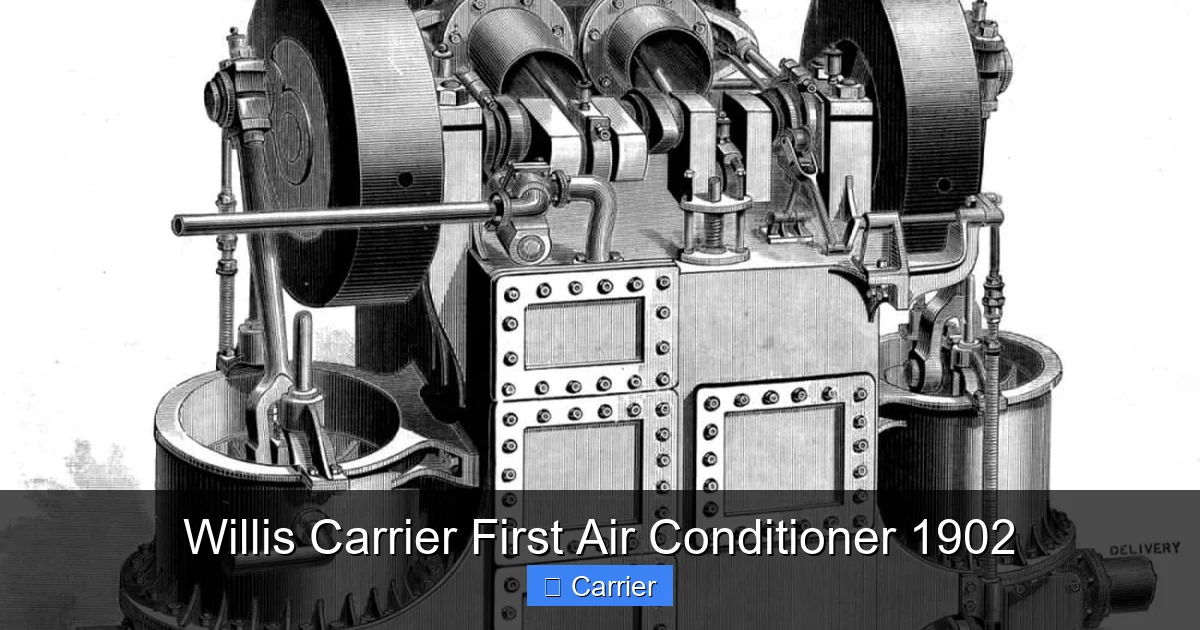
Carrier’s genius lay in applying thermodynamics and fluid mechanics to everyday problems. He understood that air conditioning wasn’t just about blowing cold air—it was about managing heat and moisture transfer. His system worked like this:
– Air was drawn over a chilled coil filled with refrigerants.
– Heat from the air transferred to the coil, cooling the space.
– Water vapor in the air condensed on the cold surface, reducing humidity.
– The now-cooled and drier air was blown back into the room.
This process was called “conditioning” because it didn’t just cool—it prepared air to meet specific requirements. Carrier even created charts to predict how different temperatures and humidity levels affected materials, a precursor to today’s psychrometric charts used by HVAC technicians.
He also introduced the concept of “comfort zones”—ideal ranges for human well-being—which later became standard in building design. Before this, people accepted summer heat as unavoidable. Carrier showed them otherwise.
From Idea to Industrial Standard
Within a year, Carrier had filed his first patent (U.S. Patent No. 812,724) and founded the Carrier Engineering Corporation in 1915. His company grew rapidly, installing systems in textile mills, banks, and eventually homes and theaters. The 1920s saw the rise of “movie palaces” in hot cities like Los Angeles and Atlanta—thanks to air conditioning, audiences flocked inside even in summer.
But Carrier’s influence went beyond business. He believed in research, hiring top scientists and engineers. His team developed new refrigerants, improved compressor designs, and created standardized testing methods. These advances made air conditioning safer, more efficient, and scalable.
By the 1930s, Carrier was no longer just an inventor—he was a pioneer shaping an entire industry. And it all started with a printing plant in Brooklyn.
How Willis Carrier’s First Air Conditioner Changed Manufacturing
Visual guide about Willis Carrier First Air Conditioner 1902
Image source: diak46rl5chc7.cloudfront.net
Precision Control in Production
One of the most profound impacts of Carrier’s invention was its effect on manufacturing. Before air conditioning, factories operated in whatever climate nature provided. In humid summers, metal parts expanded. In dry winters, static electricity damaged electronics. But with controlled environments, manufacturers could ensure consistency.
For example, textile mills no longer had to shut down in high-humidity months. Rubber processing plants could maintain optimal conditions for vulcanization. Even delicate instruments like watches and cameras benefited from stable environments.
Carrier himself noted that controlling humidity alone could reduce product defects by up to 50%. This wasn’t just cost savings—it was a leap in quality control. Companies could meet higher standards, compete globally, and innovate faster.
New Industries, New Opportunities
The ripple effects of Carrier’s system were enormous. Suddenly, industries that required tight environmental controls emerged or expanded. Pharmaceutical companies needed sterile labs. Data centers required cooled server rooms. Food processing plants had to prevent spoilage.
These weren’t just side effects—they were direct results of reliable climate control. And they wouldn’t exist without Carrier’s breakthrough.
Moreover, the ability to work in extreme climates opened up new markets. Factories could be built in hotter regions, workers weren’t tied to cooler northern states, and supply chains became more flexible. Urban planning also changed—buildings could be taller and denser because air conditioning made them livable year-round.
Workplace Productivity and Safety
Beyond product quality, Carrier’s system improved worker conditions. Hot, humid factories led to fatigue, dehydration, and accidents. With air conditioning, productivity rose, absenteeism fell, and morale improved.
Studies from the 1920s and 1930s showed that employees in cooled environments performed tasks faster and made fewer errors. This was especially important during World War II, when factories produced weapons and vehicles at high speeds. Air conditioning helped sustain round-the-clock operations.
Today, OSHA and other safety agencies recognize thermal comfort as part of workplace wellness. Carrier’s early advocacy for human-centered design laid the groundwork for modern ergonomics and occupational health standards.
The Evolution of Air Conditioning: From 1902 to Today
The Early Years: Mechanical Cooling Takes Off
After 1902, air conditioning remained a niche technology—mostly used in large commercial buildings. But Carrier’s company kept pushing boundaries. In the 1920s, they introduced window units for homes and offices, making personal cooling accessible.
However, early systems were bulky, noisy, and expensive. Refrigerants like ammonia were toxic, and energy use was high. Still, demand grew. By 1930, over 100 Carrier systems were installed annually in the U.S. alone.
The Great Depression slowed progress, but WWII accelerated innovation. Military needs drove advances in refrigeration, miniaturization, and reliability. Post-war, these technologies trickled down to consumers.
Mid-Century Boom: Mass Adoption and Cultural Shifts
The 1950s and 60s were the golden age of air conditioning. Automobile air conditioners appeared in the late 1950s, thanks partly to Carrier patents. Suburban homes were built with central AC systems. Movie theaters became summer destinations. Even schools and hospitals installed cooling units.
This wasn’t just about comfort—it was about lifestyle transformation. Americans moved south and west, cities expanded, and the “air-conditioned nation” was born. According to some estimates, by 1970, over half of U.S. households had central air.
But this boom came with consequences. Energy consumption soared. Cities became hotter due to waste heat from AC units—a phenomenon known as the urban heat island effect. Environmental concerns grew as chlorofluorocarbons (CFCs), once seen as miracle chemicals, were linked to ozone depletion.
Modern Innovations: Efficiency, Sustainability, and Smart Tech
Today, Carrier leads the way in sustainable cooling. Their latest products use natural refrigerants like CO₂ and hydrocarbons, reducing environmental harm. They’ve also embraced digital controls, AI optimization, and renewable energy integration.
For example, Carrier’s “Intelligent Comfort” systems learn user preferences, adjust settings automatically, and cut energy use by up to 30%. Their data centers run on 100% renewable power in some cases. Even small businesses benefit from compact, efficient units inspired by Carrier’s original designs.
And yes—many modern HVAC systems still use principles Carrier established: chilled coils, humidity control, and centralized distribution.
Willis Carrier’s Legacy: More Than Just Cool Air
Inspiring Future Generations
Carrier didn’t just invent a machine—he changed how humans interact with their environment. His story shows that solving one problem can unlock entire industries. Students studying engineering, sustainability, or entrepreneurship often cite Carrier as a role model.
His emphasis on research and experimentation set a standard for corporate innovation. Today, companies like Google and Tesla follow similar models—investing heavily in R&D and hiring top talent.
Environmental Responsibility
While early air conditioning had a carbon footprint, Carrier later acknowledged its impact. In the 1970s, he supported efforts to phase out CFCs. Carrier Corporation now promotes green building certifications like LEED and advocates for energy-efficient designs.
They’ve also partnered with governments worldwide to improve access to cooling in developing nations—without sacrificing sustainability.
Human-Centric Design
Perhaps Carrier’s greatest gift was putting people first. He didn’t build machines for machines’ sake. He asked: how does this help people live better lives? That mindset drives modern UX design, healthcare tech, and smart home systems.
Even today, when you feel a cool breeze in your office, remember that it started with a young man who cared about precision, comfort, and progress.
Practical Tips for Homeowners Inspired by Carrier’s Principles
If you’re fascinated by Carrier’s story, here are some ways to apply his lessons at home:
1. Prioritize Both Temperature and Humidity
Don’t just crank the thermostat down. Use a hygrometer to check humidity levels. Ideal indoor ranges are 40–60% RH. Too low? Dry skin and static. Too high? Mold risk and discomfort.
2. Maintain Your System Regularly
Just like Carrier tested his coils and airflow, schedule annual HVAC inspections. Clean filters, check refrigerant levels, and seal duct leaks. A well-maintained system runs efficiently and lasts longer.
3. Choose Energy-Efficient Models
Look for ENERGY STAR-rated units. Modern systems use variable-speed compressors and smart thermostats—just like Carrier’s evolving designs.
4. Zone Your Home for Better Control
Like industrial systems, zoned heating and cooling lets you condition only occupied areas. Save money and increase comfort.
5. Embrace Smart Technology
Use apps to monitor usage, get maintenance alerts, and adjust settings remotely. Carrier would approve.
Conclusion: The Cooling Revolution Continues
Willis Carrier’s first air conditioner in 1902 wasn’t just a machine—it was a spark. It ignited a chain reaction of innovation, economic growth, and cultural change. From printing presses to smartphones, from factories to flying cars, we live in a world shaped by controlled climates.
Yet, as we enjoy modern conveniences, we must remember the lessons behind them. Sustainability matters. Efficiency counts. And every improvement starts with solving a real problem—like a wrinkling sheet of paper in a Brooklyn shop.
Carrier proved that engineering isn’t just about formulas and blueprints. It’s about empathy, curiosity, and courage. He looked at a messy situation, saw an opportunity, and changed everything.
So next time you step into a cool, quiet room on a sweltering day, take a moment to appreciate the journey from 1902 to now. Because somewhere in that story is the legacy of a young engineer who dared to dream—and deliver—cool air.
Frequently Asked Questions
Who invented the first air conditioner?
Willis Carrier invented the first modern air conditioning system in 1902. His breakthrough system controlled both temperature and humidity, solving critical industrial problems and launching the HVAC industry.
What did Willis Carrier’s first air conditioner do?
Carrier’s 1902 air conditioner used chilled coils to cool and dehumidify air. It stabilized environmental conditions in a printing plant, preventing paper warping and improving print quality—marking the start of modern climate control.
Why is Willis Carrier important in HVAC history?
Carrier transformed air conditioning from a novelty into a precision tool for industry. His company, Carrier Corporation, became a global leader, and his principles underpin today’s energy-efficient, smart HVAC systems.
How did the first air conditioner impact society?
It enabled mass manufacturing, spurred suburban development, popularized movie theaters, and improved public health. Air conditioning reshaped urban planning, transportation, and daily life across the globe.
Are modern air conditioners based on Carrier’s design?
Yes. Most residential and commercial systems still use chilled coils, refrigerant cycles, and humidity control—core concepts Carrier pioneered. Modern improvements focus on efficiency and sustainability.
Did Willis Carrier face challenges with his invention?
Absolutely. Early systems were expensive, energy-hungry, and used hazardous refrigerants. Carrier overcame skepticism, refined his designs, and advocated for research-driven innovation to make air conditioning safer and scalable.