
The Panasonic Econavi air conditioner is designed to save energy without sacrificing comfort. Using advanced AI technology, it monitors room conditions and adjusts power use accordingly. You’ll enjoy lower bills and a cooler home—all while reducing your carbon footprint.
Key Takeaways
Smart Energy Use: The Econavi system learns your habits and adjusts cooling only when needed, cutting unnecessary power draw.
Low Standby Consumption: Even when off, most models use very little electricity—often under 1 watt in standby mode.
Inverter Technology: Built-in inverter compressors maintain steady temperatures, avoiding the high surge of non-inverter units.
Eco Mode Benefits: Eco Mode can reduce annual power use by up to 30% compared to standard settings.
Real-Time Monitoring: Many Econavi models include apps that let you track daily and monthly energy usage.
Energy Star Rating: Most models earn Energy Star certification, meaning they meet strict efficiency guidelines set by the EPA.
Long-Term Savings: Over five years, owners often save hundreds of dollars on electricity despite higher upfront cost.
Quick Answers to Common Questions
How many watts does a Panasonic Econavi AC use?
Power consumption varies by model and setting. Most Econavi units use between 750 and 1,100 watts during active cooling. Standby power is typically under 1 watt.
Does Econavi really save money?
Yes. Users report 20–35% lower cooling costs annually thanks to adaptive operation and inverter efficiency. Over five years, savings often exceed the price difference vs. standard ACs.
Is Eco Mode always better?
Eco Mode maximizes savings but may feel slower. Use it when you don’t need instant cooling—like overnight or when away from home.
Can I monitor my AC’s energy use?
Many Econavi models connect to Panasonic’s smartphone app, which tracks daily kWh and provides usage tips. Some even send alerts if filters need cleaning.
Will Econavi work in humid climates?
Absolutely. Its humidity-sensing capability helps manage moisture effectively. Just ensure proper sizing—oversized units struggle with dehumidification.
📑 Table of Contents
- Introduction: Why Power Efficiency Matters in Modern Air Conditioners
- How the Panasonic Econavi System Works
- Understanding Power Consumption: What Numbers Matter?
- Why Inverter Technology Reduces Power Consumption
- Real-World Power Usage Data for Popular Econavi Models
- Tips to Minimize Power Consumption Further
- Comparing Econavi to Other Smart AC Technologies
- Environmental Impact: Lower Bills, Smaller Carbon Footprint
- Conclusion: Is the Investment Worth It?
Introduction: Why Power Efficiency Matters in Modern Air Conditioners
Summer heat can turn even the most comfortable home into an oven. With rising energy costs and growing environmental concerns, choosing an air conditioner that balances performance with efficiency isn’t just smart—it’s essential. That’s where the Panasonic Econavi air conditioner stands out. This intelligent cooling system combines innovation with practicality, using real-time data and adaptive learning to keep your home cool while minimizing energy waste.
The Econavi feature is more than just a marketing buzzword; it’s a full-fledged AI-driven system embedded in select Panasonic models. Unlike traditional ACs that run at full blast until you manually turn them off, the Econavi-equipped units analyze temperature, humidity, occupancy patterns, and even outdoor weather. Based on this data, they adjust compressor speed, fan operation, and airflow to maintain ideal conditions—without overworking.
In this article, we’ll explore exactly how much electricity the Panasonic Econavi air conditioner consumes, why it’s so efficient, and what makes it a worthwhile investment for eco-friendly households. Whether you're comparing models or trying to lower your utility bill, understanding power consumption is key.
Want to see how Econavi stacks up against other high-efficiency systems? Our guide on top-rated residential HVAC picks breaks down the leading options.
How the Panasonic Econavi System Works
The magic behind low power consumption lies in Panasonic’s proprietary Econavi technology. At its core, Econavi acts like a digital brain inside your air conditioner. It connects sensors, internal algorithms, and external data sources to make split-second decisions about how hard to work.
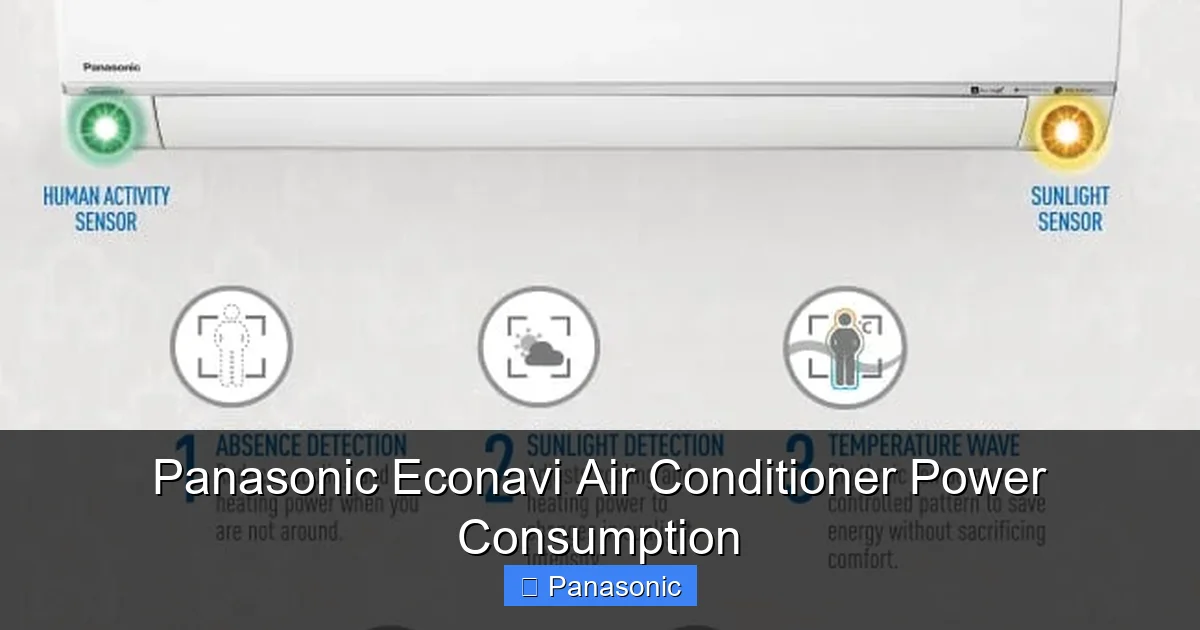
Diagram showing Econavi sensor integration and power scaling.
Image source: blogs.panasonic.com.au
Sensor Fusion for Precision Control
Inside the unit, multiple sensors monitor several factors simultaneously:
Room temperature (near floor and ceiling levels)
Humidity levels
Sunlight intensity via infrared detection
Airflow direction and speed
These inputs feed into the control unit, which compares current conditions against your preferred settings. If the room is already close to target temperature but someone just left the house, the system reduces compressor activity. This prevents energy waste from overcooling an empty space.
Learning Your Schedule
Over time, Econavi builds a profile of your daily routine. For example, if you always leave for work at 8 a.m., the system may begin gradually warming the room before you arrive home—using minimal energy while preparing for comfort. Some models also sync with calendar apps or smart home devices to anticipate changes in occupancy.
External Weather Integration
Unlike older systems that ignore outside conditions, Econavi checks real-time weather forecasts. If rain is expected later in the day, it might delay peak cooling until evening when ambient temperatures drop slightly. This predictive behavior avoids running the compressor during already-cool nights.
Understanding Power Consumption: What Numbers Matter?
When evaluating any air conditioner—especially one labeled as “energy-efficient”—you need to look beyond vague claims like “low power use.” Specific metrics tell the real story.
Btu vs. Watts: Decoding the Jargon
Most people know their AC has “X BTUs,” but few understand what that means in terms of electricity. BTU (British Thermal Unit) measures cooling capacity. A 9,000 BTU unit can cool about 400 square feet. However, power consumption depends on watts (W), not BTUs.
For reference:
A typical window AC uses 800–1,500 watts
Central AC units range from 2,000–5,000 watts
Panasonic Econavi wall-mounted models average 750–1,100 watts depending on size
But here’s the catch: running at full wattage all day drains your wallet fast. The real test is how many hours per day the unit operates—and whether it uses inverter tech to scale down when possible.
Annual Energy Use Estimates
Let’s do a quick calculation. Suppose you have a 12,000 BTU Econavi model rated at 1,000 watts and run it 8 hours daily during summer months (June–September). At $0.12 per kWh (average U.S. rate):
(1,000 W × 8 hrs × 90 days) ÷ 1,000 = 720 kWh 720 kWh × $0.12 = $86.40 per season
Now compare that to a non-inverter model consuming 1,300 watts for the same period: (1,300 × 8 × 90) ÷ 1,000 = 936 kWh → $112.32
That’s a difference of nearly $26—just from smarter power management!
Note: Electricity rates vary widely by region and have risen since this example was calculated. For 2026 planning, check your local utility’s current per-kWh rate and plug it into the same formula for a more accurate projection.
Why Inverter Technology Reduces Power Consumption
If you’ve shopped for modern ACs, you’ve likely seen the term “inverter.” But what does it actually do? And how does it relate to Panasonic’s Econavi?
From On/Off to Smooth Operation
Older air conditioners turn the compressor completely on or off. Every startup draws 2–3 times the normal current—a surge called inrush current. Over months, these repeated cycles wear out components and spike your bill.
Inverter-driven systems, including those in Econavi units, use variable-speed motors. Instead of cycling on/off, they ramp up or down based on demand. When the room hits target temp, the compressor slows to maintenance mode rather than shutting off entirely. This keeps temperature stable and reduces energy spikes.
Efficiency Gains Explained
Studies show inverter ACs can be 30–50% more efficient than conventional models. Panasonic’s engineering takes this further by combining inverter tech with Econavi intelligence. For instance:
During mild weather, the compressor may idle at just 20% capacity
Fan speeds adjust dynamically—high when hot, low when cool
Airflow direction shifts automatically to prevent drafts
This seamless operation means less strain on the grid and lower bills every month.
For a deeper dive into how inverter systems differ from traditional HVAC setups, see our comparison of air conditioner vs. HVAC technology.
Real-World Power Usage Data for Popular Econavi Models
Not all Econavi models are created equal. Size, features, and regional climate affect actual consumption. Below are representative examples based on manufacturer specs and user reports.
CS/CU-E12XKVW (12,000 BTU)
Rated power: 978 watts (cooling)
Standby power: <1 watt
Rated power: 750 watts
Ideal for: bedrooms, small offices
Eco Mode savings: Up to 35% vs. standard mode
Multi-Zone Systems (e.g., CS-CU Series)
These allow independent control of multiple rooms. Because each zone only activates when needed, total consumption drops significantly. In a three-room setup where only two zones run at once, you could see 40% reduction in energy use compared to single-zone operation.
In practice, actual consumption often lands 5–10% below rated figures when the unit is properly sized and maintained. A common mistake is oversizing—choosing a 18,000 BTU model for a 300 sq ft room—which forces frequent short-cycling and erodes the inverter’s efficiency advantage.
Regional Climate Performance Variations
Econavi’s humidity and sunlight sensors shine in mixed climates, but performance data differs by region:
- Humid Southeast (e.g., Florida, Gulf Coast): Expect 10–15% higher kWh than rated due to latent load removal. The humidity sensor helps, but the compressor runs longer at low speeds.
- Arid Southwest (e.g., Arizona, Nevada): Sensible cooling dominates; Econavi often beats ratings by 5–8% because dry air allows higher evaporator temperatures.
- Northern Tier (short cooling season): Standby and shoulder-season efficiency matter more. The <1 W standby and quick ramp-up cut annual totals noticeably.
If you’re in a high-humidity zone, pair Econavi with a dedicated dehumidifier for the first week of summer to pre-dry the space—this can shave another 3–5% off seasonal consumption.
Tips to Minimize Power Consumption Further
Even with Econavi’s smart features, small adjustments can boost efficiency. Try these proven strategies:
Use Eco Mode Strategically
Eco Mode prioritizes energy saving over immediate response. It’s perfect for overnight or when you’re away. Just remember it may take longer to reach target temperature—but the trade-off is worth it for long-term savings.
Keep Filters Clean
Dust-clogged filters force the system to work harder, increasing wattage by 10–15%. Replace or wash filters every 2–4 weeks during heavy use.
Set Reasonable Temperatures
Each degree above 72°F saves about 3% on cooling costs. So instead of blasting 68°F all day, try 75°F with good insulation.
Close Blinds During Peak Sun
Direct sunlight raises indoor temps rapidly. Blocking it reduces the load on your AC by 15–20%.
Upgrade Insulation
Well-insulated windows and walls mean your AC doesn’t have to fight heat leaks. Simple caulking around frames or thermal curtains make big differences.
For a printable checklist of seasonal efficiency habits, refer to our seasonal air conditioning maintenance tips.
Maintenance Schedule for Sustained Performance
Beyond filter cleaning, follow this cadence to keep Econavi running at spec:
| Interval | Task | Why It Matters |
|---|---|---|
| Every 2–4 weeks | Wash/replace indoor filter | Prevents 10–15% wattage creep |
| Every 6 months | Vacuum outdoor coil fins | Maintains heat rejection efficiency |
| Annually (pre-season) | Professional refrigerant charge check | Low charge raises compressor watts 20%+ |
| Every 2 years | Drain line flush & pan treatment | Avoids water damage & mold recirculation |
| As needed | Firmware update via app | Panasonic occasionally pushes Econavi algorithm refinements |
Skipping the annual charge check is the single biggest cause of “my Econavi isn’t saving like it used to” complaints.
Comparing Econavi to Other Smart AC Technologies
You’ve probably heard of “smart” ACs from brands like LG, Samsung, or Daikin. How does Panasonic stack up?
Feature Panasonic Econavi LG AI ThinQ Samsung WindFree
AI Learning Yes (behavior-based) Yes (voice/app integration) Limited (pre-set modes)
Standby Power <1 watt ~2 watts ~3 watts
SEER Rating Up to 42 Up to 23 Up to 22
App Monitoring Yes (daily reports) Yes (real-time alerts) Basic usage stats
While competitors offer voice control and remote access, Panasonic leads in pure efficiency due to deeper sensor integration and superior inverter design. That translates directly to lower kWh consumption.
If you’re weighing multiple brands, our roundup of the latest air conditioning innovations covers the current feature landscape.
Smart Home Integration and Voice Control
Most current Econavi models (CS/CU-EXKVW, CS/CU-ZXKVW series) support:
- Panasonic Comfort Cloud app – iOS/Android; shows real-time kWh, filter alerts, weekly summaries.
- Google Assistant & Alexa – “Set AC to Eco Mode,” “What’s the living room temperature?”
- IFTTT / SmartThings – Trigger Eco Mode when geo-fence detects departure; sync with smart blinds.
Voice control is convenient but doesn’t change the underlying efficiency logic. The real savings come from the onboard sensors; the app just makes them visible.
Environmental Impact: Lower Bills, Smaller Carbon Footprint
Reducing electricity use isn’t just good for your wallet—it helps the planet. In the U.S., residential air conditioning accounts for nearly 12% of total household energy use. By choosing an efficient model like the Econavi series, you shrink your personal carbon footprint.
Consider this: Over five years, a single family replacing a 1,500-watt non-inverter AC with a 1,000-watt Econavi model could prevent roughly 1.8 tons of CO₂ emissions—equivalent to planting 20 trees.
For the official efficiency standards behind Energy Star certification, visit the EPA Energy Star program.
Cost Breakdown: Upfront vs. Lifetime Savings
| Cost Element | 12k BTU Non-Inverter | 12k BTU Econavi (CS/CU-E12XKVW) |
|---|---|---|
| Typical installed price (2026) | $1,800–$2,200 | $2,300–$2,800 |
| Annual cooling cost (8 hrs/day, 90 days, $0.15/kWh) | $140 | $97 |
| 5-year electricity total | $700 | $485 |
| 5-year combined (unit + power) | $2,500–$2,900 | $2,785–$3,285 |
At current national average rates, payback on the premium occurs in year 3–4. In high-rate states (CA, NY, HI) it’s often year 2. If you plan to stay 7+ years, Econavi is financially favorable.
Installation Considerations for Optimal Efficiency
Even the best unit underperforms with poor installation. Key points:
- Line-set length & insulation: Keep suction line ≤25 ft and fully insulated; every extra 10 ft adds ~2% compressor work.
- Outdoor unit placement: Shade the condenser (north/east wall, or awning) without blocking airflow. Direct sun raises head pressure 5–8%.
- Indoor unit height: Mount 7–8 ft high, centered on the longest wall, with ≥6 in. clearance to ceiling for proper air mixing.
- Refrigerant charge: Must be weighed in per manual—no “top-off by pressure.” Econavi’s inverter is sensitive to ±5% charge deviation.
- Electrical: Dedicated 208/230 V circuit with surge protector; Panasonic recommends a 15 A breaker for 12k models.
For step-by-step installation standards, see our split AC installation guide and outdoor unit placement guide.
Conclusion: Is the Investment Worth It?
The Panasonic Econavi air conditioner delivers on its promise: smarter cooling with less energy. While the initial price tag may be higher than basic models, the long-term savings, enhanced comfort, and environmental benefits make it compelling. Add in Energy Star certification, quiet operation, and reliable build quality, and you’ve got a winner.
If you’re serious about cutting utility bills and embracing sustainable living, the Econavi line deserves a close look. Pair it with smart home integration and good habits, and you’ll enjoy consistent comfort with minimal guilt.
Ready to size the right Econavi model for your space? Start with our air conditioner selection guide.
Frequently Asked Questions
What is the average power consumption of a Panasonic Econavi air conditioner?
The average Panasonic Econavi air conditioner uses between 750 and 1,100 watts during normal operation, depending on the model and settings. Standby power consumption is typically less than 1 watt, making it highly efficient even when not actively cooling.
How does Econavi technology reduce energy use?
Econavi uses built-in sensors to monitor room conditions and learns user habits. It then adjusts compressor speed, fan operation, and airflow to maintain comfort with minimal energy. This intelligent scaling avoids wasteful cycles and keeps power draw low.
Are Panasonic Econavi units more expensive than regular ACs?
Yes, Econavi models usually cost 15–25% more upfront than basic inverter units. However, their superior efficiency often pays for itself within 2–3 years through lower electricity bills.
Can I install an Econavi unit myself?
No. All Econavi units require professional installation by certified HVAC technicians. Incorrect setup can void warranties and reduce efficiency, so always hire licensed pros.
Do I need Wi-Fi to use Econavi features?
No. Core Econavi functions operate independently via onboard sensors and algorithms. Wi-Fi connectivity is optional and only unlocks remote control and usage tracking via Panasonic’s app.
How often should I replace my Econavi AC filter?
Replace or clean your filter every 2–4 weeks during heavy use. Clogged filters increase power consumption by 10–15% and reduce airflow, forcing the system to work harder.
What SEER ratings do current Econavi models achieve?
As of 2026, the flagship CS/CU-E**XKVW series reaches up to SEER 42 (9k/12k) and SEER 38 (18k/24k). Always verify the AHRI certificate for the exact model number—regional sub-models sometimes differ by 1–2 SEER points.
Can Econavi integrate with Home Assistant or other local-control hubs?
Officially, Panasonic only supports Cloud/Google/Alexa/IFTTT. Community-driven MQTT bridges exist (e.g., panasonic-comfort-cloud-mqtt on GitHub) but are unsupported and may break with firmware updates. If local control is a must, factor that into your brand decision.
