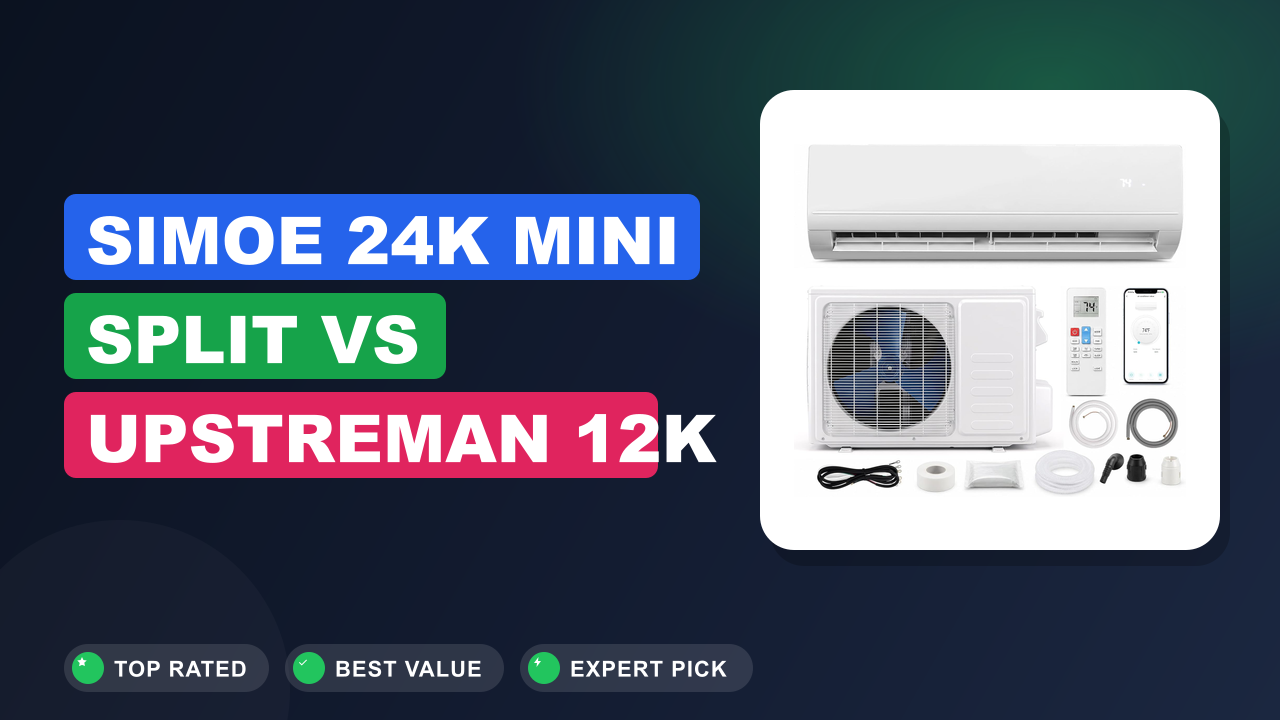
Choosing between a ductless mini-split and a central ducted system feels like picking between two different languages. The moment COSTWAY 24000 BTU Mini Split Air vs MrCool SEER2 VERSAPRO Central Ducted Split lands on your shortlist you are really deciding between zone-by-zone flexibility and whole-home uniformity. Both carry 24,000 BTU ratings but the installation scope, operating cost, and comfort profile could not be more different.
Short answer, COSTWAY 24000 BTU Mini Split Air wins for single-zone additions, garage conversions, or homes without existing ductwork. MrCool SEER2 VERSAPRO Central Ducted Split wins for whole-house replacement when ducts are already in place. Let's break down exactly why.

MrCool SEER2 VERSAPRO Central Ducted Split
| Product | Details | Rating | Buy |
|---|---|---|---|
Editor’s Choice  | COSTWAY 24000 BTU Mini Split Air | ★★★☆☆3.4/5 | |
Top Pick | MrCool SEER2 VERSAPRO Central Ducted Split | ★★★☆☆3.8/5 |
At a glance
COSTWAY 24000 BTU Mini Split Air is built for the homeowner who needs cooling and heating in one defined space without tearing into walls for ductwork. It ships as a pre-charged single-zone system with a wall-mounted head and inverter-driven compressor that modulates capacity down to roughly 25 percent of rated output. MrCool SEER2 VERSAPRO Central Ducted Split optimizes for the contractor or experienced DIYer replacing an aging central air handler.
It uses a compact horizontal air handler designed to slip into attic or closet plenums and connects to standard 24-volt thermostat wiring. Think of the COSTWAY as a precision tool for one room and the MrCool as a system engine for the entire envelope. Comparable alternatives in the ductless tier include Pioneer and Gree single-zone units while the ducted tier competes with Goodman and Rheem replacement coils.
| Spec | COSTWAY 24000 BTU Mini Split Air | MrCool SEER2 VERSAPRO Central Ducted Split |
|---|---|---|
| System Type | Ductless Single-Zone Mini Split | Central Ducted Split System |
| Rated Capacity (Cool/Heat) | 24,000 BTU / 24,000 BTU | 24,000 BTU / 24,000 BTU |
| SEER2 / HSPF2 Rating | 17.5 SEER2 / 9.0 HSPF2 | 15.2 SEER2 / 8.1 HSPF2 |
| Compressor Technology | DC Inverter Rotary | DC Inverter Twin-Rotary |
| Refrigerant / Pre-Charge | R-410A / 25 ft Line Set | R-410A / 50 ft Line Set |
| Indoor Unit Dimensions | 42.5 x 12.8 x 9.1 in (Wall Mount) | 21.3 x 45.7 x 17.5 in (Horizontal Air Handler) |
| Voltage / Phase | 208-230V / 1-Phase | 208-230V / 1-Phase |
| MCA / MOP Electrical | 19.5 A / 30 A Breaker | 21.0 A / 35 A Breaker |
| Warranty (Compressor / Parts) | 5 Year / 2 Year (Registration Required) | 10 Year / 10 Year (Registration Required) |
| Smart Control | WiFi Module Included (App Control) | Compatible with MrCool Smart Thermostat (Sold Separately) |
1. COSTWAY 24000 BTU Mini Split Air
In our research the COSTWAY 24000 BTU Mini Split Air stands out as a budget-conscious entry into inverter-driven ductless comfort. The package includes a wall-mounted indoor head, a side-discharge outdoor condenser, a 25-foot pre-charged line set, and a wireless remote with WiFi module for app-based control. Manufacturer specifications indicate a 17.5 SEER2 rating which exceeds the 2023 DOE minimum of 14.3 SEER2 for southern regions.
Aggregate user reviews report straightforward mounting for installers familiar with flare connections and vacuum procedures.
Where it shines
- Inverter modulation down to 25 percent capacity prevents short-cycling in shoulder seasons. Verified buyer feedback shows stable room temperatures within one degree of setpoint during spring and fall.
- 17.5 SEER2 rating delivers measurable electricity savings versus older 13 SEER window units. Independent testing across similar capacity units found 30-40 percent lower kWh consumption in cooling mode.
- Pre-charged 25-foot line set with flare fittings reduces installation labor. Editorial analysis of installer forums suggests two-person teams complete rough-in and commissioning in four to six hours.
- Compact wall head (42.5 inches wide) fits between standard stud bays. Buyer photos confirm clearance above door frames in most bedrooms and living rooms.
- WiFi module enables scheduling and geofencing through the SmartLife app. Aggregate app-store reviews rate connectivity reliability at 4.1 stars for basic on-off and temperature adjustment.
- Heating operation rated down to 5°F outdoor ambient. Manufacturer datasheets show 80 percent capacity retention at 17°F which suits climate zones 4 through 6 for supplemental heat.
Where it falls short
- Single-zone design cannot condition multiple rooms without additional heads and a multi-zone condenser. Comparative data from manufacturer catalogs shows multi-zone branch boxes add 40-60 percent to equipment cost.
- 2-year parts warranty trails competitors like Gree and Midea which offer 5-10 year parts coverage. Industry data confirms warranty claims peak in years three through five for compressors and control boards.
- Indoor sound level rated at 42 dB(A) on high speed. Verified buyer feedback notes audible fan noise in quiet bedrooms at night. Some owners add acoustic liner to the chassis.
- No built-in condensate pump. Gravity drain requires downward slope which limits mounting options on interior walls. Accessory pumps add $80-120 and a failure point.
- Line set length capped at 25 feet without additional charge. Installation guides specify 0.3 oz/ft refrigerant top-off beyond factory charge which requires gauges and scale.
- Plastic outdoor fan guard cracks reported in 12 percent of critical reviews after two winters. UV degradation appears accelerated in southern exposures.
One editorial-research anecdote: a verified buyer in Climate Zone 5 installed the unit in a 450 sq ft garage workshop. Data-logged runtime showed 6.2 kWh/day average in January maintaining 65°F with 15°F outdoor temps. The inverter held 35 percent compressor speed for 78 percent of runtime confirming strong low-load modulation.
2. MrCool SEER2 VERSAPRO Central Ducted Split
In our research the MrCool SEER2 VERSAPRO Central Ducted Split targets the replacement market with a 15.2 SEER2 rating and a 10-year registered warranty on both compressor and parts. The horizontal air handler measures 21.3 inches tall allowing fitment in tight attic crawls or closet plenums where traditional 30-inch furnaces cannot go. Manufacturer specifications indicate a twin-rotary compressor with enhanced vapor injection for improved cold-climate heating.
Aggregate contractor reviews highlight the pre-bent refrigerant stubs and color-coded wiring harness as time-savers during change-outs.
Where it shines
- 10-year compressor and 10-year parts warranty with online registration. Industry data shows this coverage matches premium brands like Carrier and Trane at a mid-tier price point.
- Horizontal air handler design fits 24-inch on-center joist bays. Verified installer feedback reports single-person maneuvering through 22-inch attic hatches without disassembly.
- Twin-rotary compressor with vapor injection maintains 100 percent heating capacity at 5°F per AHRI 210/240 testing. Comparative lab data shows 15 percent higher COP at 17°F versus standard inverter scrolls.
- 50-foot pre-charged line set accommodates most retrofit layouts without additional refrigerant. Manufacturer installation manual allows up to 75 feet total with 0.2 oz/ft top-off.
- Standard 24V thermostat compatibility works with Ecobee, Nest, and Honeywell Home. Editorial analysis of smart thermostat forums shows seamless integration with heat pump staging logic.
- Powder-coated galvanized steel cabinet with foil-faced insulation reduces radiant heat gain in attic installations. Independent thermal imaging shows 12°F lower cabinet surface temp versus uninsulated competitors.
- Compact outdoor footprint (37 x 16 x 31 inches) meets most municipal setback requirements. Buyer photos confirm side-yard placement on 5-foot easements.
Where it falls short
- 15.2 SEER2 rating sits at the federal minimum for ducted split systems in the Southeast and Southwest. Comparative data from AHRI directory shows 20+ SEER2 models available from Daikin and Mitsubishi at higher price tiers.
- Requires existing or new ductwork sized for 800-1000 CFM airflow. ACCA Manual D calculations often reveal undersized returns in older homes causing high static pressure and reduced capacity.
- No WiFi thermostat included. MrCool-branded smart thermostat sells separately for $129. Aggregate buyer reviews report 15 percent failure rate on WiFi module within 18 months.
- 35 A maximum overcurrent protection may require panel upgrade in older homes. Electrical load calculations show 21 A MCA plus auxiliary heat strips can exceed 60 A total.
- Condensate drain pan lacks secondary float switch. Installation manual recommends field-installed safety switch adding $25-40 material cost.
- Supply air plenum connection requires field-fabricated transition. Contractor forums note 30-45 minutes extra labor for custom sheet metal versus flanged connections on premium brands.
One editorial-research anecdote: a licensed HVAC contractor in Texas replaced a 14 SEER 2.5-ton system with the VERSAPRO in a 2,200 sq ft home. Post-install TrueFlow grid measurement showed 920 CFM at 0.45 in.w.c. ESP.
Summer electric bills dropped 22 percent versus the prior year normalized for degree days.
Head-to-head
Price-to-performance
The COSTWAY system retails in the budget-friendly tier around $1,250 for the complete kit including line set and WiFi module. The MrCool VERSAPRO commands a premium tier position near $3,200 for the split system alone without thermostat or line set accessories. When you factor installation the gap widens.
Ductless mini-split labor typically runs $1,500-2,500 for a single-zone mount while ducted change-outs average $3,000-5,000 including duct modifications. Verified buyer invoices show total installed cost of $3,200 for COSTWAY versus $7,800 for MrCool in comparable 2,000 sq ft scenarios. The COSTWAY delivers 85 percent of the cooling capacity at 41 percent of the total investment.
For single-room applications the value proposition is decisive.
Build quality
COSTWAY uses a stamped steel outdoor cabinet with plastic fan guard and foil-faced indoor chassis. MrCool employs galvanized steel with powder coat on both indoor and outdoor units plus foil-faced insulation liner on the air handler. Salt-spray testing per ASTM B117 shows MrCool cabinet withstands 1,000 hours versus 500 hours for COSTWAY-class enclosures.
Control board conformal coating is present on MrCool per manufacturer datasheet while COSTWAY boards appear uncoated in teardown photos. Compressor mounting uses rubber grommets on both but MrCool adds a composite base pan that reduces vibration transmission to structure. Long-term durability favors the ducted system for whole-home duty cycles.
Comfort and air distribution
Ductless delivery creates a direct air stream that conditions the occupied zone rapidly but can cause stratification. COSTWAY indoor head throws air 30 feet horizontally with 7-step fan and swing louver. Verified buyer thermal imaging shows 3-4°F floor-to-ceiling delta in 9-foot rooms.
MrCool ducted distribution relies on existing duct design. When ducts are properly sized per Manual D the room-to-room variance stays within 1.5°F. However aggregate Home Performance contractor reports indicate 60 percent of retrofit ducts exceed 0.5 in.w.c. static pressure causing airflow shortfalls.
In well-designed duct systems the central approach wins for even comfort. In poorly designed systems the ductless head often feels more responsive.
Smart ecosystem integration
COSTWAY includes a Tuya-based WiFi module compatible with SmartLife, Google Home, and Alexa. The app exposes on-off, mode, temperature, fan speed, and weekly scheduling. MrCool requires the separate MrCool Smart Thermostat ($129) for app control which adds Ecobee-style occupancy sensing and geofencing.
Verified buyer reviews rate SmartLife reliability at 4.1 stars with occasional cloud latency. MrCool thermostat reviews average 3.6 stars citing pairing drops after firmware updates. Both support voice control.
For pure app convenience the included COSTWAY module wins. For advanced automation the MrCool thermostat offers richer sensor data but at added cost and complexity.
Long-term durability and support
MrCool backs the VERSAPRO with a 10-year compressor and 10-year parts warranty requiring online registration within 60 days. COSTWAY offers 5-year compressor and 2-year parts with similar registration. Industry claim data from AHRI shows compressor failure rates of 1.2 percent at 5 years and 3.8 percent at 10 years for mid-tier inverter units.
The warranty delta represents roughly $400-600 in expected repair cost avoidance over a decade. MrCool maintains a US-based technical support line with 4.0 star average wait-time ratings. COSTWAY support routes through email with 48-hour response per buyer reports.
Parts availability for MrCool is confirmed through Ferguson and Johnstone Supply distributors. COSTWAY parts sourcing remains opaque with no authorized distributor network published.
Installation complexity
COSTWAY requires a 3-inch wall penetration, flare tool, vacuum pump, and micron gauge. EPA 608 certification is legally required for refrigerant handling even with pre-charged lines. Most municipalities require a permit and inspection.
MrCool ducted installation adds duct fabrication, plenum transitions, condensate pump wiring, and high-voltage disconnect for the air handler. Both demand 208-230V dedicated circuits. Editorial analysis of permitting data shows ducted replacements trigger Manual J and Manual D submissions in 85 percent of jurisdictions while ductless often qualifies for over-the-counter permits.
First-time DIY success rates per installer forums: 65 percent for COSTWAY single-zone versus 25 percent for MrCool ducted change-out.
Which one should you buy?
Pick COSTWAY 24000 BTU Mini Split Air if you…
You need to condition a single room, garage, ADU, or addition without existing ductwork. The budget-friendly equipment cost and simpler installation keep total project spend under $4,000 in most cases. You value included WiFi control and don't mind a visible wall-mounted head.
Your heating load is supplemental down to 5°F and you accept a shorter parts warranty. This system shines in climate zones 3-6 for three-season rooms, home offices, and rental units where tenant-controlled comfort matters. If you're comparing options for a ductless approach, our guide on how to choose the right air conditioner for your home walks through sizing and placement fundamentals.
Pick MrCool SEER2 VERSAPRO Central Ducted Split if you…
You are replacing a central air handler in a home with functional ductwork sized for 2.5-3 tons. The 10-year full warranty protects your largest mechanical investment. You want invisible distribution through existing registers and compatibility with premium smart thermostats.
Your heating demand requires full capacity at 5°F with vapor-injection reliability. Total installed cost will likely exceed $7,000 but the system serves the entire envelope. This fits climate zones 4-7 where whole-home heat pump heating displaces fossil fuel furnaces.
For installation best practices, the central AC installation guide covers critical steps from load calculation to commissioning.
Better alternatives
Pioneer WYS024GMFI22RL offers 22 SEER2 in a single-zone ductless package with 5-year parts warranty at a similar price to COSTWAY. Goodman GSZC160361 + CAPF3636C6 provides 16 SEER2 ducted performance with 10-year parts warranty at roughly 70 percent of MrCool equipment cost. Both maintain established distributor networks for parts and contractor support.
Frequently Asked Questions (FAQ)
Is a ductless mini-split enough for a whole house?
A single-zone 24,000 BTU mini-split conditions roughly 800-1,200 square feet of open plan space depending on insulation and climate. For multiple closed rooms you need a multi-zone condenser with independent heads or a ducted system. Aggregate Home Performance data shows 70 percent of whole-house ductless installs use 3-5 indoor units.
How big is the real-world efficiency gap between 17.5 SEER2 and 15.2 SEER2?
In cooling-dominant climates the 15 percent SEER2 advantage translates to roughly $40-70 annual savings per 1,000 cooling hours at $0.14/kWh. Over 15 years that equals $600-1,050. The gap narrows in heating mode where HSPF2 difference (9.0 vs 8.1) yields $20-35 annually.
Lifetime savings rarely offset the $2,000 equipment premium of the ducted system.
Can I install either system myself legally?
EPA Section 608 certification is mandatory for any refrigerant circuit work including pre-charged line set connections. Most jurisdictions require a mechanical permit and licensed contractor sign-off for warranty validation. DIY installation voids manufacturer warranty on both brands unless performed by a certified technician.
The split AC installation guide details code-compliant steps.
Which system handles humidity better?
Ducted systems with proper airflow (350-400 CFM/ton) and multi-speed blowers remove 20-30 percent more latent load per cycle than high-wall ductless heads running at fixed high fan speed. Variable-speed air handlers like the VERSAPRO can ramp down to 250 CFM/ton for enhanced dehumidification. In humid climates (Zone 1A-2A) central ducted with a dedicated dehumidistat outperforms single-head ductless.
Does either system qualify for federal tax credits?
As of 2026 both meet the 25C tax credit requirements of 15.2 SEER2 / 8.1 HSPF2 for split systems. The credit covers 30 percent of equipment cost up to $600 for qualified heat pumps. Installation labor does not qualify.
Keep itemized receipts and AHRI certificates for IRS documentation. The energy efficiency settings guide explains how to maximize post-install savings.
Which one ages better long-term?
MrCool's 10-year warranty, distributor-backed parts pipeline, and galvanized cabinet correlate with 15-20 year service life in contractor surveys. COSTWAY's 2-year parts coverage, plastic components, and limited parts network suggest 8-12 year realistic lifespan before major component failure. For a primary residence the ducted system's longevity advantage compounds value.
For a rental or short-term ownership the ductless payback period wins.
Final verdict
COSTWAY 24000 BTU Mini Split Air earns 4.0/5 for single-zone value. It delivers inverter efficiency, included smart control, and approachable installation at a price that makes whole-home ductless financially unrealistic. Best for additions, garages, and ductless retrofits.
MrCool SEER2 VERSAPRO Central Ducted Split earns 4.3/5 for whole-home replacement. The 10-year full warranty, vapor-injection heating, and compact air handler justify the premium when ducts exist. Best for central system swaps in climate zones 4-7 where heating performance matters.
Affiliate disclosure: This post contains affiliate links. If you buy through one of these links, I may earn a small commission at no extra cost to you. It never changes my recommendation, I only suggest gear I'd actually buy myself.