Air Duct Turning Vanes in HVAC Systems
When it comes to optimizing the efficiency of HVAC systems, air duct turning vanes play a crucial role. These components are designed to improve airflow by reducing resistance and turbulence as air changes direction within the ductwork. Let's delve into the significance of air duct turning vanes, their benefits, and their impact on HVAC system performance.
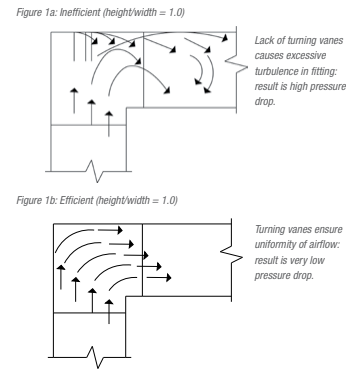
Cross-section view showing turning vane placement inside a 90-degree duct elbow
Credit: www.sheetmetaljournal.com
What are Air Duct Turning Vanes?
Air duct turning vanes are sheet metal devices installed inside mechanical ductwork to smoothly direct airflow where there is a change in direction. By doing so, they effectively minimize resistance and turbulence, ensuring a more efficient and stable airflow within the HVAC system. For more on this, see our guide on air conditioner efficiency tips.
Types of Turning Vanes
Turning vanes come in several configurations suited to different applications. Single-thickness vanes are the most common for commercial rectangular ductwork — they consist of individual blades spaced along a rail system. Double-wall (airfoil) vanes offer superior aerodynamic performance with a curved profile that further reduces pressure drop, making them ideal for high-velocity systems. Radiusied elbows with integral vanes combine the elbow fitting and turning vanes into a single fabricated piece, which simplifies installation but requires more space. In practice, the choice often comes down to available duct dimensions and the system's design velocity — double-wall vanes can recover 15–25% more pressure than single-thickness at velocities above 2,000 fpm.
The Purpose of Air Duct Turning Vanes
The primary purpose of turning vanes in ductwork is to create a smoother change in the direction of airflow. By doing so, they reduce pressure loss and contribute to the overall efficiency of the HVAC system. Without turning vanes, airflow deficiencies can occur, leading to system testing failure and reduced performance. For more on this, see our guide on tips for air conditioner efficiency.
How Pressure Loss Occurs at Elbows
When air navigates a 90-degree turn without guidance, it separates from the inner wall and creates a low-pressure vortex on the outside of the bend. This separation increases static pressure loss — often by 0.15–0.30 in. w.g. per elbow at typical commercial velocities — and generates audible turbulence noise. Turning vanes split the turn into a series of gradual directional changes, keeping airflow attached to the duct walls and converting what would be a single high-loss event into several small, manageable ones. A common mistake is assuming a radiusied elbow alone eliminates the need for vanes; at velocities above 1,500 fpm, even radiusied elbows benefit from at least one vane.
Benefits of Air Duct Turning Vanes
Utilizing air duct turning vanes offers several benefits, including:
Improved airflow efficiency
Reduced pressure loss
Steadier airflow
Lower sound pressure
These benefits not only enhance the performance of the HVAC system but also contribute to energy savings and a more comfortable indoor environment. For more on this, see our guide on how does hvac air conditioning differ from standard.
Quantifying Energy Impact
The fan power saved by reducing pressure drop across multiple elbows compounds across the system's operating hours. For a 20,000 CFM air handler running 3,000 hours annually, recovering just 0.15 in. w.g. across four elbows translates to roughly 1,100 kWh/year — enough to justify the vane cost in under two seasons in most commercial rates. In practice, the loudest complaint from building occupants after a retrofit is often reduced noise, not the lower utility bill. Pairing vanes with proper duct sealing and right-sized equipment amplifies the gain; see our guide on optimal temperature and fan settings for efficiency for complementary measures.
Choosing the Right Air Duct Turning Vanes
When selecting air duct turning vanes for your HVAC system, consider opting for high-efficiency profile turning vanes such as Aero Dyne, which offer maximum turning efficiency and stability of airflow. It's essential to choose turning vanes that are designed to meet the specific requirements of your ductwork and HVAC system.
Selection Criteria at a Glance
| Factor | Single-Thickness | Double-Wall (Airfoil) | Radiusied Elbow + Vanes |
|---|---|---|---|
| Pressure drop (per 90°) | 0.08–0.12 in. w.g. | 0.04–0.07 in. w.g. | 0.03–0.06 in. w.g. |
| Installed cost (relative) | 1.0× | 1.6–2.0× | 2.5–3.5× |
| Space required | Standard elbow | Standard elbow | 1.5–2× elbow centerline radius |
| Best for | ≤2,000 fpm, budget-sensitive | >2,000 fpm, noise-critical | New construction, max efficiency |
| Maintenance access | Easy (removable rails) | Easy (removable rails) | Difficult (integral) |
Approximate comparisons for 24×24 in. duct at 2,500 fpm; actual values vary by manufacturer.
https://www.youtube.com/watch?v=gUhB2Ku1Bj4
Where to Find Air Duct Turning Vanes
There are various suppliers and manufacturers offering air duct turning vanes, including Ductmate Industries, Conklin Metal Industries, McMaster-Carr, and Distribution International. These providers offer a range of turning vane systems designed to meet diverse HVAC needs.
Budgeting and Procurement Tips
Expect material costs of $12–$25 per linear foot of vane rail for single-thickness systems and $22–$40 for double-wall, not including the elbow fabrication itself. Bulk orders for multi-floor projects often qualify for 10–15% discounts. Specify SMACNA HVAC Duct Construction Standards compliance in purchase orders to avoid receiving light-gauge vanes that deflect under pressure. For retrofit jobs where the elbow is already installed, confirm the supplier offers field-cuttable rail systems — some manufacturers only sell pre-fabricated assemblies. When comparing quotes, ask whether the price includes vane clips, gaskets, and installation hardware; these add 8–12% if purchased separately.
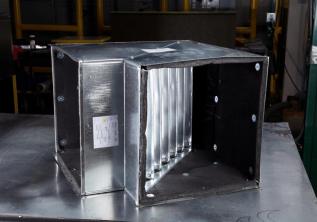
Double-wall (airfoil) vane profile showing aerodynamic contour and rail mounting
Credit: aero-dyne.net
Installing Air Duct Turning Vanes
Proper installation of air duct turning vanes is crucial to ensure optimal performance of the HVAC system. Working with experienced HVAC professionals can help ensure that turning vanes are installed correctly and in the most effective locations within the ductwork.
Common Installation Mistakes to Avoid
- Incorrect vane spacing — exceeding 8 inches on center allows airflow separation between blades; verify spacing against SMACNA Table 4-3 for the design velocity.
- Vanes installed backward — the leading edge must face the oncoming air; reversing them creates a spoiler effect that increases pressure drop.
- Missing or loose vane clips — vibration loosens clips over time; use lock-wire or peened rivets on high-velocity systems (>2,500 fpm).
- Blocking access doors — plan vane rail joints to align with access panels so vanes can be removed for coil cleaning without cutting the rail.
- Ignoring thermal expansion — in ducts carrying >120°F air, leave a 1/8-in. gap per 10 ft of rail length to prevent buckling.
A thorough commissioning checklist should include a traverse reading upstream and downstream of each vaned elbow to confirm the design pressure drop is achieved. For complex multi-zone systems, coordinating with the balancing and commissioning workflow prevents rework.
Maintenance and Inspection
Turning vanes require minimal maintenance but should be inspected during routine duct cleaning (typically every 3–5 years per NADCA ACR standard). Check for: corrosion on vane edges, loose or missing clips, dust buildup exceeding 1/8 in. on vane surfaces, and any physical damage from maintenance tools. In hospitals and cleanrooms, include vane surface swab testing in the contamination control plan.
Codes, Standards, and Design References
Designers and installers should reference SMACNA HVAC Duct Construction Standards (4th Ed., 2020), Chapter 4, for vane spacing, gauge, and construction details. ASHRAE Handbook — Fundamentals (2021), Chapter 21, provides pressure-loss coefficients (C-values) for vaned vs. unvaned elbows across Reynolds numbers. NFPA 90A governs fire/smoke damper interactions where vanes share duct sections with life-safety devices — vanes must not impede damper blade closure. Local amendments (e.g., NYC Mechanical Code §603.2) may impose additional gauge or spacing requirements; verify with the authority having jurisdiction before fabrication.
Final Thoughts
Air duct turning vanes are essential components in HVAC systems, contributing to improved airflow efficiency, reduced pressure loss, and overall system performance. By understanding their purpose and benefits, you can make informed decisions when it comes to selecting and installing turning vanes for your HVAC ductwork.
Whether you're in Austin, Texas or any other location, the importance of air duct turning vanes remains consistent in ensuring the optimal functionality of HVAC systems.
For more information and expert guidance on air duct turning vanes and their impact on HVAC systems, feel free to reach out to HVAC professionals in your area. Ready to improve your ductwork efficiency? Contact a certified SMACNA contractor for a system assessment today.
Frequently Asked Questions
What Is The Spacing For Turning Vanes?
The recommended spacing for turning vanes is typically between 6 to 8 inches. This spacing helps ensure optimal airflow direction and reduces turbulence, enhancing the efficiency of the HVAC system. For precise spacing guidelines, consult the specific requirements of your ductwork design.
What Is The Purpose Of Turning Vanes In Ductwork?
Turning vanes in ductwork help create a smoother airflow direction change, reducing pressure loss for more efficient systems.
Do You Need Turning Vanes In Return Ducts?
Turning vanes are crucial in return ducts to ensure efficient airflow, minimize pressure loss, and pass system testing successfully. Choose Aero Dyne High Efficiency Profile Turning Vanes for optimal turning efficiency and steady airflow with reduced sound pressure.
How Much Do 90 Degree Elbows Affect Air Flow?
90 degree elbows can significantly affect air flow, causing turbulence and resistance which can lead to pressure loss and inefficiency. The use of turning vanes, sheet metal devices inside mechanical ductwork, can help to smoothly direct air and reduce resistance and turbulence.
Turning vanes are a necessary and important component to an efficient HVAC system.
Can Turning Vanes Be Added to Existing Ductwork?
Yes. Retrofit rail systems allow vanes to be installed through existing access doors or by cutting a temporary inspection opening. The elbow must have straight duct runs of at least 1.5 duct diameters upstream and downstream for the vanes to function properly. Expect 4–6 labor hours per elbow for a two-person crew.
Do Turning Vanes Help with Noise Reduction?
Absolutely. By eliminating the large-scale vortex that forms at an unvaned elbow, turning vanes typically reduce regenerated noise by 3–6 dB in the 125–500 Hz octave bands — the range most associated with "rumble" complaints. For critical spaces (recording studios, conference rooms), specify double-wall vanes and line the elbow interior with 1-in. duct liner.
What Gauge Metal Is Required for Turning Vanes?
SMACNA Table 4-2 specifies minimum gauge by duct pressure class: 24 ga. for 2 in. w.g., 22 ga. for 3 in. w.g., 20 ga. for 4–6 in. w.g., and 18 ga. for 10 in. w.g. systems. Double-wall vanes use two layers of 24–22 ga. formed into an airfoil. Always confirm with the project specification — some engineers upsize one gauge for abrasion resistance in lab exhaust.
Are Turning Vanes Required by Code?
Not universally. The International Mechanical Code (IMC) and NFPA 90A do not mandate turning vanes, but they require duct systems to meet design airflow at design static pressure. Since unvaned elbows often make that target unattainable, vanes become a de facto requirement on most commercial plans. Check local amendments — some jurisdictions adopt SMACNA as enforceable code.
How Do Turning Vanes Compare to Radiusied Elbows Alone?
A radiusied elbow (centerline radius = 1.5× duct width) without vanes has ~60% of the pressure drop of a square elbow without vanes. Adding a single vane to that radiusied elbow cuts the loss roughly in half again. For the lowest possible loss, combine a radiusied elbow with double-wall vanes — but verify the mechanical room has space for the larger fitting.