
Hitting the open road in your RV is all about freedom and adventure, but let’s be real – comfort is key! Nobody wants to swelter in summer heat or shiver on a chilly evening. That’s where a reliable RV air conditioner heater combination comes in, offering year-round climate control in one convenient package. These versatile units aren’t just about cooling; many feature built-in heat pumps or supplementary heaters to keep your rig cozy no matter the weather.
Choosing the right RV air conditioner heater can feel a bit overwhelming with so many options out there. You’re looking for efficiency, quiet operation, durability, and features that fit your specific RVing style, whether you’re a full-timer, weekend warrior, or off-grid enthusiast. To help you narrow down your choices, we’ve rounded up 7 of the best units on the market. Let’s dive in and find the perfect climate control solution for your home on wheels!
1. RecPro RV Air Conditioner 15K Ducted or Non-Ducted

This RecPro unit is a fantastic all-rounder, designed to keep you comfortable in your RV with minimal fuss. What truly makes it stand out is its whisper-quiet operation combined with a robust 15K BTU capacity, ensuring fast cooling and effective heating. It’s built for those who value peace and quiet while enjoying powerful climate control, perfect for a restful night’s sleep or a quiet evening in.
-
Key Features:
- Low Amp Draw for Energy Efficiency – Ideal for off-grid, solar, or generator setups.
- Durable, Road-Ready Construction – UV-resistant plastic, aerodynamic shape reduces drag.
- Whisper-Quiet 55.4 dB Operation – Noise level as soft as gentle rain.
- Remote and LED Touch Controls – Adjust modes wirelessly or onboard, no thermostat wiring needed.
- 15K BTU AC with Built-In Heat Pump – Provides fast cooling and supplemental heating for four-season comfort.
-
Pros:
- Excellent for energy-conscious users and boondockers.
- Extremely quiet compared to traditional RV AC units.
- Versatile controls with remote and touch panel.
- Integrated heat pump for year-round use.
- Aerodynamic design is great for fuel efficiency.
-
Cons:
- Installation might require professional help for some users, though designed to be straightforward.
- 15K BTU might be overkill for very small RVs, but excellent for most.
-
User Impressions: Users frequently praise how quiet this unit is, often mentioning they can finally sleep without the disruptive hum of their old AC. Its low power draw is also a big hit with those who enjoy dry camping or have solar setups, making it a favorite for sustainable RV living.
See it on Amazon here
2. 12V RV Air Conditioner with Heat Pump, 11,500 BTU Rooftop

Designed for the ultimate off-grid adventurer, this 12V RV air conditioner heater is a game-changer. Its standout feature is the direct 12V DC power capability, meaning you don’t need an inverter or generator to stay cool or warm. This makes it incredibly efficient for battery-powered or solar setups, opening up a world of possibilities for remote camping without sacrificing comfort.
-
Key Features:
- High-Efficiency 11,500 BTU Cooling Performance – Powerful cooling for RVs, vans, and trailers.
- 12V DC Direct Power No Inverter Needed – Runs directly on your 12V battery system.
- Ultra Quiet Operation Sleep in Comfort – As low as 45dB sound level inside the cabin.
- Slim, Low-Profile Design with Durable Housing – Only 7.1 inches high, reduces wind drag.
- Easy Installation & Wide Compatibility – Fits standard 14.1″x14.1″ rooftop openings.
-
Pros:
- Perfect for off-grid and solar-powered RVs, eliminating generator noise.
- Extremely quiet operation enhances relaxation.
- Low-profile design minimizes wind resistance and fits under RV covers.
- High strength ABS housing ensures durability.
-
Cons:
- 11,500 BTU might be less powerful than 15K units for very large RVs in extreme heat.
- Requires a robust 12V battery system to maximize runtime.
-
User Impressions: Campers who value silent operation and freedom from shore power rave about this 12V unit. They love the peace of mind knowing they can stay comfortable without running a noisy generator, making it ideal for national park stays and boondocking.
See it on Amazon here
3. TOSOT 16000 BTU GO Cool RV Air Conditioner, Non-Ducted

The TOSOT 16000 BTU Go Cool stands out for its sheer power and smart capabilities. With a whopping 16,000 BTU cooling and 12,500 BTU heating capacity, it’s designed to tackle larger RVs (16 to 24 feet) and extreme weather conditions. The added convenience of smart WiFi control means you can manage your RV’s climate from your smartphone, making it perfect for tech-savvy travelers.
-
Key Features:
- All-Weather Comfort – 16,000 BTU cooling and 12,500 BTU heating capacity for spaces up to 600 sq ft.
- Flexible Operation – Smart WiFi control via the free Gree+ app for remote management.
- Versatile Performance – Works flawlessly in outdoor temperatures from 23°F to 115°F.
- Easy Installation – Non-ducted configuration fits standard 14.25 in x 14.25-inch rooftop vent openings.
- Accessory Kit Included – Sealing material and bolts for quick startup.
-
Pros:
- Exceptional cooling and heating power for larger RVs.
- WiFi control adds modern convenience and flexibility.
- Wide operating temperature range makes it truly all-weather.
- Non-ducted design simplifies installation for compatible RVs.
-
Cons:
- Not compatible with RVs that have existing ductwork.
- Higher BTU might draw more power, requiring a solid electrical setup.
-
User Impressions: RVers with larger rigs or those who frequently travel to areas with extreme temperatures find this unit to be a powerful and reliable workhorse. The smart control feature is a particular favorite, allowing them to pre-cool or heat their RV before returning.
See it on Amazon here
4. RecPro RV Air Conditioner 15K | Quiet AC | 110-120V

This RecPro 15K unit is a popular choice for those seeking a balance of power, quietness, and versatility. It effectively handles both cooling and heating, making it a true four-season RV air conditioner heater. Its dual compatibility for ducted and non-ducted systems means it’s a flexible option for many RV setups, offering a premium climate control experience with minimal noise.
-
Key Features:
- Energy-Efficient Low Amp Draw – Power multiple appliances without overloading.
- Rugged, Durable Design Built for Travel – UV-resistant plastic, aerodynamic profile.
- Ultra-Quiet Operation – Just 55.4 dB, similar to gentle rain.
- Multi-Function Remote + LED Touch Display – Wireless remote and touchscreen panel for control.
- Built-In Heat Pump for 4-Season Comfort – 15,000 BTU AC with integrated heat pump.
- Ducted and Non-Ducted Compatibility – Works with both airflow systems.
-
Pros:
- Flexible installation for almost any RV setup.
- Low noise level for a peaceful interior environment.
- Strong 15,000 BTU cooling and reliable heat pump.
- Energy-efficient design is gentle on power systems.
-
Cons:
- May require an adequate 110-120V shore power or generator connection.
- The 55.4 dB, while quiet for an RV AC, is slightly higher than some ultra-quiet 12V models.
-
User Impressions: Owners consistently highlight this unit’s effectiveness in maintaining comfortable temperatures in various climates. Its quiet hum is often mentioned as a significant upgrade from louder traditional units, and the flexibility for ducted or non-ducted setups is a major plus for many.
See it on Amazon here
5. RV Air Conditioner, 12V 10000 BTU Rooftop Air Conditioner

For campers prioritizing quick comfort and robust build quality, this 12V 10,000 BTU RV air conditioner heater is an excellent pick. It focuses on rapid cooling and durable construction, ensuring it can stand up to the rigors of the road. While its PTC heater is supplementary, it provides quick warmth for mild temperatures, making it a reliable choice for diverse travel conditions where quick temperature adjustments are desired.
-
Key Features:
- Efficient Cooling: 10,000 BTU AC cools your RV in just 15 minutes.
- Supplementary Heating: 4,500 BTU PTC heater for mild temperatures and small spaces.
- Durable & Weather-Resistant: UV-stabilized ABS, EPDM foam gasket, zinc-coated condenser.
- Quiet Operation: Brushless copper motor fans, spring-supported mounts, directional duct.
- Smart Control & Easy Operation: Remote control, temperature monitoring, multiple modes (eco, sleep, turbo).
-
Pros:
- Very fast cooling, great for quickly reaching comfort.
- Built to last with high-quality, weather-resistant materials.
- Quiet operation thanks to brushless motors and design.
- Multiple smart modes offer personalized climate control.
-
Cons:
- PTC heater is supplementary, not ideal as a primary heat source in extreme cold or large spaces.
- 10,000 BTU might struggle with very large RVs in intense heat.
-
User Impressions: Reviewers appreciate the quick cooling effect, especially after a long day in the sun. The robust construction instills confidence for long-term travel, and the quietness is often noted as a welcome relief compared to older units.
See it on Amazon here
6. RV Air Conditioner with Heat 12V Universal Rooftop AC

This universal 12V RV air conditioner heater is an economical and versatile option, particularly for truck cabs and smaller RVs where engine-off operation is crucial. Its standout feature is the cost-effective comfort it provides, running directly from your vehicle’s 12V battery and potentially saving you a significant amount on fuel by eliminating idle time. It’s a fantastic choice for those who value efficiency and silent operation during stops.
-
Key Features:
- Economic Comfort Anytime – 12V DC power from vehicle battery/external power, saving fuel costs.
- Quick Cooling/Heating Without The Wait – Regulates temperature in as little as 9 minutes.
- Tranquil Retreat on the Go – Less than 50 dBs with innovative frequency-adjusting technology.
- Durable and Easy Installation – High-quality ABS material, impact and corrosion resistant.
- Versatility Unleashes Boundless Exploration – Wide application for diverse landscapes and climates.
-
Pros:
- Significant fuel savings by running on 12V power with the engine off.
- Extremely quick to cool or heat, ideal for short breaks.
- Very quiet operation, enhancing peacefulness on the road or at camp.
- Robust build quality and straightforward installation.
-
Cons:
- BTU capacity is not explicitly stated, implying it might be better suited for smaller spaces like truck cabs or compact RVs.
- Requires a strong 12V battery system to sustain operation for extended periods.
-
User Impressions: Truckers and van lifers are particularly fond of this unit for its ability to provide comfort during breaks without idling. The quick temperature changes and quiet operation are frequently highlighted, making it a smart investment for mobile professionals and compact RV owners.
See it on Amazon here
7. TURBRO Inverter 13.5K BTU RV Air Conditioner with Cooling
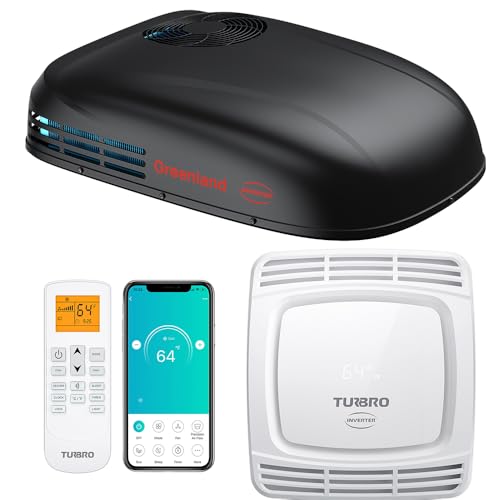
The TURBRO Inverter 13.5K BTU unit is designed for maximum efficiency and an enhanced user experience. Its energy-saving inverter compressor is a game-changer, delivering up to 30% greater efficiency and smoother, quieter operation. Coupled with smart app control and an innovative atmosphere lamp function, this RV air conditioner heater offers both performance and a touch of modern luxury, making it perfect for RVers seeking an advanced, feature-rich climate control system.
-
Key Features:
- Energy-Saving Inverter Compressor: Up to 30% greater efficiency, minimizes energy use and noise, soft start.
- Year-round Comfort: 13,500 BTU cooling and heating (heat pump up to four times output of electric heaters).
- Slim Rooftop Unit: 10.0″ thickness, 35% thinner than competitors, reduces air resistance.
- Enhanced User Experience: Ceiling assembly with atmosphere lamp (blue, yellow, white lights), remote/smart app control.
- Universal Compatibility: Suitable for all RVs, campers, food trucks, no length restrictions; fits standard roof openings.
-
Pros:
- Superior energy efficiency and ultra-quiet operation due to inverter technology.
- Powerful year-round heating and cooling with an effective heat pump.
- Sleek, low-profile design reduces drag and looks great.
- Modern smart features like app control and ambient lighting.
-
Cons:
- Inverter technology might come at a higher price point initially.
- Requires a stable power source (110-120V AC) for optimal performance.
-
User Impressions: RVers who have upgraded to this unit consistently praise its quiet performance and the significant energy savings. The slim profile and added features like the atmosphere lamp are often mentioned as delightful bonuses, enhancing the overall camping experience.
See it on Amazon here
Frequently Asked Questions about RV Air Conditioner Heaters
Q1: What’s the main difference between an RV AC with a heat strip and one with a heat pump?
A1: The key difference lies in how they produce heat. An RV air conditioner heater with a heat strip uses electric resistance coils to generate heat, similar to a toaster, which can be less efficient. A heat pump, on the other hand, works by reversing the AC’s cooling cycle, extracting heat from the outside air and transferring it inside. Heat pumps are generally much more energy-efficient, especially in mild to moderate temperatures.
Q2: How many BTUs do I need for my RV’s climate control?
A2: The ideal BTU (British Thermal Unit) capacity depends on your RV’s size, insulation, window area, and the climate you typically travel in. A good rule of thumb is:
* Small RVs (under 20 ft): 8,000 – 10,000 BTU
* Medium RVs (20-30 ft): 13,500 – 15,000 BTU
* Large RVs (over 30 ft) or in hot climates: 15,000 BTU or more, possibly requiring a second unit.
Always consider higher BTUs if you frequently camp in hot, humid areas or have poor insulation.
Q3: Are 12V RV air conditioners with heaters effective for off-grid camping?
A3: Absolutely! 12V RV air conditioner heater units are designed specifically for off-grid use. They run directly from your RV’s battery bank (often supplemented by solar panels), eliminating the need for a generator or shore power. While their BTU might be slightly lower than traditional AC units, they are highly efficient and perfect for extended boondocking, offering quiet comfort without fuel consumption.
Q4: How do I maintain my RV air conditioner heater for optimal performance?
A4: Regular maintenance is crucial. Here are some tips:
* Clean or replace air filters regularly (every 2-4 weeks during heavy use).
* Inspect and clean the condenser and evaporator coils annually.
* Check electrical connections for tightness.
* Clear any debris from the rooftop unit.
* Ensure the condensate drain is clear to prevent leaks.
* Winterize your unit if you live in colder climates according to the manufacturer’s instructions.
Q5: Can I install an RV air conditioner heater myself, or do I need a professional?
A5: Many RV air conditioner heater units are designed for DIY installation, especially if you’re replacing an existing unit that uses a standard 14″x14″ opening. However, if you’re uncomfortable with electrical wiring, cutting roof openings, or handling heavy equipment, a professional installation is highly recommended to ensure safety and proper sealing. Always refer to the manufacturer’s installation manual.
Q6: What are the benefits of an inverter compressor in an RV AC unit?
A6: Inverter compressors offer several significant advantages. They can vary their speed, allowing them to precisely match the cooling/heating demand. This leads to:
* Greater Energy Efficiency: They consume less power, saving on electricity or fuel.
* Quieter Operation: They avoid the constant on/off cycling of traditional compressors.
* More Consistent Temperature: They maintain a steady temperature without noticeable fluctuations.
* Softer Starts: Reduced power surge upon startup, which is kinder to your electrical system.
Q7: How much power does an RV air conditioner heater typically draw?
A7: The power draw varies greatly depending on the BTU rating, whether it’s 12V or 120V, and if it has an inverter.
* 120V AC Units: A 13,500 BTU unit might draw around 12-15 amps for cooling, and a 15,000 BTU unit 14-17 amps. Heat strips generally draw similar amounts, while heat pumps are more efficient.
* 12V DC Units: These are measured in DC amps, which can be much higher (e.g., 40-70+ amps DC) but directly from your battery, making them inverter-free. Always check the manufacturer’s specifications for exact figures and ensure your electrical system can handle the load.
Final Thoughts
Choosing the right RV air conditioner heater means investing in year-round comfort for your travels. Whether you prioritize whisper-quiet operation, off-grid efficiency, brute heating and cooling power, or smart home integration, there’s a perfect unit out there for your rig. Take a close look at the features, pros, and cons of these top picks, consider your specific needs and travel style, and get ready to enjoy truly comfortable adventures, no matter what the forecast brings!

