
Title: 7 Top 12V Air Conditioners for RVs: Stay Cool on the Road!
Hitting the open road in your RV is all about freedom, adventure, and comfort. But let's be real, when the summer sun is blazing, that comfort can quickly turn into a sweaty mess without a reliable air conditioning system. Traditional RV ACs often rely on shore power or a noisy generator, which isn't always ideal for off-grid camping or maintaining peace in nature. That's where a 12V air conditioner for RV comes in!
These innovative units are designed to run directly off your RV's 12-volt battery system, offering quiet, efficient cooling without needing a noisy generator or an inverter. Perfect for van life enthusiasts, boondockers, or anyone looking to minimize their carbon footprint, a 12V RV air conditioner provides true freedom.
We've scoured the market to bring you a comprehensive look at the 7 best 12V air conditioners for RVs available today. Get ready to enjoy a cool oasis, no matter where your travels take you!
Why Go 12V for Your RV AC?
Before we dive into the reviews, let's quickly touch on why a 12V system might be your ideal solution for RV climate control:
Off-Grid Power: Direct battery operation means you can stay cool even when you're far from any hookups.
Solar Friendly: Easily integrates with solar panel setups, making your RV truly self-sufficient.
Quiet Operation: Many 12V units are designed for exceptionally quiet performance, perfect for peaceful nights.
Energy Efficiency: Modern 12V compressors are incredibly efficient, helping you conserve battery power.
No Generator Needed: Say goodbye to the noise and fuel consumption of a gas generator just to run your AC.
The 7 Best 12V Air Conditioners for RVs Reviewed
Let's break down the top contenders and see what makes each one a great choice for keeping your RV cool.
1. 12V RV Air Conditioner with Heat Pump, 11,500 BTU Rooftop

This unit combines powerful cooling with a heat pump for year-round comfort.
This powerhouse 12V air conditioner is designed for serious cooling and year-round comfort. Boasting an impressive 11,500 BTU cooling capacity, it's capable of tackling even scorching temperatures, making it a fantastic option for larger RVs, travel trailers, or those who frequent warmer climates. What really sets it apart is its direct 12V DC operation, eliminating the need for an inverter and simplifying your off-grid power setup. Plus, it doubles as a heat pump, offering versatile climate control.
Key Features:
- High-Efficiency 11,500 BTU Cooling Performance
- 12V DC Direct Power No Inverter Needed
- Ultra Quiet Operation (as low as 45dB)
- Slim, Low-Profile Design with Durable Housing (7.1 inches high)
- Easy Installation & Wide Compatibility (fits standard 14.1"x14.1" rooftop openings)
Pros:
- Exceptional cooling capacity for a 12V unit
- True 12V DC direct power saves on complexity and efficiency losses
- Quiet operation ensures peaceful rest
- Integrated heat pump for year-round comfort
- Low-profile design reduces wind drag and fits under covers
Cons:
- Higher BTU might mean higher instantaneous power draw, requiring a robust battery bank
- Installation may still require careful planning for proper wiring
User Impressions: Customers frequently highlight the impressive cooling power and the convenience of direct 12V operation without an inverter. The quiet performance is a significant plus, making it easy to relax or sleep. Its ability to both cool and heat is a strong selling point for those who camp in varied climates.
2. RV Air Conditioner, 12V 10000 BTU Rooftop Air Conditioner

This unit features a durable build and smart control options for personalized comfort.
Looking for rapid cooling that doesn't compromise on durability or smart features? This 12V air conditioner delivers 10,000 BTUs of cooling, promising to cool your RV in as little as 15 minutes. It's built like a tank with UV-stabilized materials and a zinc-coated condenser, ensuring it can handle the rigors of the road and harsh weather. Its inclusion of a supplementary PTC heater adds a touch of warmth for cooler evenings, making it a versatile choice for many RVers.
Key Features:
- Efficient 10,000 BTU Cooling for rapid comfort
- 4,500 BTU PTC heater provides supplementary warmth
- Durable & Weather-Resistant construction (UV-stabilized ABS, EPDM gasket, zinc-coated condenser)
- Quiet Operation with brushless copper motor fans
- Smart Control & Easy Operation (remote control, temperature monitoring, eco, sleep, turbo modes)
Pros:
- Quick cooling performance
- Robust and durable design built for outdoor life
- Multiple smart modes for personalized comfort and energy saving
- Quiet fan operation enhances relaxation
- Easy to control with included remote
Cons:
- PTC heater is supplementary; not designed as a primary heat source in extreme cold
- Requires adequate battery capacity for sustained cooling
User Impressions: Users often praise the speed at which this unit cools down their RV, making a noticeable difference in comfort quickly. The quietness is also a commonly mentioned benefit, allowing for restful nights. The smart control features, like the various modes, are appreciated for their convenience and ability to optimize energy use.
3. Outequip RV Air Conditioner, 12V 10000 BTU Rooftop Air
This model is optimized for extended battery-powered operation, ideal for off-grid adventures.
The Outequip 12V 10000 BTU unit shares many great features with its counterparts, including fast cooling and robust construction. Its standout quality, however, is the explicit focus on extended battery-powered operation. This unit is specifically designed for serious off-grid adventurers, with detailed estimates on how long it can run on common 12V battery capacities (up to 10 hours with a 600Ah battery). If long stretches of boondocking are your jam, this air conditioner is built to keep you comfortable.
Key Features:
- Efficient 10,000 BTU cooling, cools RV in 15 minutes
- Battery-Powered for Off-Grid Use (8-10 hours cooling with appropriate battery)
- Durable & Weather-Resistant construction
- Quiet Operation with brushless copper motor fans
- Smart Control & Easy Operation (remote control, temperature monitoring, multiple modes)
Pros:
- Excellent battery life estimation provides clarity for off-grid planning
- Rapid cooling capabilities for quick comfort
- Built to withstand harsh environmental conditions
- Very quiet, promoting a peaceful interior environment
- Intelligent control options for tailored climate management
Cons:
- Requires a substantial battery bank to achieve advertised run times
- The supplementary heater capacity is not specified in the given features
User Impressions: Reviewers frequently highlight the reliable performance when running solely on battery power, confirming its suitability for extended off-grid stays. The quick cooling and quiet nature are also highly appreciated, contributing significantly to the overall RV experience.
4. 12V RV Air Conditioner, 15000 BTU Heat Pump and Cooling
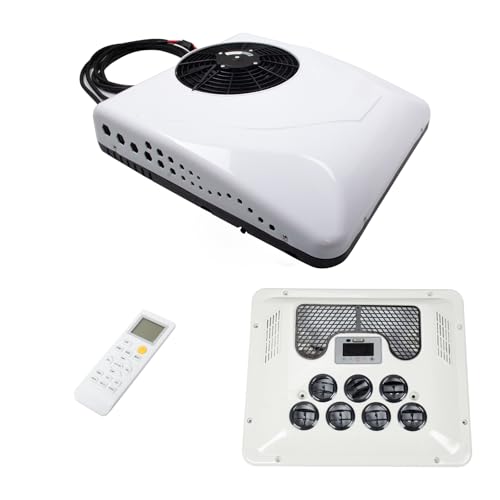
This unit features a horizontal compressor for enhanced stability and durability.
For RVers who demand maximum cooling power and year-round climate control, this 15,000 BTU 12V RV air conditioner is a strong contender. Its most innovative feature is the horizontal compressor, which provides superior stability, durability, and a lower center of gravity – a real plus for minimizing road shock. With both powerful cooling and efficient heating via intelligent frequency conversion, this unit promises worry-free comfort in all seasons, wrapped in a sleek, aerodynamic design.
Key Features:
- 🛺【Stable and Durable】Horizontal compressor for less vibration and lower center of gravity
- 🛺【Cooling and Heating Capacity】15,000 BTU rapid cooling and intelligent frequency conversion heating
- 🛺【Quiet Operation】Low noise operation of 45 decibels
- 🛺【Fashionable Appearance】Curved, ultra-thin, light, streamlined design reduces wind resistance
- 🛺【Wide Compatibility】Suitable for most RVs, vans, and various vehicles; easy to install
Pros:
- Exceptionally high 15,000 BTU cooling and heating capacity for a 12V unit
- Horizontal compressor design enhances stability and longevity
- Very quiet operation for undisturbed peace
- Sleek, aerodynamic design improves aesthetics and reduces wind drag
- Wide compatibility across many vehicle types
Cons:
- Its high BTU output will necessitate a very robust 12V power system
- Users must carefully check sunroof dimensions as a "kind reminder" suggests potential fitment issues for some
User Impressions: Customers rave about the powerful cooling ability, especially in larger RVs or extremely hot conditions. The quietness is consistently praised, as is the innovative and stable compressor design. The combined heating and cooling functions are a huge draw for year-round adventurers.
5. Countrymod 12V DC RV Air Conditioner 10000 BTU RV AC

This model features an intelligent inverter design for superior energy efficiency.
The Countrymod 10,000 BTU 12V DC air conditioner stands out with its intelligent inverter design, making it a champion of energy efficiency. By precisely adjusting the compressor speed, it delivers cooling on demand, leading to significant power savings – up to 5 times more efficient than standard ACs. This translates to an impressive battery life of up to 10 hours on appropriate setups, perfect for extended off-grid stays. Its ductless design also makes installation a breeze for many RV models.
Key Features:
- 300-900W Inverter Design with 10,000 BTU rapid cooling
- Energy-saving efficiency (0.3 kWh/hour, 5x more efficient)
- Ultra-low decibel (45-55 dB) operation
- Stable and durable horizontal compressor
- Easy to Install, fits standard 14" x 14" roof vent, ductless design
Pros:
- Highly energy-efficient due to variable frequency inverter design
- Excellent battery life for prolonged off-grid cooling
- Extremely quiet operation for maximum comfort
- Stable and durable horizontal compressor design
- Simple, ductless installation for compatible RVs
Cons:
- Not suitable for RVs with existing ductwork, limiting compatibility for some
- While efficient, still requires sufficient battery capacity for optimal performance
User Impressions: Many users commend its remarkable energy efficiency, which significantly extends their boondocking capabilities. The quiet operation is frequently highlighted as a major benefit, allowing for peaceful evenings. The straightforward, ductless installation is also a plus for DIY enthusiasts.
6. Treeligo 12V RV Air Conditioner Ultra-Quiet AC, Easy
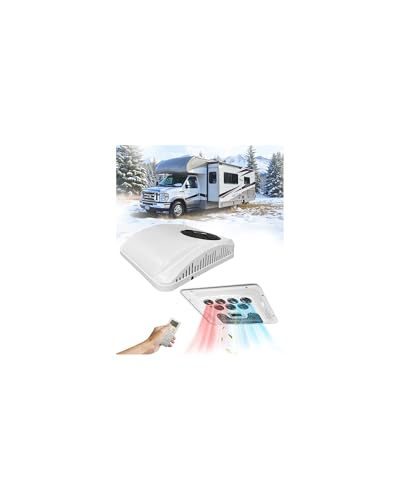
This unit features a 12V DC scroll air compressor for enhanced energy efficiency.
The Treeligo 12V RV Air Conditioner offers a balanced approach to comfort, providing 7900 BTU cooling and a useful 3000 BTU heating function. What makes this unit particularly appealing is its focus on energy efficiency through a 12V DC scroll air compressor, reducing reliance on gasoline and promising significant fuel savings. It's designed for roof-mounted installation in standard skylight openings, making it a practical choice for many RVers seeking reliable, fuel-free climate control.
Key Features:
- 【Heating & Cooling】7900 BTU cooling capacity and 3000 BTU heating function
- 【Energy Efficiency】Powered by a 12V DC scroll air compressor, reducing gasoline reliance
- 【Roof-Mounted Design】Fits standard skylight openings (specific min/max dimensions provided)
- 【Technical Specs】Power: 350W-850W; Rated Current: 35A-70A; R134A refrigerant
- 【After-Sales Support】Prompt assistance within 24 hours
Pros:
- Offers both cooling and heating for year-round comfort
- High energy efficiency can lead to significant fuel savings
- Specifically designed for roof-mounted installation in standard openings
- Good after-sales support for peace of mind
- Suitable for parking use, running off the vehicle's battery
Cons:
- Lower BTU might not be sufficient for very large RVs or extreme heat
- "Not recommended for starter batteries" requires a dedicated house battery system
User Impressions: Customers appreciate the dual heating and cooling functions, providing versatility across seasons. The energy efficiency is a frequently praised aspect, contributing to lower operating costs. The responsive after-sales support also instills confidence in buyers.
7. TMAIRSUS DC 12V RV Air Conditioner Rooftop 8000BTU with

This unit features an ultra-thin, low-profile design for improved aerodynamics.
The TMAIRSUS DC 12V RV Air Conditioner is an excellent option for those seeking a compact yet powerful climate control solution. With 8000 BTU cooling and efficient electric heating, it ensures comfortable temperatures year-round. Its ultra-thin, low-profile design is a major highlight, minimizing wind resistance and maintaining vehicle height clearance, which is crucial for fuel efficiency and fitting under covers. Easy installation and ultra-quiet operation round out this well-designed package, controlled conveniently by remote or a wall panel.
Key Features:
- 【Powerful 8000BTU Cooling & Efficient Heating】All-weather climate control
- 【Ultra Thin & Low Profile Design】Just 6.3 inches thick, minimizes wind resistance
- 【Easy Installation & Complete Kit】Designed for standard skylight openings (12.6 x 10.4 inch to 13.39 x 11.02 inch)
- 【Ultra Quiet & Remote Control】Operates at a peaceful 52dB
- 【Energy Efficient 12V DC Operation】Runs directly on vehicle's 12V battery system (30-60A)
Pros:
- Effective cooling and heating in one compact unit
- Extremely low-profile design is great for aerodynamics and vehicle clearance
- Installation kit makes DIY setup straightforward
- Very quiet operation for an undisturbed environment
- Energy-efficient 12V DC operation for off-grid use
Cons:
- The specified skylight opening dimensions might be slightly less common than the standard 14"x14"
- 8000 BTU might be on the lower side for very large RVs in scorching heat
User Impressions: Customers frequently commend its incredibly slim profile, which makes a noticeable difference in vehicle aesthetics and aerodynamics. The combination of quiet operation and effective cooling/heating, all running on 12V, is a major draw for RVers who value both comfort and efficiency.
Quick Comparison: Which Unit Fits Your Rig?
BTU ratings only tell part of the story — roof opening size, battery capacity, and whether you need heat matter just as much. The fundamentals we use when choosing a unit that fits a space indoors hold true here too; the difference is that your "power outlet" is a battery bank instead of a wall socket. Here's how the seven contenders stack up side by side:
| Unit | Cooling / Heating | Standout Strength | Best For |
|---|---|---|---|
| 11,500 BTU Heat Pump Rooftop | 11,500 BTU / heat pump | Direct 12V power, no inverter losses | Larger RVs and hot climates |
| 10,000 BTU Smart Rooftop | 10,000 BTU / 4,500 BTU PTC heater | Durability plus smart eco/sleep/turbo modes | Full-season campers |
| Outequip 10,000 BTU | 10,000 BTU | Clear off-grid run-time estimates | Serious boondockers |
| 15,000 BTU Horizontal Compressor | 15,000 BTU / frequency-conversion heating | Maximum cooling power in a 12V package | Big rigs and extreme heat |
| Countrymod 10,000 BTU Inverter | 10,000 BTU / variable-speed inverter | ~0.3 kWh/h draw, up to 10 hours on battery | Battery-first, solar-heavy setups |
| Treeligo 7,900 BTU | 7,900 BTU / 3,000 BTU heat | Efficient scroll compressor, low power draw | Vans and small trailers |
| TMAIRSUS 8,000 BTU | 8,000 BTU / electric heating | Ultra-thin 6.3-inch profile | Low-clearance roofs and aerodynamics |
Bottom line: confirm your roof cutout and battery capacity first, then pick the row that matches your travel style — and order before the next heat wave turns install day into a sweaty one.
Getting the Most From Your 12V Air Conditioner
A 12V AC is a system, not just a box on the roof. These are the details that separate a setup that hums along all summer from one that disappoints on the first hot weekend.
The Honest Trade-Offs to Weigh
In practice, the air conditioner itself is rarely the expensive part — the power system behind it is. Before you commit, be clear-eyed about three things:
- Upfront cost: A quality 12V unit plus a capable lithium battery bank and charging gear usually costs more upfront than a traditional 120V AC and a budget generator — but you recoup it in silence, fuel savings, and access to quiet campgrounds where generators aren't welcome.
- Weight and height: Every rooftop unit adds weight high on the vehicle, and the low-profile models on this list exist precisely because a few inches matter for wind drag, clearance, and storage covers.
- Cooling ceiling: In humid, triple-digit heat, even a 15,000 BTU 12V unit will cycle hard. Pre-cooling in the morning and managing heat load (window covers, awnings out, parking in shade) does as much for comfort as extra BTUs.
Size the Battery Bank First
A common mistake is buying the AC first and the batteries second. Work the math in reverse: take the unit's average amp draw (not its peak), multiply by the hours of cooling you want per day, and add margin so you're never deep-cycling your bank. As a planning framework, a unit averaging 40–50 amps for 6–8 evening hours calls for several hundred amp-hours of usable capacity — which is why current-gen lithium (LiFePO4) chemistry has become the default for 12V AC setups: it delivers most of its rated capacity, handles high continuous discharge, and recharges quickly. The U.S. Department of Energy publishes practical consumer guidance on lithium battery technology if you want to go deeper on the chemistry and safety side. Pairing the unit with efficient temperature settings — a few degrees warmer than you'd set at home, plus eco or sleep mode — can stretch a single charge dramatically.
Keep the Power Flowing: Solar, Alternator, and Monitoring
Your recharge plan matters as much as your storage. Solar is the cleanest match: size the array so that, on a good sun day, it replaces roughly what the AC and your other loads consume — and expect the math to get tight during multi-day cloudy stretches, which is exactly when a DC-DC charger fed by the alternator earns its keep on drive days. Install a shunt-based battery monitor so you're working with real state-of-charge numbers instead of voltage guesses; voltage under load lies. And when forecasts turn extreme, run the unit in the late morning to pull the interior temperature down before peak heat arrives, rather than asking the compressor to fight a sweltering cabin all afternoon — it's the same logic behind NOAA's heat safety guidance about reducing exposure during the hottest hours. Compressor and battery technology keep maturing year over year, and we track newer DC climate tech as it lands.
Install It Right the First Time
Most installation headaches trace back to three avoidable issues: a cutout that doesn't match the template, wiring that's too thin for the run, and a roof seal rushed at the end of a long day. Measure the opening and roof thickness twice, run properly sized wire with a fuse or breaker matched to the manufacturer's maximum draw, keep the battery run as short as practical, and finish with butyl tape under the gasket plus a self-leveling sealant bead around the flange. Confirm the condensate drains aren't blocked before you button everything up. If heights, wiring, or sealing make you hesitate, a professional RV technician can typically complete the swap in a few hours — money well spent versus a leak discovered during a rainstorm two states from home.
When Cooling Fades Mid-Trip
If cooling suddenly fades on a hot afternoon, resist the urge to assume the worst. Nine times out of ten the culprit is restricted airflow — a filter loaded with dust, a dirty condenser coil, or a blocked vent — rather than a failed compressor. Shut the unit down, work through the checks in order, and you'll usually be back to cold air before the ice melts in the cooler.
Frequently Asked Questions (FAQ)
Q1: What size 12V air conditioner for RV do I need?
A1: The right size (measured in BTUs) depends on your RV's size, insulation, and the climate you'll be in. A general rule of thumb is:
- 5,000 – 8,000 BTU: Small campers, pop-ups, van conversions
- 9,000 – 12,000 BTU: Medium-sized RVs, travel trailers (up to 25 ft)
- 13,500 – 15,000 BTU: Larger RVs, fifth wheels (over 25 ft) It's always better to slightly overestimate than underestimate, especially in very hot climates.
Q2: How much battery power do I need to run a 12V RV air conditioner?
A2: Running a 12V AC requires a substantial 12V battery bank (often referred to as a "house battery" or "deep cycle batteries"). The exact capacity needed depends on the AC's power draw (amps) and how long you want to run it. For example, an AC drawing 50 amps for 8 hours would require 400 amp-hours (Ah) of battery capacity. Most RVers will use multiple deep-cycle batteries (e.g., lithium-ion for best performance) and often supplement with solar panels to recharge.
Q3: Can I install a 12V air conditioner for RV myself?
A3: Many 12V RV air conditioners are designed for DIY installation, especially if they fit a standard 14"x14" rooftop vent opening. However, it requires basic electrical knowledge, comfort with rooftop work, and the ability to seal properly to prevent leaks. If you're unsure about wiring or structural modifications, it's always best to consult a professional RV technician.
Q4: Are 12V RV air conditioners noisy?
A4: Generally, modern 12V RV air conditioners are designed to be much quieter than traditional AC units or generators. Many units boast noise levels as low as 45-55 dB, which is comparable to a quiet conversation or ambient office noise. However, noise levels can vary between models and settings (e.g., "turbo" mode might be louder).
Q5: Do all 12V RV ACs also provide heat?
A5: Not all of them, but many do! Several models on our list feature either a heat pump function or a supplementary PTC heater. A heat pump is generally more efficient for heating than a resistive heater, but neither might be sufficient as a sole heat source in extremely cold temperatures. Always check the product specifications for heating capabilities.
Q6: How energy-efficient are these 12V units compared to standard ACs?
A6: 12V RV air conditioners are typically much more energy-efficient than traditional 120V AC units when running directly off your battery. This is largely due to advancements in DC inverter compressor technology, which allows the compressor speed to adjust to cooling demand, consuming less power overall. This efficiency is key to longer run times when off-grid.
Q7: What maintenance is required for a 12V RV air conditioner?
A7: Regular maintenance is similar to other RV ACs:
- Clean or replace air filters: Usually monthly during heavy use.
- Check and clean the condenser and evaporator coils: Annually or bi-annually to ensure optimal airflow and efficiency.
- Inspect seals and gaskets: Ensure the rooftop seal is intact to prevent leaks.
- Check electrical connections: Annually for corrosion or loose wiring. Proper maintenance will prolong the life and efficiency of your unit.
One habit worth building: keep a yearly upkeep checklist inside a cabinet door and run through it every spring before your first big trip. Fifteen minutes on a ladder in April beats discovering a cracked gasket or a coil clogged with cottonwood fluff during a July heat wave.
Q8: Can I run a 12V RV air conditioner while driving?
A8: Yes — and it's one of the biggest advantages of the format. Because the unit runs on DC power, it can cool the cabin while your alternator recharges the house batteries as you drive, so you arrive at camp already comfortable. Two practical notes: use a DC-DC charger if you run lithium batteries (they need a controlled charge profile a raw alternator feed doesn't provide), and confirm your specific model is rated for mobile use — rooftop units built for vehicles are engineered for road vibration, but it's worth verifying in the manual before you rely on it.
Q9: How long will a 12V RV air conditioner last?
A9: There's no fixed expiration date, but a well-maintained unit should serve you for many seasons. The sealed DC compressors in these units have fewer wear points than you might expect, and most premature failures trace back to clogged filters, dirty coils, or leaking roof seals rather than the compressor itself. Keep up with the routine in Q7 above and treat any loss of cooling as a maintenance signal, not a death sentence.
Conclusion
Choosing the right 12V air conditioner for RV life means investing in comfort, freedom, and efficiency. Whether you're a full-time RVer, a weekend warrior, or a boondocking enthusiast, these battery-powered AC units offer a fantastic way to keep cool without compromise. From high BTU powerhouses to ultra-efficient inverter models, there's a 12V solution out there to fit every RV and travel style. So go ahead, pick your favorite, and hit the road knowing you'll always have a cool, comfortable sanctuary waiting for you. Happy travels!
Want more deep dives like this one? Browse our hands-on cooling guides for practical setup, sizing, and maintenance advice you can use before your next trip.

