
Ah, the open road! The freedom of RV travel is unmatched, but let’s be real: when temperatures soar, that freedom can quickly turn into a sweaty ordeal. Keeping your home-on-wheels comfortable is key to enjoying your adventures, and that’s where a reliable RV air conditioner comes in. While many RVs sport rooftop units, some discerning travelers opt for an RV basement air conditioner for its unique advantages like a lower profile and centralized cooling.
But not all RV air conditioners are created equal, and sometimes “basement” can be a bit of a misnomer, as other innovative cooling solutions also offer fantastic benefits. In this guide, we’ll dive deep into seven top-rated RV air conditioner options, including a true basement model and several high-performance alternatives, to help you make the best choice for your travel style and rig. Let’s find your perfect cool companion!
Why Consider an RV Basement Air Conditioner (and its Alternatives)?
An RV basement air conditioner is typically tucked away in a storage compartment or bay, offering several benefits. They often allow for a cleaner rooftop aesthetic, can contribute to a lower overall vehicle height, and centralize the weight distribution. They usually connect to a ducted system, providing even cooling throughout the RV.
However, the world of RV cooling has expanded! We’re also looking at powerful rooftop units and even portable, split-design systems that offer their own set of advantages, like easier installation, 12V off-grid compatibility, or superior BTU output. We’ve rounded up a mix to give you a comprehensive overview.
Our Top 7 RV Air Conditioner Picks
Let’s break down some of the best cooling solutions available for your RV.
Coleman 46515811 2 Ton A/C Basement

This Coleman unit stands out as a true RV basement air conditioner, offering a robust 2-ton (27,000 BTU equivalent) cooling capacity specifically designed for under-floor installation. Ideal for larger motorhomes or those seeking a sleek, uncluttered roofline, this system delivers powerful, centralized climate control. Its dual compressors ensure efficient operation, while the integrated heat pump means you’re covered for both hot summers and chilly evenings, making it a versatile choice for four-season RVers.
-
Key Features:
- Basement Mount design for a low-profile aesthetic
- Two 13,500 BTU compressors for strong cooling power
- Operates on standard 120 Volt power
- Integrated Heat Pump for heating capabilities
- Compact dimensions: 45-7/8″ L x 20-7/8″ W x 18.0625″ H
- New model number: 36515-011
-
Pros:
- Excellent cooling capacity for larger RVs
- Maintains a clean, low-profile roof
- Centralized weight distribution
- Provides both cooling and heating
- Durable Coleman reputation
-
Cons:
- More complex installation than rooftop units
- Takes up valuable storage space
- Higher initial cost compared to some alternatives
-
User Impressions: RVers praise this Coleman basement unit for its reliable performance and ability to keep large spaces comfortable, even in extreme heat. The quiet operation, due to its remote mounting, is a frequently highlighted benefit, though some note the installation complexity.
RV Air Conditioner, 12V 10000 BTU Rooftop Air Conditioner

For those prioritizing quick cooling and off-grid capability, this 12V rooftop air conditioner is a game-changer. Delivering a swift 10,000 BTU, it can cool your RV in as little as 15 minutes. What truly sets it apart is its efficient 12V DC operation, making it perfect for dry camping or solar-powered setups where AC power isn’t readily available. It’s built to last with durable, weather-resistant materials and features a quiet brushless motor for peaceful operation.
-
Key Features:
- Efficient 10,000 BTU cooling, cools in 15 minutes
- 4,500 BTU PTC heater for supplementary warmth
- Durable, UV-stabilized ABS materials and zinc-coated condenser
- Quiet operation with brushless copper motor fans
- Smart control via remote with eco, sleep, and turbo modes
- 12V DC power, ideal for off-grid use
-
Pros:
- Rapid cooling performance
- Excellent for 12V battery/solar systems (no inverter needed)
- Robust, weather-resistant construction
- Very quiet operation
- Smart features and easy control
-
Cons:
- Heater is supplementary, not for extreme cold
- Rooftop mount impacts profile
- 10,000 BTU might be less than traditional basement or 120V rooftop units
-
User Impressions: Customers love the efficiency and the ability to run this unit off their 12V system, making boondocking much more comfortable. The quick cooling and low noise level receive high marks, though some wish the heating element was stronger for colder climates.
Ivation 6,500 BTU Camper Air Conditioner | Portable
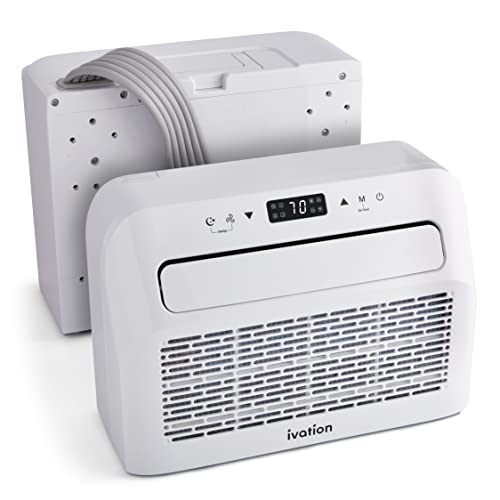
The Ivation 6,500 BTU portable air conditioner offers a unique split-design solution that’s fantastic for smaller RVs, vans, or even as supplemental cooling. Its innovative saddle-mounting on a windowsill means the noisy compressor stays outside, preserving your window view and ensuring exceptionally quiet interior operation. This unit combines an AC, fan, and dehumidifier, providing versatile climate control without the permanent installation commitment of a rooftop or RV basement air conditioner.
-
Key Features:
- 6,500 BTU Air Conditioner, Fan & Dehumidifier
- Split design with external compressor for quiet indoor operation
- Saddle mounts over windowsill, preserving window functionality
- Digital display with controls for temperature (60°F-86°F), fan speed, swing, timer, sleep mode
- Portable styling for quick, tool-free installation
- Suitable for RVs, vans, travel trailers, tiny homes, or apartments
-
Pros:
- Extremely quiet due to external compressor
- Versatile 3-in-1 function (cool, dehumidify, ventilate)
- No permanent installation required
- Preserves window light and view
- Easy to move between vehicles or locations
-
Cons:
- Lower BTU output, best for smaller spaces
- Requires a suitable window for saddle mounting
- Compressor unit sits outside, might be visible
-
User Impressions: Users appreciate the Ivation’s quiet performance and ease of installation, making it a popular choice for converted vans and smaller campers. Its ability to function as a dehumidifier is also a major plus, though some bigger RV owners might find the cooling capacity insufficient for their needs.
12V RV Air Conditioner with Heat Pump, 11,500 BTU Rooftop

This 12V rooftop unit steps up the cooling game with a robust 11,500 BTU capacity, all while running directly off your 12V battery system – no inverter needed! It’s an ideal choice for serious off-gridders and boondockers who refuse to compromise on comfort. Beyond its powerful cooling, it features an integrated heat pump for year-round climate control and boasts ultra-quiet operation, making those starry nights even more peaceful. Plus, its slim, low-profile design minimizes wind drag and fits under most RV covers.
-
Key Features:
- High-efficiency 11,500 BTU cooling performance
- 12V DC direct power – no inverter or generator needed
- Ultra-quiet operation, as low as 45dB inside
- Integrated heat pump for heating capabilities
- Slim, low-profile design (7.1 inches high)
- Durable ABS housing, UV-resistant
- Easy DIY installation, fits standard 14.1″x14.1″ rooftop openings
-
Pros:
- Powerful cooling capacity for a 12V unit
- True off-grid capability without AC power
- Extremely quiet for undisturbed rest
- Provides both cooling and heating
- Aerodynamic design reduces drag
-
Cons:
- Rooftop mounting affects vehicle height
- Requires a robust 12V battery bank
- Higher initial investment
-
User Impressions: Reviewers rave about the silent operation and the freedom this 12V unit provides for off-grid adventures. The cooling power is consistently praised, even in hot climates, and the integrated heat pump adds significant value. Installation is noted as straightforward for those with basic DIY skills.
RecPro RV Air Conditioner 15K | Quiet AC | 110-120V

RecPro brings a powerful and quiet 15,000 BTU rooftop air conditioner to the table, designed for efficient cooling without the usual noise. Operating at a mere 55.4 dB, it’s as quiet as a gentle rain, allowing you to truly relax in your RV. This unit is built tough with UV-resistant plastic, features a low amp draw for energy efficiency, and includes a heat pump for versatile 4-season comfort. With both ducted and non-ducted compatibility, it’s a flexible choice for various RV setups.
-
Key Features:
- 15,000 BTU cooling capacity
- Ultra-quiet operation at 55.4 dB
- Energy-efficient low amp draw
- Rugged, UV-resistant design
- Multi-function remote + LED touch display
- Built-in heat pump for 4-season comfort
- Ducted and non-ducted compatibility
-
Pros:
- High cooling power for larger RVs
- Remarkably quiet operation
- Energy-efficient, good for generators/solar
- Provides both cooling and heating
- Flexible installation options
-
Cons:
- Rooftop installation affects profile
- Requires 110-120V AC power
- Noise level, while quiet for an AC, is still present
-
User Impressions: Many users are impressed by how quiet this RecPro unit is compared to older RV ACs, making a significant difference in comfort. Its strong cooling performance and the dual cool/heat function are highly valued, as is its compatibility with different ducting systems.
TOSOT 16000 BTU GO Cool RV Air Conditioner, Non-Ducted

The TOSOT 16,000 BTU GO Cool RV Air Conditioner is a powerhouse for larger RVs (16 to 24 feet long), offering impressive cooling and heating capabilities for true all-weather comfort. What makes it stand out is its smart WiFi control, allowing you to manage and monitor the unit directly from your smartphone, a huge convenience on the road. Designed for non-ducted setups, it’s incredibly easy to install in standard 14.25″ x 14.25″ rooftop openings, making it a hassle-free upgrade for many RVers.
-
Key Features:
- High 16,000 BTU cooling and 12,500 BTU heating capacity
- Covers spaces up to 600 sq ft, ideal for 16-24 ft RVs
- Smart WiFi control via the free Gree+ app
- Works flawlessly in outdoor temps from 23°F to 115°F
- Non-ducted configuration for easy installation
- Fits standard 14.25″ x 14.25″ rooftop vent openings
- Accessory kit included for quick setup
-
Pros:
- Exceptional cooling and heating power
- Convenient smartphone control
- Wide operating temperature range
- Very easy, non-ducted installation
- Suitable for larger RVs
-
Cons:
- Not compatible with ducted RV systems
- Rooftop mounted, affecting clearance
- May require separate shipments for all components
-
User Impressions: RVers love the sheer power of the TOSOT unit, noting its ability to quickly cool even large interiors in hot climates. The WiFi control is a standout feature, praised for its convenience. The straightforward installation is also a big plus for DIY enthusiasts.
RecPro RV Air Conditioner 15K Ducted or Non-Ducted

This is another excellent RecPro 15,000 BTU rooftop AC unit, offering similar robust features to its counterpart but emphasizing its compatibility with both ducted and non-ducted systems. Like the previous RecPro, it boasts a whisper-quiet 55.4 dB operation, low amp draw for energy efficiency (great for off-grid or generator use), and a built-in heat pump. Its durable, aerodynamic design ensures it can handle the rigors of the road while keeping your travel trailer or motorhome comfortable year-round. This is a versatile pick for almost any RV climate control need.
-
Key Features:
- 15,000 BTU cooling capacity
- Whisper-quiet 55.4 dB operation
- Low amp draw for energy efficiency
- Durable, UV-resistant construction with aerodynamic shape
- Remote and LED touch controls
- Built-in heat pump for 4-season comfort
- Compatible with both ducted and non-ducted RV systems
-
Pros:
- High cooling and heating power
- Extremely quiet operation
- Energy-efficient for lower power consumption
- Flexible installation for most RV types
- Robust and road-ready design
-
Cons:
- Rooftop installation (not a true RV basement air conditioner)
- Requires 110-120V AC power
- Still a visible unit on the roof
-
User Impressions: This RecPro unit consistently receives high marks for its quiet performance and powerful cooling. Customers appreciate the flexibility of ducted/non-ducted options and the convenience of the remote control. Its overall reliability and energy efficiency are frequently mentioned as reasons for satisfaction.
Choosing the Right RV Air Conditioner for You
Deciding on the perfect RV air conditioner involves a few key considerations:
- Basement vs. Rooftop vs. Portable: A true RV basement air conditioner offers a low profile and centralized weight but can be harder to install and service. Rooftop units are common, powerful, and easier to install but add height. Portable/window units are flexible and quiet but have lower BTU and require a window setup.
- BTU Capacity: This needs to match your RV’s size and insulation. Larger RVs, or those frequently in hot climates, will need higher BTUs (13,500 to 16,000+). Smaller vans might be fine with 6,500-10,000 BTU.
- Power Source: Do you need 12V DC for off-grid adventures, or will you primarily be hooked up to 110-120V AC shore power or a generator?
- Heat Pump Function: For year-round comfort, a unit with an integrated heat pump is a fantastic addition, providing heating without needing a separate furnace.
- Noise Level: Some units are significantly quieter than others. If peace and quiet are a priority, look for low dB ratings.
- Ducting: Do you have a ducted system in your RV, or do you need a non-ducted (free-flowing) unit?
Carefully weighing these factors against your typical RVing style will guide you to the best choice for staying cool and comfortable on your journeys.
Frequently Asked Questions About RV Air Conditioners
Q1: What exactly is an RV basement air conditioner?
A: An RV basement air conditioner is a climate control unit that is installed in one of the storage bays or basement compartments of an RV, rather than on the roof. This design keeps the RV’s roof clear and can contribute to a lower overall vehicle height and a more centralized weight distribution. They typically connect to a ducted system to distribute air throughout the RV.
Q2: What are the main benefits of a basement-mounted RV AC unit?
A: Benefits include a cleaner, lower-profile roof (no bulky unit on top), reduced wind resistance, a lower center of gravity (which can improve handling), and often quieter operation inside the RV because the compressor is located further away. Many also offer centralized ducted cooling, providing even temperatures throughout.
Q3: How does an RV basement air conditioner differ from a rooftop unit?
A: The primary difference is placement. Basement units are installed below the floor, while rooftop units sit on top of the RV. Basement units tend to be larger, more complex to install, and usually operate via a ducted system. Rooftop units are generally easier to install, come in more varied BTU sizes, and can be ducted or non-ducted.
Q4: What BTU size do I need for my RV?
A: The ideal BTU (British Thermal Unit) capacity depends on your RV’s size, insulation, and the climate you typically travel in. As a rough guide:
* Small RVs (under 20 ft): 8,000 – 10,000 BTU
* Medium RVs (20-30 ft): 13,500 – 15,000 BTU
* Large RVs (over 30 ft): 15,000 BTU or more, often needing two units or a high-capacity basement unit.
Consider if you frequently camp in extreme heat; it might be worth going slightly higher.
Q5: Can I install an RV air conditioner myself?
A: It depends on your DIY skills and the type of unit. Rooftop units that fit standard openings can often be installed by an experienced DIYer. However, installing an RV basement air conditioner or units requiring extensive ductwork or electrical modifications can be complex and are often best left to professional RV technicians to ensure proper sealing, wiring, and safety.
Q6: Are there 12V RV air conditioners for off-grid camping?
A: Yes, absolutely! As seen in our reviews, several high-efficiency 12V DC air conditioners are now available. These units run directly from your RV’s battery bank (often supplemented by solar panels) without needing an inverter or generator, making them perfect for boondocking and off-grid adventures.
Q7: How do I maintain my RV air conditioning system?
A: Regular maintenance is key to longevity. This includes:
* Cleaning or replacing air filters regularly (every 2-4 weeks during heavy use).
* Checking and clearing debris from condenser and evaporator coils.
* Ensuring drain holes are clear to prevent water buildup.
* Inspecting electrical connections for corrosion or damage.
* Having the system professionally checked for refrigerant levels and overall health every few years.
Conclusion
Whether you opt for the discreet power of an RV basement air conditioner, the sheer efficiency of a modern rooftop unit, or the versatile convenience of a portable split design, ensuring your RV has a robust cooling solution is paramount for comfortable travels. We hope this guide has shed some light on the diverse options available, helping you pick the perfect climate control system to keep your adventures cool, calm, and collected, no matter where the road takes you! Happy travels!

