
Panasonic inverter drive air conditioners are revolutionizing home cooling with intelligent speed control that adapts to your environment. Unlike traditional ACs that cycle on and off, these units adjust compressor speed smoothly, saving energy and reducing wear. You’ll enjoy quieter performance, lower bills, and consistent comfort all year round.
Key Takeaways
Inverter Technology: Panasonic inverter drives adjust compressor speed in real time, maintaining ideal temperatures without frequent cycling.
Energy Efficiency: Up to 60% less power consumption compared to non-inverter models, thanks to reduced energy waste.
Quiet Operation: Advanced noise-reduction design ensures indoor noise levels as low as 19 dB—so quiet you might not even hear it running.
Fast Cooling & Heating: Inverter models reach desired temperatures faster by ramping up power intelligently during startup.
Longer Lifespan: Less mechanical stress from constant starts/stops means fewer repairs and longer equipment life.
Smart Features: Many models include Wi-Fi connectivity, smartphone apps, and eco-friendly R32 refrigerant for safer operation.
Year-Round Comfort: Stable humidity control and gentle airflow make these units perfect for both summer and winter use.
Quick Answers to Common Questions
Do Panasonic inverter ACs really save money?
Yes! Because the compressor runs at varying speeds instead of cycling on/off constantly, Panasonic inverter models use up to 60% less energy than traditional air conditioners. Over time, this translates to significant reductions in your electricity bill—often paying for the higher upfront cost within 2–3 years. For more on this, see our guide on panasonic air conditioner maintenance tips.
Are inverter ACs louder than regular ones?
Not at all. Thanks to advanced noise-dampening materials and intelligent motor control, most Panasonic inverter air conditioners operate below 20 decibels—quieter than a whisper. Even during peak operation, sound levels stay under 40 dB, making them ideal for bedrooms and offices.
Can I install a Panasonic inverter AC myself?
While you can plug in a window model, professional installation is strongly recommended—especially for split systems. Incorrect refrigerant handling or poor sealing can drastically reduce efficiency and void warranties. Certified technicians ensure optimal performance and safety. For more on this, see our guide on inverter air conditioner tips.
How long do Panasonic inverter ACs last?
With proper maintenance, these units typically last 15–20 years. The inverter technology reduces mechanical wear, and Panasonic backs many components with 10-year warranties. Regular filter cleaning and annual servicing help maximize lifespan.
Do inverter ACs work well in humid climates?
Absolutely. Panasonic models include dedicated dehumidification modes that extract moisture without overcooling the room. Combined with features like Nanoe™ filtration, they maintain comfort and prevent mold growth in high-humidity environments. For more on this, see our guide on how to choose the right air conditioner for.
📑 Table of Contents
- What Is a Panasonic Inverter Drive Air Conditioner?
- How Inverter Technology Works: A Simple Explanation
- Benefits of Choosing a Panasonic Inverter AC
- Choosing the Right Panasonic Inverter AC for Your Home
- Installation Tips & Maintenance Made Easy
- The Future of Cooling: What’s Next for Panasonic Inverter Tech?
What Is a Panasonic Inverter Drive Air Conditioner?
Imagine coming home on a sweltering afternoon, stepping into a room that’s already cool—no sudden blast of cold air, just steady, refreshing comfort. That’s the magic of a Panasonic inverter drive air conditioner . Unlike older air conditioners that simply turn on full power or shut off completely, these smart systems use advanced inverter technology to fine-tune their output. Think of it like a car with cruise control: instead of speeding up then slamming on the brakes, the compressor adjusts its speed smoothly to match your room’s needs.
The core of this innovation lies in the inverter drive itself. Located inside the outdoor unit, the inverter converts electricity from your wall outlet into a variable frequency current that powers the compressor. This allows the compressor to run at different speeds rather than just “on” or “off.” When your room hits the set temperature, instead of shutting down entirely, it slows down to maintain that perfect climate. The result? Consistent temperatures, less energy used, and noticeably quieter operation. For more on this, see our guide on are air conditioner brackets required in nyc.
Panasonic has been a leader in inverter technology since the early 2000s, refining it with proprietary enhancements like dual rotary compressors and AI-powered climate sensing. Their latest models even feature self-diagnostic systems that alert you before problems arise. Whether you're looking for a window unit, split system, or ceiling cassette, Panasonic offers inverter-driven options across every category.
Inverter vs. Non-Inverter: Key Differences
Understanding the contrast helps justify the investment. The table below highlights practical differences you’ll experience daily. For more on this, see our guide on air conditioner vs hvac.
| Feature | Panasonic Inverter Drive | Traditional Fixed-Speed AC |
|---|---|---|
| Compressor operation | Variable speed, continuous | Single speed, on/off cycling |
| Temperature stability | ±0.5 °C | ±2–3 °C swings |
| Startup current | Low (soft start) | High (locked-rotor amps) |
| Energy use (annual) | 40–60 % less | Baseline |
| Sound pressure (indoor) | 19–35 dB | 35–50 dB |
| Typical lifespan | 15–20 years | 10–15 years |
| Refrigerant (modern) | R32 (low GWP) | Often R410A (higher GWP) |
In practice, the elimination of hard starts is the single biggest factor for both efficiency and component longevity. If you’re comparing against traditional HVAC systems, the inverter’s soft-start capability also reduces stress on your home’s electrical panel.
How Inverter Technology Works: A Simple Explanation
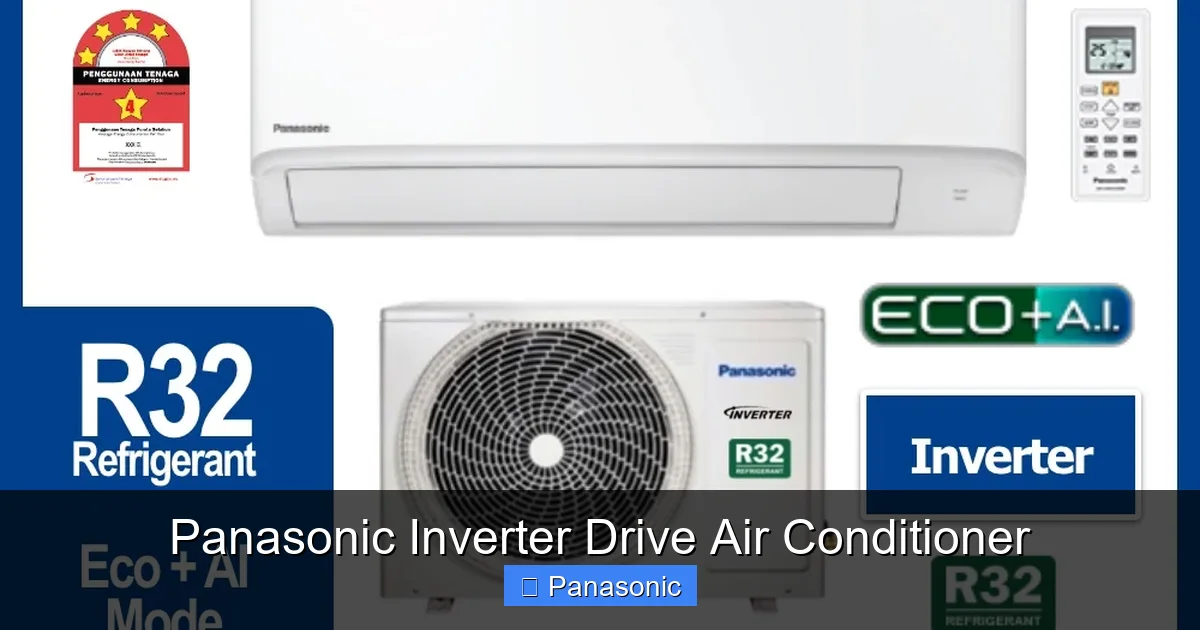
Diagram illustrating how the inverter drive adjusts compressor speed to match cooling demand.
Image source: down-my.img.susercontent.com
At first glance, “inverter drive” sounds technical—but the concept is surprisingly intuitive. Let’s break it down step by step.
In traditional air conditioners (also called non-inverter or fixed-speed units), the compressor operates at one fixed speed. To change the room temperature, the unit either runs at max power until the thermostat says “cool enough,” then turns off completely. This creates temperature swings: your room might be freezing for five minutes, then warm again while the AC cycles back on. It’s like flickering a light switch—bright, then dark, repeat.
With an inverter drive, the compressor doesn’t stop. Instead, it modulates its speed based on real-time data from sensors inside the room. If you’ve just walked in from the heat, it ramps up quickly. Once the room reaches your set temperature, it drops to a whisper-quiet idle mode. No more hot-cold spikes. Just smooth, stable comfort.
Here’s where Panasonic really shines: their inverter algorithms are tuned for responsiveness and efficiency. For example, some models use fuzzy logic to predict how long it will take to reach target temps based on outside weather, insulation quality, and even how many people are in the room. They also minimize compressor strain by avoiding abrupt speed changes—extending component life significantly.
Another key feature is the use of high-efficiency DC motors and permanent magnet synchronous (PMSM) technology. These components convert more electrical energy into cooling power with less loss as heat—a big reason why inverter ACs can be up to 60% more efficient than older models.
The U.S. Department of Energy notes that variable-speed compressors can reduce energy use by 30–50% compared to single-speed units, depending on climate and usage patterns (variable-speed compressors).
Benefits of Choosing a Panasonic Inverter AC
So why go with a Panasonic inverter drive air conditioner over standard models? The advantages add up fast—and they affect everything from your wallet to your peace of mind.
Energy Savings That Add Up
One of the biggest draws is cost savings. Because the compressor runs continuously at optimal speeds, it avoids the massive energy spike that happens when a non-inverter unit kicks in cold. According to ENERGY STAR estimates, inverter ACs use roughly 40–60% less electricity annually than conventional units. Over five years, that could mean hundreds—even thousands—of dollars saved on utility bills.
Panasonic takes this further with eco-modes and sleep timers. For instance, their Nanoe™ X technology ionizes particles to deactivate airborne pollutants while using minimal extra power. And because the system isn’t constantly restarting, there’s less demand surge on your home’s electrical circuit—which can delay or prevent the need for costly upgrades.
Silence That Feels Like Luxury
Nobody wants to live next door to a jet engine. Traditional ACs can hit 50+ decibels when starting up—roughly equivalent to a vacuum cleaner. But Panasonic inverter models often operate below 20 dB, which is quieter than a library. Even during peak cooling, sound levels stay under 35 dB.
This quietness comes from multiple sources: aerodynamic fan blades, vibration-dampening mounts, and smart motor controls that avoid resonance frequencies. Some ceiling cassettes even have directional airflow settings so you can aim cool air exactly where you want it—without disturbing others.
Faster, More Even Temperature Control
Ever notice how some rooms feel drafty while others stay stuffy? Non-inverter units struggle with uneven distribution because they treat the whole house as one zone. Inverter ACs excel here too. Many Panasonic models support multi-zone setups, allowing different thermostats in separate rooms to dictate individual temperatures.
Take a two-story home: upstairs gets sunny and hot, downstairs stays mild. With a multi-split inverter system, you can cool only the upper floor while leaving the lower level comfortable. This targeted approach saves energy and prevents wasted effort.
Durability Built to Last
Mechanical stress causes most AC failures. Constantly turning the compressor on/off wears out capacitors, bearings, and windings over time. Inverter systems reduce this wear dramatically since the compressor rarely stops entirely. Panasonic backs this with industry-leading warranties—some parts covered for up to 10 years.
Additionally, their outdoor units are built with corrosion-resistant coatings and rust-proof cabinets, especially important in humid coastal areas.
Eco-Friendly Design Meets Smart Living
Modern Panasonic inverter ACs prioritize sustainability. Most now use R32 refrigerant, which has a global warming potential (GWP) nearly 70% lower than older refrigerants like R410A. Lower GWP means less environmental impact if the unit leaks—and better compliance with future regulations.
Many models also include features like:
- Auto-clean cycles that dry internal coils to prevent mold
- Air purifiers with plasma clusters or nanoparticle filters
- Wi-Fi connectivity via the Panasonic Comfort Cloud app (available on iOS/Android)
- Voice control compatibility with Alexa and Google Assistant
These aren’t gimmicks—they enhance health, convenience, and long-term value.
Health and Air Quality Benefits
Beyond temperature, Panasonic’s Nanoe™ X technology releases hydroxyl radicals that inhibit bacteria, viruses, and allergens on surfaces and in the air. In practice, this means fewer seasonal allergy flare-ups and a fresher indoor environment—especially valuable in tightly sealed, energy-efficient homes. Pairing this with optimal humidity settings further discourages dust-mite and mold growth.
Choosing the Right Panasonic Inverter AC for Your Home
With dozens of models across price points and sizes, picking the right one requires knowing what matters most to you. Here’s how to match a Panasonic inverter drive air conditioner to your lifestyle.
Room Size Matters—But Not Just Square Footage
Most manufacturers list capacity in BTU (British Thermal Units). A general rule: multiply your room’s square footage by 25 BTU. So a 150 sq ft bedroom needs about 3,750 BTU. But this ignores variables like ceiling height, windows, insulation, and sun exposure.
Panasonic provides detailed sizing guides and uses tools like their “Room Sizer” calculator online. They also offer oversized models (e.g., 18,000 BTU for a small apartment) that cool faster initially but may cycle less efficiently over time. For best results, consult a certified technician.
Split vs. Window vs. Cassette: Which Fits Best?
- Window Units: Affordable and simple, but block light and restrict ventilation. Panasonic offers slim-profile window models with inverter tech.
- Split Systems: Most popular for homes. Indoor unit mounted high, outdoor unit outside. Quiet, efficient, and stylish.
- Cassette & Floor-standing: Ideal for large open spaces like living rooms or offices. Hidden installation maintains aesthetics while delivering powerful airflow.
All types now come with inverter drives in Panasonic’s lineup, ensuring consistent benefits regardless of form factor.
Special Features to Consider
- Humidity Control: Essential in tropical climates. Look for “dry mode” or “dehumidify” functions.
- Remote Sensors: Some remotes include motion detection so the AC adjusts based on human presence.
- Filter Alerts: Remind you when to clean or replace washable filters—important for allergy sufferers.
- Auto Swing Louvers: Automatically shift airflow left-right and up-down for uniform cooling.
Panasonic’s “Econavi” AI mode is particularly clever: it learns your schedule and preferences over weeks, then auto-adjusts settings for maximum comfort and efficiency.
Panasonic Model Series Comparison
Panasonic groups its inverter ACs into three main tiers. Use this quick reference to narrow choices before speaking with an installer.
| Series | Target Use | Key Features | Typical Warranty (Compressor) |
|---|---|---|---|
| Standard (CS/CU‑E) | Budget‑conscious, single rooms | Inverter, R32, basic Wi‑Fi, Nanoe™ | 5 years |
| Premium (CS/CU‑X) | Whole‑home, multi‑zone | Dual rotary, Econavi AI, Nanoe™ X, wider airflow | 10 years |
| Flagship (CS/CU‑Z) | Extreme climates, max efficiency | 2‑stage compressor, CO₂ sensor, hybrid solar‑ready | 10 years + labor |
When selecting the ideal capacity, remember that oversizing a Premium unit can negate its efficiency advantage at part-load.
Installation Tips & Maintenance Made Easy
Even the best Panasonic inverter drive air conditioner won’t perform well if installed poorly or neglected. Follow these practical tips:
Professional Installation Is Non-Negotiable
Improper refrigerant charging, leaky ducts, or misaligned pipes can cut efficiency by 30%. Always hire a licensed HVAC technician certified by NATE or equivalent. Ask them to:
- Vacuum the system before refilling refrigerant
- Seal all pipe connections with nitrogen
- Test for leaks with electronic detectors
Panasonic recommends this for every new install—and many retailers include free professional setup with purchase.
Simple Monthly Maintenance
You don’t need to be an engineer, but a little routine care goes a long way:
- Clean or replace air filters every 1–2 months (especially during pollen season)
- Remove dust from grilles with compressed air or a soft brush
- Wipe down exterior panels to prevent buildup
- Use the “auto-clean” function monthly to dry internal coils
Avoid placing furniture directly in front of vents—this restricts airflow and forces the compressor to work harder.
Troubleshooting Common Issues
If your Panasonic inverter AC isn’t cooling well:
- Check if filters are clogged
- Ensure the outdoor unit isn’t obstructed by plants or debris
- Verify remote batteries aren’t dead
- Confirm the temperature setting isn’t accidentally switched to “heat”
For persistent problems, use the diagnostic codes shown on the indoor unit’s display. Most indicate specific issues like low refrigerant or fan motor faults. Contact Panasonic support or your installer—never attempt DIY refrigerant handling.
Common Installation Mistakes to Avoid
A proper install prevents the majority of early-service calls. Watch for these frequent errors:
- Undersized line sets – restricts refrigerant flow, raises head pressure.
- Insufficient vacuum – leaves moisture that forms acid, killing the compressor.
- Poor outdoor unit placement – recirculation of hot exhaust air cuts capacity 10‑15 %.
- Skipping nitrogen purge – oxidation inside copper lines leads to leaks within years.
- Incorrect refrigerant charge – even 10 % over/under changes SEER by 5+ points.
Following proper split-system mounting guidelines and outdoor unit placement practices from certified guides ensures your system delivers its rated performance. For general installation best practices, review the core principles before scheduling your install.
The Future of Cooling: What’s Next for Panasonic Inverter Tech?
Panasonic continues pushing boundaries beyond basic inverter efficiency. Recent innovations include:
- AI Climate Prediction: New models analyze weather forecasts and occupancy patterns to pre-cool your space before you arrive.
- Hybrid Solar Integration: Experimental prototypes pair ACs with rooftop solar panels to offset grid usage entirely.
- CO₂ Sensing: Detects indoor air quality and adjusts ventilation accordingly—ideal for tight-sealed, energy-efficient homes.
- Modular Design: Future units may allow easy expansion (e.g., adding another indoor head later) without rewiring.
Sustainability remains central. By 2030, Panasonic aims for net-zero emissions across its product lifecycle. Expect more R290 (propane-based) refrigerants, recycled plastics, and extended warranty programs tied to responsible disposal.
As smart homes evolve, Panasonic inverter ACs will likely integrate deeper with ecosystems like Apple HomeKit or Samsung SmartThings, becoming hubs for whole-house climate management rather than standalone appliances.
Regulatory shifts are accelerating too. The EPA’s HFC phase-down schedule will make low-GWP refrigerants like R32 and R290 the only viable options for new equipment within the next few years, so investing in compatible technology now avoids premature obsolescence.
Cost Considerations and ROI
Upfront cost for a Panasonic inverter split system typically ranges from $2,500–$5,500 installed (single zone), with multi-zone setups adding $1,500–$3,000 per additional head. While that’s 20–30 % above a comparable non-inverter unit, the payback period in most U.S. climates is 2–4 years when you factor in lower utility bills, reduced repair frequency, and potential utility rebates. Many manufacturers and local utilities offer instant rebates of $200–$500 for ENERGY STAR‑certified inverter models—ask your installer about current programs. Ready to cut your cooling costs? Use Panasonic’s Room Sizer tool to find your perfect match and request a free in-home estimate from a certified dealer.
Frequently Asked Questions
Is an inverter air conditioner worth the extra cost?
Yes, especially if you live in extreme climates or run your AC frequently. While initial prices are higher, energy savings, durability, and comfort justify the investment over the unit’s lifetime. Panasonic inverter ACs often pay for themselves in 2–3 years through lower utility bills.
Can I upgrade my old AC to an inverter system?
Not easily. Inverter technology is built into the compressor and control board. Retrofitting usually requires replacing the entire outdoor unit and sometimes the indoor head. Consult a professional to evaluate feasibility and cost.
What size inverter AC do I need for a 1,200 sq ft home?
For a single-zone setup, a 12,000–14,000 BTU unit is typically sufficient. However, factors like ceiling height, window orientation, and number of occupants affect sizing. Panasonic’s online Room Sizer tool helps determine exact requirements based on your home layout.
Do Panasonic inverter ACs use special refrigerants?
Modern models primarily use R32 refrigerant, which is environmentally friendly with a lower global warming potential than older options. R32 is safe, efficient, and complies with international regulations—making it ideal for long-term sustainability.
How often should I service my Panasonic inverter AC?
Perform basic maintenance monthly: clean filters, clear debris around outdoor units, and run the auto-clean function. Schedule professional servicing once a year to check refrigerant levels, inspect coils, and verify electrical connections.
Are Panasonic inverter ACs compatible with smart home systems?
Yes! Most recent models support Wi-Fi connectivity and integrate with voice assistants like Alexa and Google Assistant. The Panasonic Comfort Cloud app lets you monitor usage, adjust settings remotely, and receive maintenance alerts from your smartphone.
