Yes, Willis Carrier is widely credited as the inventor of modern air conditioning. In 1902, he developed a system to control humidity in a Brooklyn printing plant—marking the birth of mechanical cooling. This innovation revolutionized industries and everyday life worldwide.
Key Takeaways
- Willis Carrier created the first modern air conditioner in 1902. His breakthrough solved a humidity problem at a printing press, proving that controlling temperature and moisture was possible with machinery.
- Carrier’s invention was born out of necessity, not ambition for personal fame. He aimed to stabilize paper and ink during production, not to create a consumer product.
- The term “air conditioning” didn’t exist yet when Carrier worked on his system. He coined the phrase years later to describe his climate-control process.
- Carrier founded the company that still bears his name—Carrier Corporation—in 1915. It became a global leader in HVAC technology and innovation.
- His work laid the foundation for modern climate control in homes, offices, hospitals, and cars. Today’s AC units are direct descendants of his original design principles.
- Other inventors contributed to early cooling technologies, but Carrier pioneered systematic air conditioning. His approach combined science, engineering, and practical application.
- Carrier’s legacy extends beyond refrigeration—he shaped entire industries and daily comfort standards. Without him, summer would look very different today.
📑 Table of Contents
- Was Willis Carrier Really the Inventor of Air Conditioning?
- The Humidity Problem That Sparked a Revolution
- The Birth of the Term “Air Conditioning”
- From Printing Presses to Global Comfort
- The Science Behind the Cool: How Carrier’s System Worked
- Did Anyone Else Invent Air Conditioning Before Carrier?
- Carrier’s Lasting Legacy
- Practical Tips: Bringing Carrier’s Principles Into Your Home
- Conclusion: A True Game-Changer
Was Willis Carrier Really the Inventor of Air Conditioning?
Imagine walking into a room where the air feels crisp, dry, and perfectly balanced—no more sticky humidity or sweltering heat. That’s the magic of modern air conditioning, a technology so embedded in our lives that we often forget how revolutionary it once was. But here’s the real question: Is it true that Carrier invented the air conditioner?
The short answer? Yes—but with important context. Willis Carrier, an American engineer and inventor, is widely recognized as the father of modern air conditioning. In 1902, he designed the world’s first system to control both temperature and humidity in a commercial space. While others had experimented with cooling before, Carrier’s work introduced a systematic, repeatable method for climate control—laying the foundation for everything from office buildings to your home’s AC unit.
But let’s dive deeper. The story isn’t just about one man in a lab coat. It’s about innovation born from necessity, the evolution of technology, and how a single idea changed the world.
The Humidity Problem That Sparked a Revolution
Visual guide about Is It True That Carrier Invented the Air Conditioner
Image source: img.home.co.th
In the early 1900s, New York City was booming with industry—and so were its printing plants. One such facility, run by Sackett-Wilhelms Lithographing and Publishing Company in Brooklyn, was losing thousands of dollars every year due to inconsistent print quality. The culprit? Humidity.
When air is too moist, paper expands; when it dries out, it contracts. This caused misalignment in printing presses, resulting in wasted materials and delayed deliveries. The plant manager turned to consulting firms, and eventually, they brought in a young engineer named Willis Carrier.
Carrier was only 25 at the time, but he already had a reputation for thinking differently. Instead of just blasting cold air (which would lower temperature but worsen humidity), he devised a clever solution: use evaporation and precise airflow to reduce both heat and moisture.
His system worked like this: chilled coils cooled incoming air, causing water vapor to condense—removing humidity naturally. Then, the dry, cool air was gently circulated through the building. It wasn’t just about making people comfortable—it was about solving a scientific and industrial challenge.
This moment marked the birth of modern air conditioning. Carrier hadn’t set out to invent a “cooling machine” for homes or theaters. He wanted to stabilize conditions in a factory. Yet, his breakthrough opened doors no one could have imagined.
The Birth of the Term “Air Conditioning”
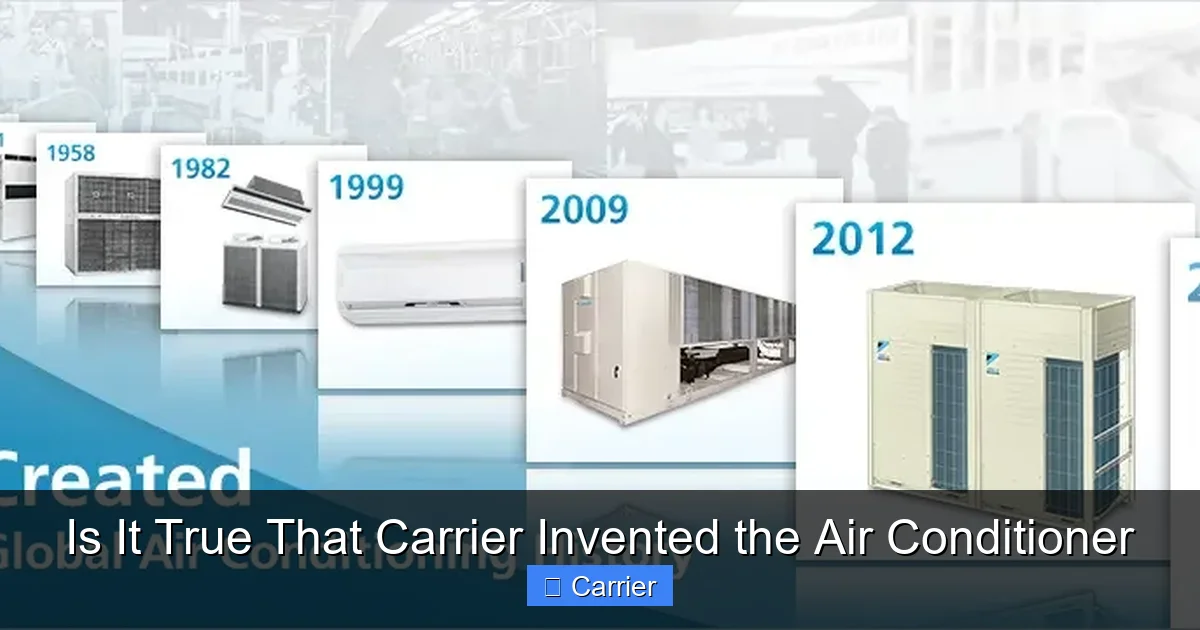
Visual guide about Is It True That Carrier Invented the Air Conditioner
Image source: pickhvac.com
You might assume the phrase “air conditioning” existed long before Willis Carrier used it. But here’s a fun fact: He actually invented the term.
Years after his 1902 breakthrough, Carrier began promoting his technology to other industries—textiles, food processing, pharmaceuticals—all of which needed stable environments. To explain what his machines did, he needed a clear label. In 1906, he officially coined the phrase “air conditioning” in a technical bulletin, describing it as “the treatment of air so the quantities of its heat, moisture, and motion may be regulated.”
That definition remains the core principle of HVAC (heating, ventilation, and air conditioning) systems today.
So while others may have tinkered with cooling or refrigeration earlier, Carrier gave the concept a name, a purpose, and a scalable framework. His work transformed air conditioning from a niche solution into a global industry standard.
From Printing Presses to Global Comfort
At first, Carrier’s invention was limited to large-scale industrial applications. Factories, warehouses, and laboratories benefited most. But soon, people noticed something remarkable: When workers breathed easier, productivity soared.
This led to rapid adoption in offices, movie theaters, and department stores. By the 1920s, cities like Chicago and Detroit had begun installing central air systems in public spaces. Families started dreaming of home comfort—though it would take decades for residential AC to become affordable.
Carrier himself didn’t stop there. In 1915, he founded Carrier Engineering Corporation in New York, dedicated to advancing climate control technology. Over the next century, the company expanded globally, developing innovations like:
– Packaged rooftop units for commercial buildings
– Energy-efficient chillers for hospitals
– Smart thermostats linked to weather data
– Eco-friendly refrigerants with low global warming potential
Today, Carrier is a household name—not because everyone owns their products, but because their influence permeates modern life. You’ll find their systems in airports, data centers, supermarkets, and yes—your living room.
The Science Behind the Cool: How Carrier’s System Worked
To understand why Carrier’s invention mattered, you need to know the basic science. His system operated on three key principles:
1. Evaporative Cooling
By passing warm air over chilled coils filled with refrigerant, moisture condensed and heat was absorbed. This lowered both temperature and humidity simultaneously—something older methods couldn’t do.
2. Precise Airflow Control
Instead of blasting cold air everywhere, Carrier’s fans delivered air at controlled speeds and volumes. This prevented drafts while maintaining consistent conditions.
3. Integration of Heat and Moisture Regulation
Most prior systems focused only on temperature. Carrier showed that humidity control was equally vital—especially in sensitive environments like labs or textile mills.
These weren’t revolutionary physics—they were brilliant applications of existing science. Carrier’s genius lay in combining them into a practical, reliable machine.
Did Anyone Else Invent Air Conditioning Before Carrier?
It’s tempting to say, “Wait—wasn’t there someone else?” And you’d be right to ask.
Before Carrier, several inventors experimented with cooling:
– **Oliver Evans** (1820s): Built an early refrigeration device using ammonia gas.
– **John Gorrie** (1850s): Created ice-making machines for patients in Florida, though his work wasn’t widely adopted.
– **Jacob Perkins**: Developed an early vapor-compression system in the 1830s.
However, none of these focused on controlled indoor climates for continuous use. They were either experimental, small-scale, or not designed for commercial environments.
Carrier’s contribution was different: He created a systematic, replicable, and commercially viable solution that could be adapted across industries. That’s why historians and engineers credit him as the true pioneer.
Carrier’s Lasting Legacy
Willis Carrier died in 1950, but his impact lives on. Here’s how his work reshaped the world:
– **Workplace Productivity**: Studies showed employees in air-conditioned offices were 10–15% more productive than those in unconditioned spaces.
– **Public Health**: Reduced heat-related illnesses and deaths in hot climates.
– **Urban Development**: Enabled construction in extreme climates, fueling growth in desert cities like Phoenix and Las Vegas.
– **Cultural Shifts**: Summer vacations moved indoors; outdoor events became feasible year-round.
– **Technological Spin-offs**: Innovations in insulation, ductwork, and smart controls all trace back to Carrier’s foundational ideas.
Even today, new technologies—like geothermal heat pumps or AI-driven climate systems—build on Carrier’s original vision of precise environmental control.
Practical Tips: Bringing Carrier’s Principles Into Your Home
Want to honor Carrier’s legacy? You don’t need a 1902-style machine—but you can apply his core ideas to save energy and improve comfort:
1. Control Humidity, Not Just Temperature
Use a dehumidifier in humid months or ensure your AC removes moisture effectively. Dry air feels cooler and prevents mold.
2. Maintain Consistent Airflow
Keep vents unobstructed and schedule annual HVAC maintenance. Poor airflow wastes energy and strains your system.
3. Upgrade to Efficient Systems
Look for ENERGY STAR-rated units. Modern Carrier systems use advanced compressors and variable-speed fans, just like the original—but smarter.
4. Use Smart Thermostats
Programs like Nest or Ecobee learn your habits and adjust temperatures automatically, reducing waste.
5. Seal Ducts and Insulate
Leaky ducts lose up to 30% of cooled air. Sealing them saves money and improves performance.
By following these tips, you’re not just staying cool—you’re honoring the spirit of innovation that started with one engineer’s curiosity.
Conclusion: A True Game-Changer
So, is it true that Carrier invented the air conditioner? Absolutely—and then some. Willis Carrier didn’t just build a machine; he launched an era of human comfort, safety, and progress. His work proved that science, when applied thoughtfully, can solve real-world problems and transform society.
From printing presses to smartphones, Carrier’s influence is everywhere. And while today’s air conditioners are far more advanced, they all carry his DNA.
Next time you turn on your AC, remember: You’re not just fighting the heat. You’re tapping into a legacy of ingenuity that began with a young man who asked, “What if we could control the air itself?”
And the answer? We can. We do. Thanks to Carrier.
Frequently Asked Questions
Who exactly invented the first air conditioner?
Willis Carrier, an American engineer, invented the first modern air conditioning system in 1902. His breakthrough solved a humidity issue at a Brooklyn printing plant by creating a machine that controlled both temperature and moisture.
Did anyone else invent cooling machines before Willis Carrier?
Yes—early inventors like John Gorrie and Oliver Evans experimented with refrigeration and cooling, but their systems were small-scale or experimental. Carrier’s was the first to offer systematic, commercial-grade climate control.
What did Willis Carrier originally want to achieve with his invention?
Carrier aimed to stabilize humidity and temperature in a printing plant to prevent paper expansion and ink misalignment. He wasn’t trying to make people comfortable—just fix a production problem.
When did air conditioning become common in homes?
Residential air conditioning grew slowly after the 1920s, but mass adoption didn’t happen until the 1950s and 1960s, thanks to improved affordability and efficiency.
Is the Carrier brand still around today?
Yes! Founded by Willis Carrier in 1915, Carrier Corporation remains a top global manufacturer of HVAC systems, serving homes, businesses, and industries worldwide.
How does modern air conditioning compare to Carrier’s original design?
Modern systems are far more efficient, quieter, and eco-friendly. However, they still rely on Carrier’s core principles: controlling temperature, humidity, and airflow through mechanical means.