The Carrier air conditioner 1.5 ton is a reliable, energy-efficient cooling solution perfect for medium-sized rooms in India. With advanced inverter technology, smart features, and strong after-sales support, it delivers consistent comfort and long-term savings.
Key Takeaways
Ideal Room Size: The 1.5-ton capacity suits rooms up to 150–180 sq. ft., making it perfect for bedrooms and living areas in Indian homes.
Energy Efficiency: Most models feature 3- or 5-star ratings and inverter compressors, reducing electricity bills by up to 30% compared to non-inverter units.
Advanced Cooling Technology: Carrier uses high-efficiency rotary compressors and anti-bacterial filters for faster cooling and healthier air.
Smart & Convenient Features: Wi-Fi connectivity, voice control via Alexa/Google Assistant, and sleep mode enhance user experience.
Durability & Warranty: Built with copper condensers and anti-corrosion coating, backed by 1-year comprehensive and 10-year compressor warranties.
Quiet Operation: Operates as low as 38 dB, ensuring peaceful sleep and minimal disturbance.
Trusted Brand Reputation: Carrier is a global leader in HVAC with strong service networks across India, ensuring easy maintenance and support.
📑 Table of Contents
- Introduction: Why Choose a Carrier Air Conditioner 1.5 Ton?
- What Makes the 1.5-Ton Capacity Ideal for Indian Homes?
- Choosing the Right Carrier 1.5 Ton Model for Your Needs
- Energy Efficiency: Saving Money and the Planet
- Refrigerant Technology: R32 and the 2026 Regulatory Landscape
- Advanced Features That Enhance Comfort and Convenience
- Smart Home Ecosystem Integration
- Durability and Build Quality: Built to Last
- Noise Levels and Real-World Performance
- Installation, Maintenance, and Warranty
- Installation Costs and What to Expect
- Customer Support and Service Network
- Comparison Table: Carrier 1.5 Ton vs Key Competitors
- Common Issues and Troubleshooting Tips
- Conclusion: Is the Carrier Air Conditioner 1.5 Ton Right for You?
- Frequently Asked Questions
Introduction: Why Choose a Carrier Air Conditioner 1.5 Ton?
When the summer heat hits hard—especially in cities like Delhi, Chennai, or Mumbai—having a reliable air conditioner isn’t just a luxury; it’s a necessity. Among the many brands available in India, Carrier stands out as a trusted name in home cooling. Their 1.5-ton air conditioners are especially popular, offering the perfect balance of power, efficiency, and smart features for most Indian households.
Whether you’re upgrading from an older unit or buying your first AC, the Carrier air conditioner 1.5 ton is designed to deliver consistent cooling without breaking the bank on electricity bills. With rising temperatures and increasing power costs, choosing the right AC model can make a big difference in both comfort and savings. Carrier combines decades of engineering expertise with modern technology to create units that are not only powerful but also durable and eco-friendly.
What Makes the 1.5-Ton Capacity Ideal for Indian Homes?
The “tonnage” of an air conditioner refers to its cooling capacity—not weight. A 1.5-ton AC can remove 18,000 BTUs (British Thermal Units) of heat per hour. This capacity is widely considered the sweet spot for most Indian homes, especially in urban apartments and mid-sized houses.
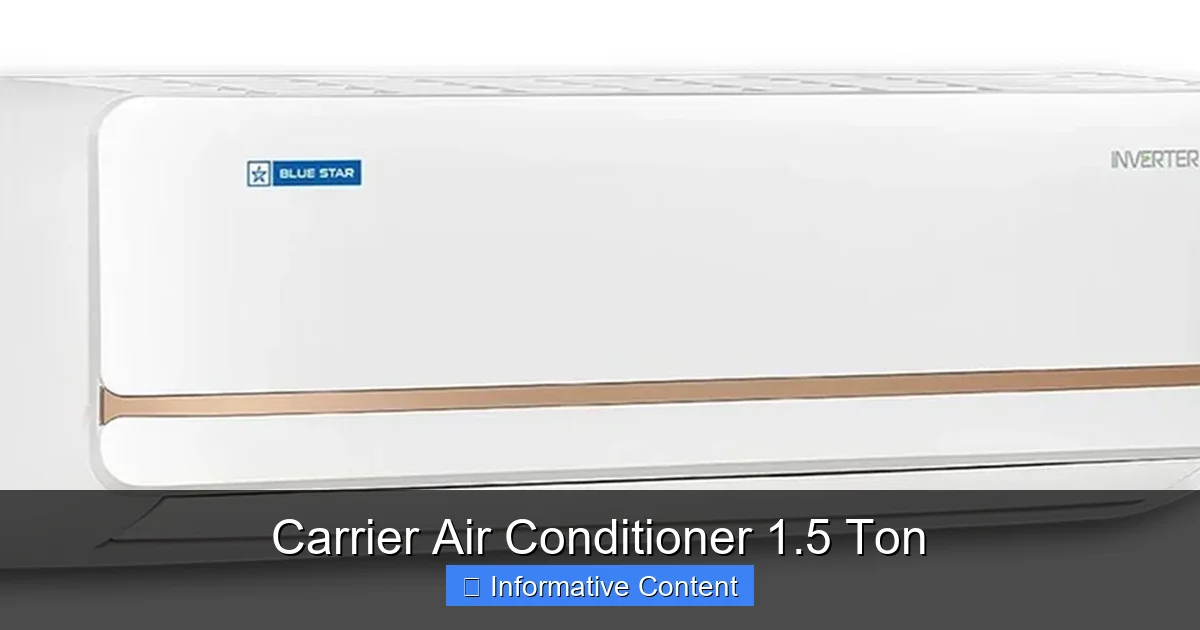
Carrier 1.5-ton split air conditioner indoor unit showing sleek design and display panel
Image source: 5.imimg.com
Perfect Room Size Match
For rooms ranging from 120 to 180 square feet—typical bedroom or small living room sizes—a 1.5-ton AC provides optimal cooling without overworking the unit. Oversized units cool too quickly, leading to humidity issues and frequent on/off cycles, while undersized ones struggle to maintain comfort. Carrier’s 1.5-ton models are engineered to match these room dimensions precisely, ensuring even temperature distribution and energy efficiency.
Balanced Power Consumption
Unlike larger 2-ton units that consume more power, the 1.5-ton capacity strikes a balance between performance and energy use. In cities with moderate to high summer temperatures (35°C–45°C), this size cools effectively without excessive strain on your electricity meter. Many users report noticeable reductions in their monthly bills after switching from older, non-inverter 1.5-ton models to newer Carrier inverter variants.
Flexibility Across Seasons
Even during shoulder seasons or in regions with milder summers, the 1.5-ton Carrier AC adapts well. Thanks to inverter technology, it adjusts compressor speed based on room temperature, avoiding the energy spikes common in conventional fixed-speed units. This means you get steady cooling whether it’s a scorching April afternoon or a humid July evening.
Choosing the Right Carrier 1.5 Ton Model for Your Needs
Carrier’s 1.5-ton lineup includes several series — Flexicool, Estra, Superia, and the premium Xtreme — each targeting a different price-to-performance tier. The Flexicool 3-star models suit budget-conscious buyers who still want inverter reliability, while the 5-star Estra and Superia variants deliver the lowest running cost and quietest operation. If your room faces west, has large windows, or sits on the top floor, step up to a 5-star unit with a higher ISEER (Indian Seasonal Energy Efficiency Ratio) — typically 5.0 or above — to handle the extra heat load without short-cycling. In practice, a common mistake is selecting solely on star rating; always check the ISEER value on the BEE label, because two 5-star models can differ by 0.5–0.7 ISEER points, translating to 150–200 kWh per year. For a step-by-step buying framework, see how to match capacity, features, and budget to your room.
Energy Efficiency: Saving Money and the Planet
One of the biggest concerns for Indian consumers is electricity cost. With rising tariffs and increasing reliance on cooling, energy efficiency has become a top priority. Carrier addresses this head-on with its range of high-star-rated 1.5-ton air conditioners.
BEE Star Ratings Explained
The Bureau of Energy Efficiency (BEE) in India assigns star ratings to appliances based on their energy performance. Carrier offers 1.5-ton models across 3-star, 4-star, and 5-star categories. While 3-star units are more budget-friendly upfront, 5-star inverter models can save up to ₹2,000–₹3,000 annually on electricity bills, paying for the price difference within 2–3 years.
Inverter Technology: The Game Changer
Traditional ACs run at full power until the room reaches the set temperature, then shut off completely—only to restart when it warms up again. This cycle wastes energy and causes temperature fluctuations. Carrier’s inverter ACs, however, use variable-speed compressors that ramp up or slow down as needed. This results in:
Up to 30% lower power consumption
More consistent room temperature
Reduced wear and tear on components
Faster initial cooling
Real-World Savings Example
Imagine running your AC for 8 hours daily during summer. A 5-star inverter Carrier 1.5-ton AC might consume around 1.2 units of electricity per hour, while a 3-star non-inverter model could use 1.6–1.8 units. At ₹8 per unit, that’s a difference of ₹32–₹48 per day—or over ₹1,000 per month. Over five years, that adds up to significant savings.
Refrigerant Technology: R32 and the 2026 Regulatory Landscape
All current Carrier 1.5-ton inverter models ship with R32 refrigerant, which has a global warming potential (GWP) of 675 — roughly one-third that of the older R410A (GWP 2,088). India’s phasedown schedule under the Kigali Amendment aligns with BEE’s push for lower-GWP refrigerants, and as of 2026, R32 is the de facto standard for new residential split ACs. This matters for two reasons: first, R32 systems operate at slightly higher pressures, so only certified technicians with R32-rated tools should service them; second, the lower refrigerant charge (typically 15–20% less by weight) reduces both environmental impact and long-term top-up costs. The Bureau of Energy Efficiency publishes updated refrigerant guidelines and star-rating criteria each year — worth a quick check before purchase.
Advanced Features That Enhance Comfort and Convenience
Carrier doesn’t just focus on cooling—it prioritizes user experience. Their 1.5-ton air conditioners come packed with smart, practical features that make daily use easier and more enjoyable.
Wi-Fi Connectivity and Smart Controls
Many newer Carrier models support Wi-Fi, allowing you to control your AC via smartphone apps like Carrier’s own “Konnekt” or third-party platforms. You can turn it on before reaching home, adjust temperatures remotely, or schedule operations—all from your phone. This is especially useful during unexpected heatwaves or when you’re running late.
Voice Assistant Compatibility
Integration with Amazon Alexa and Google Assistant means you can say, “Hey Google, set the AC to 24 degrees,” without lifting a finger. Perfect for lazy Sunday mornings or when your hands are full with groceries.
Sleep Mode and Auto Clean
Sleep mode gradually increases the temperature by 1–2°C over a few hours, mimicking natural body cooling during sleep—saving energy and preventing chills. Meanwhile, Auto Clean (or Hydrophilic Blue Fin technology) runs a drying cycle after shutdown to prevent mold and bacteria buildup inside the unit, ensuring cleaner air and longer lifespan.
Anti-Bacterial and Allergen Filters
Indoor air quality matters, especially for families with kids, elderly members, or allergy sufferers. Carrier ACs include multi-stage filtration systems that trap dust, pollen, smoke, and even some viruses. Some models feature PM 2.5 filters, which are increasingly important in polluted urban areas.
Smart Home Ecosystem Integration
Beyond basic Alexa/Google voice commands, Carrier’s Konnekt app now supports routines and scenes — for example, “Good Night” can lock doors, dim lights, and set the AC to 26°C with sleep mode in one tap. If you run a Home Assistant or Apple HomeKit hub, community-developed integrations let you expose Carrier AC entities locally without cloud dependency, which is handy during internet outages. In practice, a common mistake is assuming all “Wi-Fi ready” models include the module in-box; some entry-level SKUs require a separate USB dongle (typically ₹1,200–₹1,800). Verify the box contents before installation day. For a deeper look at where residential HVAC controls are heading, see latest innovation in air conditioning.
Durability and Build Quality: Built to Last
An air conditioner is a long-term investment. Carrier ensures its 1.5-ton units withstand India’s harsh climate conditions—high humidity, dust, voltage fluctuations, and salty coastal air.
Copper Condensers for Superior Performance
Unlike cheaper aluminum coils, Carrier uses 100% copper condensers in most of its 1.5-ton models. Copper offers better heat transfer, resists corrosion, and lasts longer. It also requires less maintenance and performs efficiently even in extreme heat.
Anti-Corrosion Coating
Coastal cities like Mumbai, Chennai, and Kochi face high salinity in the air, which can corrode AC components. Carrier applies special anti-corrosion coatings (like Gold Fin or Blue Fin) to protect critical parts, extending the unit’s life by several years.
Sturdy Cabinet Design
The outdoor unit (condenser) is built with weather-resistant materials and reinforced frames to handle rain, dust, and accidental bumps. Indoor units feature sleek, scratch-resistant panels that blend well with modern home décor.
Noise Levels and Real-World Performance
Carrier quotes 38 dB (indoor, low fan) for its premium 1.5-ton models, but real-world readings depend heavily on installation quality. Mounting the indoor unit on a vibration-isolated bracket, routing refrigerant pipes with gentle bends, and ensuring the outdoor unit sits on a rubber-padded stand can shave 3–5 dB off the perceived level. In practice, a common mistake is placing the outdoor unit directly on a shared wall or balcony slab without isolation — this transmits compressor hum into bedrooms. If noise sensitivity is a priority, specify a “silent mount” kit during the dealer survey; most authorized installers stock them for ₹800–₹1,200. For context on how split-system acoustics compare to ducted or cassette alternatives, see how HVAC air conditioning differs from standard air conditioning.
Installation, Maintenance, and Warranty
Buying a great AC is only half the battle—proper installation and regular care ensure it performs at its best for years.
Professional Installation Matters
Carrier recommends certified technicians for installation. A poorly installed unit can leak refrigerant, vibrate excessively, or fail to cool properly. Always choose authorized dealers who provide free or subsidized installation with purchase. Proper placement of the indoor and outdoor units, correct piping length, and secure mounting are crucial.
Routine Maintenance Tips
Clean or replace filters every 4–6 weeks during peak usage.
Check for dust buildup on the outdoor unit and clear debris.
Ensure proper drainage to avoid water leakage.
Schedule annual servicing before summer begins.
Comprehensive Warranty Coverage
Carrier offers a 1-year comprehensive warranty on the entire unit and a 10-year warranty on the compressor—one of the best in the industry. This reflects confidence in their product quality and gives buyers peace of mind. Always register your product online and keep service records for hassle-free claims.
Installation Costs and What to Expect
While many dealers advertise “free installation,” the fine print often covers only standard 3–4 m copper piping, basic wall brackets, and a single drain hose. Expect add-ons for: extra piping (₹450–₹600 per metre), core-cutting through RCC walls (₹800–₹1,500 per hole), outdoor unit stand fabrication (₹1,000–₹2,000), and voltage stabilizer purchase if your area sees swings beyond 150–280 V (₹2,500–₹4,000 for a 4 kVA unit). A realistic all-in budget for a typical 2-bedroom apartment install in 2026 is ₹6,000–₹10,000 above the AC price. Always get a written site-survey quote before committing. For a visual walkthrough of the process, see split AC installation guide.
Customer Support and Service Network
One reason Carrier remains a top choice in India is its extensive service network. With service centers in over 300 cities and thousands of authorized technicians, help is rarely far away—even in tier-2 and tier-3 towns.
Customers praise Carrier’s responsive customer care, especially during summer months when AC breakdowns spike. Many models also come with free annual maintenance checks for the first year, helping users stay on top of upkeep.
Comparison Table: Carrier 1.5 Ton vs Key Competitors
| Feature | Carrier 1.5T 5-Star (Estra/Superia) | LG 1.5T 5-Star Dual Inverter | Daikin 1.5T 5-Star (ATKL/FTKL) | Voltas 1.5T 5-Star Adjustable |
|---|---|---|---|---|
| ISEER (typical) | 5.1–5.3 | 5.2–5.4 | 5.0–5.2 | 4.9–5.1 |
| Compressor warranty | 10 years | 10 years | 10 years | 10 years |
| Refrigerant | R32 | R32 | R32 | R32 |
| Copper condenser | Yes (100%) | Yes (100%) | Yes (100%) | Yes (100%) |
| Anti-corrosion fin | Gold Fin / Blue Fin | Ocean Black Fin | Blue Fin | Blue Fin |
| Wi-Fi / App | Konnekt | ThinQ | Daikin Smart | Voltas Smart |
| Voice control | Alexa, Google | Alexa, Google | Alexa, Google | Alexa, Google |
| PM 2.5 filter | Select models | Select models | Standard on 5-star | Select models |
| Typical price range (2026) | ₹42,000–₹48,000 | ₹44,000–₹50,000 | ₹45,000–₹52,000 | ₹38,000–₹44,000 |
Street prices fluctuate with seasonal offers; check authorized dealers for current deals.
Common Issues and Troubleshooting Tips
Even reliable units occasionally need attention. Here are the most frequent Carrier 1.5-ton owner reports and first steps:
- Water dripping from indoor unit — usually a clogged drain pipe or tilted drain pan. Flush the drain with a wet/dry vacuum; ensure the indoor unit is level (slope 2–3° toward drain).
- AC not cooling, compressor running — check for dirty outdoor coil, low refrigerant (requires pro), or blocked airflow (curtains/furniture too close to indoor unit).
- Wi-Fi drops offline — power-cycle the router and AC; ensure 2.4 GHz band is enabled (Konnekt doesn’t support 5 GHz). Re-pair via app if needed.
- Unusual rattling/vibration — loose cabinet screws, unbalanced fan blade, or outdoor unit on uneven pad. Tighten accessible screws; call service for fan balance.
- Error codes (E1, E4, F0, etc.) — photograph the display and share with Carrier helpline (1800-103-2000) for remote diagnosis; many codes map to sensor faults that a technician can resolve in one visit.
For brand-agnostic troubleshooting flowcharts, see troubleshoot AC blowing warm air and AC condenser troubleshooting.
Conclusion: Is the Carrier Air Conditioner 1.5 Ton Right for You?
If you’re looking for a dependable, energy-efficient, and feature-rich air conditioner for a medium-sized room, the Carrier air conditioner 1.5 ton is an excellent choice. It combines proven reliability with modern innovations like inverter technology, smart controls, and superior air filtration—all tailored for Indian conditions.
While the initial cost may be slightly higher than some budget brands, the long-term savings on electricity, lower maintenance needs, and extended lifespan make it a smart investment. Whether you live in a bustling metro or a quiet suburb, Carrier’s 1.5-ton AC delivers comfort you can count on, season after season.
Ready to experience reliable cooling? Visit an authorized Carrier dealer or check trusted online retailers for the latest 2026 models and seasonal offers.
Frequently Asked Questions
Is a 1.5-ton AC sufficient for a 200 sq. ft. room?
A 1.5-ton AC is ideal for rooms up to 180 sq. ft. For a 200 sq. ft. space, especially if it gets direct sunlight or has high ceilings, consider a 2-ton unit for better cooling performance.
How much electricity does a Carrier 1.5-ton inverter AC consume?
A 5-star inverter model typically uses 1.0–1.3 units per hour, depending on usage and ambient temperature. This translates to roughly 8–10 units per day with 8 hours of operation.
Can I install a Carrier 1.5-ton AC myself?
No. Professional installation by authorized technicians is essential to ensure safety, efficiency, and warranty validity. DIY installation may void the warranty and cause performance issues.
Does Carrier offer no-cost EMI options?
Yes, many retailers and online platforms (like Amazon, Flipkart, and Croma) offer no-cost EMI plans for Carrier 1.5-ton ACs, making them more affordable upfront.
How often should I service my Carrier AC?
Schedule professional servicing once a year, preferably before summer. Clean filters monthly during peak usage to maintain airflow and efficiency.
Are Carrier ACs compatible with stabilizers?
Most modern Carrier inverter ACs have built-in voltage stabilizers and can handle input voltages from 150V to 280V, reducing the need for an external stabilizer in most Indian homes.
What is the difference between Carrier Flexicool and Estra series?
The Flexicool series targets the 3-star segment with essential inverter features, while the Estra series offers 5-star ISEER ratings, quieter operation (down to 38 dB), and additional filters like PM 2.5 — ideal if running cost and air quality are priorities.
Does Carrier provide annual maintenance contracts (AMC) after the first year?
Yes, Carrier’s authorized service partners offer paid AMC packages (typically ₹2,500–₹4,000/year for 1.5-ton splits) covering two preventive visits, coil cleaning, gas pressure check, and priority breakdown response.