Camping is all about enjoying the great outdoors, but let’s be honest, sometimes those warm summer nights or humid days can really put a damper on the experience. Sweating in your sleeping bag isn’t anyone’s idea of a good time! That’s where a fantastic portable air conditioner for your tent comes in handy. These compact powerhouses can transform your camping trip from sticky to serene, ensuring you get a good night’s sleep and a comfortable day in camp.
But with so many options out there, how do you choose the best tent for air conditioner setup? Don’t sweat it! We’ve done the legwork for you, diving deep into features, power options, and user feedback to bring you a comprehensive review of the top 7 portable AC units designed to keep you cool when you’re out exploring. Let’s find the perfect companion for your next adventure!
1. Cybertake Portable Camping Air Conditioner, 5100 BTU
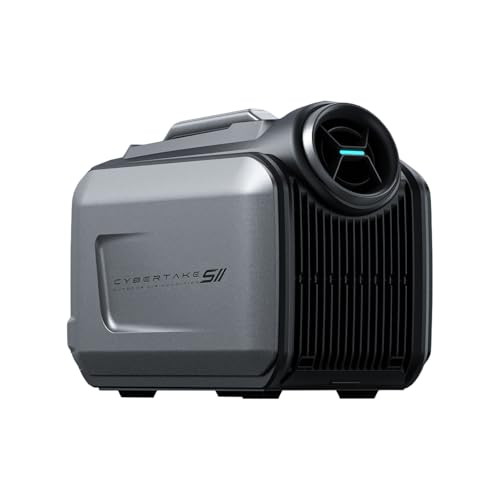
This Cybertake unit is a true game-changer for campers seeking ultimate comfort and versatility. What makes it stand out is its incredible flexibility in power options and its robust ability to not just cool, but also heat your space. Whether you’re off-grid with a power station or hooked up to your RV, this portable AC unit delivers consistent climate control, making it a fantastic choice if you’re looking for the best tent for air conditioner setup that adapts to any situation.
-
Key Features:
- Versatile power options: AC wall outlet, car/RV (12V/24V), portable power station (DC 48V).
- Robust 5100 BTU cooling and 6100 BTU heating.
- Conditions spaces up to 130 sq. ft.
- 4 modes: Cool, Heat, Dehumidify, Eco+.
- 3 adjustable fan speeds and precise temperature control (60°F to 90°F).
- 0-12 hour timer.
- Quick 30-second setup with full accessory kit.
- Whisper-quiet 40dB operation.
- IPX4 water-resistant shell and durable construction.
-
Pros:
- Excellent power versatility for various camping scenarios.
- Offers both cooling and heating, extending its usability year-round.
- Relatively powerful BTU for its portable size.
- Quiet operation ensures peaceful sleep.
- Rugged and splash-proof design is ideal for outdoor use.
-
Cons:
- May be overkill or slightly larger than needed for very small, single-person tents.
- Requires a 48V DC power station for optimal portable performance, which might be an additional investment.
-
User Impressions: Campers rave about the Cybertake’s ability to keep them comfortable in diverse weather conditions. Many appreciate the heating function for chilly nights and the relatively low noise level. The multiple power input options are a huge plus for those who venture off the beaten path.
- See it on Amazon here
2. VIVOSUN AeroLush C08 Smart Air Conditioner, 8000BTU, 4-in-1

The VIVOSUN AeroLush C08 is a powerhouse, especially if you’re looking to maintain precise climate control in a larger grow tent or even a sizeable glamping tent. What truly sets it apart is its smart control capabilities and precision sensors, making it ideal for those who want to monitor and adjust their environment with accuracy, even remotely. This isn’t just a portable AC; it’s a smart climate management system.
-
Key Features:
- 8000 BTU compressor for superior cooling.
- Precision Sensirion sensors for real-time temperature, humidity, and VPD monitoring.
- 4-in-1 Versatility: Cooling, drying, heating, and fan modes.
- Smart Control via Vivosun app for remote monitoring and integration with Smart Grow System.
- Portable design with built-in handles and caster wheels.
- Self-evaporating system and auto-restart after power outages.
- Recommended for grow tents up to 5×5 ft.
-
Pros:
- High 8000 BTU capacity, suitable for larger tents or spaces.
- Advanced smart controls and sensor monitoring.
- Comprehensive 4-in-1 functionality.
- Extremely convenient with its self-evaporating and auto-restart features.
- Easy to move with wheels and handles.
-
Cons:
- Initially designed for grow tents, so some features might be more specialized than a general camping AC needs.
- Higher BTU means it might be overkill for very small tents, potentially using more power than necessary.
-
User Impressions: Users love the powerful cooling and the smart features that allow them to control the climate from their phone. While primarily marketed for grow tents, many outdoor enthusiasts appreciate its robust performance and portability for larger camping setups or even RVs.
- See it on Amazon here
3. CYBERTAKE Portable Air Conditioner, 3-in-1 AC Unit (3300 BTU)

Another strong contender from Cybertake, this 3300 BTU model focuses on energy efficiency and quiet operation, making it an excellent option for campers who prioritize a peaceful night’s sleep without draining their power station too quickly. Its custom Panasonic compressor and smart inverter algorithm mean you get powerful cooling for less energy, a key factor when choosing the best tent for air conditioner for extended trips.
-
Key Features:
- 3300 BTU cooling, powered by a custom 48V Panasonic compressor.
- High-efficiency 48V DC system with smart 3.0 inverter algorithm for energy saving (100W/hour in sleep mode).
- Multiple power supply options: AC, DC battery (with boost converter), portable power stations, car chargers.
- Ultra-quiet 38 dB Sleep Mode.
- Portable design (21.6 lbs) with aluminum alloy frame and ergonomic handle.
- Auxiliary drainage function when humidity is below 70%.
- 5-in-1 Versatility: Bluetooth App Control, Cooling, Dehumidifier, Fan, Eco-Sleep Mode, 24H Timer.
- Uses R290 eco-friendly refrigerant.
-
Pros:
- Exceptional energy efficiency, especially in Eco-Sleep mode.
- Incredibly quiet, perfect for sleeping.
- Very lightweight and compact for easy portability.
- Eco-friendly refrigerant choice.
- Versatile power options and app control add convenience.
-
Cons:
- 3300 BTU might struggle with very large tents in extreme heat.
- DC battery requires a separate boost converter purchase.
-
User Impressions: Customers are highly impressed with how quiet this unit runs, especially in sleep mode, and its minimal power consumption. Its compact size and portability also receive high praise, making it a favorite for hikers and solo campers.
- See it on Amazon here
4. VEVOR Portable Air Conditioner, 4250 BTU 3-Speed Air

The VEVOR Portable Air Conditioner stands out with its robust 4250 BTU cooling power and crucial compatibility with DC 24V power supplies, making it a fantastic choice for those relying on vehicle power in their RV, truck, or car camping setup. Its “no-drain” design is also a huge plus, simplifying operation and eliminating the hassle of condensation management.
-
Key Features:
- Powerful 4250 BTU cooling with 530W output and R290 refrigerant.
- Compatible with DC 24V car power supplies.
- Ideal for rooms ≤8㎡ (approx. 86 sq. ft.).
- Multiple modes: Cooling, sleep, dehumidifying, and fan functions.
- Adjustable fan speeds and a 24-hour timer.
- No-drain design for hassle-free operation.
- Equipped with exhaust hose and outlet adapter for bidirectional cooling (indoor/outdoor).
-
Pros:
- Strong cooling capacity for its size.
- Direct DC 24V compatibility is perfect for vehicle-based camping.
- “No-drain” feature significantly reduces maintenance.
- Versatile modes for different climate needs.
- Portable and lightweight for easy transport.
-
Cons:
- Less powerful than some high-end units, might struggle with larger tents or extreme heat.
- Primarily 24V DC focused, so 12V users might need converters or look elsewhere.
-
User Impressions: Campers frequently highlight the VEVOR’s effectiveness in small to medium tents and its invaluable 24V DC compatibility. The no-drain feature is a consistent favorite, making setup and use incredibly simple.
- See it on Amazon here
5. ZY.Hyisinn Portable Air Conditioner, 3300BTU Tent Air
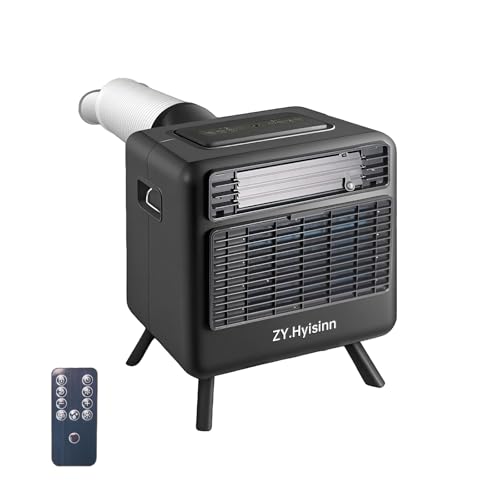
If rapid cooling and straightforward operation are high on your priority list, the ZY.Hyisinn Portable Air Conditioner is definitely worth a look. Its ability to drop temperatures significantly in minutes makes it a great pick for quickly making your tent comfortable after a hot day, and the inclusion of a remote control adds a layer of convenience that campers appreciate.
-
Key Features:
- 3300 BTU powerful cooling, capable of dropping temperature by 60°F in 15 mins.
- Adjustable temperature range: 60-86°F.
- 0-24 hour timer and adjustable fan speed (high/low).
- Two ways to operate: control panel and remote control.
- Compact size (11.73″D x 14.01″W x 14.48″H) and 28 lbs weight.
- Plugs into standard 110V outlet.
- Three preset modes: Cool, Dehumidify, and Fan.
- Safety Lock and Sleeping Mode for quiet and power-saving operation.
-
Pros:
- Impressive rapid cooling capability.
- User-friendly with both on-device and remote controls.
- Safety lock and sleep mode enhance usability and comfort.
- Suitable for 110V outlets, making it easy to use where power is available.
- Versatile with cooling, dehumidifying, and fan functions.
-
Cons:
- At 28 lbs, it’s not the lightest option for extended hikes.
- Primarily 110V AC powered, limiting off-grid portable power options unless you have a robust inverter.
-
User Impressions: Users appreciate how quickly this unit cools down their space, making it perfect for those immediate relief moments. The remote control is a big hit, allowing adjustments without leaving your sleeping bag. Its performance in small tents is frequently praised.
- See it on Amazon here
6. Portable Air Conditioner, 2000BTU 11.5Lb Tent Air

For ultralight campers or those needing a truly minimal cooling solution for a small tent, this 2000 BTU portable air conditioner is a standout. Weighing a mere 11.5 lbs, it’s one of the lightest on the market, making it incredibly easy to transport. Plus, its unique 4-in-1 functionality, including a lighting mode, adds an unexpected layer of utility. If you’re looking for the absolute lightest best tent for air conditioner solution for a 1-3 person tent, this is it.
-
Key Features:
- Ultra-compact and lightweight: only 11.5 lbs (5.2kg).
- 2000 BTU cooling capacity, suitable for 1-3 person tents.
- Uses a Panasonic compressor for efficiency.
- Low noise level: <49dB.
- Super large air outlet with 6 levels of wind speed (max 8.3m/s).
- 4-in-1 functionality: Cooling, Strong Cooling, Ventilation, Sleep, Dehumidification, Lighting.
- Two ways to operate: Control panel and remote control.
- Comes with a 24V DC power cord for car/truck cigarette lighters.
- 1.2L water storage tank with drain pipe for extended use.
-
Pros:
- Extremely lightweight and portable, ideal for minimalists.
- Compact size saves valuable tent space.
- Unique lighting function adds emergency utility.
- 24V DC compatibility makes it suitable for trucks and some RVs.
- Versatile 6 modes for different conditions.
-
Cons:
- 2000 BTU is only suitable for very small, enclosed spaces; not for larger tents.
- Noise level (up to 49dB) might be noticeable for sound-sensitive individuals, despite being relatively low.
- Higher price due to miniaturization and Panasonic compressor.
-
User Impressions: Reviewers love the incredible portability and small footprint of this unit, confirming its suitability for single or small two-person tents. The convenience of the remote control and the unique lighting feature are often mentioned as pleasant surprises.
- See it on Amazon here
7. 5200BTU Portable Air Conditioners Camping Tent Air

This 5200 BTU portable air conditioner offers a fantastic balance of strong cooling power and handheld portability, making it a versatile choice for a variety of camping and outdoor activities. Its ability to quickly drop temperatures, combined with a “no-drain” feature under certain conditions, means less hassle and more immediate comfort wherever you set up camp.
-
Key Features:
- Fast cooling: 5200 BTUs, can reduce temperature by 18°F (10°C) in 5 minutes.
- Covers an area of 140 sq. ft.
- Consumes less than 400W/hour, uses a GMCC High-end compressor.
- Temperature control range: 60℉-88℉ (16℃-30℃).
- Handheld portable design: 22.511.813.7 inches, weighs 33 pounds.
- Four modes: Cool, Dry, Sleep, and Fan with remote control.
- 24-hour timer.
- Low noise level of 46-50dB in sleeping mode.
- No-Drain design when air humidity is less than 70%.
-
Pros:
- Excellent cooling capacity for medium to larger tents.
- Rapid temperature reduction for immediate comfort.
- Relatively low power consumption for its BTU output.
- Versatile for various indoor and outdoor scenarios.
- “No-drain” feature simplifies operation under moderate humidity.
-
Cons:
- At 33 lbs, it’s one of the heavier portable options on this list.
- Requires drainage above 70% humidity, which can be frequent in some humid climates.
-
User Impressions: Users praise this unit for its powerful and quick cooling, noting its effectiveness even in larger tent setups. The portability, despite the weight, is appreciated thanks to the integrated handle. Many also highlight the quiet sleep mode as a significant benefit.
- See it on Amazon here
Frequently Asked Questions (FAQ)
Q1: How many BTUs do I need for my tent air conditioner?
A: The ideal BTU (British Thermal Unit) depends on your tent size and the outside temperature. As a general rule:
* Small tents (1-3 people, up to 50 sq ft): 2,000-3,500 BTU
* Medium tents (4-6 people, 50-100 sq ft): 3,500-5,000 BTU
* Large tents/Glamping (6+ people, 100+ sq ft): 5,000-8,000+ BTU
Remember that extreme heat and direct sunlight will require more BTUs to be effective.
Q2: What are the common power options for a portable tent AC unit?
A: Most portable tent ACs offer versatile power options:
* AC Wall Outlet (110V/240V): Standard household plug, suitable for campgrounds with electrical hookups.
* DC Power (12V/24V/48V): Connects to car cigarette lighters, RV power, or specialized portable power stations. This is crucial for off-grid camping.
* Portable Power Stations/Solar Generators: Increasingly popular for providing power to AC units in remote locations, often combined with solar panels for recharging.
Q3: Can I use a regular window AC unit in a tent?
A: While technically possible, it’s generally not recommended. Window AC units are designed for permanent installation and proper window sealing. Using them in a tent is usually inefficient, requires significant modification to the tent (creating a large opening), and can pose safety risks due to instability and potential weather exposure. Portable AC units are specifically designed for tent environments.
Q4: How do I vent a portable air conditioner in a tent?
A: Proper venting is crucial for any portable AC. Most units come with an exhaust hose that expels hot air. You’ll need to direct this hose outside the tent. Common methods include:
* Tent AC Port: Some tents come with a designated zippered port for AC hoses.
* Window/Door Flap: Run the hose out through a partially unzipped window or door flap, then seal around it with clips or Velcro to prevent warm air from re-entering.
* DIY Cutout: For more permanent setups, some campers might create a reinforced cutout in a tent wall, but this can void warranties and compromise tent integrity.
Q5: Are tent air conditioners noisy?
A: The noise level varies significantly by model, typically ranging from 38 dB (whisper-quiet) to around 60 dB (comparable to a normal conversation). Many portable ACs feature “sleep modes” that reduce fan speed and compressor activity to lower noise levels, making them more suitable for nighttime use. Always check the dB rating in the specifications if noise is a concern for you.
Q6: Do portable tent ACs require drainage?
A: Many portable ACs collect condensation as they cool and dehumidify. Some units have a “self-evaporating” design, where the moisture is expelled with the hot exhaust air, eliminating the need for manual drainage under normal humidity conditions. Others have a water tank that needs to be emptied periodically or an option to connect a drain hose for continuous drainage, especially in high-humidity environments. Always check the product features regarding drainage.
Q7: What is R290 refrigerant and why is it important?
A: R290 (propane) is a natural refrigerant that is increasingly used in portable air conditioners due to its significantly lower Global Warming Potential (GWP) compared to older refrigerants like R410A. It’s an eco-friendly choice that helps reduce the environmental impact of your cooling equipment, making it a more sustainable option for outdoor enthusiasts.