Dreaming of hitting the open road, exploring remote destinations, and enjoying the freedom of boondocking? Sounds amazing, right? But let’s be real – the great outdoors can get hot, especially when you’re adventuring in the summer months. That’s where a reliable air conditioning system comes in, and for the savvy RVer, a DC air conditioner for RVs is a game-changer. These aren’t your traditional shore power units; they run directly off your 12V battery system, making them perfect for off-grid adventures.
Choosing the right 12V RV AC unit can feel a bit overwhelming with so many options out there. You’re looking for efficiency, quiet operation, and enough cooling power to keep your space comfortable without draining your batteries in an hour. We’ve scoured the market to bring you a roundup of the top contenders, helping you find the best DC air conditioner for RV travel. Get ready to stay cool, no matter how far off the beaten path you go!
Why Choose a DC Air Conditioner for Your RV?
Opting for a DC-powered air conditioner over a traditional AC unit (which requires 120V shore power or a generator) offers several distinct advantages for RVers:
- Off-Grid Freedom: This is the big one! DC units run directly from your RV’s 12V battery bank, often paired with solar panels. This means you can stay cool without needing hookups or running a noisy generator.
- Energy Efficiency: Many modern DC units utilize inverter technology, which allows them to modulate compressor speed. This not only provides more consistent cooling but also significantly reduces power consumption compared to older, on/off style AC units.
- Quiet Operation: Without a generator roaring nearby, and with advanced compressor technology, DC air conditioners often operate much more quietly, enhancing your peace and quiet in nature.
- Reduced Generator Use: Less reliance on a generator means saving on fuel costs, less noise pollution, and a more environmentally friendly footprint.
- Compact & Low-Profile: Many DC models are designed with a sleek, low-profile footprint, reducing wind drag and fitting easily onto various RV types.
How We Picked the Best
To help you navigate the choices, we focused on several key factors: cooling capacity (BTU), power consumption, noise levels, installation ease, durability, and additional features like heating or smart controls. We wanted to find units that offer robust performance without compromising your off-grid capabilities.
Here are our top picks for the best DC air conditioner for RVs available today:
1. 12V RV Air Conditioner with Heat Pump, 11,500 BTU Rooftop

This 12V RV air conditioner is a powerhouse for those serious about off-grid comfort, not just for cooling but also for staying warm. With a robust 11,500 BTU cooling capacity and an integrated heat pump, it’s designed to keep you comfortable year-round, all while running directly from your 12V battery system. Its ultra-quiet operation and slim profile make it a premium choice for discreet and efficient climate control.
Key Features:
– High-Efficiency 11,500 BTU Cooling Performance for scorching temperatures.
– 12V DC Direct Power, eliminating the need for an inverter or generator.
– Ultra Quiet Operation (as low as 45dB) with advanced noise-reduction technology.
– Slim, Low-Profile Design (only 7.1 inches high) to reduce wind drag.
– Durable Housing made with high-strength ABS for UV resistance.
– Easy Installation & Wide Compatibility, fitting standard 14.1″x14.1″ rooftop openings.
Pros:
– Exceptional cooling and heating capacity for its class.
– True 12V operation, ideal for solar and battery setups.
– Very quiet, promoting undisturbed rest.
– Low-profile design is aesthetically pleasing and functional.
– Robust build quality for long-term reliability.
Cons:
– Higher BTU might mean higher amperage draw when running at full capacity.
– The heat pump feature may not be sufficient for extreme cold.
User Impressions:
Customers rave about the cooling power and the convenience of the heat pump. Many highlight its surprisingly quiet operation, which is a huge plus for sleeping or just relaxing. The direct 12V connection is a major draw for off-grid enthusiasts, though some users note the importance of having an adequate battery bank to support its full potential.
2. RV Air Conditioner, 12V 10000 BTU Rooftop Air Conditioner

This 10,000 BTU RV air conditioner offers a rapid cooling experience, promising to chill your RV in a mere 15 minutes. It’s built tough to withstand the rigors of RV life, featuring UV-stabilized materials and a zinc-coated condenser. Beyond just cooling, it includes a supplementary PTC heater for those milder chilly nights, making it a versatile choice for many travelers who need quick and reliable climate control.
Key Features:
– Efficient 10,000 BTU cooling for quick comfort.
– 4,500 BTU PTC heater for supplementary warmth.
– Durable & Weather-Resistant construction with UV-stabilized ABS and zinc-coated condenser.
– Quiet Operation thanks to brushless copper motor fans and spring-supported mounts.
– Smart Control & Easy Operation with remote control, temperature monitoring, and multiple modes (eco, sleep, turbo).
Pros:
– Very fast cooling performance.
– Built to last in harsh outdoor conditions.
– User-friendly smart controls enhance comfort.
– Quiet operation compared to many traditional units.
– Offers both cooling and a supplemental heating option.
Cons:
– PTC heater isn’t suitable as a primary heat source in very cold conditions or large RVs.
– Max BTU output might still draw significant power, requiring a good battery setup.
User Impressions:
Users frequently praise this unit’s ability to cool down their RVs quickly, which is a massive benefit on hot days. The smart control features and remote are also big hits for convenience. While the heater is appreciated for mild weather, owners understand its limitations for truly cold environments. Its robust construction gives many peace of mind on the road.
3. Countrymod 12V DC RV Air Conditioner 10000 BTU RV AC

The Countrymod 10,000 BTU unit stands out with its intelligent variable frequency design, which allows it to adjust compressor speed and cooling output on demand. This smart approach not only achieves rapid cooling but also optimizes energy consumption, boasting impressive efficiency and extended battery life. Its horizontal compressor design contributes to stability and durability, making it a solid choice for consistent performance.
Key Features:
– 300-900W Inverter Design for rapid and adjustable 10,000 BTU cooling.
– Energy-saving efficiency, consuming only 0.3 kWh per hour (5x more efficient than standard ACs).
– Ultra-low decibel operation (45-55dB), providing a comfortable, quiet environment.
– Stable and durable horizontal compressor design for less vibration and a lower center of gravity.
– Easy to Install, fitting standard 14″ x 14″ roof vents and designed for ductless RVs.
Pros:
– Highly energy-efficient, extending battery life significantly.
– Very quiet operation, great for restful nights.
– Intelligent cooling adjusts to maintain optimal comfort.
– Durable and stable design built for the road.
– Simple, ductless installation for compatible RVs.
Cons:
– Not suitable for RVs with existing duct systems.
– May require professional installation if you’re not comfortable with electrical work.
User Impressions:
Many users are genuinely impressed by the energy efficiency, noting how little power it draws, which is crucial for off-grid living. The quiet performance is also a recurrent positive point, allowing for peaceful evenings. Its smart cooling feature receives praise for maintaining a steady, comfortable temperature without direct, uncomfortable airflow.
4. Aspligo 12v rv rooftop dc air conditioner 8000BTU 12 volt

The Aspligo 8000 BTU 12V rooftop DC air conditioner offers a compact and user-friendly solution for cooling a variety of vehicles. It boasts a fast cooling capacity and a quiet operation, ensuring comfort whether you’re driving or parked. Designed for easy, all-in-one installation, it’s a versatile choice for anyone looking for straightforward climate control without complex modifications.
Key Features:
– Fast Cooling 8000BTU, increasing cooling capacity by 15% compared to some AC power systems.
– Remote Control and LED display for easy operation and temperature adjustment.
– Low Noise 50dB, providing a quiet environment for driving and sleeping.
– Easy Installation as an all-in-one unit with pre-assembled parts and clear instructions.
– Universal Fit for a wide range of vehicles including trucks, RVs, vans, and agricultural vehicles.
– Includes a 1000W hot air volume for supplementary warmth.
Pros:
– Very easy and quick installation process.
– Quiet operation suitable for overnight use.
– Remote control adds convenience.
– Versatile fit for many vehicle types, not just RVs.
– Good cooling capacity for its size and power draw.
Cons:
– 8000 BTU might be less powerful for larger RVs in extreme heat.
– Heating capacity is relatively low and supplemental.
– Specific roof opening requirements mean checking compatibility carefully.
User Impressions:
Customers love how easy this unit is to install, often noting they had it up and running quickly. The low noise level is frequently highlighted as a significant advantage for comfortable travel and rest. While some with larger RVs wish for more BTUs, it’s generally praised for its efficient cooling within its specified capacity, especially for smaller to medium-sized spaces.
5. Universal 12V Air Conditioner Hidden Underbody RV Air
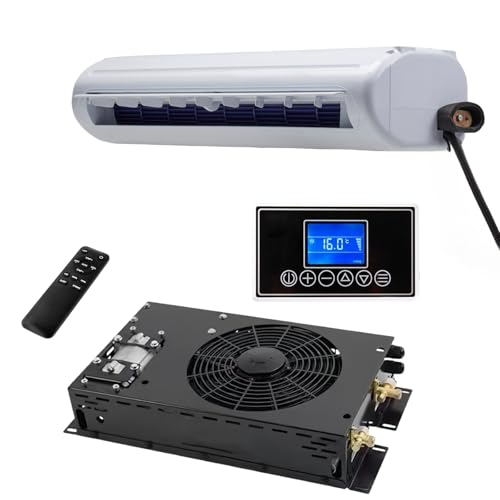
This Universal 12V air conditioner offers a unique “hidden design” with its outdoor unit mounted under the vehicle, saving roof space and maintaining a clean RV aesthetic. Providing around 9000 BTU cooling, it’s a powerful and discreet solution. Its intelligent power-saving features automatically adjust compressor output based on temperature, optimizing energy use for extended boondocking.
Key Features:
– Hidden design with a durable metal shell for underbody installation.
– Cooling capacity of 2200-2400W (approx. 9000BTU).
– Power saving functionality with automatic compressor power adjustment.
– Separate control panel for adjusting air volume, temperature, and low-pressure protection.
– Applicable to a wide range of vehicles including trucks, campers, trailers, and RVs.
– Comes pre-charged with refrigerant for direct use after installation.
Pros:
– Saves valuable roof space, ideal for solar panels or roof racks.
– Discrete installation maintains vehicle aesthetics.
– Smart power management helps conserve battery life.
– Robust metal outdoor unit for enhanced durability.
– Good cooling capacity for various vehicle sizes.
Cons:
– Installation underbody can be more complex than rooftop for some.
– Requires a strong 12V battery system with at least 70A output.
– Evaporator unit still needs an interior mounting spot (e.g., ceiling).
User Impressions:
The unique underbody installation is a huge selling point for those who want to keep their roof clear or have height restrictions. Users appreciate the robust build of the outdoor unit and the effective cooling. The power-saving features are also frequently mentioned as a benefit for longer off-grid stays, provided their battery setup can handle the initial current draw.
6. Countrymod 12V DC RV Air Conditioner 11000 BTU RV AC

Stepping up from its 10,000 BTU sibling, the Countrymod 11,000 BTU DC RV air conditioner delivers even more rapid cooling with the same intelligent variable frequency design. It maintains exceptional energy efficiency, consuming only 0.3 kWh per hour, ensuring your battery lasts longer. With its ultra-low decibel operation and stable horizontal compressor, this unit offers powerful yet quiet climate control for larger RVs or hotter climates.
Key Features:
– 300~900w inverter Design for rapid 11,000 BTU cooling capacity.
– Energy-saving efficiency, consuming only 0.3 kWh per hour for up to 10 hours of battery life.
– Ultra-low decibel operation (45-55dB) for a peaceful cabin environment.
– Stable and durable horizontal compressor design for reduced vibration and increased lifespan.
– Easy to install, fitting standard 14″ x 14″ roof vents, suitable for ductless RVs.
Pros:
– Higher cooling capacity for larger spaces or extreme heat.
– Outstanding energy efficiency prolongs off-grid comfort.
– Exceptionally quiet operation, perfect for sleeping.
– Robust and stable construction designed for RV travel.
– Straightforward installation for compatible RVs.
Cons:
– Like its 10,000 BTU counterpart, it’s not designed for ducted RV systems.
– Higher BTU might translate to a higher peak current draw, demanding a capable battery bank.
User Impressions:
Owners of the 11,000 BTU Countrymod are particularly satisfied with its powerful cooling, often citing its ability to quickly bring down temperatures in more spacious RVs. The incredible energy efficiency continues to be a highlight, making it a favorite among serious boondockers. The quietness is also consistently praised, making for a much more enjoyable camping experience.
7. Universal 12V Air Conditioner Hidden Underbody RV Air

Another excellent option from Universal, this 12V air conditioner also features the innovative hidden underbody design, preserving your RV’s rooftop real estate for solar panels or storage. Offering a solid 9000 BTU of cooling, it’s designed with an LCD style evaporator and a brushless motor, contributing to its energy-efficient operation. It intelligently adjusts compressor power based on temperature, making it a smart choice for conserving battery life on the go.
Key Features:
– Hidden design with a durable metal shell for underbody installation, saving roof space.
– Cooling capacity of 2200-2400W (approx. 9000BTU).
– Power saving with an LCD style evaporator and brushless motor for automatic compressor adjustment.
– Applicable to a wide array of vehicles including trucks, campers, trailers, and RVs.
– Comes pre-charged with refrigerant for immediate use after proper connection.
– Settable temperature range of 16-32 °C.
Pros:
– Maximizes roof space for other amenities.
– Energy-efficient operation thanks to smart compressor control and brushless motor.
– Robust and durable external unit construction.
– Good cooling power for many RV sizes.
– Aesthetically pleasing as it’s largely out of sight.
Cons:
– Requires careful planning and execution for underbody installation.
– Needs a robust battery system capable of delivering 70A starting current.
– Evaporator unit installation on the interior still needs to be factored in.
User Impressions:
Similar to the other underbody unit, this model garners praise for its discreet design and effective cooling. The LCD evaporator and brushless motor are noted for contributing to its efficiency, allowing users to extend their off-grid stays. Reviewers emphasize the importance of verifying battery output before purchase to ensure optimal performance.
Buyer’s Guide: What to Look for in a DC RV Air Conditioner
Choosing the perfect DC air conditioner for RV life involves balancing several factors. Here’s a quick guide to help you make an informed decision:
- BTU Output: BTU (British Thermal Units) indicates cooling power.
- Small RVs/Vans (up to 20 ft): 5,000-8,000 BTU might suffice.
- Medium RVs (20-30 ft): 8,000-12,000 BTU is generally recommended.
- Large RVs (over 30 ft) or extreme heat: You’ll want 12,000+ BTU, potentially even considering multiple units.
- Remember: More BTUs mean more power draw, so balance cooling needs with battery capacity.
- Power Consumption & Battery Compatibility: This is critical for 12V units.
- Check the amperage draw (A) at both peak and average operation.
- Ensure your battery bank (lithium-ion is highly recommended) and charging system (solar, alternator) can sustain the AC for your desired run time.
- Many units need a significant starting current, so verify your battery can deliver this.
- Noise Level (dB): Quieter is always better, especially for sleeping or relaxing. Look for units in the 45-55 dB range.
- Installation Type:
- Rooftop: Most common, fits standard 14″x14″ vent openings. Can add to overall height.
- Underbody/Split System: Saves roof space, but installation can be more complex, requiring refrigerant lines and interior evaporator mounting.
- Durability & Weather Resistance: Your RV AC will face the elements. Look for UV-stabilized housing, robust compressors, and good gaskets.
- Additional Features:
- Heat Pump/PTC Heater: Provides supplemental warmth.
- Inverter Technology: More energy-efficient and provides consistent cooling.
- Remote Control & Smart Modes: Enhance convenience and optimize performance (eco, sleep, turbo modes).
- Low-Profile Design: Reduces wind drag and potential clearance issues.
FAQ: Your Top Questions About DC RV Air Conditioners Answered
Q1: How much battery power do I need for a 12V RV AC?
A1: This depends entirely on the AC unit’s amperage draw and how long you plan to run it. A unit drawing 30-60 amps would deplete a 100Ah (amp-hour) battery in 1.5-3 hours. For practical off-grid use, a battery bank of at least 200-400Ah (preferably lithium iron phosphate – LiFePO4) is often recommended, especially if you’re not consistently charging with solar.
Q2: Can a 12V RV AC cool a large RV?
A2: A single 12V DC unit, typically ranging from 8,000 to 11,500 BTU, is generally suitable for small to medium-sized RVs (up to around 25-30 feet). For larger RVs, or in extremely hot climates, you might need a higher BTU unit, or consider installing two smaller units to cover different zones effectively.
Q3: Are DC RV air conditioners noisy?
A3: Modern DC RV air conditioners are often designed for quiet operation, especially those with inverter compressors and brushless motors. Many models advertise noise levels between 45-55 decibels (dB), which is comparable to a quiet refrigerator or a normal conversation, making them much quieter than most generators.
Q4: What’s the difference between rooftop and underbody installation for DC RV ACs?
A4: Rooftop units are typically all-in-one and fit into a standard roof vent opening. They are generally easier to install but add to the RV’s height and occupy roof space. Underbody (or split system) units have the compressor and condenser mounted underneath the RV, with an evaporator unit inside. This saves roof space and can lower the RV’s center of gravity but usually involves more complex installation with refrigerant lines and interior wiring.
Q5: Do 12V RV ACs work with solar power?
A5: Yes, 12V DC RV air conditioners are designed to be highly compatible with solar power systems. The solar panels charge your 12V battery bank, which then powers the AC unit. For effective operation, you’ll need a sufficiently sized solar array, charge controller, and battery bank to meet the AC’s power demands, especially during peak usage.
Q6: Is a heat pump feature necessary in a DC RV AC?
A6: A heat pump provides heating by reversing the cooling cycle, efficiently extracting heat from the outside air and moving it indoors. While it’s great for taking the chill off during mild temperatures, it’s usually not sufficient as a primary heat source in very cold conditions (below freezing), where a dedicated RV furnace would be needed. It’s a nice bonus for extending your comfortable camping season.
Q7: How much does it cost to install a DC RV air conditioner?
A7: Installation costs vary widely. If you’re handy and comfortable with electrical work and cutting into your RV roof (or managing underbody mounting), a DIY installation can save you money. Professional installation can range from a few hundred dollars to over a thousand, depending on the complexity of the unit, your RV’s existing setup, and labor rates in your area.
Conclusion
Staying cool on your RV adventures, especially when you’re exploring off the grid, doesn’t have to be a dream. With the advancements in 12V DC air conditioning technology, you can enjoy consistent comfort without relying on shore power or a noisy generator. We’ve highlighted some of the best DC air conditioner for RV options available, each offering unique benefits from powerful cooling to exceptional energy efficiency and quiet operation.
Remember to consider your RV size, power setup, and personal comfort priorities when making your choice. By investing in the right DC RV air conditioner, you’ll unlock a new level of freedom and enjoyment on all your future road trips. Happy trails, and stay cool!