
Dreaming of hitting the open road, exploring remote destinations, and enjoying the freedom of boondocking? Sounds amazing, right? But what about those scorching summer days when you just want to kick back in a cool RV? That’s where a reliable solar panel for RV air conditioner setup comes into play! Powering your RV’s air conditioning with solar energy is the ultimate way to stay comfortable off-grid, allowing you to escape the heat without needing noisy generators or constant hookups.
While powering an entire RV air conditioner solely with solar might seem like a big task, advancements in solar technology have made it more accessible and efficient than ever. You’ll need a robust solar panel system, a capable battery bank, and a suitable inverter to convert that DC power into AC power for your unit. But don’t worry, we’re here to help you navigate the options!
In this guide, we’ll dive into some of the top solar panel options and kits designed to help you keep your RV cool, whether you’re just looking for supplementary power or a full off-grid solution. We’ve rounded up five excellent products, each offering unique benefits to fit different RVers’ needs.
Why You Need Solar Power for Your RV AC
Going solar for your RV’s air conditioning isn’t just about saving money on campsite fees; it’s about unparalleled freedom and comfort. Imagine parking by a serene lake, miles from any electrical hookups, and still being able to blast your AC. Solar power offers a quiet, eco-friendly alternative to generators, giving you peace of mind and preserving the tranquility of nature. It’s perfect for extended boondocking trips, reducing your carbon footprint, and enhancing your overall mobile living experience.
How Much Solar Power Do You Really Need?
Running an RV air conditioner on solar power is definitely achievable, but it requires a significant amount of energy. Most standard RV AC units consume between 1200 to 2000 watts of power when running, with a higher surge wattage at startup. To consistently power an AC, you’re not just looking at the solar panels themselves, but a complete system including a large battery bank (preferably lithium-ion for its depth of discharge and lifespan), a powerful inverter, and an efficient charge controller.
A general rule of thumb for sustained AC use might involve 400-800+ watts of solar panels and a substantial battery bank (200-400Ah or more, especially if lithium). It’s a significant investment, but the payoff in comfort and independence is huge. Smaller panels or kits might suffice for minimal, intermittent AC use or for running other appliances, but for dedicated AC power, think big!
Our Top Picks: Best Solar Panels for RV Air Conditioner
Let’s explore some fantastic options that can get you started on your journey to a cooler, more independent RV lifestyle.
ECO-WORTHY 200 Watts 12 Volt/24 Volt Solar Panel Kit

This ECO-WORTHY 200W solar panel kit is a fantastic starting point for RVers looking to dabble in off-grid power, offering a comprehensive package that’s ready to install. It’s particularly appealing for those who want a reliable power source for various applications, including keeping small appliances running and supplementing their RV battery to handle lighter cooling loads or fan use. The kit stands out for its all-inclusive nature, providing everything you need to get up and running quickly, making it a favorite for DIY enthusiasts and newcomers to solar alike.
-
Key Features
- Daily Output 800wh/day under 4 hours full sunshine conditions.
- High-performance monocrystalline solar cells with up to 21.5% efficiency.
- Durable, corrosion-resistant aluminum alloy frame for longevity.
- Withstands strong wind (2400Pa) and snow load (5400Pa).
- IP65 rated junction box for complete protection.
- Pre-drilled holes and plug-and-play cables for quick installation.
- Connectable in series (24V) or parallel (12V).
- Includes 2 x 100W mono solar panels, Z mounting brackets, 30A solar controller, 16.4ft 10 AWG solar cables, 2-in-1 connectors, and tray cable.
-
Pros
- Complete kit makes installation straightforward for beginners.
- High efficiency monocrystalline panels.
- Robust and durable design built for outdoor elements.
- Flexible wiring options (series or parallel).
- Excellent customer support and warranty.
-
Cons
- 200W might be too low for continuous, heavy-duty RV AC use alone.
- Included controller is a basic 30A PWM, not an MPPT which is more efficient.
-
User Impressions
Customers frequently praise this kit for its ease of installation and the fact that it comes with everything needed to start generating power. Many users find it perfect for charging RV batteries, running lights, and other small appliances, noting its solid build quality and reliable performance. Some advanced users suggest upgrading the charge controller for optimal efficiency. - See it on Amazon here
Renogy 200 Watts 12 Volts Monocrystalline RV Solar Panel
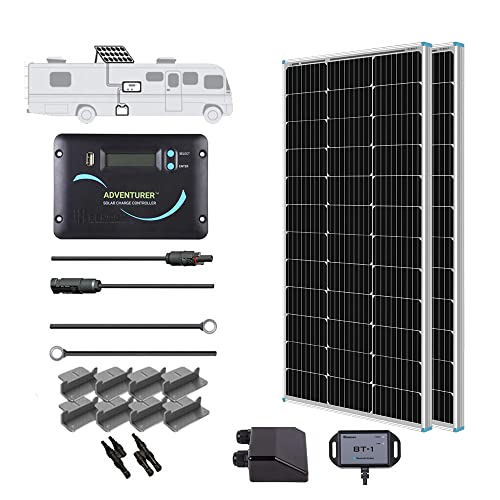
The Renogy 200 Watts Monocrystalline RV Solar Panel kit is another fantastic option from a well-respected brand in the solar industry, specifically geared towards RV and mobile applications. What makes this kit shine is its focus on robust performance and integrated protection for your battery system. It’s a stellar choice for RVers who demand efficiency and peace of mind when it comes to safeguarding their power setup, offering a great balance of power generation and system intelligence.
-
Key Features
- 800Wh daily output (under 4 hours sunlight).
- 22% high solar cell efficiency.
- Corrosion-resistant aluminum frame withstands high winds (2400Pa) and snow loads (5400Pa).
- Includes Renogy Adventurer-Li 30A PWM solar power charge controller (flush mount design).
- Controller offers multiple protections: overcharge, overvoltage, discharge, short circuit, reversed polarity.
- Supports lithium, lead-acid, and gel batteries.
- Pre-drilled holes and Plug&Play cables for fast mounting.
- Includes 3 pairs of Y branch connectors for parallel requirements.
- IP67 protection degree; operates from -40°F to +194°F.
-
Pros
- High-efficiency monocrystalline panels.
- Integrated, flush-mountable charge controller with comprehensive protection features.
- Durable construction suitable for harsh outdoor conditions.
- Versatile battery compatibility.
- Renogy’s strong reputation and technical support.
-
Cons
- 30A PWM controller, while protective, is less efficient than an MPPT controller.
- Similar to other 200W kits, it might need supplementing for full RV AC power.
-
User Impressions
RV owners often highlight the Renogy kit for its quality components and ease of integration into their existing systems. The Adventurer-Li controller is a particular favorite for its flush-mount design, which gives a clean look inside the RV. Users appreciate the robust build and the brand’s reliability, making it a go-to for many looking to enhance their off-grid capabilities. - See it on Amazon here
Renogy 100W Solar Panel N-Type, 12V 100 Watt Solar Panel

The Renogy 100W N-Type Solar Panel is not a full kit, but it’s a game-changer if you’re looking to expand an existing solar setup or build a highly efficient system from scratch. What truly sets this panel apart is its advanced N-Type cell technology, which delivers superior efficiency and better performance in challenging conditions, especially high temperatures. If you’re serious about maximizing power generation from each panel, and need a reliable building block for a robust solar panel for RV air conditioner system, this is an excellent choice.
-
Key Features
- Unmatched Cell Efficiency: Grade A+ N-Type cells delivering an impressive 25% conversion efficiency.
- 16BB Technology: Enhances photoelectric conversion efficiency, mitigates hot spots and hidden cracks, ensuring longer service life.
- Enhanced Performance in High Temperatures: Low temperature coefficient minimizes power loss in hot conditions.
- Built to Last: IP65 protection, low-iron tempered glass, and corrosion-resistant aluminum frames.
- Long-Term Reliability: Low degradation (≤1% first year, ≤0.4% annually) with a 10-year material/workmanship commitment and 25-year performance guarantee (80% output).
-
Pros
- Exceptional 25% conversion efficiency – generates more power per square foot.
- Superior performance in hot climates.
- Enhanced durability and longer lifespan due to advanced cell technology.
- Industry-leading warranty and degradation rates.
- Ideal for expanding larger RV solar systems.
-
Cons
- This is a standalone panel; you’ll need to purchase a charge controller, wiring, and batteries separately.
- Higher upfront cost per panel due to advanced technology.
-
User Impressions
Customers who invest in these N-Type panels are typically experienced solar users or those committed to building a top-tier system. They highly praise the superior output, especially in less-than-ideal weather or high heat, and the visible difference in charging speeds compared to older panels. The robust build and long-term guarantees also provide significant peace of mind. - See it on Amazon here
ECO-WORTHY 1.6KWH Complete Solar Panel Kit 390W 12V for RV/Cabin

Now, if you’re serious about running demanding appliances like an RV air conditioner, the ECO-WORTHY 1.6KWH Complete Solar Panel Kit is where it gets exciting. This isn’t just a few panels; it’s an entire off-grid solar system designed to be a “one-stop shop” solution. What truly makes this kit stand out is its substantial power generation (390W panels) combined with significant energy storage (100Ah lithium battery) and a robust 1000W inverter, making it genuinely capable of powering larger AC devices, including a dedicated solar panel for RV air conditioner application. This kit takes the guesswork out of building a complex system.
-
Key Features
- One-stop shopping experience: Includes all materials for a complete solar system.
- 1.6KWH Power Generation & 1.28KWH Storage: Ideal daily power output (under 4 hours sunlight) with a 100Ah lithium battery.
- Capable of running TV, air conditioner, water heater, refrigerator, coffee maker, microwave and other AC 110V devices.
- Quick Installation in 4 Steps: Simplified connection process even for novices.
- Reliable Service: One-on-one dedicated customer service and lifelong technical support.
- Package Includes: 2pcs 195W solar panels (390W total), 1pc 12V 100Ah lithium battery, 1pc 1000W inverter, 1pc 40A MPPT controller and Bluetooth module, plus all necessary wires.
-
Pros
- Truly comprehensive kit, eliminating compatibility concerns.
- Powerful enough for significant AC loads, including RV air conditioners.
- Includes a high-capacity lithium battery for excellent storage.
- Comes with an efficient 40A MPPT charge controller and 1000W inverter.
- Simplified installation process.
- Excellent customer support.
-
Cons
- Higher initial investment compared to smaller kits.
- While capable, running an RV AC for extended periods might still require careful power management.
-
User Impressions
Users are incredibly impressed with the comprehensiveness and power of this ECO-WORTHY kit. Many report successfully running multiple appliances, including their RV AC for short bursts or intermittent cooling, without issue. The inclusion of a lithium battery and MPPT controller is a major highlight, as is the simplified installation that makes it accessible even for those with limited solar experience. - See it on Amazon here
RecPro RV Solar Ventilation Fan | Solar Powered Ceiling Fan
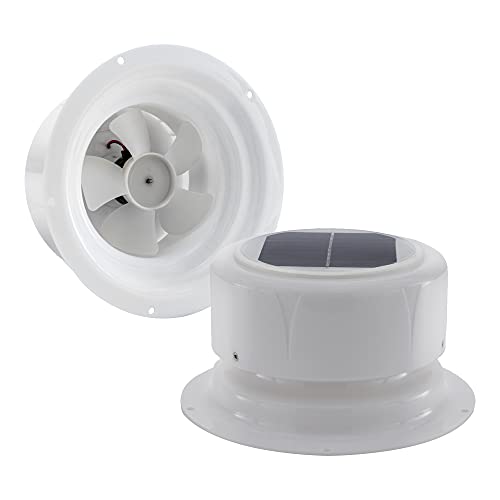
While not a direct solar panel for RV air conditioner power source, the RecPro RV Solar Ventilation Fan is an incredibly clever solar-powered solution that enhances RV comfort, especially in warmer climates. This isn’t about running your main AC unit, but rather about proactively removing heat, odors, and moisture from your RV, thereby reducing the load on your air conditioner or even making AC unnecessary on milder days. It’s a fantastic, low-power way to improve air circulation and comfort, quietly and efficiently using the sun’s energy.
-
Key Features
- Solar-Powered Ventilation: Built-in solar panel powers the fan automatically.
- Removes odors and moisture from RV holding tanks (can also improve general airflow).
- Silent & Reliable Operation: Provides quiet, consistent ventilation.
- Easy Installation: Universal design fits most RV plumbing caps; includes screws for quick setup.
- Durable & Aerodynamic Design: Heavy-duty plastic with a low-profile shape to reduce drag.
- Versatile Options: Measures 7″W × 3 5/8″H, compatible with ventilation holes up to 5 1/4″, available in black or white.
-
Pros
- Completely solar-powered – no wiring or batteries needed for operation.
- Improves RV air quality by removing odors and moisture.
- Silent operation, perfect for quiet enjoyment.
- Very easy and quick to install.
- Durable, low-profile design.
- Can reduce the need for or load on your primary RV AC.
-
Cons
- Does NOT power an RV air conditioner; it’s a ventilation fan.
- Provides airflow, not active cooling like an AC unit.
-
User Impressions
RV owners love this fan for its simple, effective solution to common RV problems like stale air and holding tank odors. They frequently highlight its effortless installation and the fact that it just “works” without any fuss. Many report a noticeable improvement in air freshness and a reduction in heat buildup, making their RVs more comfortable even before switching on the AC. It’s often recommended as an essential accessory for any RV. - See it on Amazon here
Buyer’s Guide: Choosing the Right Solar Setup for Your RV AC
Investing in a solar panel for RV air conditioner setup is a significant decision. Here’s what to consider to ensure you make the best choice for your mobile adventures:
- System Size (Wattage): This is paramount. A typical RV AC uses 1200-2000 watts. You’ll need enough solar panels (e.g., 400W to 800W or more) to replenish your battery bank sufficiently, especially if you plan to run the AC for extended periods. Consider your average daily sunlight hours.
- Battery Bank Capacity: Solar panels generate power, but batteries store it. For AC use, you’ll need a large-capacity deep-cycle battery bank, ideally lithium-ion (LiFePO4) due to their lighter weight, faster charging, deeper discharge cycles, and longer lifespan compared to lead-acid batteries. Aim for at least 200Ah, and often 400Ah or more, for consistent AC power.
- Inverter Size and Type: Your RV AC runs on AC power, but solar panels and batteries produce DC power. You’ll need a pure sine wave inverter to convert DC to AC. Ensure the inverter’s continuous wattage rating is higher than your AC’s running wattage, and its surge rating can handle the AC’s startup spike.
- Charge Controller (MPPT vs. PWM): An MPPT (Maximum Power Point Tracking) charge controller is highly recommended for RV solar setups, especially for larger systems. MPPT controllers are significantly more efficient than PWM (Pulse Width Modulation) controllers, extracting up to 30% more power from your solar panels, which is crucial when trying to power an energy-hungry appliance like an AC.
- Panel Type (Monocrystalline vs. Polycrystalline): Monocrystalline panels (like those reviewed) are generally more efficient and perform better in low-light conditions and hot temperatures, making them ideal for RV applications where space might be limited and conditions vary.
- Installation Considerations: Do you want fixed panels on your roof, or portable panels that you can set up in the sun while your RV is parked in the shade? Consider roof space, weight distribution, and ease of wiring. Complete kits can simplify installation, but ensure you have the necessary tools or professional help.
- Budget: A full solar setup capable of running an RV AC can be a substantial investment. Be realistic about your budget and consider starting with a smaller system that can be expanded later if funds are tight.
Frequently Asked Questions (FAQ)
Q1: How many solar panels do I need to run an RV air conditioner?
A: This depends heavily on your AC unit’s wattage, your battery bank’s capacity, and how long you plan to run the AC. For consistent use, you’re generally looking at 400-800 watts or more of solar panels, coupled with a large lithium battery bank (e.g., 200-400Ah+). A smaller setup might handle brief AC bursts or reduce overall load.
Q2: Can I run my RV AC with a portable solar panel?
A: A single portable solar panel (e.g., 100W-200W) is typically not enough to run a full RV air conditioner on its own. It might help trickle charge your battery or run smaller appliances. To power an AC, you’d need multiple portable panels linked together to create a larger array, along with a robust inverter and battery bank.
Q3: What kind of battery is best for an RV solar setup?
A: Lithium-ion (LiFePO4) batteries are highly recommended for RV solar setups, especially when powering high-draw appliances like AC. They offer deeper discharge cycles, a longer lifespan, faster charging, and are significantly lighter than traditional lead-acid batteries.
Q4: Is a complete solar kit better than buying components separately?
A: For beginners or those who want a simpler installation, a complete solar kit is often better. It ensures all components are compatible and provides a clearer path to setup. However, buying components separately allows for greater customization, often higher quality individual parts (like an MPPT controller over PWM), and can be more cost-effective if you know exactly what you need.
Q5: How do I calculate my RV’s daily energy consumption?
A: List all the appliances you plan to use, their wattage, and how many hours per day you’ll use them. Multiply watts by hours to get watt-hours. Sum these up for your total daily watt-hours. For your AC, remember to account for both running and surge wattage. This calculation helps determine the size of your solar panels and battery bank.
Q6: What’s the difference between MPPT and PWM charge controllers?
A: MPPT (Maximum Power Point Tracking) controllers are more advanced and efficient, capable of harvesting up to 30% more power from your solar panels by dynamically adjusting to extract the maximum voltage and current. PWM (Pulse Width Modulation) controllers are simpler and more affordable but less efficient, essentially acting as a switch to regulate charging. For powering an RV AC, an MPPT controller is almost always preferred.
Q7: Can I use solar power for other appliances besides the AC?
A: Absolutely! Once you have a solar system installed, you can power nearly anything in your RV, from lights, fans, and water pumps to TVs, microwaves, coffee makers, and refrigerators. The more robust your solar setup, the more appliances you can run off-grid, extending your boondocking adventures.
Conclusion
Embracing solar power for your RV’s air conditioning system is a game-changer for off-grid travel. While it requires a significant initial investment and a well-planned system, the freedom to stay cool anywhere the road takes you is truly invaluable. Whether you opt for a compact kit to supplement your power or a full-blown system capable of running your AC for hours, investing in a reliable solar panel for RV air conditioner setup means more comfortable, independent adventures. Happy travels, and stay cool out there!

