
The William Carrier air conditioner revolutionized indoor comfort by introducing the first modern air conditioning system in 1902. His invention not only transformed how we cool buildings but also enabled advancements in industries like manufacturing, healthcare, and computing. Today, Carrier remains a global leader in HVAC innovation, continuing the legacy of its founder.
Key Takeaways
- Willis Carrier invented the first modern air conditioner in 1902 to solve humidity issues in a printing plant, marking the birth of controlled indoor climate.
- Carrier’s invention went beyond comfort—it enabled precision in manufacturing, improved health in hospitals, and made data centers possible.
- The Carrier brand remains a top HVAC manufacturer, offering energy-efficient air conditioners, heat pumps, and smart climate solutions.
- Modern Carrier air conditioners feature advanced technology like variable-speed compressors, Wi-Fi connectivity, and eco-friendly refrigerants.
- Proper sizing, installation, and maintenance are crucial for maximizing efficiency and lifespan of any William Carrier air conditioner system.
- Carrier offers a range of models from budget-friendly to premium, with options for homes, offices, and industrial use.
- The legacy of Willis Carrier lives on through ongoing innovation in sustainable cooling and smart home integration.
📑 Table of Contents
- The Birth of Modern Cooling: Willis Carrier’s Revolutionary Invention
- How a William Carrier Air Conditioner Works: The Science Behind the Cool
- Types of William Carrier Air Conditioners: Finding the Right Fit
- Energy Efficiency and Environmental Impact
- Installation, Maintenance, and Longevity
- Smart Features and Home Integration
- The Legacy of Willis Carrier: Innovation That Changed the World
The Birth of Modern Cooling: Willis Carrier’s Revolutionary Invention
Imagine a world without air conditioning. No cool escapes on sweltering summer days, no climate-controlled hospitals, and no reliable way to manufacture sensitive electronics. That was life before 1902—until a young engineer named Willis Haviland Carrier changed everything.
Born in 1876 in Angola, New York, Willis Carrier was a curious and analytical mind from the start. After earning a degree in engineering from Cornell University, he began working at the Buffalo Forge Company, where he was tasked with solving a problem at a Brooklyn printing plant. The issue? High humidity was causing paper to expand and contract, making it impossible to print images accurately. Moisture in the air was ruining the precision of color alignment.
Carrier didn’t just want to cool the air—he wanted to control it. In July 1902, he designed a system that could regulate both temperature and humidity. His solution involved passing air over coils filled with cold water, which cooled the air and removed moisture through condensation. This was the world’s first modern air conditioning system, and it laid the foundation for indoor climate control as we know it.
At first, the invention was purely industrial. But Carrier quickly realized its broader potential. By 1906, he had patented the “Apparatus for Treating Air,” and by 1915, he co-founded the Carrier Engineering Corporation with six other engineers. The company’s mission was simple: to make indoor environments more comfortable, productive, and healthy.
From Printing Plants to Movie Theaters: The Spread of Air Conditioning
In the early 20th century, air conditioning was a luxury few could afford. But as the technology improved and costs decreased, its applications expanded rapidly. One of the first major public uses of Carrier’s system was in movie theaters during the 1920s. As summer heatwaves made theaters unbearable, theater owners installed air conditioning to attract more customers. The phrase “cooling off at the movies” became a summer ritual, and air conditioning helped fuel the golden age of Hollywood.
But the impact went far beyond entertainment. Hospitals began using air conditioning to control infection rates and improve patient recovery. Factories adopted it to maintain consistent conditions for manufacturing, especially in industries like textiles, pharmaceuticals, and food processing. By the 1950s, residential air conditioning became more common, transforming American life—especially in the South and Southwest, where summers are long and hot.
Willis Carrier didn’t live to see the full impact of his invention—he passed away in 1950—but his legacy was already global. Today, air conditioning is essential in homes, offices, schools, and vehicles worldwide. And the company he founded, Carrier, remains one of the most trusted names in HVAC (heating, ventilation, and air conditioning).
How a William Carrier Air Conditioner Works: The Science Behind the Cool
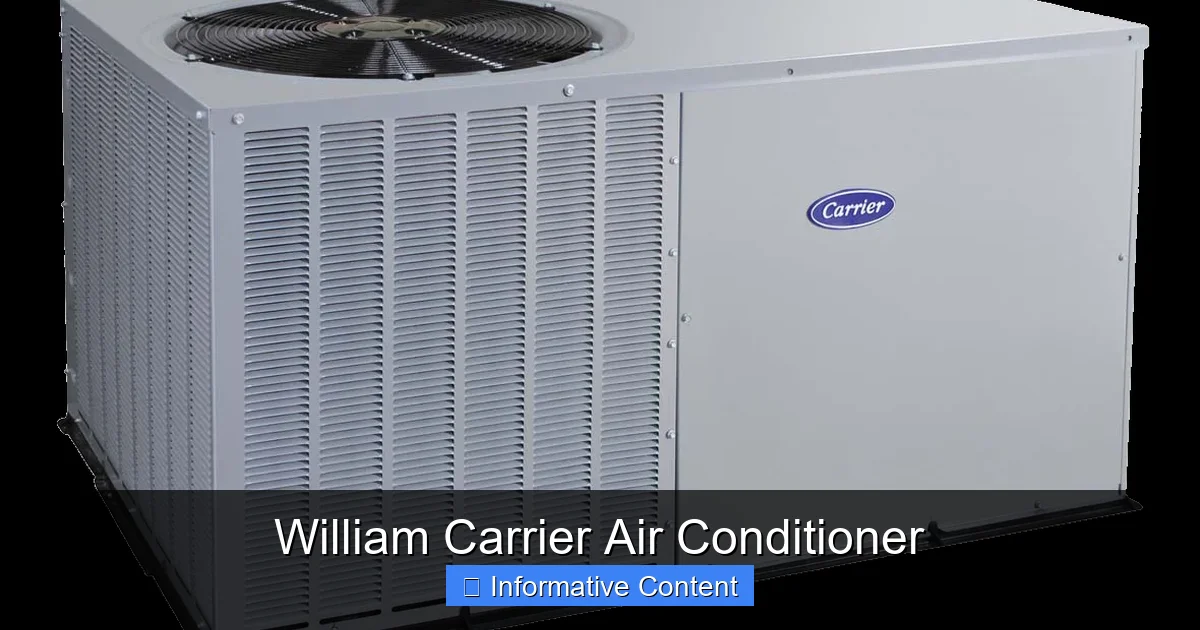
Visual guide about William Carrier Air Conditioner
Image source: images.carriercms.com
So, how does a William Carrier air conditioner actually work? While modern systems are far more advanced than Carrier’s original design, the core principles remain the same: remove heat and moisture from indoor air and release it outside.
At the heart of every Carrier air conditioner is the refrigeration cycle. This cycle uses a special fluid called a refrigerant, which absorbs and releases heat as it changes between liquid and gas states. The process involves four main components: the compressor, condenser, expansion valve, and evaporator coil.
Here’s a simple breakdown:
– The **compressor** (usually located in the outdoor unit) pressurizes the refrigerant gas, raising its temperature.
– The hot, high-pressure gas flows to the **condenser coil**, where it releases heat to the outside air and condenses into a liquid.
– The liquid refrigerant passes through the **expansion valve**, which reduces its pressure and temperature.
– The cold, low-pressure liquid enters the **evaporator coil** inside your home, where it absorbs heat from indoor air blown over the coil by a fan.
– The refrigerant evaporates back into a gas and returns to the compressor to start the cycle again.
Meanwhile, a dehumidification process occurs naturally: as warm, moist air passes over the cold evaporator coil, moisture condenses and drips into a drain pan, reducing indoor humidity.
Modern Enhancements in Carrier Systems
Today’s William Carrier air conditioners go far beyond basic cooling. Many models feature **variable-speed compressors**, which adjust their output to match the cooling demand. Unlike older single-speed units that turn on and off frequently, variable-speed systems run continuously at lower speeds, providing more consistent temperatures, better humidity control, and quieter operation.
Another innovation is **two-stage or multi-stage cooling**, which allows the unit to operate at a lower capacity most of the time and ramp up only when needed. This improves efficiency and comfort.
Carrier also integrates **smart technology** into many of its systems. With Wi-Fi-enabled thermostats and mobile apps, homeowners can control their air conditioner remotely, set schedules, monitor energy usage, and receive maintenance alerts. Some models even use geofencing to detect when you’re away and adjust settings to save energy.
And let’s not forget **eco-friendly refrigerants**. Older air conditioners used R-22 (Freon), which damages the ozone layer. Carrier has transitioned to safer alternatives like R-410A and newer, lower-global-warming-potential refrigerants such as Puron Advance, aligning with environmental regulations and sustainability goals.
Types of William Carrier Air Conditioners: Finding the Right Fit
Not all air conditioners are created equal—and Carrier offers a wide range of systems to meet different needs, budgets, and home sizes. Whether you’re cooling a small apartment or a large suburban home, there’s likely a Carrier model designed for you.
Central Air Conditioners
The most common type of residential air conditioning, central systems use ductwork to distribute cool air throughout the home. Carrier offers several tiers of central air conditioners, from entry-level models like the **Carrier Comfort Series** to high-efficiency units like the **Infinity Series**.
– **Comfort Series**: Affordable and reliable, these units are ideal for budget-conscious homeowners. They typically have a Seasonal Energy Efficiency Ratio (SEER) rating of 14–16, which is the minimum required by law in many regions.
– **Performance Series**: A step up in efficiency and features, with SEER ratings up to 17. These models often include two-stage compressors and better sound insulation.
– **Infinity Series**: Carrier’s premium line, featuring SEER ratings up to 26, variable-speed technology, and advanced humidity control. These systems are designed for maximum comfort and energy savings.
Ductless Mini-Split Systems
For homes without ductwork—or for room additions, garages, or sunrooms—Carrier offers **ductless mini-split air conditioners**. These systems consist of an outdoor compressor unit and one or more indoor air-handling units mounted on walls or ceilings.
Mini-splits are highly efficient because they eliminate duct losses, which can account for up to 30% of energy waste in traditional systems. They also allow for **zoned cooling**, meaning you can set different temperatures in different rooms. Carrier’s ductless models often include inverter technology for quiet, consistent operation and come with remote controls or smartphone apps.
Heat Pumps: Cooling and Heating in One
Many Carrier air conditioners are actually **air-source heat pumps**, which can both cool and heat your home. In cooling mode, they work like a standard air conditioner. In heating mode, they reverse the refrigeration cycle to extract heat from the outside air—even in cold weather—and bring it indoors.
This makes heat pumps an energy-efficient alternative to furnaces, especially in milder climates. Carrier’s **Infinity Heat Pump** and **Performance Heat Pump** lines offer high efficiency (up to 20 SEER and 13 HSPF) and are compatible with smart thermostats.
Packaged Units
For homes with limited indoor space, Carrier offers **packaged air conditioners**, which combine the compressor, condenser, and evaporator in a single outdoor unit. These are often installed on rooftops or beside the house and are common in commercial buildings and some residential applications.
Energy Efficiency and Environmental Impact
One of the biggest concerns for homeowners today is energy efficiency—and for good reason. Air conditioning can account for nearly half of a home’s summer energy bill. That’s why choosing an efficient system is crucial, both for your wallet and the planet.
Understanding SEER Ratings
The **Seasonal Energy Efficiency Ratio (SEER)** measures how efficiently an air conditioner uses electricity over a typical cooling season. The higher the SEER, the less energy the unit consumes. As of 2023, the U.S. Department of Energy requires new air conditioners to have a minimum SEER of 14 in the North and 15 in the South.
Carrier’s high-end models exceed these standards dramatically. For example, the **Infinity 26 Central Air Conditioner** boasts a SEER rating of up to 26, making it one of the most efficient units on the market. Over time, this can translate to hundreds—or even thousands—of dollars in energy savings.
ENERGY STAR Certification
Many Carrier air conditioners are **ENERGY STAR certified**, meaning they meet strict efficiency guidelines set by the U.S. Environmental Protection Agency. These units use 8–10% less energy than standard models and often qualify for utility rebates and tax incentives.
For example, installing an ENERGY STAR-certified Carrier air conditioner in a typical home can save about $300 in energy costs over its lifetime. In hotter climates, the savings are even greater.
Sustainability and Refrigerants
Carrier is committed to reducing the environmental impact of its products. The company has phased out ozone-depleting refrigerants and is transitioning to next-generation alternatives with lower global warming potential.
The **Puron Advance** refrigerant, used in many new Carrier systems, has zero ozone depletion potential and a significantly lower climate impact than older refrigerants. Carrier also supports responsible refrigerant recovery and recycling programs to minimize environmental harm.
Additionally, Carrier is investing in **renewable energy integration** and **smart grid compatibility**, allowing HVAC systems to work more efficiently with solar panels and time-of-use electricity pricing.
Installation, Maintenance, and Longevity
Even the best air conditioner won’t perform well if it’s not installed or maintained properly. A poorly sized or incorrectly installed system can lead to high energy bills, uneven cooling, and frequent breakdowns.
Proper Sizing Matters
One of the most common mistakes homeowners make is choosing an air conditioner that’s too big or too small. An oversized unit will cycle on and off frequently, wasting energy and failing to dehumidify properly. An undersized unit will run constantly, struggling to keep up on hot days.
Carrier recommends a **professional load calculation** (also called a Manual J calculation) to determine the correct size based on your home’s square footage, insulation, windows, orientation, and local climate. A qualified HVAC contractor can perform this assessment and recommend the right model.
Professional Installation
Installing an air conditioner is not a DIY project. It requires specialized tools, knowledge of electrical and refrigerant systems, and adherence to local codes. Carrier-certified contractors are trained to install systems correctly, ensuring optimal performance and warranty coverage.
Key installation steps include:
– Properly sealing and insulating ductwork
– Correctly charging the refrigerant
– Ensuring proper airflow and drainage
– Testing system performance and safety
Routine Maintenance for Peak Performance
To keep your William Carrier air conditioner running efficiently, regular maintenance is essential. Here are some simple tips:
– **Change air filters every 1–3 months**, especially during peak usage. Dirty filters restrict airflow and reduce efficiency.
– **Clean the outdoor unit** by removing leaves, dirt, and debris from around the condenser coils.
– **Inspect and clean indoor coils and drain lines** annually to prevent mold and clogs.
– **Schedule professional tune-ups** once a year, ideally before summer. A technician will check refrigerant levels, test electrical connections, lubricate moving parts, and ensure everything is working safely.
With proper care, a Carrier air conditioner can last **15–20 years**—or even longer. Regular maintenance not only extends lifespan but also helps maintain efficiency and prevents costly repairs.
Smart Features and Home Integration
The future of home comfort is smart—and Carrier is leading the way. Many of today’s William Carrier air conditioners come with advanced features that make cooling easier, more efficient, and more personalized.
Wi-Fi Thermostats and Mobile Apps
Carrier’s **Côr Home Automation** system and **Carrier Home App** allow you to control your air conditioner from anywhere using your smartphone. You can adjust the temperature, set schedules, monitor energy usage, and receive alerts if something goes wrong.
For example, if you forget to change the filter, the app can notify you. If you’re on vacation, you can remotely turn up the thermostat to save energy—and cool the house before you return.
Voice Control and Smart Home Compatibility
Many Carrier systems work with popular smart home platforms like **Amazon Alexa**, **Google Assistant**, and **Apple HomeKit**. This means you can say, “Hey Google, set the temperature to 72 degrees,” and your air conditioner will respond.
Integration with smart home ecosystems also allows for automation. For instance, your system can detect when windows are open and pause cooling, or adjust settings based on your daily routine.
Geofencing and Adaptive Learning
Some Carrier thermostats use **geofencing** to detect when you’re approaching home and start cooling in advance. Others use **adaptive learning** to analyze your preferences and automatically adjust settings for maximum comfort and efficiency.
These features not only improve convenience but also reduce energy waste—making your home smarter and more sustainable.
The Legacy of Willis Carrier: Innovation That Changed the World
Willis Carrier didn’t just invent a machine—he launched a revolution. His air conditioner transformed industries, improved public health, and reshaped how we live, work, and play. From enabling the growth of cities in hot climates to making modern computing possible, the impact of his invention is immeasurable.
Today, the Carrier brand continues to innovate. With a focus on energy efficiency, sustainability, and smart technology, Carrier air conditioners are more advanced and environmentally responsible than ever. Whether you’re looking for a quiet, efficient central system or a flexible ductless solution, there’s a William Carrier air conditioner designed to meet your needs.
And while the world has changed dramatically since 1902, one thing remains the same: the desire for comfort, control, and peace of mind. Thanks to Willis Carrier, we can enjoy all three—every single day.
Frequently Asked Questions
Who invented the first air conditioner?
Willis Haviland Carrier invented the first modern air conditioner in 1902 while working at the Buffalo Forge Company. His invention was designed to control humidity in a printing plant, but it eventually revolutionized indoor climate control worldwide.
What makes Carrier air conditioners different from other brands?
Carrier air conditioners are known for their reliability, energy efficiency, and advanced technology. As the original inventor of air conditioning, Carrier continues to lead in innovation, offering features like variable-speed compressors, smart thermostats, and eco-friendly refrigerants.
How long do Carrier air conditioners typically last?
With proper installation and regular maintenance, a Carrier air conditioner can last 15 to 20 years or more. Routine care, such as changing filters and scheduling annual tune-ups, is key to maximizing lifespan and performance.
Are Carrier air conditioners energy efficient?
Yes, many Carrier models are highly energy efficient, with SEER ratings up to 26. Several are ENERGY STAR certified, meaning they meet strict efficiency standards and can help reduce energy bills and environmental impact.
Can I install a Carrier air conditioner myself?
No, air conditioner installation should always be done by a licensed HVAC professional. Proper installation ensures safety, efficiency, and warranty coverage. DIY installation can lead to poor performance, higher energy costs, and potential hazards.
Do Carrier air conditioners work with smart home systems?
Yes, many Carrier air conditioners are compatible with smart thermostats and home automation platforms like Amazon Alexa, Google Assistant, and Apple HomeKit. This allows for remote control, voice commands, and energy-saving automation.