Finding the fuse for your old Carrier air conditioner isn’t as scary as it sounds. Whether you’re dealing with a tripped breaker or a blown fuse, knowing where to look can save you time and money. This guide covers everything from the electrical panel to internal components, helping you diagnose and fix common issues with confidence.
Key Takeaways
- The main fuse or circuit breaker for your Carrier AC is typically located in your home’s main electrical panel. This protects the entire system from power surges and overloads.
- Older Carrier units may have internal fuses inside the control board or near the compressor. These are less common in modern systems but still worth checking.
- Always turn off power at the breaker before inspecting any electrical component. Safety first—never work on live circuits.
- If you can’t locate a traditional fuse, your Carrier AC likely uses a circuit breaker instead. Many older models were upgraded over time to meet updated electrical codes.
- Calling a licensed HVAC technician is recommended if you’re unsure or uncomfortable handling electrical repairs. They can safely diagnose and replace faulty components.
- Regular maintenance helps prevent fuse-related failures. Clean coils, check filters, and ensure proper airflow to reduce strain on your system.
📑 Table of Contents
- Where Is the Fuse for My Old Carrier Air Conditioner?
- Understanding Your Carrier AC’s Electrical System
- Locating the Main Power Source: The Electrical Panel
- Checking the Outdoor Condenser Unit
- Inspecting the Indoor Air Handler or Furnace
- Examining the Control Board
- When There’s No Fuse—And What to Do Next
- Why Your Old Carrier Might Need Upgrades
- Final Thoughts: Know When to Call a Pro
- Conclusion
Where Is the Fuse for My Old Carrier Air Conditioner?
If your old Carrier air conditioner suddenly stops working, the first thing you might think of is the fuse. After all, fuses are simple, reliable, and easy to replace—right? But here’s the catch: many older Carrier air conditioners don’t actually use traditional glass fuses anymore. Instead, they rely on circuit breakers, internal protection mechanisms, or even solid-state controls that don’t require physical fuses at all.
That doesn’t mean your unit isn’t protected—it just means you’ll need to look in different places. Whether you’re troubleshooting a tripped breaker or suspecting a blown internal component, understanding how your Carrier AC is wired can save you time, frustration, and possibly a costly service call. In this comprehensive guide, we’ll walk you through every possible location where a fuse or its equivalent might be hiding in your older Carrier air conditioning system.
Understanding Your Carrier AC’s Electrical System
Before diving into where to find the fuse, it helps to understand how your Carrier air conditioner handles electrical protection. Unlike older appliances that used individual fuses for motors or compressors, modern (and even some older) Carrier units use centralized protection systems.
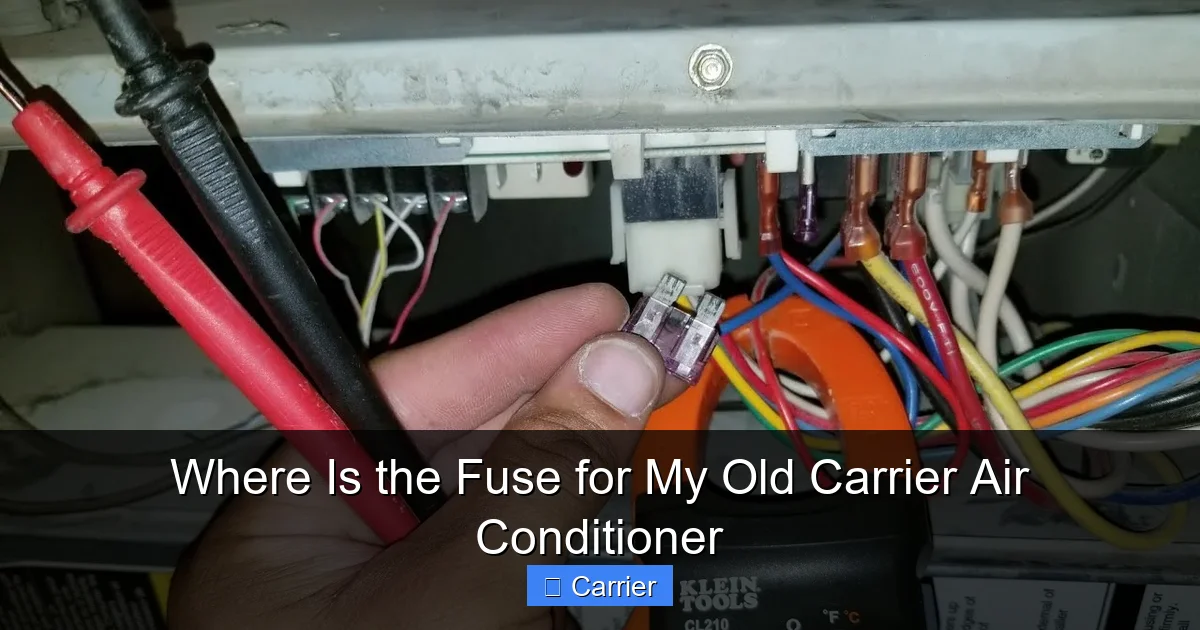
Visual guide about Where Is the Fuse for My Old Carrier Air Conditioner
Image source: i.ytimg.com
What Happened to Traditional Fuses?
In the past, air conditioners often had small, screw-in fuses—sometimes labeled “F1” or “F2”—located near the compressor or control board. These would blow if a motor drew too much current or if there was a short circuit. However, starting in the 1980s and accelerating through the 1990s, manufacturers began phasing out these standalone fuses in favor of more advanced protection methods.
Today, most Carrier AC units rely on:
- Circuit breakers in your home’s main electrical panel
- Internal thermal overloads built into motors
- Electronic control boards with self-resetting protection
- Compressor hard-start kits that include built-in surge protection
So if you’re looking for a “fuse” and can’t find one, don’t panic—your Carrier AC is probably just using a more modern approach to safety.
Locating the Main Power Source: The Electrical Panel
The most common place to find the fuse (or breaker) for your Carrier air conditioner is in your home’s main electrical panel. This is the central hub that distributes electricity throughout your house and protects each major appliance with a dedicated circuit.
Visual guide about Where Is the Fuse for My Old Carrier Air Conditioner
Image source: s3.amazonaws.com
How to Find It
Your electrical panel is usually located in a basement, garage, utility closet, or outside wall of your home. It’s a metal box with a clear plastic or glass cover and several switches (breakers) inside.
Once you open the panel:
- Look for a breaker labeled “AC,” “HVAC,” or something similar.
- It may also have a number like “20A” or “30A” indicating its amperage.
- If multiple breakers serve different zones, check the one closest to your outdoor condenser unit.
If the breaker is in the “off” position or has shifted slightly between on and off states, that’s your culprit. Flip it completely off, wait 30 seconds, then flip it back on. If your AC restarts, the issue was likely a temporary overload. If not, move to the next step.
Safety Reminder
Never touch breakers while barefoot or standing on wet surfaces. Always wear rubber-soled shoes and avoid contact with metal pipes or faucets nearby. When in doubt, shut off the main breaker for the entire house before inspecting the panel.
Checking the Outdoor Condenser Unit
After ruling out the main panel, the next logical place to look is the outdoor condenser unit itself. While newer models rarely have external fuses, some older Carrier units—especially those made before the mid-1990s—may still feature protective devices mounted directly on the unit.
Where to Look Inside the Condenser
Open the front access panel of your outdoor unit (usually secured by two screws). You’ll see:
- A large capacitor (round, cylindrical, with wires coming out)
- The compressor (a heavy metal cylinder with refrigerant lines)
- Fan motor (mounted above the compressor)
Between the compressor and fan, you might spot:
- A small, rectangular black box labeled “Capacitor” or “Run Capacitor”
- A fuse holder** sometimes attached to the side of the compressor
If you see a fuse here, it’s likely a **time-delay fuse** rated around 5–10 amps. These were used in very early Carrier models to protect against voltage spikes during startup. To test it, unplug the unit (or turn off the breaker), remove the fuse, and check for a broken filament with a multimeter or by visual inspection. Replace only with an identical rating.
Note on Modern Units
Most Carrier condensers today don’t have external fuses because the compressor includes internal thermal cutoffs. If yours lacks a visible fuse, skip this step and head indoors.
Inspecting the Indoor Air Handler or Furnace
If your Carrier AC is part of a packaged system (common in homes without central ductwork), or if it connects to a furnace, the indoor unit becomes another critical inspection point. In these setups, the air handler often contains relays, capacitors, and sometimes even backup fuses for the blower motor.
Accessing the Indoor Unit
For split systems with a separate indoor evaporator coil (usually in the attic or crawlspace):
- Remove the access panel covering the blower assembly
- Look behind the motor housing for any small fuse blocks
For furnace-connected systems:
- Open the furnace cabinet door
- Check the control board area for fuse holders labeled “MOTOR” or “IGNITION”
These fuses are rare but do exist in certain older Carrier models like the Carrier 58PAV or 63MA series. If present, they’ll be clearly marked and easily replaceable.
Testing the Blower Motor
If you suspect the blower isn’t running due to a blown fuse, listen carefully. Does the compressor kick on but no air comes out? That points to a motor issue. Use a multimeter to test continuity across the motor terminals. If resistance is infinite, the motor or its associated fuse may be dead.
Examining the Control Board
The heart of your Carrier AC’s electrical system is often the control board—a small circuit board inside the indoor unit or near the thermostat. While it doesn’t contain traditional fuses, it does have sensitive electronic components that can fail and mimic fuse problems.
Signs of Control Board Failure
- Unit won’t start at all—no clicks, no hum
- Random shutdowns** during operation
- Error codes displayed** on digital thermostats
- Buzzing or burning smell** from the indoor unit
If you notice these symptoms, the control board may be fried—not because of a blown fuse, but due to power surges or age. Unfortunately, control boards aren’t user-serviceable. Replacement requires professional diagnosis and ordering the exact model number from Carrier or an HVAC supplier.
Can You Test the Board Yourself?
Only if you’re experienced with electronics. You’d need a multimeter to check voltage inputs/outputs and possibly a schematic diagram for your specific model. For most homeowners, this is best left to a technician.
When There’s No Fuse—And What to Do Next
Here’s the reality: if you’ve checked the main breaker, outdoor unit, indoor handler, and control board—and found nothing—chances are your Carrier AC simply doesn’t use a traditional fuse anymore. This is normal for units manufactured after 1995.
Common Alternatives to Fuses
- Circuit breakers in the main panel (most common)
- Thermal overload switches** inside motors (self-resetting)
- Solid-state relays** on the control board
- Hard-start capacitors** with built-in protection
In such cases, the real problem could be:
- Dirty air filter** causing overheating
- Refrigerant leak** reducing efficiency
- Faulty thermostat** sending wrong signals
- Wiring corrosion** in connections
DIY Troubleshooting Steps
Try these before calling a pro:
- Replace the air filter—clogged filters are the #1 cause of AC failure
- Clear debris around the outdoor unit—keep at least 2 feet clearance
- Reset the thermostat**—turn it off, unplug for 5 minutes, plug back in
- Check for tripped breakers**—even if they seem fine, toggle them off/on
Why Your Old Carrier Might Need Upgrades
If your Carrier AC is over 15–20 years old, it’s possible that outdated wiring or lack of surge protection contributed to repeated electrical issues. Older homes often weren’t built with high-efficiency HVAC systems in mind, leading to compatibility problems.
Considerations for Replacement
- Energy Star ratings**: Newer units use 20–40% less energy
- Smart thermostats**: Compatible with modern Carrier models for remote control
- Extended warranties**: Often included with new installations
Even if your current system works, upgrading improves reliability, comfort, and resale value. A qualified HVAC contractor can assess whether repair or replacement makes sense based on your unit’s age, condition, and local climate.
Final Thoughts: Know When to Call a Pro
While finding the fuse (or its modern equivalents) is important, safety should always come first. If you’re uncomfortable opening electrical panels, handling capacitors, or interpreting error codes, it’s okay—and smart—to call a licensed HVAC technician.
Reputable contractors offer free diagnostics and can quickly identify whether the issue is electrical, mechanical, or environmental. Plus, they carry genuine Carrier parts and know exactly what to look for in your specific model.
Remember: a properly maintained Carrier air conditioner can last 15–20 years with routine care. But when electrical components fail, it’s not always about replacing a fuse—it might be time for a deeper inspection.
Conclusion
Finding the fuse for your old Carrier air conditioner starts with understanding that not all protection systems use traditional fuses. From the main electrical panel to the control board, your unit relies on a combination of breakers, thermal switches, and electronic safeguards. By methodically checking each location—and prioritizing safety—you can often resolve minor issues yourself. But when in doubt, don’t hesitate to reach out to a professional. Your comfort, safety, and wallet will thank you.
Frequently Asked Questions
Is it safe to check the electrical panel myself?
Yes, but only if you take precautions. Wear rubber-soled shoes, avoid water sources nearby, and never touch live wires. If you’re unsure, turn off the main breaker instead. When in doubt, consult an electrician or HVAC technician.
My Carrier AC won’t turn on—could it be a blown fuse?
Possibly, but unlikely if your unit is newer than 1995. Most Carrier models now use circuit breakers or internal protection. Start by checking the breaker in your main panel. If that doesn’t help, inspect the outdoor unit and indoor handler for any visible fuse blocks.
Where is the fuse located on a Carrier 5-ton unit?
On older 5-ton Carrier units, look in the outdoor condenser for a small fuse holder near the compressor. If none exists, check the main electrical panel for a dedicated HVAC breaker. Internal fuses are rare in larger units.
Can I replace a fuse in my Carrier AC myself?
Yes, if you find a removable fuse (typically 5–10 amp time-delay type). Turn off power first, remove the old fuse, and install a new one of the same rating. Never use a higher-amperage fuse—it can damage your system or start a fire.
Why did my Carrier AC lose power suddenly?
This is often caused by a tripped circuit breaker due to an overload, short circuit, or voltage surge. Check your main panel first. Other causes include dirty filters, refrigerant leaks, or failing capacitors. Regular maintenance reduces these risks.
Should I upgrade my old Carrier AC or just repair it?
If your unit is over 15 years old and frequently breaks down, upgrading may save you money long-term. Newer models are more efficient, quieter, and come with better warranties. A licensed HVAC contractor can give you a cost-benefit analysis based on your home and usage.