
CH 38 on an LG air conditioner indicates a communication error between the indoor and outdoor units. This issue often stems from wiring problems, power supply issues, or faulty components, but it’s usually fixable with basic troubleshooting or professional help.
Key Takeaways
- CH 38 means a communication failure: The indoor and outdoor units aren’t talking properly due to signal disruption.
- Common causes include loose wiring, power fluctuations, or damaged cables: These interrupt the data exchange between units.
- Check connections first: Inspect and tighten all electrical connections between indoor and outdoor components.
- Power cycling can resolve temporary glitches: Turn off the AC and breaker, wait 10 minutes, then restart.
- Weather and voltage issues play a role: Storms or unstable power can trigger CH 38 errors.
- Professional diagnosis may be needed: If basic fixes fail, a certified technician should inspect the system.
- Regular maintenance prevents future errors: Clean filters and inspect wiring annually to avoid communication problems.
Quick Answers to Common Questions
What does CH 38 mean on LG air conditioner?
CH 38 indicates a communication error between the indoor and outdoor units of your LG air conditioner, meaning they’re not exchanging signals properly.
Can I fix CH 38 myself?
Yes, in many cases. Try power cycling the system and checking wiring connections. If the issue persists, call a technician.
Is CH 38 a serious problem?
It’s not always serious, but it can lead to system shutdowns or inefficiency if ignored. Prompt troubleshooting is recommended.
Why does CH 38 keep coming back?
Recurring CH 38 may indicate a faulty control board, damaged wiring, or unstable power supply—issues best handled by a professional.
Does CH 38 affect cooling performance?
Yes. Without proper communication, the AC may not cool effectively, cycle improperly, or shut down entirely.
📑 Table of Contents
What Does CH 38 Mean on LG Air Conditioner?
If you’ve ever glanced at your LG air conditioner’s display and seen “CH 38” flashing, you’re not alone. This error code can be confusing, especially if you’re not familiar with HVAC systems. But don’t panic—CH 38 is a common issue with a clear meaning and often straightforward solutions.
At its core, CH 38 indicates a communication error between your air conditioner’s indoor and outdoor units. Think of your AC system like a team: the indoor unit (the one inside your home) and the outdoor unit (the big box in your yard) need to constantly exchange information to work together. When that communication breaks down, the system throws up the CH 38 code as a warning sign.
This error doesn’t mean your AC is broken beyond repair. In fact, in many cases, it’s a temporary glitch caused by something as simple as a loose wire or a power surge. But ignoring it can lead to bigger problems, like your AC shutting down completely or running inefficiently, which drives up energy bills.
Understanding what CH 38 means is the first step toward fixing it. In this guide, we’ll walk you through the causes, troubleshooting steps, and when to call a professional. Whether you’re a DIY enthusiast or just want to know what’s going on, this article will help you get your LG air conditioner back to cooling your home quietly and effectively.
Understanding the CH 38 Error Code
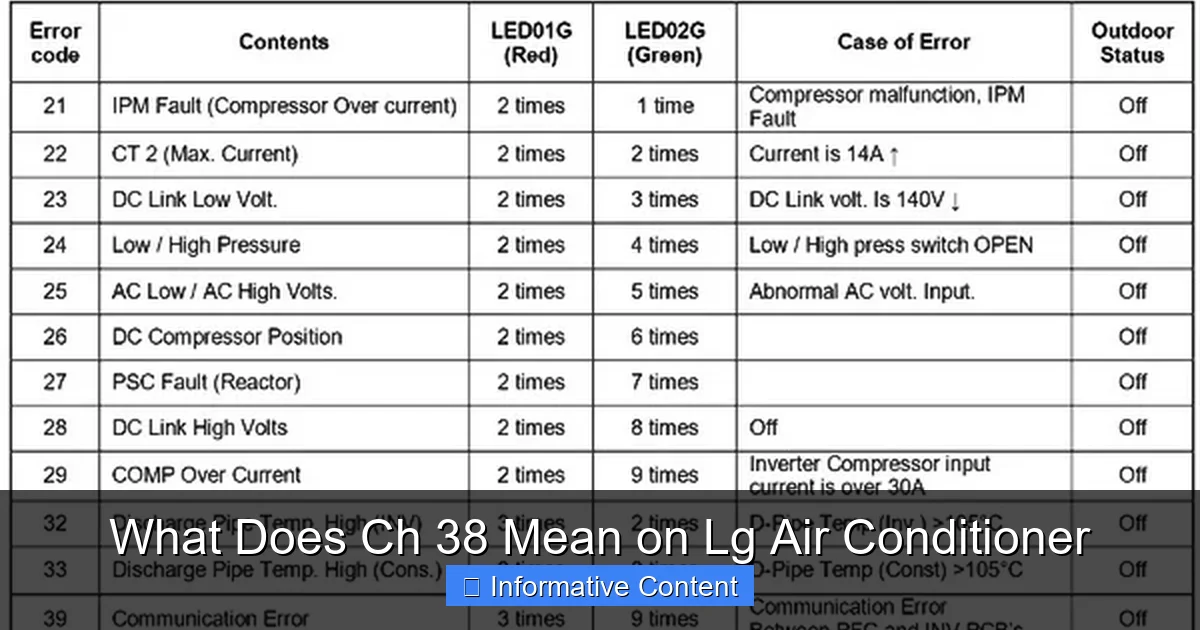
Visual guide about What Does Ch 38 Mean on Lg Air Conditioner
Image source: removeandreplace.com
The CH 38 error code on an LG air conditioner is part of the brand’s diagnostic system designed to help users and technicians identify problems quickly. LG uses a series of “CH” codes (short for “Check”) to signal different malfunctions. CH 38 specifically points to a breakdown in communication between the indoor and outdoor units.
To understand why this happens, it helps to know how your AC system works. The indoor unit contains the evaporator coil, air filter, and fan, while the outdoor unit houses the compressor, condenser coil, and another fan. These two units are connected by refrigerant lines and electrical wiring. They rely on a continuous flow of data—like temperature readings, fan speed commands, and compressor status—to operate smoothly.
When the indoor unit sends a signal to the outdoor unit (or vice versa) and doesn’t receive a proper response, the system logs a communication failure. That’s when CH 38 appears on the display. It’s essentially your AC saying, “I’m trying to talk to my partner, but I’m not getting an answer.”
This error can occur suddenly or develop over time. For example, a wire might loosen due to vibration, or corrosion could build up on a connection. In some cases, a power outage or lightning strike can disrupt the system’s electronics, causing a temporary communication hiccup.
It’s important to note that CH 38 is not the same as a refrigerant leak or a motor failure. Those issues have their own error codes. CH 38 is purely about signal transmission. That means the mechanical parts of your AC might be perfectly fine—it’s the “conversation” between units that’s broken.
How Communication Works in LG Air Conditioners
LG air conditioners use a digital communication protocol to coordinate between indoor and outdoor units. This system relies on low-voltage control wires (usually 4- or 5-wire bundles) that run through the wall from the indoor unit to the outdoor unit. These wires carry signals that tell the compressor when to start, adjust fan speeds, and monitor system performance.
Each unit has a control board (also called a PCB or printed circuit board) that processes these signals. If one board sends a command and doesn’t get a confirmation back within a set time, it assumes the connection is lost and triggers the CH 38 error.
This communication is essential for features like inverter technology, which allows the compressor to adjust its speed based on cooling demand. Without proper communication, the system can’t optimize performance, leading to inefficiency or shutdowns.
Why Communication Errors Matter
Even though CH 38 doesn’t always mean a major component has failed, it’s not something you should ignore. A broken communication link can cause your AC to:
– Stop cooling entirely
– Cycle on and off frequently
– Run at reduced efficiency
– Overheat due to lack of coordination
In extreme cases, the system may enter a protective shutdown mode to prevent damage. That’s why addressing CH 38 promptly is crucial for both comfort and system longevity.
Common Causes of the CH 38 Error
Now that you know what CH 38 means, let’s look at the most common reasons it appears. Understanding these causes can help you troubleshoot effectively and avoid future issues.
Loose or Damaged Wiring
The most frequent cause of CH 38 is a problem with the wiring between the indoor and outdoor units. Over time, vibrations from the compressor or fan can loosen connections. Rodents, pests, or physical damage during landscaping can also chew through or dislodge wires.
Check the connection terminals at both ends—inside the indoor unit and at the outdoor unit. Look for loose screws, frayed wires, or signs of burning. Even a slightly loose wire can interrupt the signal.
Power Supply Issues
Unstable voltage or power surges can disrupt the communication system. If your home experiences frequent brownouts, lightning strikes, or uses an undersized electrical circuit, the control boards may not function properly.
For example, if a storm causes a voltage spike, it can temporarily fry a component on the control board, leading to CH 38. Similarly, if the outdoor unit isn’t getting consistent power, it can’t respond to the indoor unit’s signals.
Faulty Control Boards
The indoor or outdoor control board may be damaged or malfunctioning. These boards are sensitive to heat, moisture, and electrical surges. If one board fails to send or receive signals correctly, communication breaks down.
Signs of a bad control board include burnt smells, visible damage, or the unit not responding to remote commands even when powered.
Incorrect Wiring During Installation
If your AC was recently installed or serviced, CH 38 could be due to improper wiring. Technicians must follow LG’s wiring diagram precisely. Swapping wires or using incorrect gauges can cause communication errors.
This is especially common in DIY installations or when unqualified technicians perform repairs.
Environmental Factors
Extreme weather can also trigger CH 38. High humidity, salt air (near the ocean), or dust buildup can corrode connections. In cold climates, ice or snow buildup around the outdoor unit can damage wiring or block ventilation, affecting performance.
Age and Wear
Like any electronic system, AC components degrade over time. After 10–15 years, control boards and wiring insulation may deteriorate, increasing the risk of communication errors.
Regular maintenance can slow this process, but eventually, older units may need component replacements.
How to Troubleshoot CH 38 on Your LG Air Conditioner
If you see CH 38 on your display, don’t panic. Many cases can be resolved with simple troubleshooting steps. Here’s a step-by-step guide to help you diagnose and fix the issue.
Step 1: Power Cycle the System
Start with the easiest fix: turning the system off and on again. This resets the control boards and can clear temporary glitches.
– Turn off the air conditioner using the remote or control panel.
– Go to your electrical panel and turn off the breaker that powers the AC unit.
– Wait at least 10 minutes. This allows capacitors to discharge and the system to fully reset.
– Turn the breaker back on and restart the AC.
If CH 38 disappears, the issue was likely a temporary communication hiccup. If it returns, move to the next step.
Step 2: Check the Wiring Connections
Inspect the wiring between the indoor and outdoor units.
– Turn off power to the AC at the breaker.
– Open the indoor unit’s access panel (usually held by screws).
– Locate the terminal block where the wires connect.
– Check that all wires are securely fastened. Tighten any loose screws.
– Look for signs of damage: frayed insulation, burnt spots, or corrosion.
– Repeat the inspection at the outdoor unit.
If you find damaged wires, do not attempt to repair them yourself unless you’re qualified. Call a technician.
Step 3: Inspect the Outdoor Unit
The outdoor unit is exposed to the elements and more prone to damage.
– Ensure the unit is level and stable. Uneven placement can stress wiring.
– Clear away debris, leaves, or snow blocking airflow.
– Check that the unit isn’t vibrating excessively, which can loosen connections.
– Look for signs of pest activity (chewed wires, nests).
Step 4: Test the Power Supply
Use a multimeter to check voltage at the outdoor unit.
– Turn off power.
– Remove the outdoor unit’s access panel.
– Locate the power input terminals.
– Turn power back on and measure voltage (should match your system’s rating, e.g., 220V).
– If voltage is low or fluctuating, contact an electrician.
Step 5: Check for Error Codes on the Outdoor Unit
Some LG models display error codes on the outdoor unit’s control board. Look for LED blink patterns or a small display. Refer to your user manual or LG’s support site to decode them.
If the outdoor unit shows a different error, it may point to a specific component failure.
Step 6: Reset the System Using the Remote
Some LG models allow a soft reset via the remote:
– Press and hold the “Reset” or “Test” button (if available) for 5 seconds.
– Or, press “Mode” and “Fan” buttons simultaneously for 3 seconds.
This can clear temporary errors without a full power cycle.
When to Call a Professional
While many CH 38 issues can be fixed at home, some require expert attention. Here’s when you should call a certified HVAC technician:
– You’ve tried all troubleshooting steps and CH 38 persists.
– You notice burnt smells, sparks, or visible damage.
– The wiring is damaged or corroded.
– You’re uncomfortable working with electrical components.
– The system is under warranty (DIY repairs may void it).
A professional can perform advanced diagnostics, such as testing control board continuity, checking refrigerant levels, or using specialized tools to trace signal loss.
They can also verify that the system was installed correctly and recommend upgrades if needed.
What to Expect During a Service Call
When a technician arrives, they’ll likely:
– Review the error history and symptoms.
– Inspect wiring and connections.
– Test voltage and signal transmission.
– Check control boards for damage.
– Replace faulty components if necessary.
Most CH 38 repairs are completed in under an hour, unless major rewiring is needed.
Preventing Future CH 38 Errors
Once you’ve resolved CH 38, take steps to prevent it from happening again.
Schedule Annual Maintenance
Have a technician inspect your system once a year. They’ll clean coils, check refrigerant, tighten connections, and test communication signals.
Protect Against Power Surges
Install a whole-house surge protector to guard against lightning and grid fluctuations.
Keep the Outdoor Unit Clean
Clear debris regularly and trim vegetation to ensure proper airflow and reduce stress on components.
Inspect Wiring During Filter Changes
When you replace your air filter (every 1–3 months), take a quick look at the indoor unit’s wiring to catch issues early.
Avoid DIY Repairs Unless Qualified
Improper handling can worsen the problem or create safety hazards.
Conclusion
The CH 38 error on your LG air conditioner is a communication issue between the indoor and outdoor units. While it can be alarming, it’s often caused by simple problems like loose wiring or power fluctuations. With basic troubleshooting—like power cycling and checking connections—you may be able to resolve it yourself.
However, if the error persists or you’re unsure about electrical work, don’t hesitate to call a professional. Regular maintenance and surge protection can help prevent future occurrences, keeping your AC running smoothly for years to come.
Understanding CH 38 empowers you to act quickly, avoid unnecessary service calls, and maintain a comfortable home environment. Stay informed, stay proactive, and your LG air conditioner will thank you.
Frequently Asked Questions
What causes CH 38 on LG air conditioners?
CH 38 is typically caused by loose or damaged wiring, power supply issues, faulty control boards, or environmental factors like moisture or pests.
How do I reset my LG air conditioner after CH 38?
Turn off the AC and the circuit breaker, wait 10 minutes, then turn everything back on. This power cycle often clears temporary errors.
Can a power outage cause CH 38?
Yes. Power surges or outages can disrupt the communication system, especially if voltage spikes damage control boards.
Is CH 38 covered under warranty?
Most LG warranties cover parts and labor for manufacturing defects. However, damage from improper installation or power issues may not be covered.
How much does it cost to fix CH 38?
Simple fixes like tightening wires are low-cost. If a control board needs replacement, expect $200–$500 depending on the model and labor rates.
Can I still use my AC if it shows CH 38?
It’s not recommended. The system may not cool properly or could shut down unexpectedly, potentially causing further damage.