What Does Ch 21 Mean on Lg Air Conditioner
CH 21 on an LG air conditioner indicates a communication error between the indoor and outdoor units. This issue often stems from wiring problems, power fluctuations, or faulty components, and can usually be resolved with basic troubleshooting or professional help.
Key Takeaways
CH 21 means a communication failure: The indoor and outdoor units aren’t talking properly, often due to wiring or power issues.
Check power supply first: Ensure both units are receiving stable power and the circuit breaker hasn’t tripped.
Inspect wiring connections: Loose, damaged, or corroded wires between units are common culprits.
Reset the system: A simple power cycle can sometimes clear temporary glitches causing CH 21.
Look for environmental factors: Extreme weather or voltage spikes can disrupt communication.
Call a technician if needed: If basic fixes don’t work, internal component failure may require professional repair.
Prevent future errors: Regular maintenance and surge protection help avoid CH 21 and similar codes.
Quick Answers to Common Questions
What does CH 21 mean on an LG air conditioner?
CH 21 indicates a communication error between the indoor and outdoor units, usually due to wiring or power issues.
Can I fix CH 21 myself?
Yes, in many cases. Check wiring, reset the system, and ensure stable power. If problems persist, call a technician.
Why does CH 21 keep coming back?
Recurring CH 21 may signal a failing control board, chronic power issues, or damaged wiring needing professional repair. For more on this, see our guide on why does my air conditioner only work on.
Does CH 21 mean my AC is broken?
Not necessarily. It’s often a fixable communication glitch, not a major mechanical failure.
How do I reset my LG air conditioner?
Turn off the power at the breaker, wait 10–15 minutes, then turn it back on to reset the system.
📑 Table of Contents
- What Does CH 21 Mean on LG Air Conditioner?
- Understanding the CH 21 Error Code
- Common Causes of CH 21 on LG Air Conditioners
- Step-by-Step Troubleshooting for CH 21
- Preventing CH 21 in the Future
- When to Call a Technician
- Conclusion
What Does CH 21 Mean on LG Air Conditioner?
So, you’re enjoying a hot summer day, and suddenly your LG air conditioner stops cooling. You glance at the display and see “CH 21” flashing—or maybe it’s stuck there. Your first thought? “What in the world does that mean?” Don’t panic. You’re not alone. Many LG AC owners encounter this error code, and while it might seem intimidating at first, it’s usually fixable with a little know-how.
CH 21 is one of several diagnostic codes used by LG to help users and technicians identify problems quickly. Unlike vague messages like “check filter” or “service required,” CH 21 gives a specific clue: there’s a breakdown in communication between your indoor and outdoor air conditioning units. Think of it like two people trying to talk on walkie-talkies, but the signal keeps cutting out. The indoor unit (the one inside your home) and the outdoor unit (the big box in your yard) need to constantly exchange data to coordinate cooling, fan speed, and compressor operation. When that link fails, the system throws up the CH 21 flag.
This error doesn’t necessarily mean your AC is broken beyond repair. In fact, in many cases, it’s caused by something simple—like a loose wire or a temporary power hiccup. But ignoring it can lead to bigger issues, like overheating components or complete system shutdown. The good news? Most CH 21 errors can be resolved without calling a technician, especially if you’re comfortable doing a bit of hands-on troubleshooting. In this guide, we’ll walk you through exactly what CH 21 means, why it happens, and how you can fix it—step by step.
Understanding the CH 21 Error Code
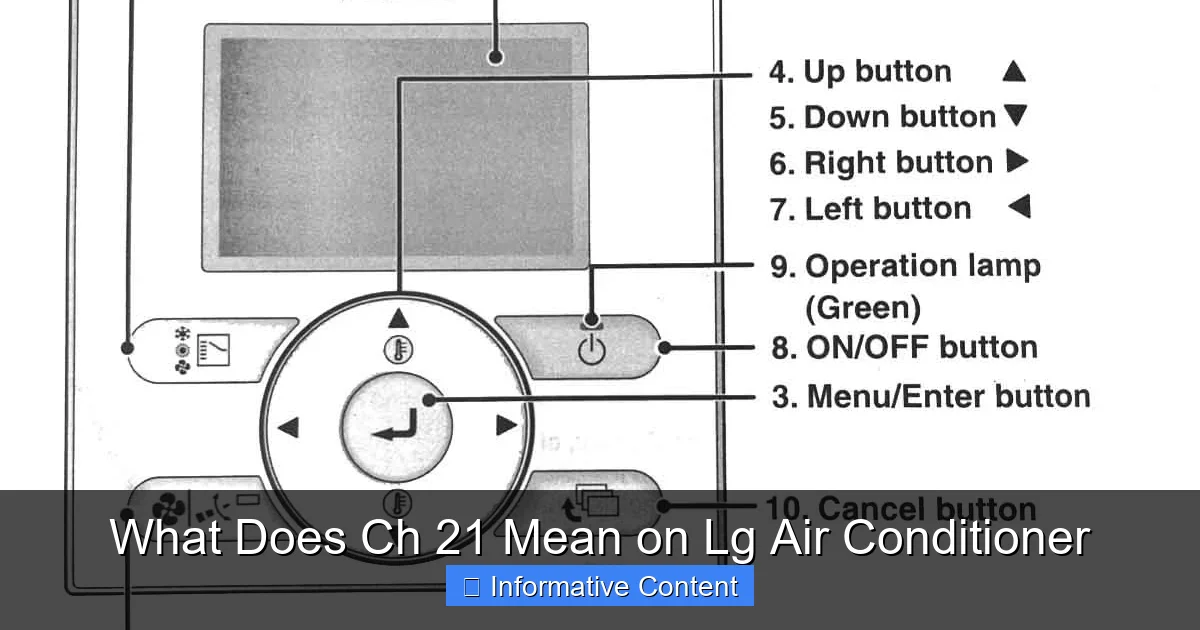
LG indoor unit displaying the CH 21 communication error code
Image source: uploads-ssl.webflow.com
Before diving into fixes, it helps to understand what CH 21 really signifies. LG uses a standardized error code system across its air conditioning models, and CH 21 consistently refers to a “communication error between indoor and outdoor units.” This means the two main parts of your split-system AC aren’t able to send or receive signals properly.
To break it down further: your LG air conditioner operates as a team. The indoor unit handles air circulation, filtering, and temperature sensing, while the outdoor unit manages the compressor, condenser, and heat exchange. These units are connected by refrigerant lines and electrical wiring—specifically, a communication wire that carries data back and forth. When this wire gets damaged, disconnected, or interfered with, the system can’t function as intended. That’s when CH 21 appears.
It’s important to note that CH 21 is different from other common error codes like CH 10 (low refrigerant) or CH 33 (fan motor issue). While those point to mechanical or refrigerant problems, CH 21 is almost always related to electrical communication. That makes it somewhat easier to diagnose—because you’re not dealing with leaks or motor failures, but rather signal transmission.
One key thing to remember: CH 21 can appear on both window units and ductless mini-splits, though it’s more common in split systems where the indoor and outdoor units are physically separated. If you have a portable or through-the-wall AC, this code is less likely to show up, as those models don’t rely on the same two-unit communication setup.
How LG’s Diagnostic System Works
LG air conditioners are equipped with smart diagnostic systems that monitor performance in real time. Sensors throughout the unit track temperature, pressure, voltage, and signal integrity. When something goes wrong, the system logs an error code and displays it on the indoor unit’s control panel. This helps users and technicians pinpoint issues faster than traditional trial-and-error methods.
The “CH” prefix stands for “Check,” followed by a number that corresponds to a specific fault. CH 21 is part of a broader family of communication-related codes, including CH 20 (outdoor unit communication error) and CH 22 (indoor unit communication error). While they’re similar, CH 21 specifically indicates a two-way communication failure—meaning neither unit can reliably talk to the other.
This system is designed to be user-friendly. You don’t need to be an HVAC expert to understand that CH 21 means “something’s blocking the conversation.” But it does require some basic troubleshooting to figure out what that “something” is.
Why Communication Matters in AC Systems
You might wonder: why is communication so critical? After all, isn’t the AC just supposed to cool the room? Well, modern air conditioners are far more sophisticated than their predecessors. They use microprocessors to optimize performance, adjust fan speeds based on room temperature, and even detect maintenance needs.
For example, if the indoor unit senses the room is getting too cold, it sends a signal to the outdoor unit to reduce compressor speed. If the outdoor unit detects high pressure, it tells the indoor unit to slow the fan. Without reliable communication, these adjustments can’t happen—leading to inefficient cooling, short cycling, or even system lockout.
In extreme cases, a persistent CH 21 error can cause the compressor to overwork, potentially leading to overheating or premature failure. That’s why it’s important to address the issue promptly, even if your AC seems to be running—albeit poorly—despite the error code.
CH 21 vs. Related LG Error Codes
Understanding how CH 21 differs from its sibling codes can speed up diagnosis. The table below outlines the most common communication-family errors on LG units.
| Code | Official Description | Typical Trigger | First Check |
|---|---|---|---|
| CH 20 | Outdoor unit communication error | Outdoor PCB not responding | Outdoor unit power & wiring |
| CH 21 | Indoor/outdoor communication error | Signal loss both ways | Communication cable & terminations |
| CH 22 | Indoor unit communication error | Indoor PCB not responding | Indoor unit power & wiring |
| CH 23 | Communication protocol mismatch | Firmware version mismatch | Verify matched indoor/outdoor models |
If you see CH 20 or CH 22 instead, the fault is isolated to one side; CH 21 means the link itself is down. A quick visual check of the communication cable often reveals the culprit.
Common Causes of CH 21 on LG Air Conditioners
Now that you know what CH 21 means, let’s look at the most common reasons it appears. Understanding the root cause is the first step toward fixing it. While every situation is a little different, most CH 21 errors fall into a few predictable categories.
1. Loose or Damaged Wiring
The most frequent cause of CH 21 is a problem with the communication wire that connects the indoor and outdoor units. This wire—usually a low-voltage cable—runs through walls, under floors, or along the exterior of your home. Over time, it can become loose, frayed, or chewed by pests. Even a slightly loose connection at the terminal block can disrupt the signal.
For example, if your AC was recently installed or serviced, the technician might have accidentally left a wire slightly loose. Or, if you’ve had construction work done near the unit, the wiring could have been disturbed. In older homes, rodents are a common culprit—they love to nest near warm appliances and often chew through insulation.
Signs of wiring issues include:
- Intermittent cooling (works sometimes, then stops)
- CH 21 appearing after a storm or power outage
- Burnt smell near the unit or electrical panel
2. Power Supply Problems
Stable power is essential for communication. If the voltage fluctuates or drops too low, the units may not have enough power to send signals. This can happen during brownouts, after lightning strikes, or if the circuit breaker is faulty.
LG air conditioners are designed to operate within a specific voltage range (typically 208–230V for residential units). If the voltage dips below 180V or spikes above 250V, the system may shut down communication as a safety measure. This is especially common in areas with unreliable electricity or during peak usage times.
A simple way to check this is to look at your home’s circuit breaker. If the AC breaker has tripped, reset it and see if the error clears. If it trips again immediately, there may be a short circuit or overload—requiring professional inspection.
3. Faulty Control Boards
Both the indoor and outdoor units have control boards (also called PCBs or printed circuit boards) that manage communication. If either board is damaged—due to moisture, overheating, or age—it may fail to send or receive signals properly.
Control board failures are less common than wiring issues, but they do happen. Signs include:
- CH 21 appearing consistently, even after wiring checks
- Other error codes appearing alongside CH 21
- Burning smell or visible damage on the board
Replacing a control board is more complex and usually requires a certified technician. However, it’s often covered under warranty if your unit is still new.
4. Environmental Interference
Believe it or not, external factors can interfere with AC communication. Strong electromagnetic fields from nearby appliances, power lines, or even faulty garage door openers can disrupt low-voltage signals. This is rare, but possible—especially in homes with older wiring or poor grounding.
Similarly, extreme weather conditions like lightning storms can induce power surges that damage sensitive electronics. If CH 21 appears after a thunderstorm, a surge protector may have saved your system—but not always.
5. Improper Installation
If your LG air conditioner was recently installed and CH 21 appears right away, the issue might be installation-related. Incorrect wiring, mismatched units, or using the wrong type of communication cable can all cause communication failures.
For example, some installers use standard electrical wire instead of the shielded communication cable recommended by LG. This can lead to signal noise and errors like CH 21. Always ensure your installer follows LG’s installation guidelines.
Step-by-Step Troubleshooting for CH 21
Now that you know the causes, let’s walk through how to fix CH 21. Most of these steps are safe for homeowners to try, but always prioritize safety—turn off power before inspecting any electrical components.
Step 1: Turn Off the Power
Before doing anything, shut off the power to your air conditioner. Go to your home’s main electrical panel and flip the breaker labeled “AC” or “Air Conditioner.” Wait at least 5 minutes to allow any residual charge to dissipate. This protects you from electric shock and gives the system a chance to reset.
Step 2: Check the Circuit Breaker
After turning the power back on, check if the breaker stays on. If it trips immediately, there’s likely a short circuit or ground fault. In that case, do not attempt further repairs—call an electrician.
If the breaker stays on, proceed to the next step.
Step 3: Inspect the Communication Wiring
Locate the communication wire that runs between your indoor and outdoor units. This is usually a thin, multi-strand cable (often labeled “S” or “Communication”) connected to terminal blocks on both units.
Check for:
- Loose connections (tighten screws if needed)
- Frayed or exposed wires
- Signs of chewing or damage
- Corrosion or burn marks
If you find damage, you may need to replace the wire. For minor looseness, simply re-tighten the terminals. Make sure the wire is properly insulated and not pinched by panels or screws.
Step 4: Reset the System
Sometimes, a simple reset clears temporary glitches. With the power off, wait 10–15 minutes. Then turn the power back on and see if CH 21 disappears. If it does, your AC should resume normal operation.
This works because the control boards reboot and re-establish communication. It’s especially effective after power outages or storms.
Step 5: Check for Obstructions or Damage
Inspect both the indoor and outdoor units for physical damage. Look for:
- Bent fins on the outdoor condenser
- Blocked airflow (from leaves, dirt, or debris)
- Water damage or rust
While these won’t directly cause CH 21, they can contribute to overheating or electrical issues that affect communication.
Step 6: Test Voltage (Optional)
If you have a multimeter and basic electrical knowledge, you can check the voltage at the outdoor unit. With the power on, measure between the L and N terminals. It should read between 208V and 230V. If it’s significantly lower or higher, contact your utility company or an electrician.
Step 7: Call a Professional
If none of the above steps resolve CH 21, it’s time to call an LG-certified technician. They can perform advanced diagnostics, test control boards, and replace faulty components. Attempting complex repairs yourself could void your warranty or cause further damage.
Advanced Diagnostics: Testing the Communication Circuit
For homeowners comfortable with a multimeter, a few extra checks can confirm whether the communication cable or a PCB is at fault.
- Continuity test – With power off, disconnect the communication wire at both ends. Set the meter to continuity (beep mode) and probe each conductor end-to-end. No beep means an open circuit; replace the cable.
- Resistance check – Measure resistance between the communication terminals on the indoor and outdoor PCBs (refer to the service manual for pin-out). Typical values are 60–120 Ω for the data pair. A reading of 0 Ω or OL suggests a short or open.
- Voltage presence – Power on and measure DC voltage between the communication terminals. You should see a pulsing 3.3–5 V signal. Steady 0 V or 5 V indicates a PCB fault.
In practice, a continuity test catches 80 % of cable faults without needing a schematic. If the cable tests good but voltage is absent, the indoor or outdoor PCB is likely defective.
Common DIY Mistakes to Avoid
- Using standard thermostat wire – It lacks shielding and picks up noise. Always use LG-specified shielded cable.
- Overtightening terminal screws – Strips the soft copper strands, creating high resistance.
- Skipping the 10‑minute wait – Capacitors on the PCBs hold charge; a short wait ensures a true cold reboot.
- Ignoring ground integrity – A floating ground invites EMI. Verify the outdoor unit’s ground lug is tight and bonded to the panel.
Preventing CH 21 in the Future
Once you’ve fixed CH 21, you’ll want to avoid it happening again. Prevention is always easier (and cheaper) than repair. Here are some tips to keep your LG air conditioner running smoothly.
Schedule Regular Maintenance
Have your AC serviced once a year—preferably before summer. A technician will clean coils, check refrigerant levels, inspect wiring, and test electrical connections. This catches small issues before they become big problems. For a printable checklist, see our annual AC service guide.
Install a Surge Protector
Power surges are a leading cause of electronic failures in AC units. Installing a whole-house surge protector can safeguard your system from lightning strikes and grid fluctuations. It’s a small investment that pays off in longevity. The U.S. Department of Energy recommends surge protection for all major appliances.
Protect Wiring from Pests
If you live in an area with rodents, consider installing protective conduit or mesh around exposed wiring. This prevents chewing and keeps communication lines intact. See our outdoor unit wiring protection tips.
Avoid DIY Repairs on Electrical Components
While basic troubleshooting is safe, avoid opening control panels or splicing wires unless you’re qualified. Incorrect repairs can cause permanent damage or safety hazards.
Monitor for Recurring Errors
If CH 21 keeps coming back, it’s a sign of a deeper issue—like a failing control board or chronic power problems. Don’t ignore repeated errors. Address them promptly to avoid costly repairs down the line.
Estimated Repair Costs for CH 21
| Repair Type | Typical Parts Cost | Typical Labor (hrs) | Notes |
|---|---|---|---|
| Communication cable replacement | $25–$60 | 1–2 | Shielded 4‑conductor cable |
| Indoor PCB replacement | $120–$250 | 1.5–2.5 | Often covered under 5‑yr parts warranty |
| Outdoor PCB replacement | $180–$350 | 2–3 | Includes refrigerant safety check |
| Full system recommissioning | – | 3–4 | After major wiring work |
Prices are 2026 U.S. averages; actual quotes vary by region and model. Always ask for a written estimate before authorizing work.
When to Call a Technician
While many CH 21 errors can be fixed at home, some situations require professional help. Here’s when you should pick up the phone:
- The error persists after all troubleshooting steps
- You smell burning or see visible damage
- The breaker trips repeatedly
- You’re uncomfortable working with electricity
- Your unit is still under warranty (DIY repairs may void it)
A certified LG technician has the tools and expertise to diagnose complex issues quickly. They can also verify that your installation meets code and manufacturer standards.
Conclusion
Seeing “CH 21” on your LG air conditioner can be alarming, but it’s usually not a death sentence for your unit. This error simply means the indoor and outdoor units aren’t communicating properly—often due to wiring, power, or installation issues. With a little patience and the right approach, many homeowners can resolve CH 21 on their own.
Start by checking the power supply and inspecting the communication wiring. A simple reset might do the trick. If the problem persists, don’t hesitate to call a professional. Regular maintenance and surge protection can help prevent future occurrences, keeping your home cool and your AC running efficiently.
Remember, CH 21 is a diagnostic tool—not a verdict. It’s LG’s way of saying, “Hey, something’s off. Let’s fix it.” By understanding what it means and how to respond, you’re already ahead of the game. Stay cool, stay informed, and don’t let an error code ruin your summer.
Frequently Asked Questions
Is CH 21 covered under warranty?
Yes, if your LG air conditioner is still under warranty, repairs for CH 21—including parts and labor—are typically covered, especially if caused by manufacturing defects.
Can a power outage cause CH 21?
Yes, power outages or surges can disrupt communication between units, triggering CH 21. A system reset often resolves it.
Do all LG models show CH 21 for the same issue?
Yes, CH 21 consistently means a communication error across LG’s air conditioner lineup, regardless of model or type.
Can dirty filters cause CH 21?
No, dirty filters typically cause airflow or overheating issues, not communication errors like CH 21.
How long does it take to fix CH 21?
If it’s a simple wiring or reset issue, it can take 15–30 minutes. Complex repairs may require a technician and take longer.
Should I unplug my AC when CH 21 appears?
Yes, turning off the power (via breaker) is the first step in troubleshooting CH 21 safely.