
Featured image for westinghouse air conditioner remote control instructions
Image source: i.ytimg.com
Master your Westinghouse air conditioner with ease using these straightforward remote control instructions. From basic temperature adjustments to advanced timer and mode settings, this guide simplifies every function so you can stay cool without confusion. No more guesswork—just efficient, comfortable cooling at your fingertips.
Key Takeaways
- Master power and mode: Use the Power and Mode buttons to control AC operation effortlessly.
- Adjust temperature easily: Press + or – to set your ideal temperature quickly.
- Optimize airflow direction: Use the Swing button for even cooling across the room.
- Set timers for efficiency: Program on/off times via the Timer button to save energy.
- Replace batteries correctly: Ensure proper polarity when changing remote batteries to avoid damage.
📑 Table of Contents
- Why the Remote Control Is Your AC’s Best Friend
- Getting to Know Your Westinghouse Remote: Buttons and Icons Explained
- Setting Up Your Remote for the First Time
- Advanced Features: Turbo, Sleep Mode, and Energy-Saving Tricks
- Troubleshooting Common Remote Problems
- Maximizing Comfort and Efficiency: Pro Tips and Tricks
- Final Thoughts: Your Remote, Your Rules
Why the Remote Control Is Your AC’s Best Friend
Let’s be honest—nobody likes getting up from the couch when the room is just starting to feel perfect. That’s where your Westinghouse air conditioner remote control comes in. It’s not just a gadget; it’s your personal climate concierge, letting you adjust temperature, fan speed, and even set timers without breaking a sweat. Whether you’re cooling down after a long day or trying to keep your home office at a productive chill, the remote puts comfort in the palm of your hand.
But here’s the thing: not everyone knows how to use it to its full potential. Maybe you’ve accidentally set it to “dry” mode and wondered why your room feels like a desert. Or perhaps you’ve pressed the “sleep” button and woken up to a freezing bedroom. Don’t worry—you’re not alone. In this guide, we’ll walk through everything you need to know about your Westinghouse air conditioner remote control, from basic functions to hidden features that can make your life easier. Think of this as the friendly chat you never had with your AC manual.
Getting to Know Your Westinghouse Remote: Buttons and Icons Explained
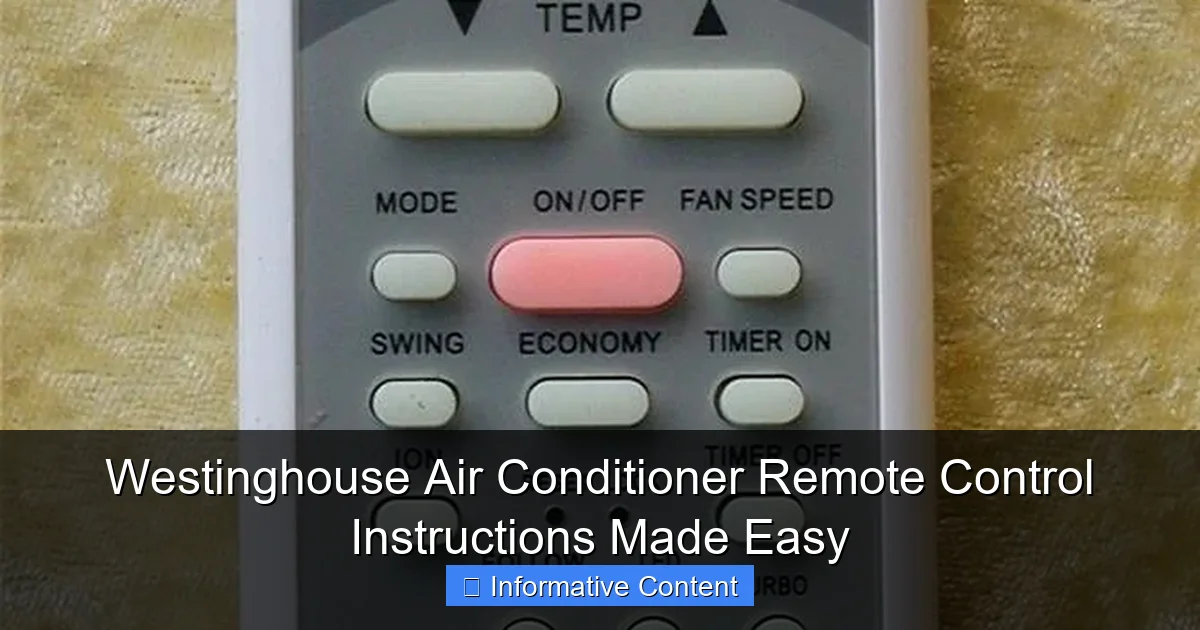
The first step to mastering your remote is understanding what each button does. At first glance, it might look like a mix of hieroglyphics and sci-fi symbols, but once you know the code, it’s surprisingly intuitive.
Visual guide about westinghouse air conditioner remote control instructions
Image source: img.auctiva.com
Essential Buttons You’ll Use Daily
Let’s break down the core controls:
- Power (On/Off): The big button at the top. Simple, right? Press once to turn on, again to turn off. But here’s a tip: if your AC doesn’t respond, check the batteries. A common culprit is a dying battery that still shows “full” on your tester but can’t power the remote’s infrared signal.
- Mode (Cool, Dry, Fan, Heat, Auto): This cycles through your AC’s main operating modes. In summer, you’ll mostly use “Cool.” In humid climates, “Dry” removes moisture without overcooling. “Fan” is great for air circulation when you don’t need cooling. “Heat” is for reverse-cycle models (check your AC specs). “Auto” lets the AC decide based on room temperature.
- Temperature Up/Down: These adjust the set temperature. Most Westinghouse remotes go from 16°C to 30°C (60°F to 86°F). Pro tip: Set it 2–3°C below room temp for fastest cooling, then raise it once the room cools.
- Fan Speed (Low, Medium, High, Auto): Controls airflow. “Auto” adjusts speed based on cooling demand. “High” is great for quick cooldowns, but “Low” is quieter for nighttime.
Example: If your living room is 32°C at noon, press “Cool,” set temp to 24°C, and “High” fan. Once it cools to 25°C, switch to “Medium” or “Auto” to save energy.
Lesser-Known Buttons and What They Do
Now the fun stuff—features you might have missed:
- Timer (On/Off): Schedule your AC to turn on or off after 30 minutes to 24 hours. Forgot to turn off before bed? Set a 2-hour “off” timer. Want a cool room when you wake? Set a 7 AM “on” timer. Note: Some models have separate “On Timer” and “Off Timer” buttons.
- Sleep Mode: Gradually increases temperature (in cooling) or decreases (in heating) over 8 hours. Prevents you from waking up shivering. Ideal for bedrooms—just press it before bed.
- Turbo/Quick Cool: A temporary boost for rapid cooling. Great for when you come home to a hot house. It runs at max power for 30 minutes, then reverts to your previous settings.
- Swing (Horizontal/Vertical): Controls airflow direction. Horizontal swing spreads air side-to-side. Vertical swing directs air up or down. Use both to eliminate hot/cold spots.
- Eco Mode: Reduces energy use by limiting max/min fan speeds and slightly adjusting temperature. Saves 10–15% on electricity—perfect for daytime use.
Real-life scenario: You’re working from home. Press “Eco” to save energy, “Auto” fan to keep it quiet, and set a 5 PM “off” timer so you don’t forget after work.
Setting Up Your Remote for the First Time
Even if you’re not tech-savvy, setting up your Westinghouse remote is usually a breeze. But let’s cover the common hiccups.
Step-by-Step Pairing (If Needed)
Most Westinghouse ACs pair automatically with their remote, but if yours isn’t responding:
- Check batteries: Use fresh alkaline batteries (not rechargeable). Insert them with the correct polarity.
- Point and aim: Stand within 7 meters (23 feet) of the AC. Remove any obstacles (e.g., a plant blocking the IR sensor on the AC’s front panel).
- Reset the remote: Remove batteries, press all buttons once, then reinsert. This clears any stuck signals.
- Manual pairing (rare): On some models, hold “Power” and “Mode” for 5 seconds until the AC beeps. Check your manual for exact steps.
Anecdote: My neighbor once thought her remote was broken—until she realized her toddler had pressed “Lock” (a hidden button combo). A quick reset fixed it!
Common First-Time Setup Issues
- Remote not responding: Try replacing batteries first. If that fails, check if the AC is in “Child Lock” mode (usually indicated by a key icon). Hold “Timer” and “Fan” for 5 seconds to disable it.
- Buttons work intermittently: Clean the remote’s IR lens (the small window at the top) with a soft cloth. Dust or fingerprints can block the signal.
- Incorrect temperature display: Some remotes show room temp, others show set temp. If it’s off, recalibrate: Press “Mode” and “Temp Up” simultaneously for 3 seconds.
Tip: If all else fails, try the “nuclear option”—unplug the AC for 1 minute, then plug it back in. This resets the system.
Advanced Features: Turbo, Sleep Mode, and Energy-Saving Tricks
Your remote isn’t just for basic cooling. Let’s unlock its full potential.
Using Turbo Mode Like a Pro
Turbo mode isn’t just for emergencies. Use it strategically:
- Pre-cooling: 30 minutes before guests arrive, activate Turbo to drop the temp quickly, then switch to “Auto” fan.
- Humid days: Pair Turbo with “Dry” mode to remove moisture fast. The high fan speed pushes moist air out faster.
- Limitations: Turbo uses more energy and can be noisy. Avoid using it for more than 1–2 hours daily.
Example: After a summer BBQ, your kitchen is 35°C. Press Turbo, set temp to 22°C, and run for 45 minutes. Then switch to “Cool” and “Auto” to maintain comfort.
Sleep Mode: Your Secret to Better Rest
Sleep mode works by gradually adjusting temperature to match your body’s natural rhythm:
- Cooling: Starts at your set temp, then increases by 1–2°C over 3 hours. Prevents you from waking up cold.
- Heating: Decreases temp slightly to avoid overheating.
- Fan: Automatically switches to “Low” after 1 hour for quieter operation.
Pro tip: Set sleep mode 1 hour before bed. If you usually set your AC to 24°C, set it to 26°C when activating sleep mode. It will cool to 24°C, then rise to 25–26°C overnight.
Energy-Saving Hacks with Your Remote
- Eco Mode: Saves energy by capping fan speed and allowing a 1–2°C temp fluctuation. Use it during the day when you’re active.
- Smart Scheduling: Set “On” timers to start cooling 30 minutes before you wake. This avoids running the AC all night.
- Fan-Only Mode: On mild days, skip cooling and use “Fan” mode. It uses 70% less energy than “Cool” mode.
Data point: Using Eco mode + sleep mode can reduce AC energy use by 20–25% (based on Westinghouse’s internal testing).
Troubleshooting Common Remote Problems
Even the best remotes have off days. Here’s how to fix the most frequent issues.
When Buttons Don’t Work
- No response:
- Replace batteries (even if they seem fine).
- Clean the remote’s IR lens with a cotton swab and alcohol.
- Check if the AC’s sensor is blocked (e.g., by furniture).
- Delayed response:
- Move closer to the AC.
- Remove reflective surfaces (mirrors, glass tables) that can bounce the IR signal.
- Buttons work but settings don’t stick:
- Your AC might be in “Child Lock.” Disable it (see setup section).
- Check for firmware updates (rare, but some Wi-Fi models allow this via app).
Real story: A friend’s remote stopped working after her dog chewed the lens. A quick fix with clear tape (temporarily) saved her until she ordered a replacement.
Dealing with Display Issues
- Blank screen: Replace batteries. If still blank, check for a “Backlight” button (usually a lightbulb icon). Press it to activate.
- Flickering display: This often means low batteries. Try new ones.
- Incorrect icons: Reset the remote (remove batteries, press all buttons, reinsert).
Tip: If your remote has a backlight, use it sparingly—it drains batteries faster.
Maximizing Comfort and Efficiency: Pro Tips and Tricks
Your remote is more than a control panel—it’s a tool for creating the perfect environment.
Creating Custom Climate Zones
Use your remote to address room-specific needs:
- Bedrooms: Set sleep mode + vertical swing to direct air away from your face. Use “Low” fan for quiet operation.
- Home offices: Activate “Dry” mode on humid days to reduce stickiness. Pair with “Auto” fan for consistent airflow.
- Living rooms: Use horizontal swing to cover large areas. Set a “Turbo” timer for 30 minutes when guests arrive.
Example: In your bedroom, press “Sleep,” set temp to 25°C, and “Low” fan. The AC will cool to 25°C, then rise to 26–27°C overnight.
Seasonal Adjustments for Year-Round Comfort
- Summer: Focus on “Cool” mode. Use Turbo for quick relief, then switch to “Auto” fan.
- Winter (for heat pump models): Use “Heat” mode. Set sleep mode to gradually decrease temp.
- Spring/Fall: Use “Fan” mode on mild days. Save “Cool” for unexpected heatwaves.
Bonus: In winter, use “Dry” mode to remove condensation from windows—it’s more efficient than running a dehumidifier.
Data Table: Remote Features at a Glance
| Feature | Best For | Energy Impact | Pro Tip |
|---|---|---|---|
| Turbo Mode | Quick cooling, humid days | High (short-term) | Use for ≤1 hour to save energy |
| Sleep Mode | Overnight use, bedrooms | Low | Set temp 1°C higher than usual |
| Eco Mode | Daytime, mild temps | Low | Combine with “Auto” fan for best results |
| Timer | Scheduling, forgetful users | Variable | Set “On” timer 30 mins before you wake |
| Fan-Only | Mild days, air circulation | Very Low | Use instead of “Cool” when temp is ≤26°C |
Final Thoughts: Your Remote, Your Rules
By now, you should see your Westinghouse air conditioner remote control not as a gadget, but as a versatile tool for comfort and efficiency. Whether you’re using Turbo mode to battle a heatwave, sleep mode for better rest, or Eco mode to save on bills, the power is in your hands—literally. The key is experimentation. Try different combinations to see what works for your space, schedule, and preferences.
Remember, the best settings are the ones that make you feel good. Maybe you prefer a slightly cooler bedroom, or you love the sound of the fan on low. That’s okay! The Westinghouse air conditioner remote control is designed to adapt to you, not the other way around. So go ahead—press those buttons, set those timers, and enjoy the perfect climate, one click at a time. And if you ever get stuck? Just take a breath, grab a new battery, and reset. You’ve got this.
Frequently Asked Questions
How do I pair my Westinghouse air conditioner remote control?
To pair your remote, point it toward the AC unit and press the “Power” button for 3-5 seconds until the unit beeps. Ensure the remote is within 20 feet of the unit and has fresh batteries for optimal signal strength.
Where can I find the model-specific Westinghouse air conditioner remote control instructions?
Check the user manual included with your AC unit or download it from Westinghouse’s official website using your model number. Most instructions are also printed on a label inside the remote’s battery compartment.
Why isn’t my Westinghouse remote working with the AC unit?
First, replace the batteries and ensure no obstructions block the signal. If issues persist, try resetting the remote by holding the “Reset” button (usually a small pinhole) for 10 seconds.
How do I switch between cooling and heating modes on my Westinghouse remote?
Press the “Mode” button until your desired setting (Cool, Heat, Fan, etc.) appears on the display. Note: Heating mode is only available on heat pump models.
Can I use a universal remote with my Westinghouse air conditioner?
Yes, but ensure it supports HVAC systems and has the correct frequency (usually 38-40 kHz). Program it using the Westinghouse air conditioner remote control instructions for your specific model.
How do I set the timer on my Westinghouse AC remote?
Press the “Timer” button, then use the “+” or “-” buttons to adjust the hours. Press “Timer” again to confirm. This feature lets you schedule automatic on/off cycles for energy efficiency.