
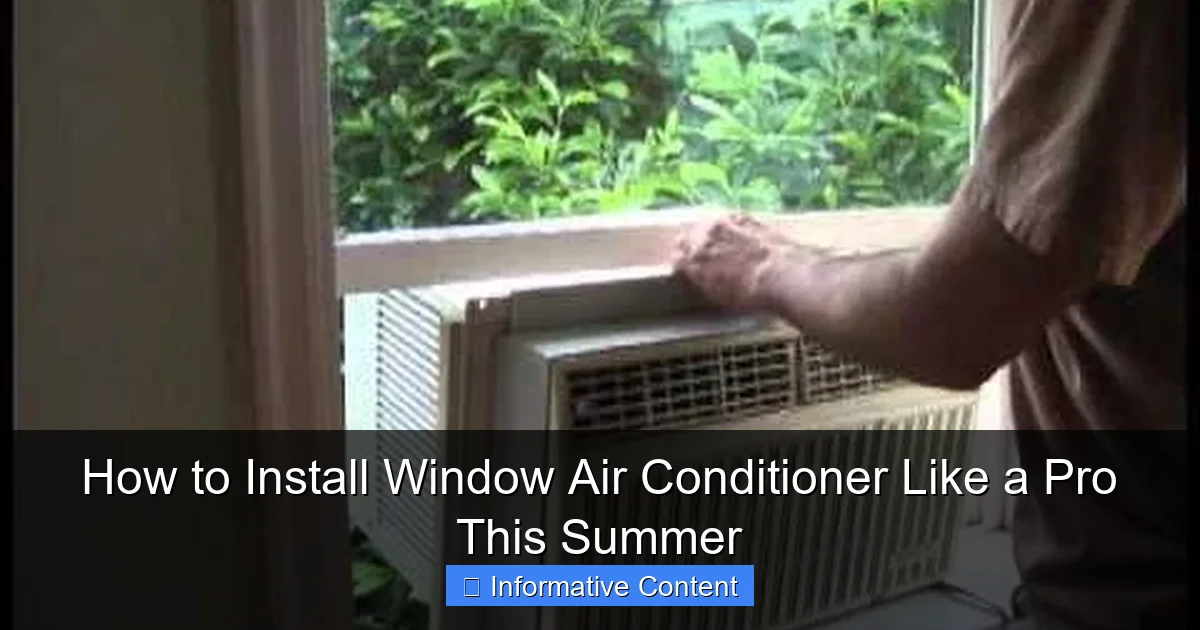
Featured image for install window air conditioner
Image source: i.ytimg.com
Installing a window air conditioner securely and efficiently starts with choosing the right unit for your window type and room size. Follow manufacturer guidelines closely, use proper support brackets, and ensure a tight seal to prevent air leaks and maximize cooling performance. With the right tools and safety precautions, a professional-quality installation takes less than an hour and keeps your home cool all summer.
Key Takeaways
- Measure your window first: Ensure a proper fit before purchasing the AC unit.
- Check for safety: Always unplug the unit before installation or adjustments.
- Seal gaps tightly: Use foam insulation to prevent air leaks and boost efficiency.
- Angle slightly outward: Tilt the AC slightly for optimal drainage and performance.
- Secure with brackets: Prevent accidents by anchoring the unit to the window frame.
- Test before summer: Run a trial to confirm cooling and drainage work properly.
📑 Table of Contents
- How to Install a Window Air Conditioner Like a Pro This Summer
- Why Proper Installation Matters (And What Can Go Wrong)
- Tools, Supplies, and Safety Prep (Don’t Skip This!)
- Step-by-Step Installation: From Box to Blast of Cold Air
- Post-Installation Checks: Don’t Plug It In Yet!
- Special Cases: Sliding, Casement, and Odd-Shaped Windows
- Maintenance and Care: Keep It Running Like New
- Data Table: Common Window AC Sizes and Window Requirements
- Final Thoughts: You’ve Got This!
How to Install a Window Air Conditioner Like a Pro This Summer
Ah, summer. The season of backyard barbecues, beach days, and… sweat-drenched shirts by noon. If your home doesn’t have central AC, you’re probably eyeing that window air conditioner box with a mix of hope and hesitation. You’re not alone. Every year, millions of people face the same dilemma: Can I really install this thing myself without breaking a window—or my back?
The good news? Yes, you absolutely can. Installing a window air conditioner is one of the most satisfying DIY home projects out there. Not only does it save you $100–$200 in labor costs, but there’s something deeply rewarding about feeling that first blast of cool air after a successful install. I’ve done it three times in two different apartments (yes, one was a narrow casement window—more on that later), and I’ve learned that with the right tools, a little patience, and the right approach, you can install window air conditioner units safely and efficiently—no pro needed.
Why Proper Installation Matters (And What Can Go Wrong)
Let’s get real: slapping an AC unit into a window and calling it a day might seem like a shortcut, but it’s a recipe for disaster. A poorly installed window air conditioner can:
Visual guide about install window air conditioner
Image source: i.ytimg.com
- Leak water into your home (hello, mold and water damage)
- Fall out of the window (yes, it happens—especially on upper floors)
- Be inefficient, driving up your electricity bill
- Create annoying vibrations or rattling noises
- Void your warranty (many manufacturers require proper installation)
The Real Cost of Cutting Corners
I once helped my neighbor “quick install” his 10,000 BTU unit. We skipped the side panels, didn’t seal the top, and thought the weight would hold it in place. Two weeks later, I heard a loud crash at 3 a.m.—the unit had shifted, the window cracked, and water was dripping into his bedroom. Total damage? Over $600 in repairs. All because we rushed the process.
Proper installation isn’t just about safety—it’s about performance. A well-sealed unit cools faster, uses less energy, and lasts longer. According to the U.S. Department of Energy, an improperly installed AC can lose up to 30% of its efficiency. That’s like paying for 10,000 BTUs but only getting 7,000 worth of cooling.
What You’ll Gain by Doing It Right
- Peace of mind: No worrying about the unit falling
- Better cooling: Less air leakage means faster temperature drop
- Lower energy bills: Sealed units don’t overwork
- Longer lifespan: Less strain on the compressor and fan
- Warranty protection: Many brands require proof of proper installation
Tools, Supplies, and Safety Prep (Don’t Skip This!)
Before you even touch the AC unit, gather your supplies. This isn’t a “wing it” job. Preparation saves time, reduces frustration, and keeps you safe.
Essential Tools & Supplies
- Measuring tape
- Phillips and flathead screwdrivers
- Drill with 1/8” and 3/8” drill bits (optional but helpful)
- Level (a $10 investment—don’t skip it!)
- Utility knife or scissors
- Weatherstripping or foam insulation (if not included)
- Support brackets (if required—check your manual)
- Work gloves (protect those hands!)
- Eye protection (dust and metal shards are real)
- Vacuum (to clean the window track)
- Old towel or blanket (to protect the unit during handling)
Safety First: Protect Yourself and Your Home
Installing a window air conditioner isn’t dangerous if you respect the weight and height. But a typical 8,000–12,000 BTU unit weighs 60–80 pounds. That’s like carrying a large dog up a ladder.
- Work with a partner: Even if you’re strong, two people make it safer and easier
- Clear the area: Remove furniture, plants, or anything fragile below the window
- Use a ladder safely: If it’s a second-floor window, use a stable extension ladder with someone holding the base
- Wear closed-toe shoes: No flip-flops when handling heavy appliances
- Check the power source: Never plug into an extension cord—use a grounded outlet
Check Your Window Type
Not all windows are created equal. Most ACs fit double-hung (up-and-down) windows. But if you have:
- Casement windows: Side-opening? You’ll need a casement AC or a custom bracket
- Sliding windows: Horizontal? Some units support this, but check specs
- Single-hung: Only the bottom sash moves? Still works, but measure carefully
Pro tip: Measure your window opening (width and height) before buying the AC. A unit that’s even an inch too wide won’t fit—and forcing it can damage the frame.
Step-by-Step Installation: From Box to Blast of Cold Air
Now for the main event. Let’s walk through installing your window air conditioner the right way. I’ll use a standard 10,000 BTU double-hung window unit as our example, but these steps apply to most models.
Step 1: Unbox and Inspect the Unit
Open the box carefully. Remove all packaging, including foam blocks and plastic film. Check for:
- Cracks or dents in the case
- Missing parts (side panels, screws, brackets)
- Damage to the power cord
Most kits include:
- Main AC unit
- Side accordion panels (left and right)
- Window support bracket (if required)
- Screws and mounting hardware
- Foam seal for the top
- User manual (read it!)
Step 2: Prepare the Window
Open the window fully. Clean the track with a vacuum or damp cloth. Remove any debris or old weatherstripping. This ensures a smooth fit and prevents air leaks.
Measure the width at the top, middle, and bottom of the opening. Use the narrowest measurement to ensure the AC will fit. If it’s slightly too wide, don’t force it—most units can be compressed 1–2 inches, but check the manual.
Step 3: Install the Support Bracket (If Required)
Many modern ACs use a sill support bracket instead of relying solely on the window. This is a metal or plastic arm that attaches to the outside sill and holds the unit’s weight.
- Position the bracket so it’s level and centered
- Mark the screw holes with a pencil
- Drill pilot holes (prevents wood from splitting)
- Secure with the provided screws
Note: If your window doesn’t allow a bracket (e.g., no exterior sill), you can use the window’s weight and seal. But always check the manual—some units require a bracket for safety.
Step 4: Attach the Side Panels
Slide the accordion panels into the grooves on the left and right sides of the AC. Most have a metal track—push them in firmly until they click or seat completely.
Test the fit: The panels should extend 1–2 inches beyond the window opening to allow for adjustment. If they’re too long, trim the end with scissors (not the accordion part).
Step 5: Position the AC Unit
This is the trickiest part. With a partner:
- Place a towel or blanket on the sill to protect the unit
- Lift the AC and tilt it slightly backward (the back is heavier)
- Lower it into the window opening, resting the front edge on the sill
- Slide it back until the back panel is flush against the outside wall
- Lower the window sash onto the unit’s top frame (not the glass!)
Pro tip: Use a level to ensure the unit is perfectly horizontal. If it’s tilted, water can leak inside or the unit won’t drain properly.
Step 6: Secure the Side Panels
Extend the accordion panels to fit snugly against the window frame. Secure them with the provided screws or brackets. Most have pre-drilled holes—align them and tighten gently. Don’t over-tighten, or you’ll warp the panel.
Step 7: Seal the Top Gap
Even with the window closed, there’s usually a gap at the top. This is where air leaks happen. Use the included foam seal (or buy a high-density weatherstrip if yours is flimsy).
- Cut the foam to fit the width of the opening
- Press it into the gap between the top of the AC and the closed window
- Close the window to compress it—this creates an airtight seal
Bonus: For extra insulation, add a piece of rigid foam board on the inside, cut to fit the remaining gap.
Post-Installation Checks: Don’t Plug It In Yet!
You’re almost there! But before you hit that power button, run through these checks. They take 5 minutes but prevent 90% of problems.
Check 1: Stability Test
Give the AC a gentle push from the front. It shouldn’t rock or shift. If it does:
- Re-tighten the side panel screws
- Adjust the support bracket
- Ensure the window sash is fully closed and locked
Check 2: Drainage Test
Condensation is normal. But it should drain outside, not inside. Here’s how to test:
- Plug in the unit and run it for 10–15 minutes
- Check the outside—you should see water dripping from the back
- If water appears inside, the unit isn’t tilted slightly back (should have 1/4” to 1/2” slope)
Fix: Loosen the side panels, adjust the unit’s angle, and re-secure.
Check 3: Airflow and Noise
Listen for:
- Rattling (loose panels or debris in the fan)
- Humming (normal) vs. grinding (bad—turn it off immediately)
- Air blowing into the room (good) vs. leaking around the unit (bad)
Use your hand to feel for air leaks around the edges. If you find one, add more foam or weatherstripping.
Check 4: Electrical Safety
Never use an extension cord. The AC draws a lot of power, and cords can overheat. Plug directly into a grounded (three-prong) outlet on its own circuit. If the outlet is shared with other appliances, consider upgrading—overloaded circuits are a fire hazard.
Special Cases: Sliding, Casement, and Odd-Shaped Windows
Not all homes have standard double-hung windows. Don’t panic—there are solutions for tricky setups.
Sliding Windows (Horizontal)
Most window ACs are designed for vertical openings, but some manufacturers make horizontal models (e.g., Frigidaire, LG). If you have a sliding window:
- Look for “sliding window AC” in the product specs
- Use a custom bracket that mounts to the wall or window frame
- Seal the sides with foam or plexiglass panels (cut to size)
DIY hack: Cut a piece of plywood to fit the opening, with a hole for the AC. Mount it to the window frame, then install the unit in the hole. Seal all edges with silicone.
Casement Windows (Crank-Out)
These are tough. The window opens outward, so a standard AC won’t fit. Options:
- Buy a casement window air conditioner (e.g., Koldfront WAC10001W, 10,000 BTU)
- Use a portable AC with a hose that vents through the window
- Install a custom plexiglass panel with a cutout for the AC
Casement ACs are pricier but designed to fit the opening and seal tightly. They often have a built-in bracket for the crank handle.
Bay, Bow, or Arched Windows
These are rare but not impossible. Your best bet:
- Consult a HVAC pro for a custom solution
- Use a portable AC with a flexible hose
- Install a through-the-wall AC in a nearby standard window
Pro tip: If you’re renting, ask your landlord about permanent modifications. Some allow it with written permission.
Maintenance and Care: Keep It Running Like New
You’ve installed your window air conditioner like a pro. Now keep it that way. A little maintenance goes a long way.
Monthly Tasks
- Clean the filter: Wash with soapy water, rinse, dry, and reinstall. A dirty filter reduces airflow and efficiency
- Wipe the exterior: Use a damp cloth—no harsh chemicals
- Check the seal: Look for gaps or loose weatherstripping
End-of-Season Care
When summer ends, don’t just unplug and forget it. Follow these steps:
- Turn off and unplug the unit
- Remove and clean the filter
- Vacuum the coils and fan (use a soft brush)
- Cover the outside with a waterproof AC cover
- Store the unit indoors (if possible) to protect from weather
When to Call a Pro
Even the best DIYers need help sometimes. Call an HVAC technician if:
- The unit isn’t cooling (could be low refrigerant—don’t try to recharge it yourself)
- It makes loud noises or vibrates excessively
- You smell burning or see smoke
- You need a permanent through-the-wall installation
Data Table: Common Window AC Sizes and Window Requirements
| BTU Rating | Cooling Area (sq ft) | Min. Window Width (inches) | Min. Window Height (inches) | Typical Weight (lbs) |
|---|---|---|---|---|
| 5,000–6,000 | 150–250 | 23 | 14 | 40–50 |
| 8,000 | 350–400 | 24 | 15 | 55–65 |
| 10,000 | 450–550 | 25 | 16 | 65–75 |
| 12,000 | 550–650 | 26 | 17 | 75–85 |
| 14,000–15,000 | 700–800 | 28 | 18 | 85–100 |
Source: Energy Star and major AC manufacturers (2023). Always check your specific model’s manual for exact dimensions.
Final Thoughts: You’ve Got This!
Installing a window air conditioner isn’t rocket science. It’s a practical, achievable project that gives you control over your comfort—and your energy bills. I’ve seen people panic at the sight of a screwdriver, but after walking them through the steps, they’re amazed at how simple it is.
Remember: install window air conditioner units safely by focusing on three things—stability, sealing, and support. Use a bracket if needed, seal every gap, and never skip the level. And if you hit a snag? Pause. Breathe. Check the manual. Most problems are fixable.
This summer, don’t suffer through another sweltering day. Take charge. Install your AC like a pro, enjoy that cool air, and pat yourself on the back. You’ve earned it. And if you ever move? You’ll know exactly how to do it again—faster, smarter, and with zero stress.
Stay cool out there. You’ve got this.
Frequently Asked Questions
How do I install a window air conditioner safely?
To install a window air conditioner safely, ensure the unit is properly secured with support brackets and side panels to prevent tipping. Always follow the manufacturer’s instructions and avoid overloading electrical circuits.
What tools do I need to install a window air conditioner?
You’ll typically need a screwdriver, measuring tape, level, support brackets, foam insulation, and safety gloves. Some models may require a drill or adjustable wrench for mounting hardware.
Can I install a window air conditioner alone?
While possible, it’s safer to have a helper due to the unit’s weight and awkward positioning. A second person can help lift, align, and secure the air conditioner during installation.
How do I seal gaps when installing a window air conditioner?
Use included side panels or accordion-style foam seals to close gaps between the unit and window frame. For extra insulation, apply weatherstripping or foam tape to prevent air leaks.
What type of window works best for a window air conditioner?
Double-hung or sliding windows are ideal for most standard units. Ensure the window frame is sturdy, opens wide enough for the AC’s width, and can support the unit’s weight.
Do I need to tilt a window air conditioner when installing?
Yes, most units require a slight tilt (about 1/4 inch) toward the outside for proper condensation drainage. Use a level to check and adjust the angle during installation.