
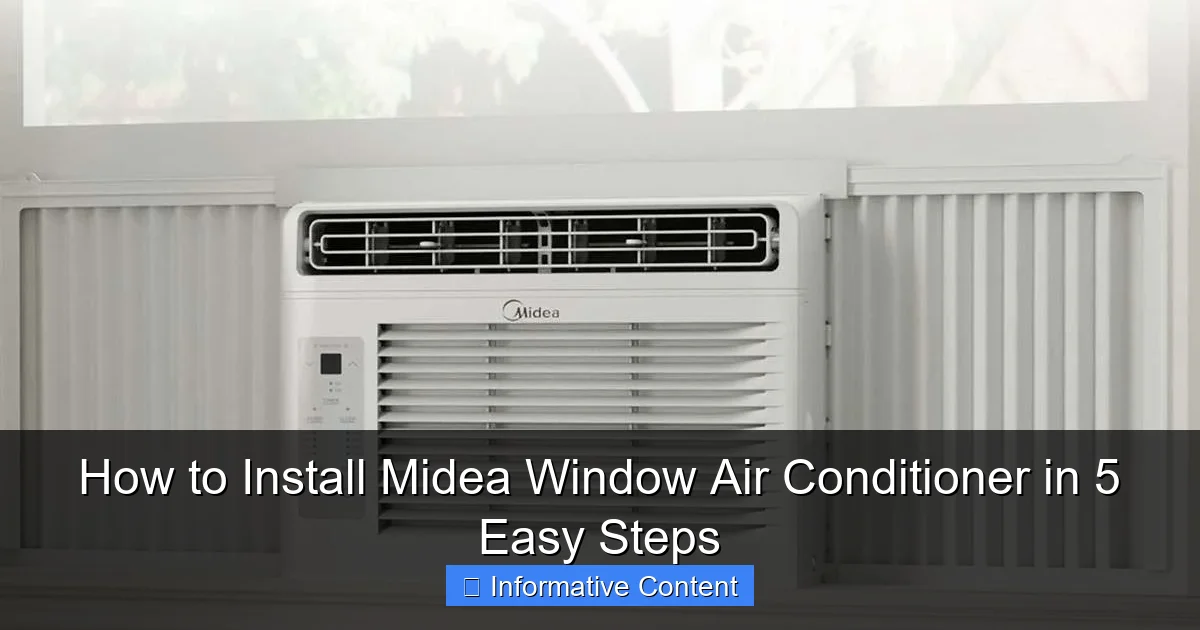
Featured image for how to install midea window air conditioner
Image source: d1pjg4o0tbonat.cloudfront.net
Installing a Midea window air conditioner is quick and straightforward when you follow the right steps. With the included mounting kit, secure the unit safely in your window, ensure a tight seal, and connect the power—no professional help needed. Proper installation ensures optimal cooling, energy efficiency, and long-term performance.
Key Takeaways
- Measure your window to ensure proper fit before purchasing the Midea AC unit.
- Secure the mounting brackets tightly to support the AC’s weight and prevent accidents.
- Seal gaps with foam strips to improve efficiency and block hot air entry.
- Plug into a grounded outlet to avoid electrical hazards and ensure safe operation.
- Test airflow and cooling immediately after installation to confirm proper functioning.
- Follow the manual’s instructions closely for model-specific details and safety warnings.
📑 Table of Contents
- Why Installing Your Midea Window Air Conditioner Doesn’t Have to Be Stressful
- Step 1: Gather Your Tools and Check the Installation Site
- Step 2: Prepare the Window and Install Support Brackets
- Step 3: Position the Midea Air Conditioner in the Window
- Step 4: Secure the Unit and Seal the Gaps
- Step 5: Connect Power and Test the Unit
- Bonus: Maintenance Tips to Extend Your Midea AC’s Life
- Final Thoughts: You’ve Got This!
Why Installing Your Midea Window Air Conditioner Doesn’t Have to Be Stressful
Let’s be honest—installing a window air conditioner can feel like a DIY nightmare. You’ve got a bulky unit, a window that never quite fits right, and a manual that reads like it was written by someone who’s never actually installed one themselves. I remember the first time I tried to install a Midea window air conditioner. I was sweating before the unit even left the box. But after a few deep breaths, a YouTube tutorial, and a little trial and error, it turned out to be way easier than I thought.
The truth is, Midea has designed their window AC units with the average homeowner in mind. They’re built for easy installation, energy efficiency, and reliable cooling—but only if you set them up correctly. Whether you’re replacing an old unit or installing your first AC, this guide will walk you through the process step-by-step, just like I wish I’d had when I started. No jargon, no fluff—just real talk about how to install a Midea window air conditioner safely, securely, and without calling a handyman.
Step 1: Gather Your Tools and Check the Installation Site
Before you even unbox your Midea window air conditioner, take a moment to assess your space and tools. A little prep now saves a lot of frustration later.

Visual guide about how to install midea window air conditioner
Image source: d1pjg4o0tbonat.cloudfront.net
What You’ll Need
- Measuring tape – To confirm window dimensions
- Level – For proper tilt and drainage
- Screwdriver (Phillips and flathead) – For securing brackets and panels
- Pencil or marker – To mark drill points
- Drill with masonry bit (if needed) – For brick or concrete walls
- Safety gloves and goggles – Always protect yourself
- Helper (optional but recommended) – AC units can be heavy!
Pro tip: Midea units typically weigh between 40–70 pounds depending on the model. If you’re installing a 10,000 BTU or higher unit, definitely recruit a friend. I learned this the hard way when I tried to muscle a 12,000 BTU unit alone—my back still remembers it.
Inspect Your Window
Not all windows are created equal. Midea ACs are designed for double-hung windows that open vertically. Check that your window:
- Opens at least 15–18 inches (depending on unit size)
- Has a sturdy sill that can support weight
- Isn’t near power lines or over a balcony (safety first!)
- Is free of obstructions like window locks, blinds, or AC security bars
Measure the window opening (width and height) and compare it to your Midea model’s specifications. Most Midea window ACs fit openings from 23 to 36 inches wide. If your window is too narrow, you may need a side filler panel (included with most models) or a custom solution.
Check the Manual and Unit
Open the box and lay out all parts. Midea units usually include:
- The main AC unit
- Side accordion panels (left and right)
- Screws, brackets, and mounting hardware
- Foam weather stripping
- Drainage hose or drip pan (on some models)
Double-check that everything is there. I once found a missing side panel and had to wait three days for a replacement—don’t make that mistake!
Step 2: Prepare the Window and Install Support Brackets
This step is all about stability. A poorly supported AC unit can slide, leak, or even fall—especially during storms or high winds.
Clean the Window Sill
Wipe down the sill with a damp cloth. Remove dust, debris, or old adhesive from a previous unit. A clean surface ensures a tight seal and prevents slipping.
Install the Support Bracket (If Included)
Most Midea models come with an L-shaped support bracket that attaches to the window frame or sill. Here’s how to install it:
- Place the bracket under the window sash (the moving part of the window).
- Lower the window so it rests securely on the bracket’s top arm.
- Mark the screw holes on the window frame or sill.
- Drill pilot holes (especially important for wooden frames to prevent splitting).
- Secure the bracket with the provided screws.
For brick or concrete, use a masonry bit and anchors. I once skipped the anchors on a stucco wall—big mistake. The screws pulled out after a week.
Alternative: Use a Window AC Support Brace
If your Midea model doesn’t include a bracket, or if you’re concerned about weight, consider a third-party window AC support brace (like those from AC-Safe or Frost King). These attach to the window frame and extend to the outside wall, distributing weight more evenly. They’re especially useful for:
- Older homes with weak sills
- Units over 60 pounds
- High floors where a fall would be dangerous
Tip: Install the support brace before placing the AC unit. It’s much easier to adjust with the window open.
Step 3: Position the Midea Air Conditioner in the Window
Now comes the moment of truth—placing the unit. This is where a helper really shines.
Open the Window and Extend Side Panels
Lower the window to the bracket (or support brace). Unfold the accordion side panels on the AC unit. These are usually stored inside the unit during shipping.
Slide the Unit Into Place
- With a helper, lift the AC and gently slide it into the window opening.
- Center it so there’s equal space on both sides.
- Make sure the back (condenser) is outside and the front (controls) is inside.
- Lower the window sash onto the top of the unit, just behind the control panel.
Important: The unit should sit at a slight outward tilt (about 1–2 degrees). This allows condensation to drain outside. Use a level to check. If it’s not tilting, shim the back feet with small wooden blocks or the included plastic shims.
Secure the Side Panels
Pull the accordion panels out to meet the window frame. Attach them using the provided screws or clips. Most Midea models use a simple “hook and screw” system:
- Hook the panel into the side of the AC unit.
- Pull it snug against the window frame.
- Secure with 2–3 screws per side.
Seal gaps with the included foam tape or weather stripping. I like to run a bead of clear silicone caulk along the top edge (where the window meets the unit) for extra leak protection—just don’t seal the bottom, or water won’t drain!
Step 4: Secure the Unit and Seal the Gaps
A secure AC isn’t just about safety—it also improves efficiency and reduces noise from vibration.
Install the Window Lock or Clamp
Most Midea models include a small metal bracket or clamp that attaches to the window frame and locks the sash in place. This prevents:
- Accidental opening (especially important in homes with kids)
- Wind from slamming the window shut
- Air leaks that reduce cooling efficiency
Attach the clamp to the window frame and secure it with screws. Tighten just enough to prevent movement—don’t over-tighten, or you could warp the frame.
Seal All Gaps
Use foam tape or weather stripping to seal:
- Between the side panels and window frame
- Along the top edge (window sash to AC unit)
- Any small gaps around the support bracket
For larger gaps, consider a window AC insulation kit (available at hardware stores). These include rigid foam panels that fit snugly around the unit. They’re a game-changer in drafty homes.
Check for Vibration and Noise
Turn the unit on (we’ll cover power in a sec). If it vibrates or rattles:
- Recheck all screws—especially on the side panels.
- Ensure the unit is level and tilted correctly.
- Add rubber pads under the AC feet (included on some models).
I once had a constant hum because the unit was touching a loose window screen. A quick adjustment fixed it.
Step 5: Connect Power and Test the Unit
Almost there! Now it’s time to plug in and power up.
Choose the Right Outlet
Midea window ACs typically require a standard 120V outlet. But check your model’s specs:
- Most units (5,000–10,000 BTU): 120V, 15-amp circuit
- High-capacity units (12,000+ BTU): May require a 20-amp circuit or dedicated outlet
Never use an extension cord or power strip. They can overheat and cause fires. If the outlet is far, consider hiring an electrician to install a dedicated line.
Plug In and Power On
Plug the Midea AC directly into the wall. Press the power button. You should hear the compressor start and feel cool air within a few minutes.
Check the display panel for error codes (rare, but possible). Refer to the manual if you see “E1,” “F0,” or other codes.
Test All Functions
- Cool mode: Set to low temp (e.g., 68°F). Feel for cool air.
- Fan speed: Cycle through low, medium, high. Listen for consistent airflow.
- Swing function (if available): Check that louvers move smoothly.
- Remote control (if included): Test all buttons.
Let it run for 10–15 minutes. Check for:
- Leaks inside or outside
- Excessive noise or vibration
- Condensation dripping from the back (normal)
Pro tip: Place a small piece of cardboard under the unit to catch drips during the first test. If it stays dry, you’re good to go.
Bonus: Maintenance Tips to Extend Your Midea AC’s Life
Installing your Midea window air conditioner is just the start. To keep it running efficiently for years, follow these simple maintenance steps.
Clean the Air Filter Monthly
The filter traps dust, pollen, and pet hair. A clogged filter reduces airflow and efficiency. To clean:
- Turn off and unplug the unit.
- Remove the front panel (usually snaps off).
- Pull out the filter.
- Rinse under cool water. Let dry completely before reinserting.
I set a monthly reminder on my phone. It takes 2 minutes and saves me from costly repairs.
Clean the Exterior and Coils
Wipe the outside with a damp cloth. For the condenser coils (outside the unit):
- Turn off and unplug.
- Use a soft brush or vacuum to remove debris.
- For heavy buildup, use a coil cleaner (available at HVAC stores).
Do this once a season. Dirty coils can reduce efficiency by up to 30%.
Winter Storage
If you remove the unit for winter:
- Drain all water (tilt the unit and let it drip).
- Clean and dry thoroughly.
- Cover with a breathable fabric or AC cover.
- Store upright in a dry place.
Never store it on its side—oil can leak into the compressor.
When to Call a Pro
Some issues need professional help:
- Refrigerant leaks (hissing sound, ice buildup)
- Electrical problems (burning smell, sparks)
- Compressor failure (unit doesn’t cool)
For minor issues, Midea’s customer service is responsive. Keep your manual and serial number handy.
| Maintenance Task | Frequency | Tools Needed | Time Required |
|---|---|---|---|
| Clean air filter | Monthly | Water, cloth | 2–5 minutes |
| Wipe exterior | Monthly | Damp cloth | 3–7 minutes |
| Clean condenser coils | Every 3 months | Brush, vacuum, coil cleaner | 10–15 minutes |
| Inspect seals and brackets | Every 6 months | Screwdriver | 5 minutes |
| Winter storage prep | Annually | Drain pan, cover | 15–20 minutes |
Final Thoughts: You’ve Got This!
Installing a Midea window air conditioner isn’t just about staying cool—it’s about taking control of your comfort without breaking the bank or your back. I’ll admit, I was nervous the first time. But once I broke it down into steps, it felt more like assembling furniture than tackling a home project.
Remember: preparation is key. Measure twice, lift with a friend, and don’t skip the sealing step. A well-installed AC cools better, uses less energy, and lasts longer. Plus, there’s something satisfying about looking out your window and seeing that sleek Midea unit, knowing you put it there yourself.
And if you run into a hiccup? That’s okay. Every installer does. The manual is your friend, YouTube has endless tutorials, and Midea’s support team is just a call away. Whether you’re cooling a small bedroom or a sun-baked living room, your Midea AC is ready to work hard for you—once you give it a solid foundation.
So grab your tools, open that window, and let the cool air flow. Summer doesn’t stand a chance.
Frequently Asked Questions
How do I install a Midea window air conditioner step by step?
To install a Midea window air conditioner, first ensure the unit fits your window size. Follow the 5-step process: secure the mounting bracket, place the AC, seal gaps with side panels, connect the exhaust hose (if applicable), and plug it in after checking electrical requirements.
Can I install a Midea window AC unit alone, or do I need help?
While lightweight models can be installed solo, it’s safer to have a helper for larger units. The Midea window air conditioner installation process involves lifting and securing the unit, which is easier and safer with two people.
What tools are needed for Midea window air conditioner installation?
You’ll typically need a screwdriver, tape measure, level, and sometimes a drill. Most Midea ACs come with included hardware like brackets and foam seals—no specialized tools required for standard window installations.
How do I ensure proper sealing during installation?
Use the included side panels or foam insulation strips to seal gaps between the AC and window frame. This prevents air leaks and improves energy efficiency for your Midea window air conditioner.
Is the Midea window AC compatible with all window types?
Most Midea models are designed for double-hung or sliding windows. Check your unit’s manual for minimum/maximum window dimensions and adjustability—some models include extendable side panels for custom fits.
Do I need to tilt the Midea AC during installation?
Yes, most Midea window air conditioners require a slight outward tilt (about 1/4 inch) for proper drainage. Use the adjustable brackets or included spacers to achieve this angle during installation.