
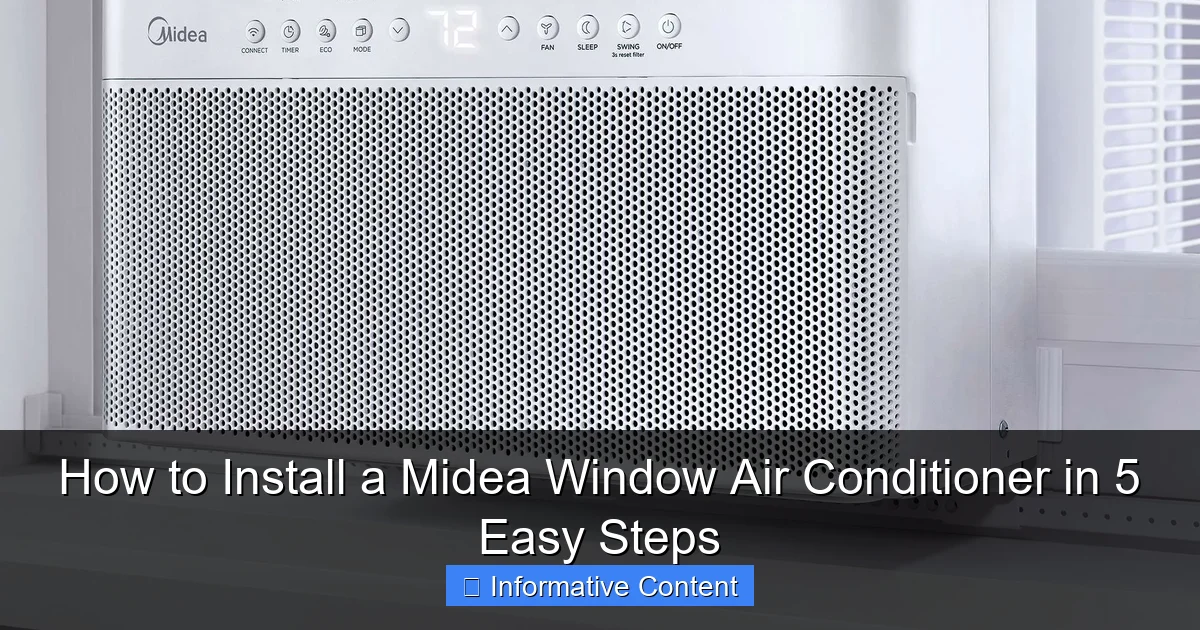
Featured image for how to install a midea window air conditioner
Image source: d1pjg4o0tbonat.cloudfront.net
Installing a Midea window air conditioner is quick and straightforward when you follow five essential steps. Begin by securely mounting the unit in a compatible window, ensuring proper support and insulation to prevent air leaks. Complete the setup with electrical safety checks and a test run for optimal cooling performance.
Key Takeaways
- Measure your window to ensure the Midea AC fits securely before purchase.
- Assemble the mounting brackets first for a stable, wobble-free installation.
- Seal gaps with foam strips to prevent air leaks and improve efficiency.
- Lift with a partner to safely position the heavy unit in the window.
- Secure the unit properly using included screws to avoid accidents.
- Test airflow and drainage immediately after installation for optimal performance.
📑 Table of Contents
- How to Install a Midea Window Air Conditioner in 5 Easy Steps
- Step 1: Gather Your Tools and Prepare the Installation Area
- Step 2: Assemble and Attach the Mounting Hardware
- Step 3: Position and Secure the Air Conditioner
- Step 4: Seal Gaps and Insulate for Efficiency
- Step 5: Test the Unit and Finalize the Setup
- Maintenance Tips and Long-Term Care
How to Install a Midea Window Air Conditioner in 5 Easy Steps
There’s nothing quite like the relief of stepping into a cool, air-conditioned room on a sweltering summer day. If you’ve just bought a Midea window air conditioner, you’re in for a treat—these units are known for their energy efficiency, quiet operation, and smart features. But before you can enjoy that crisp, cool air, you need to get it installed correctly. And let’s be honest: the idea of installing an AC unit can feel a little daunting, especially if you’ve never done it before.
The good news? Installing a Midea window air conditioner is easier than you think—especially if you follow a clear, step-by-step process. Whether you’re replacing an old unit or installing one for the first time, this guide will walk you through everything you need to know. From gathering the right tools to securing the unit safely, we’ll cover it all. No handyman skills required. Just a few basic tools, a little patience, and the confidence that yes, you *can* do this yourself.
Step 1: Gather Your Tools and Prepare the Installation Area
Before you even open the Midea AC box, take a few minutes to prepare. A little prep work can save you time, frustration, and even prevent damage to your window or unit. Think of this as laying the foundation for a smooth installation.
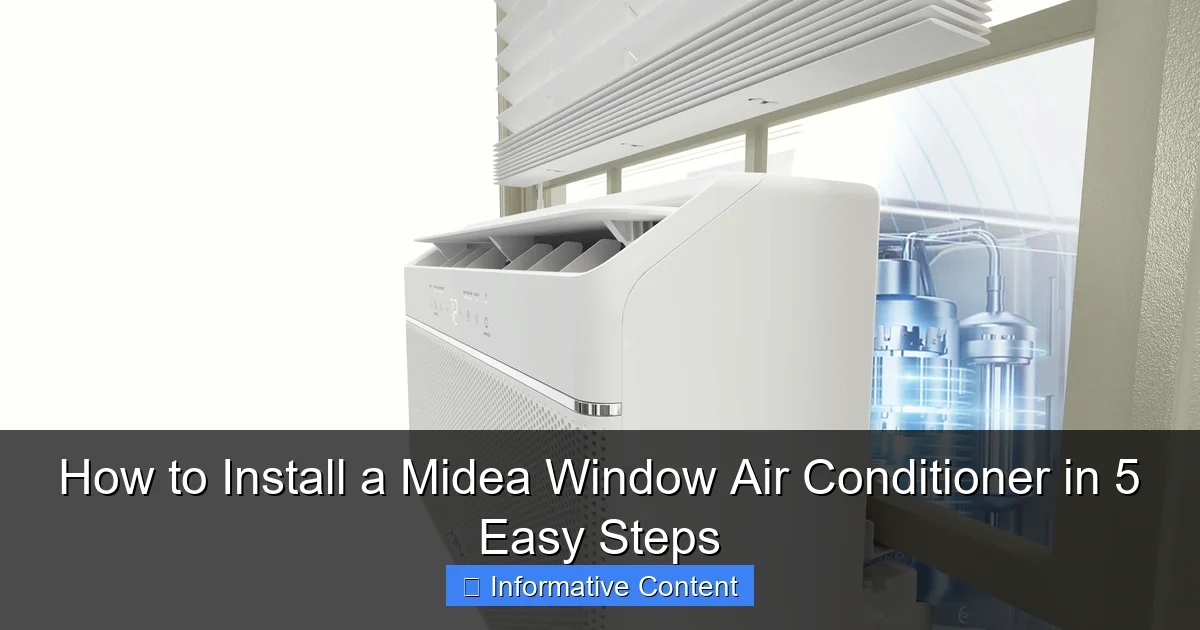
Visual guide about how to install a midea window air conditioner
Image source: web-res.midea.com
Essential Tools and Materials
- Measuring tape – For checking window and AC dimensions
- Screwdriver (Phillips and flathead) – For attaching brackets and panels
- Drill (optional) – For securing heavy-duty brackets if needed
- Level – To ensure the AC is perfectly horizontal
- Scissors or utility knife – For cutting foam or plastic seals
- Work gloves – To protect your hands (AC units can be sharp and heavy)
- Old towel or cardboard – To protect your floor or window sill
- Weather stripping or foam tape (if not included) – For sealing gaps
Most Midea window ACs come with a mounting kit that includes side panels, brackets, screws, and a foam seal. But it’s always good to double-check the manual or packaging to confirm. For example, the Midea U-Shaped Inverter Window AC includes a unique “U-brace” for added stability, while standard models may use L-brackets and accordion-style side panels.
Inspect Your Window
Not all windows are created equal. Midea ACs are designed for double-hung or slider windows with a minimum width of 23–36 inches (depending on the model) and a vertical opening of at least 14–15 inches. Measure your window opening from the top of the sill to the bottom of the upper sash. Also, measure the width at the top, middle, and bottom—some windows taper slightly.
Pro tip: Open the window and check for any obstructions—like a storm window, security bar, or window-mounted fan. You’ll need to remove these temporarily. If you have a storm window, Midea often provides a storm window kit (sold separately) that attaches to the outside frame.
Clear the Area and Protect Your Space
Lay down a towel or cardboard to catch any debris or water that might drip during installation. Remove furniture, plants, or anything fragile from below the window. You’ll be lifting the AC (which can weigh 40–70 lbs) and maneuvering it into place, so give yourself plenty of room to move.
Also, make sure you have a nearby electrical outlet. Midea units typically use a standard 115V plug (NEMA 5-15R), but larger models (12,000 BTU and up) may require a 230V outlet. Never use an extension cord—it can overheat and create a fire hazard.
Step 2: Assemble and Attach the Mounting Hardware
Now comes the fun part—actually putting things together. This step varies slightly depending on your Midea model, but the core principles remain the same: stabilize the unit, seal the gaps, and ensure it won’t fall out.
Install the Side Panels
Most Midea window ACs use adjustable accordion-style side panels (also called “fillers”) that extend to fit your window width. Here’s how to install them:
- Remove the side panels from the packaging and unfold them.
- Attach the panels to the sides of the AC using the included screws. Some models use snap-in clips—just press them into the pre-drilled holes on the unit’s casing.
- Extend the panels to match your window’s width. They should slide in and out easily.
Example: If your window is 30 inches wide and the AC is 24 inches wide, the panels will extend 3 inches on each side. Make sure they’re locked in place and don’t wiggle.
Attach the Support Brackets
This is critical for safety. Midea provides different types of brackets depending on the model:
- L-brackets – Common on standard models. Attach one end to the window sill and the other to the bottom of the AC.
- U-brace – Used on the Midea U-Shaped model. It wraps around the back of the unit and screws into the sill and window frame for extra stability.
- Support legs – Some models include adjustable legs that rest on the sill and bolt to the AC.
For L-brackets:
- Position the bracket under the window sill.
- Mark the screw holes on the sill with a pencil.
- Drill pilot holes (this prevents wood from splitting).
- Secure the bracket with the provided screws. Don’t overtighten—you want it snug, not warped.
Pro tip: Use a level to check the bracket. It should be perfectly horizontal. A tilted AC can leak water or vibrate excessively.
Apply the Foam Seal
Peel off the backing from the foam seal (usually included) and stick it along the top edge of the AC. This seals the gap between the unit and the upper window sash. If the seal is too short, cut it with scissors and overlap the ends slightly.
For extra insulation, apply foam tape or weather stripping along the sides and bottom of the side panels. This prevents hot air from sneaking in and keeps cold air from escaping.
Step 3: Position and Secure the Air Conditioner
Time to lift the AC—this is the most physically demanding part. If you’re working alone, take your time. If you have a friend, now’s the time to ask for help.
Lift and Slide the Unit Into Place
- With the help of a friend (or by yourself, using your legs, not your back), lift the AC and tilt it slightly so the bottom edge clears the window sill.
- Slide the unit into the window opening, resting it on the support bracket or legs.
- Gently lower the window sash onto the foam seal at the top of the AC. The window should rest snugly against the seal—no gaps.
Important: Never force the window down. If it doesn’t close smoothly, adjust the AC’s position. You may need to lift it slightly and realign the side panels.
Check for Level and Stability
Place your level on top of the AC. If the bubble is centered, you’re good. If not, adjust the support bracket or legs. A level AC ensures proper drainage and prevents internal components from shifting.
Wiggle the unit gently. It shouldn’t move more than 1/4 inch in any direction. If it’s loose, tighten the brackets or add shims (small wedges of wood or plastic) under the legs.
Secure the Side Panels
Once the AC is in place, extend the side panels to fill the gaps. Use the included screws or clips to secure them to the window frame. Some models have a “locking tab” that slides into a groove on the frame—make sure it’s engaged.
Pro tip: If your window frame is uneven, cut the side panels to fit with a utility knife. Just be careful not to cut too much—you want a tight seal.
Step 4: Seal Gaps and Insulate for Efficiency
You’ve installed the AC—congrats! But your work isn’t done yet. A poorly sealed unit can lose up to 30% of its cooling power, driving up energy bills and making your room feel warmer than it should.
Inspect All Gaps
Look around the entire perimeter of the AC. Common problem spots include:
- Between the side panels and the window frame
- Between the upper sash and the foam seal
- Between the lower sash and the AC casing
Use foam tape, weather stripping, or even a rolled-up towel to fill any gaps larger than 1/4 inch. For small cracks, silicone caulk (applied from the outside) works well—just don’t use it on moving parts.
Add a Window Seal Kit (Optional but Recommended)
Midea sells optional window seal kits that include a rigid plastic frame and foam inserts. These are great for older windows with warped frames. Install them around the window opening before placing the AC, then tuck the AC and side panels into the frame.
Consider a Drip Pan or Condensate Drain (for High-Humidity Areas)
If you live in a humid climate, your AC may drip water inside the room. To prevent this:
- Check if your Midea model has a built-in condensate pump. Some newer models do.
- If not, install a small drip pan under the AC (available at hardware stores).
- For long-term solutions, drill a 1/4-inch hole in the bottom of the AC’s drip tray and attach a hose to drain water outside.
Note: Only drill if your model allows it—check the manual first. Midea’s U-Shaped models have a self-evaporating system, so no drain is needed.
Step 5: Test the Unit and Finalize the Setup
You’re almost there! Now it’s time to plug in the AC and make sure everything works as expected.
Plug It In and Power On
Use the built-in power cord to plug the AC into a grounded outlet. Never use an extension cord or power strip. Turn on the AC and set it to “Cool” mode with a temperature around 70°F (21°C).
Listen and Observe
Pay attention to:
- Noise level: Midea units are designed to be quiet (as low as 42 dB). If it’s unusually loud, check for vibrations or loose parts.
- Airflow: Feel the air from the vents. It should be cool and consistent. If it’s weak, check if the filter is blocked.
- Drainage: After 15–20 minutes, look under the AC. A few drops of water are normal, but a steady stream means the unit isn’t level or the drain is blocked.
Adjust the Settings
Use the remote or control panel to test different modes:
- Cool: Standard cooling
- Eco: Saves energy by cycling the compressor
- Sleep: Gradually raises the temperature at night
- Fan: Circulates air without cooling
Many Midea models have a Wi-Fi app (like Midea Air). Download it and pair the AC to your phone for remote control, scheduling, and energy tracking.
Final Inspection
Walk around the room and feel for hot spots near the window. If you notice warm air sneaking in, add more insulation. Also, check the outside of the window—make sure no debris is blocking the exhaust.
Maintenance Tips and Long-Term Care
Your Midea AC is now installed and running smoothly—great job! But to keep it working efficiently for years, a little maintenance goes a long way.
Clean the Filter Monthly
Pull out the filter (usually located behind the front panel) and rinse it under warm water. Let it dry completely before reinstalling. A dirty filter reduces airflow and makes the AC work harder.
Inspect the Coils and Drain Pan Annually
Once a year, turn off the AC and remove the front panel. Use a soft brush or vacuum to clean the evaporator and condenser coils. Check the drain pan for algae or mold—wipe it with a mild bleach solution if needed.
Store Properly in Winter
If you remove the AC during cold months, clean it thoroughly, cover the vents with plastic, and store it upright in a dry place. Never leave it in the window—it can damage the frame and let cold air in.
Monitor Energy Use
Midea ACs are ENERGY STAR certified, but efficiency drops if the unit is dirty or poorly sealed. Use your energy bill or a smart plug to track usage. If it spikes, it’s time for maintenance.
| Maintenance Task | Frequency | Tools Needed | Notes |
|---|---|---|---|
| Clean filter | Monthly | Water, soft cloth | Let dry completely before reinstalling |
| Check seals and insulation | Every 3 months | Foam tape, weather stripping | Replace if cracked or loose |
| Clean coils and drain pan | Annually | Soft brush, vacuum, mild bleach | Turn off power first |
| Inspect for leaks | Monthly | Flashlight, towel | Check under and around unit |
Installing a Midea window air conditioner isn’t just about beating the heat—it’s about doing it smartly, safely, and efficiently. By following these five steps, you’ve taken control of your comfort without relying on a technician or breaking the bank on labor costs. Whether you’re a first-time installer or a seasoned DIYer, the process is straightforward, rewarding, and well worth the effort.
Remember, a well-installed AC isn’t just about cooling—it’s about peace of mind. You know it’s secure, sealed, and working at peak efficiency. And with Midea’s reliable technology and your careful setup, you can enjoy crisp, cool air all summer long. So take a deep breath, grab your remote, and enjoy that first blast of cold air. You’ve earned it.
Frequently Asked Questions
How do I install a Midea window air conditioner safely?
To install a Midea window air conditioner safely, ensure the unit is on a stable, level surface and the window frame is structurally sound. Always follow the manufacturer’s instructions and use the included mounting hardware to secure the unit and prevent accidents.
What tools do I need to install a Midea window AC unit?
You’ll typically need a screwdriver, measuring tape, level, and possibly a drill for brackets or side panels. Most Midea window air conditioners come with all necessary mounting hardware, but check the manual to confirm.
Can I install a Midea window air conditioner alone?
While possible, it’s safer to have a helper due to the unit’s weight and awkward positioning during installation. If installing solo, use temporary supports to hold the unit in place while securing it.
How do I seal gaps after installing my Midea window AC?
Use the included foam side panels or weatherstripping to seal gaps between the unit and window frame. This prevents air leaks, improves efficiency, and keeps insects or debris from entering.
Does the Midea window air conditioner require electrical modifications?
No, Midea window AC units typically plug into a standard 115V or 230V outlet (depending on the model). Ensure the outlet is on a dedicated circuit and meets the electrical requirements listed in the manual.
What’s the best way to secure the Midea window AC for long-term use?
Use the provided brackets, support arms, and locking hardware to anchor the unit to the window frame and exterior wall (if applicable). Regularly check screws and seals to maintain stability and efficiency.