
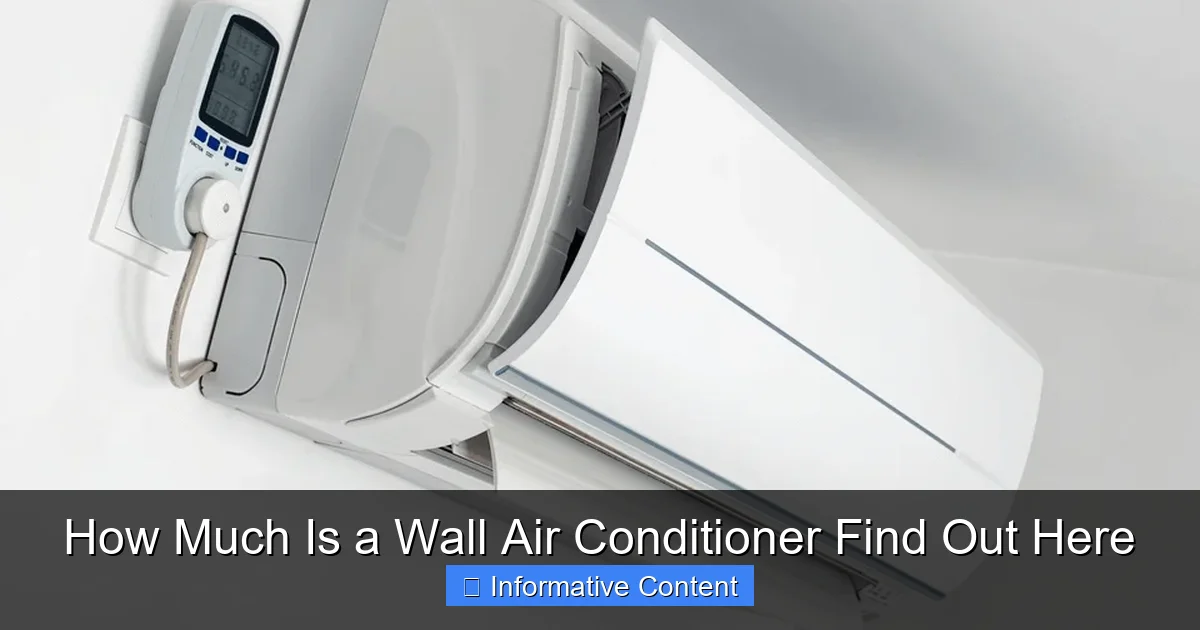
Featured image for how much is a wall air conditioner
Image source: christycoolingservices.co.uk
Wall air conditioners typically cost between $300 and $1,500, depending on size, efficiency, and features like smart controls or heating capabilities. Installation and energy efficiency ratings can also impact the overall price, so it’s essential to choose a model that fits both your budget and cooling needs.
Key Takeaways
- Budget $200–$1,500 depending on size, features, and brand for a wall air conditioner.
- Choose the right BTU based on room size to ensure efficient cooling and energy use.
- Factor in installation costs—professional setup may add $100–$500 to your total expense.
- Energy-efficient models cost more upfront but save money on long-term utility bills.
- Look for rebates and incentives from utilities or government programs to reduce overall cost.
- Compare window vs. wall units—wall models often offer better insulation and permanent placement.
📑 Table of Contents
- How Much Is a Wall Air Conditioner? Let’s Break It Down
- What Exactly Is a Wall Air Conditioner?
- How Much Is a Wall Air Conditioner? The Price Breakdown
- Factors That Influence the Total Cost
- Comparing Wall ACs: Top Models and Their Prices
- Hidden Costs and Long-Term Considerations
- Tips to Save Money and Make the Right Choice
How Much Is a Wall Air Conditioner? Let’s Break It Down
So, you’re thinking about getting a wall air conditioner. Maybe your apartment doesn’t have central AC, or you’ve got that one room that turns into a sauna every summer. You’re not alone—thousands of people face this exact dilemma each year. And if you’re anything like me, your first thought was probably, “Wait… how much is a wall air conditioner, really?”
It’s not just about the price tag. Sure, that number matters, but so do things like installation, energy bills, noise levels, and how well it actually cools your space. I remember when I bought my first wall unit. I walked into a big-box store, saw a $250 model and thought, “Perfect!” Then I got home, realized I needed a special sleeve, had to pay extra for installation, and suddenly my “budget-friendly” choice wasn’t so friendly anymore.
What Exactly Is a Wall Air Conditioner?
Before we dive into costs, let’s make sure we’re on the same page. A wall air conditioner (also called a through-the-wall AC or wall-mounted AC) is a self-contained cooling unit installed directly in an exterior wall. Unlike window units, which sit on the sill, these are built into the wall itself. They’re sleek, permanent, and often quieter than portable or window models.
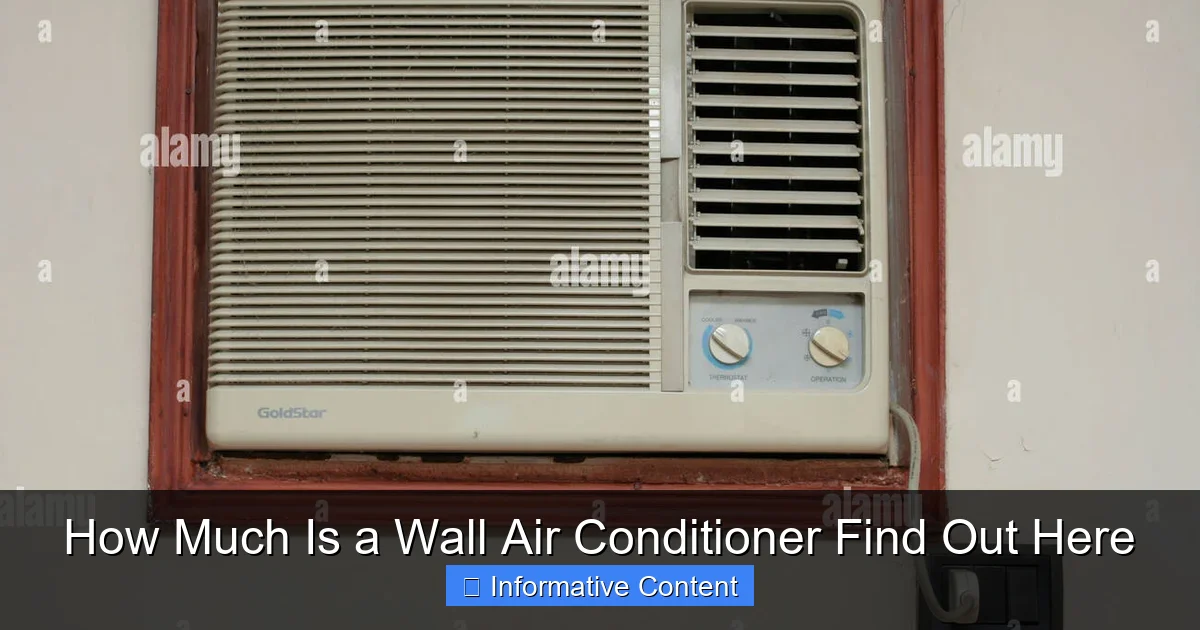
Visual guide about how much is a wall air conditioner
Image source: c8.alamy.com
Types of Wall Air Conditioners
- Standard Through-the-Wall Units: These are the most common. They fit into a custom sleeve inserted into a wall opening. Great for apartments, offices, or rooms without windows.
- Heat Pump Wall ACs: These do double duty—cooling in summer and heating in winter. Ideal for climates with mild winters. Expect to pay more upfront, but they can save money long-term.
- Ductless Mini-Split Systems: Technically not “wall ACs” in the traditional sense, but often grouped with them. They consist of an outdoor compressor and one or more indoor wall units. Super efficient, but pricier and require professional installation.
For this guide, we’ll focus mostly on standard through-the-wall units and touch on mini-splits where relevant. Think of it like choosing between a reliable sedan (standard wall AC) and a luxury hybrid (mini-split). Both get you from A to B, but the experience—and cost—is different.
Why Choose a Wall Unit Over Other Options?
You might wonder, “Why not just get a window AC?” Fair question. Here’s why wall units often win:
- Better aesthetics: No bulky box hanging out the window. It looks clean and integrated.
- Security: Once installed, it’s harder for someone to remove or tamper with.
- Less noise: Since the noisy compressor is outside the room, indoor sound levels are lower.
- More permanent solution: If you own your home or plan to stay long-term, it’s a worthwhile investment.
But here’s the catch: you need a proper wall opening. That means cutting into drywall, framing, or masonry. If you’re renting, check with your landlord first. Some won’t allow it at all.
How Much Is a Wall Air Conditioner? The Price Breakdown
Alright, let’s get to the heart of the matter: how much is a wall air conditioner? The short answer? Anywhere from $300 to over $2,000. But as you’ll see, that range depends on several factors. Let’s break it down by component.
1. Unit Cost: $300–$1,500
This is what most people think of as “the price.” The unit itself varies widely based on:
- BTU rating: Measured in British Thermal Units, this tells you how powerful the AC is. For a 150 sq ft room, you’ll want around 5,000 BTUs. For 400+ sq ft, look at 10,000–14,000 BTUs.
- Energy efficiency (EER/SEER): Higher numbers mean better efficiency. Look for ENERGY STAR-rated models—they use up to 15% less energy than standard units.
- Features: Remote control? Wi-Fi app? Sleep mode? Dehumidifier? These add convenience—and cost.
- Brand: Frigidaire, LG, GE, and Friedrich are popular mid-range brands. High-end options like Mitsubishi or Daikin can push prices past $1,000.
For example, a basic 8,000 BTU model from Frigidaire might cost $450. A high-end 12,000 BTU LG with Wi-Fi and inverter technology could run $1,200.
2. Installation Cost: $200–$800
Here’s where many people get surprised. You can’t just slide a wall AC into any hole. You need:
- A properly sized sleeve: Most units require a 26” x 15” x 16” opening. Some come with a sleeve; others don’t. A new sleeve costs $100–$300.
- Professional installation: If you’re not handy, hire a contractor. Expect to pay $200–$600 depending on your location and wall type (drywall vs. brick vs. concrete).
- Permits (in some areas): In certain cities, you need a building permit for structural changes. That adds another $50–$200.
I once tried installing one myself. Cut the hole, installed the sleeve, and… realized the unit was too deep. Had to call a pro to fix it. Lesson learned: unless you’ve done this before, hire someone.
3. Additional Accessories: $50–$200
Don’t forget the little things:
- Insulation foam: To seal gaps around the sleeve ($20–$40).
- Drain pan: Helps prevent water leaks inside the wall ($30–$70).
- Thermostat (optional): Some models support external thermostats for better temperature control ($50–$150).
- Weatherproof cover (for exterior): Protects the outside of the unit during storms ($25–$60).
4. Ductless Mini-Split Systems: $1,500–$2,500+
If you’re considering a mini-split, be prepared. These systems include an outdoor condenser and one or more indoor wall units. While highly efficient (SEER ratings of 20+), they require refrigerant lines, electrical connections, and professional HVAC installation.
Example: A single-zone Mitsubishi mini-split for a 300 sq ft room might cost $1,800 for the equipment and $700–$1,000 for installation. But hey—it heats too, and your electric bill will likely go down.
Factors That Influence the Total Cost
Now that we’ve covered the basics, let’s talk about what really affects the final price. It’s not just the unit. Several hidden (or not-so-hidden) factors come into play.
1. Room Size and BTU Needs
Size matters. A tiny 5,000 BTU unit won’t cool a large living room. An oversized 14,000 BTU unit in a small bedroom will cycle on and off too much, wasting energy.
Use this rule of thumb:
- 100–150 sq ft: 5,000–6,000 BTUs
- 150–250 sq ft: 7,000–8,000 BTUs
- 250–350 sq ft: 9,000–10,000 BTUs
- 350–450 sq ft: 12,000 BTUs
- 450–550 sq ft: 14,000 BTUs
Pro tip: If the room gets lots of sun or has poor insulation, add 10% more BTUs. Kitchens? Add 4,000 BTUs due to heat from cooking.
2. Climate and Usage Patterns
If you live in Arizona or Florida, you’ll use your AC almost daily for months. In that case, investing in a high-efficiency model pays off. Look for SEER ratings above 12 (or 14 for mini-splits).
But if you only need it for a few weeks a year (like in Seattle), a basic $400 unit might suffice. No need to spend big on features you won’t use.
3. DIY vs. Professional Installation
Can you install it yourself? Maybe. But consider:
- Do you have the tools? (Circular saw, level, drill, etc.)
- Can you safely cut through exterior walls without damaging wiring or plumbing?
- Will your landlord or HOA allow it?
I know a guy who saved $400 by DIYing his wall AC. But he’s a contractor. For the rest of us, the risk isn’t worth it. One misstep and you could damage the wall, void your warranty, or even create a safety hazard.
4. Local Building Codes and Permits
Some cities require permits for structural modifications. Others have strict rules about where and how AC units can be installed. Always check with your local building department before starting.
For example, in New York City, you need approval for any exterior modification. In California, energy efficiency standards are higher. These rules can affect both cost and timeline.
5. Long-Term Energy Costs
Don’t overlook this. A cheaper unit with a low EER (Energy Efficiency Ratio) might save you $100 upfront but cost you $50 more per year in electricity. Over 10 years, that’s $500 extra.
Use the formula: Annual energy cost = (BTU ÷ EER) × hours used per year × electricity rate
Example: A 10,000 BTU unit with an EER of 10, used 10 hours/day for 120 days/year, in a city with $0.15/kWh electricity:
(10,000 ÷ 10) × 1,200 × 0.15 = $1,800 per year
Ouch. Now imagine a unit with an EER of 12. Same usage: $1,500 per year. That’s $300 saved annually. Suddenly, the higher price makes sense.
Comparing Wall ACs: Top Models and Their Prices
Let’s look at some real-world examples. These are popular wall ACs available in 2024, with prices from major retailers like Home Depot, Lowe’s, and Amazon.
| Model | BTU | Price (Unit Only) | EER | Key Features | Best For |
|---|---|---|---|---|---|
| Frigidaire FHWW083WB1 | 8,000 | $429 | 10.8 | Remote, sleep mode, 3 fan speeds | Small bedrooms, offices |
| LG LW1017ERSM | 10,000 | $649 | 11.2 | Wi-Fi app, dehumidifier, quiet mode (50 dB) | Medium rooms, tech lovers |
| GE AHY10LZ | 12,000 | $799 | 10.7 | Energy saver mode, easy clean filter | Large rooms, budget-conscious buyers |
| Friedrich Kuhl SM18N10A | 18,000 | $1,399 | 12.1 | Commercial-grade, 24-hour timer, 45 dB | Large spaces, offices, durability seekers |
| Mitsubishi MSZ-FH12NA (Mini-Split) | 12,000 | $1,750 | 22.0 (SEER) | Heating/cooling, inverter tech, ultra-quiet | Whole-house comfort, energy savers |
Notice the trend? As BTUs and efficiency go up, so does the price. But the LG and Mitsubishi models offer smart features that justify the cost for some users. The Friedrich is a beast—built to last, but overkill for a small bedroom.
Pro tip: Watch for sales. Major retailers often run promotions in spring (March–May). I snagged my LG unit for $100 off during a Presidents’ Day sale. Set price alerts on sites like CamelCamelCamel or Honey.
Hidden Costs and Long-Term Considerations
We’ve talked about upfront costs. But what about the long game? A wall AC isn’t just a purchase—it’s a long-term commitment. Here are things to keep in mind.
1. Maintenance and Repairs
Wall ACs need care. Neglect them, and they’ll stop working or become inefficient.
- Filter cleaning: Do this monthly during peak season. A clogged filter reduces airflow and efficiency.
- Coil cleaning: Once a year, clean the evaporator and condenser coils with coil cleaner spray.
- Drain line check: Ensure water drains properly. A clogged line can cause leaks or mold.
Simple? Yes. But easy to forget. I once ignored mine for two years. The fan motor burned out. Repair cost: $200. Lesson: set a reminder on your phone.
2. Lifespan and Replacement
Most wall ACs last 10–15 years with proper care. But after that, efficiency drops, and repairs get more frequent. When deciding whether to repair or replace, ask:
- Is the repair more than half the cost of a new unit?
- Has the unit lost more than 20% of its cooling capacity?
- Are replacement parts hard to find?
If yes, it’s probably time to upgrade.
3. Impact on Home Value
If you own your home, a professionally installed wall AC can increase value—especially if it replaces a window unit. Buyers appreciate permanent, efficient solutions.
But a DIY job with messy wiring or a poorly sealed sleeve? That could hurt resale value. First impressions matter.
4. Noise and Comfort
Not all wall ACs are quiet. Some hum, rattle, or vibrate. Check decibel ratings. Look for “ultra-quiet” or “low-noise” models if you’re sensitive to sound.
I once stayed in a hotel with a loud wall AC. Couldn’t sleep. Now, I always check reviews for noise complaints before buying.
5. Smart Features and Future-Proofing
Wi-Fi connectivity lets you control the AC from your phone. Useful if you want to cool the room before you get home. But not all apps are reliable. Read user reviews.
Also, consider compatibility. Some smart units work with Alexa or Google Assistant. Others don’t. If you’re building a smart home, this matters.
Tips to Save Money and Make the Right Choice
You don’t have to break the bank to get a great wall AC. Here are my top tips for saving money—without sacrificing quality.
1. Buy Off-Season
Retailers discount ACs in fall and winter. I got my unit in November for 30% off. It sat in my garage until June, but it was worth it.
2. Look for Rebates
Many states and utility companies offer rebates for ENERGY STAR units. Check ENERGY STAR’s rebate finder. You could save $50–$200.
3. Bundle Installation
Some HVAC companies offer package deals. Buy the unit and get installation at a discount. Or negotiate with your contractor: “I’ll pay cash if you knock $100 off.”
4. Rent vs. Buy
If you’re only staying a year or two, consider a high-end portable AC instead. No installation, no permanent changes. But if you’re in it for the long haul, the wall unit is better.
5. Read Real Reviews
Don’t just trust star ratings. Read the 1- and 2-star reviews. They often reveal issues like “leaks after rain” or “remote stops working.”
6. Measure Twice, Cut Once
Before ordering, double-check your wall opening. Most sleeves are 26” wide x 15” high. But depths vary. Measure from the inside wall to the outside. Too shallow? The unit won’t fit. Too deep? Gaps and leaks.
Use a stud finder to avoid cutting through load-bearing walls. And always shut off power before cutting near electrical outlets.
So, how much is a wall air conditioner? As you’ve seen, it’s not a simple number. It’s a mix of unit cost, installation, accessories, efficiency, and long-term value. For most people, a solid wall AC will cost between $800 and $1,500 all-in—including the unit, sleeve, and professional installation.
But here’s the good news: once it’s in, you’ll enjoy years of reliable, quiet cooling. No more wrestling with window units. No more tripping over portable ACs. Just a clean, efficient system that keeps you comfortable.
Take your time. Do your research. And don’t rush the installation. A well-chosen, well-installed wall AC isn’t just a purchase—it’s a comfort upgrade. And in my book, that’s priceless.
Frequently Asked Questions
How much is a wall air conditioner on average?
The average cost of a wall air conditioner ranges from $500 to $1,500, depending on capacity (BTUs), energy efficiency, and features like smart controls. Installation fees, if needed, can add $200–$500 to the total price.
What factors affect the price of a wall air conditioner?
Key factors include cooling capacity (measured in BTUs), energy efficiency (SEER rating), brand, and additional features like Wi-Fi, remote control, or eco-modes. Higher-end models with inverter technology or heat pumps tend to cost more upfront.
Are wall air conditioners cheaper than central AC systems?
Yes, wall air conditioners are far more budget-friendly, typically costing less than 1/3 of a central AC system installation. They’re ideal for cooling single rooms or small spaces without ductwork.
How much does it cost to install a wall air conditioner?
Installation costs vary from $150 to $500, depending on labor, electrical requirements, and wall modifications. Some HVAC companies offer bundled pricing for unit and installation.
Can I find a wall air conditioner for under $500?
Budget models (5,000–8,000 BTUs) start around $300–$500, but these may lack energy-saving features or quiet operation. Always check energy ratings to avoid higher long-term electricity costs.
Do energy-efficient wall air conditioners cost more?
Yes, units with high SEER ratings (15+) or ENERGY STAR certification often cost 10–20% more but can save money on energy bills over time. The upfront cost pays off in reduced utility expenses.