
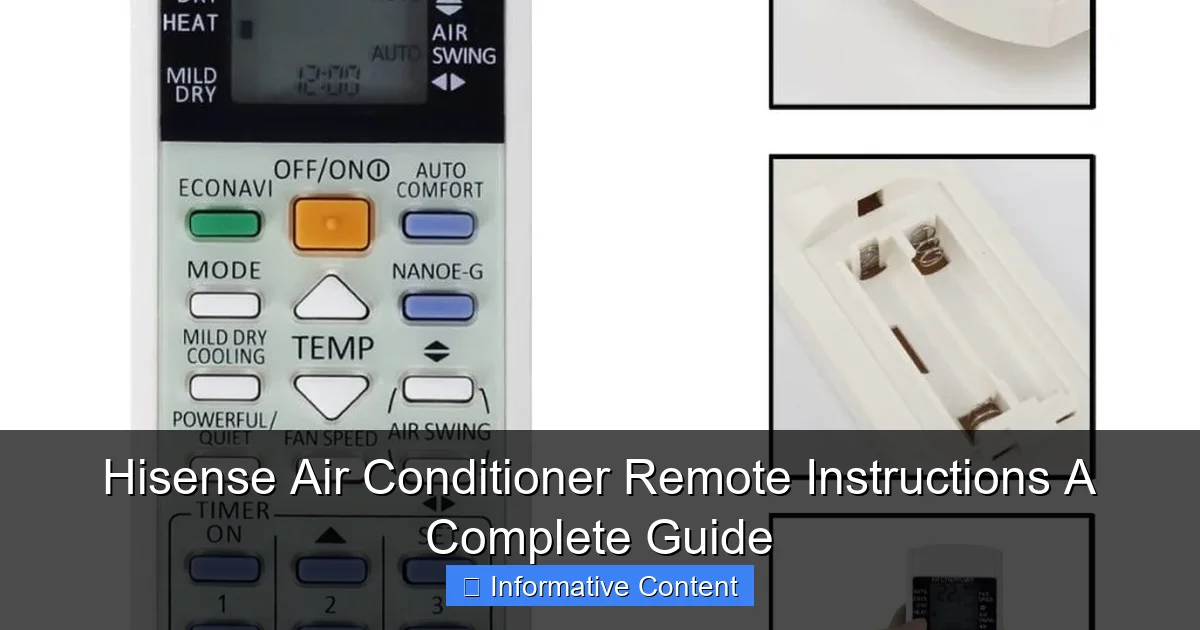
Featured image for hisense air conditioner remote instructions
Image source: acsupportspoint.com
Master your Hisense air conditioner with ease using this complete remote control guide that walks you through every button, mode, and setting for optimal comfort. From temperature adjustments to timer functions and sleep mode activation, learn how to fully utilize your remote’s features for efficient, year-round climate control.
Key Takeaways
- Power on/off easily: Press the Power button to start or stop your Hisense AC.
- Adjust temperature precisely: Use +/- buttons to set your ideal room temperature quickly.
- Switch modes effortlessly: Press Mode to toggle between cooling, heating, or fan settings.
- Control fan speed: Tap Fan to select low, medium, high, or auto airflow.
- Enable sleep mode: Activate Sleep for energy-efficient, quiet nighttime operation.
- Use timer functions: Set Timer to schedule automatic on/off times for convenience.
- Check error codes: Refer to the manual if the display shows unusual symbols or alerts.
📑 Table of Contents
- Getting Started with Your Hisense Air Conditioner Remote
- Understanding the Hisense AC Remote Layout and Buttons
- Setting Up and Programming Your Hisense Remote
- Troubleshooting Common Remote Issues
- Maximizing Comfort and Efficiency with Advanced Features
- Hisense Remote Models and Feature Comparison
- Final Thoughts: Making the Most of Your Hisense Remote
Getting Started with Your Hisense Air Conditioner Remote
You’ve just installed your shiny new Hisense air conditioner, and it’s working perfectly—until you realize you have no clue how to use the remote. Sound familiar? You’re not alone. I remember the first time I held my Hisense remote, staring at the tiny buttons, wondering if I’d need a magnifying glass and a degree in engineering just to turn on the AC. But here’s the good news: once you get the hang of it, your Hisense air conditioner remote is actually pretty intuitive and packed with features to make your life more comfortable.
In this guide, we’re going to walk through everything you need to know about your Hisense air conditioner remote instructions—no jargon, no fluff, just clear, step-by-step advice. Whether you’re trying to cool down on a sweltering summer day, warm up during a chilly winter night, or just figure out what that mysterious “Turbo” button does, we’ve got you covered. By the end, you’ll feel like a remote-control ninja, confidently adjusting settings, troubleshooting issues, and even discovering hidden features you never knew existed.
Understanding the Hisense AC Remote Layout and Buttons
Let’s start with the basics: getting to know your remote. The first step to mastering your Hisense air conditioner remote is understanding what each button does. While models vary slightly, most Hisense remotes follow a similar layout. Think of it like learning the dashboard of a new car—once you know where everything is, driving becomes second nature.
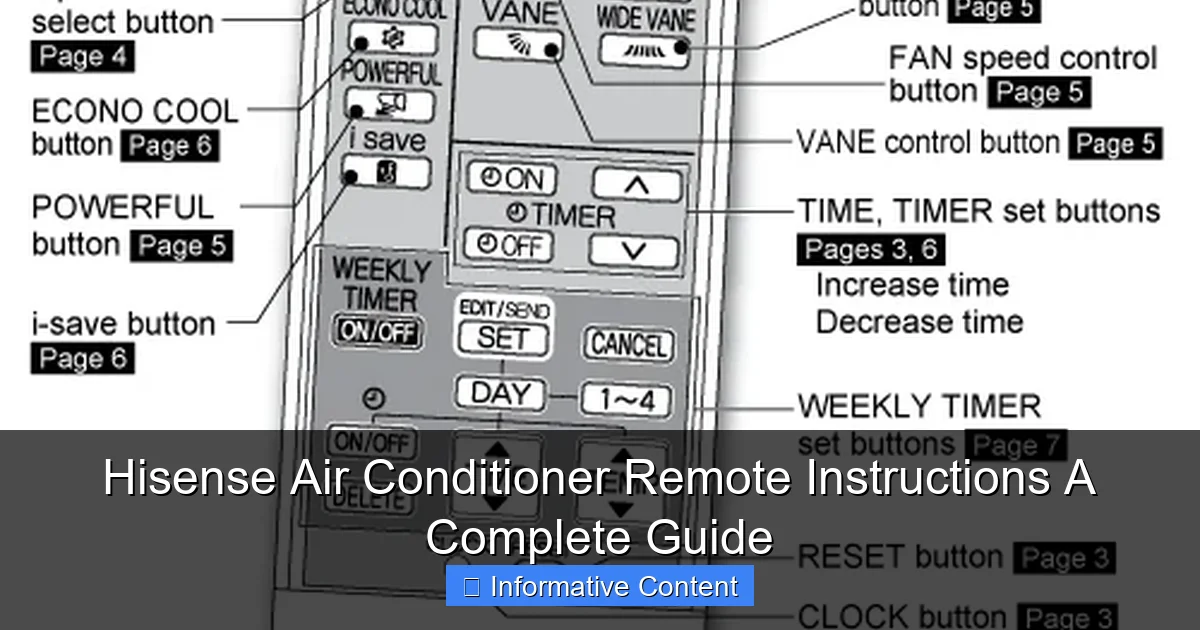
Visual guide about hisense air conditioner remote instructions
Image source: alquilercastilloshinchables.info
Main Control Buttons and Their Functions
At the top of the remote, you’ll usually find the Power button, which turns the AC on and off. Simple, right? But don’t rush past it—some models require you to press and hold it for a second to activate, so if it doesn’t respond right away, don’t panic. Below the power button, you’ll typically see:
- Mode button: Cycles through Cool, Heat, Dry, Fan, and Auto modes. This is your climate control hub. For example, press it until you see “Cool” to lower the temperature in summer.
- Temperature Up/Down buttons: Adjust the set temperature. Most Hisense units allow settings from 16°C to 30°C (60°F to 86°F). I once tried setting mine to 16°C during a heatwave—my room felt like a walk-in freezer!
- Fan Speed button: Controls airflow intensity. Options usually include Low, Medium, High, and Auto. Use Auto for balanced comfort, or High when you need quick cooling.
- Swing button: Activates vertical or horizontal louvers to direct airflow. Great for avoiding direct drafts on your face.
- Timer button: Sets on/off schedules. Perfect for turning the AC on before you get home from work.
One tip: if you’re not sure what a button does, press it and watch the display. Hisense remotes often have an LCD screen that shows real-time feedback—like a tiny, helpful assistant.
Advanced and Hidden Features
Beyond the basics, many Hisense remotes include lesser-known but super-useful buttons:
- Turbo button: Instantly ramps up cooling or heating for rapid temperature adjustment. I use this when I come home drenched in sweat—within 10 minutes, my room goes from sauna to sanctuary.
- Sleep mode: Automatically adjusts temperature and fan speed over time to save energy while you sleep. It usually increases the temperature by 1–2°C every hour (in Cool mode) to prevent overcooling.
- Eco button: Optimizes energy use by slightly adjusting the temperature and fan speed. Ideal for eco-conscious users or lowering electricity bills.
- iFeel (or Sensor) button: Found on some high-end models, this tells the AC to use the remote’s built-in temperature sensor instead of the unit’s. Great for ensuring the area *around you* stays comfortable, not just the ceiling.
- Clean/Filter Reset button: Reminds you to clean the filter or resets the timer after maintenance. I ignored mine for months—my AC started blowing dusty air. Lesson learned!
Pro tip: If your remote has a “Light” or “Display” button, use it to turn off the indoor unit’s LED panel at night. Nothing worse than a glowing blue light keeping you awake.
Setting Up and Programming Your Hisense Remote
Now that you know the buttons, let’s make your remote work *for* you. Proper setup ensures smooth operation and unlocks the full potential of your Hisense AC.
Pairing the Remote with the AC Unit
Most Hisense remotes come pre-paired with the indoor unit, but sometimes—especially after battery changes or moving the unit—you might need to re-sync. Here’s how:
- Turn on the AC using the unit’s manual power button (usually behind a panel).
- Point the remote directly at the indoor unit (within 8 meters/25 feet).
- Press and hold the Reset or Pair button (often hidden under the battery cover) for 5–10 seconds.
- The AC’s display should flash or beep, confirming the connection.
One time, my remote stopped working after a power outage. I panicked, thinking it was broken—but a simple reset fixed it. Always try this first!
Using the Timer for Energy Savings
The timer function is a game-changer. Instead of leaving the AC on all day, schedule it to turn on 30 minutes before you get home. Here’s how to set it:
- Press the Timer button. The display will show “ON” or “OFF”.
- Use the Up/Down buttons to set the time (e.g., 5:30 PM).
- Press Timer again to switch to the opposite function (e.g., set “OFF” at 10:00 PM).
- Press Enter or wait 3 seconds to save.
For example, I set mine to turn off at 7:00 AM during winter—no more waking up to a freezing room. The timer works in 30-minute increments, so you can fine-tune it.
Customizing Modes and Schedules
Hisense remotes let you combine features for personalized comfort. Try this:
- Set the AC to Cool + Sleep mode + Timer for a cool, energy-efficient night.
- Use Heat + Eco mode in winter to maintain warmth without skyrocketing bills.
- Pair Turbo + High Fan Speed for instant relief on hot days.
Bonus: Some models have a “Weekly Timer” (check your manual) for setting different schedules on weekdays vs. weekends. I use this to keep my home office cool during work hours but let it rest on weekends.
Troubleshooting Common Remote Issues
Even the best remotes can act up. Don’t throw yours across the room just yet—here’s how to solve the most common problems.
Remote Not Responding? Try These Fixes
If your remote seems dead, don’t assume it’s broken. Try these steps:
- Check the batteries: Weak batteries are the #1 culprit. Replace them with fresh AA or AAA cells. I keep spares in a kitchen drawer—saves so much hassle.
- Clean the sensor: Wipe the infrared (IR) sensor on the front of the remote with a soft cloth. Dust or grime can block signals.
- Remove obstructions: Ensure nothing blocks the remote’s path to the AC (e.g., furniture, plants). My cat once knocked over a lamp, and the remote stopped working—until I realized the lamp was in the way!
- Reset the remote: Remove batteries, press all buttons to drain residual power, then reinsert batteries. This often resolves glitches.
Display or Button Malfunctions
If the LCD screen is blank or buttons feel sticky:
- For a blank display: Batteries might be inserted incorrectly. Flip them around. Still nothing? Try new batteries—even “full” ones can lose charge over time.
- For sticky buttons: Clean with a cotton swab dipped in rubbing alcohol. I once spilled soda on mine—a quick clean saved me from buying a replacement.
- For unresponsive buttons: Check if the remote is in “Lock” mode (a padlock icon). Press and hold the “Lock” or “Function” button for 3 seconds to unlock.
When to Replace the Remote
If none of the above works, the remote might be faulty. Look for:
- Physical damage (cracks, water exposure).
- Consistent signal failure (AC doesn’t respond even at close range).
- Buttons that don’t depress properly.
Hisense sells replacement remotes online. Before buying, check if your model has a universal remote option—many third-party remotes work with Hisense units.
Maximizing Comfort and Efficiency with Advanced Features
Your Hisense remote isn’t just a temperature dial—it’s a comfort and efficiency tool. Let’s explore how to use it like a pro.
Mastering Sleep Mode for Better Rest
Sleep mode isn’t just about saving energy. It’s designed to mimic natural body temperature changes at night. Here’s how to use it:
- In Cool mode: Sleep mode gradually increases the temperature (by 1–2°C per hour) to prevent overcooling. Set it to start 1 hour before bedtime.
- In Heat mode: It slightly lowers the temperature to avoid overheating. I use this in winter—wake up cozy, not sweaty.
- Combine with Low Fan Speed for quieter operation. My AC used to sound like a jet engine at night—now it’s whisper-quiet.
Note: Sleep mode may disable the display light on some models. Use the “Light” button if you need to check the time at night.
Using Turbo Mode Without Wasting Energy
Turbo mode is great for quick relief, but it uses extra power. Use it strategically:
- Turn it on for 15–20 minutes when entering a hot/cold room.
- Switch to Auto or Eco mode afterward to maintain temperature.
- Avoid using Turbo for more than 30 minutes—it’s not designed for long-term use.
I tested this: Turbo for 15 minutes cooled my room from 32°C to 24°C. After switching to Auto, it stabilized at 24°C without extra energy.
Smart Tips for Seasonal Use
Your remote adapts to the seasons. Try these:
- Summer: Use Cool + Dry mode to reduce humidity. I live in a humid area, and this combo keeps my room dry and cool.
- Winter: Use Heat + Fan Auto for even warmth. Avoid pointing the louver directly at you—dry air can irritate your skin.
- Spring/Fall: Use Fan-only mode for gentle airflow without cooling/heating.
Hisense Remote Models and Feature Comparison
Not all Hisense remotes are the same. Here’s a quick comparison of popular models to help you identify yours and understand its capabilities.
| Model | Display Type | Key Features | Best For |
|---|---|---|---|
| RC-12 | LCD with backlight | Timer, Turbo, Sleep, Eco, Swing | Basic to mid-range ACs |
| RC-24 | LED with icons | iFeel, Weekly Timer, Filter Reset | High-end models |
| RC-36 | Touchscreen LCD | Smart home integration, App control | Smart ACs (Wi-Fi enabled) |
| Universal Remote (UR-10) | LED | Works with multiple brands | Replacement or multi-AC homes |
For example, if your remote has a touchscreen (RC-36), you can pair it with the Hisense app to control your AC from your phone. But if you have an older RC-12, you’ll need to stick to manual controls. Check your AC’s manual or the label on the back of the remote to identify your model.
Final Thoughts: Making the Most of Your Hisense Remote
Your Hisense air conditioner remote is more than just a gadget—it’s your gateway to a comfortable, energy-efficient home. From mastering the basics (like adjusting temperature and fan speed) to unlocking advanced features (like Sleep mode and timers), every button serves a purpose. I’ll never forget the first time I used the Turbo button on a 40°C day—it felt like magic. But the real magic? Learning how to use *all* the features to create a personalized comfort zone.
Remember, troubleshooting is part of the journey. Weak batteries, signal issues, or a sticky button don’t mean your remote is broken—they’re just hiccups that can be fixed with a little know-how. And if you ever feel overwhelmed, take a breath. Start with one feature at a time. Maybe today it’s setting the timer; tomorrow, it’s experimenting with Sleep mode. Before you know it, you’ll be the go-to expert for AC advice in your household.
So go ahead—grab that remote, point it at your Hisense unit, and take control. Whether you’re cooling down, warming up, or just enjoying a perfectly balanced room, you’ve got the power to make it happen. Happy cooling (or heating)!
Frequently Asked Questions
How do I pair my Hisense air conditioner remote with the unit?
To pair your Hisense air conditioner remote, ensure the unit is powered on, then press and hold the “Pair” or “Connect” button on the remote for 3-5 seconds until the LED indicator flashes. Refer to your model’s manual for specific steps, as some may require entering a code displayed on the AC unit.
What are the basic functions of the Hisense air conditioner remote?
The Hisense air conditioner remote includes buttons for power, mode selection (cool, heat, fan, dry), temperature adjustment, fan speed, timer, and sleep mode. Most models also feature an “Eco” or “Turbo” button for energy-saving or rapid cooling/heating.
How do I troubleshoot a Hisense remote that’s not responding?
First, check the batteries and replace them if necessary. Ensure there’s no obstruction between the remote and the AC sensor, and try resetting the remote by holding the power button for 10 seconds. If issues persist, consult the Hisense air conditioner remote instructions for model-specific troubleshooting.
Can I use my Hisense AC remote for other brands?
No, Hisense remotes are designed specifically for Hisense air conditioners and may not be compatible with other brands. Universal remotes can sometimes work, but functionality may be limited compared to the original Hisense air conditioner remote.
How do I set the timer on my Hisense air conditioner remote?
Press the “Timer” button on the remote, then use the up/down arrows to set the desired time. Press “Confirm” or “Enter” to activate the timer. The AC will turn on/off automatically at the scheduled time, as outlined in your Hisense air conditioner remote instructions.
Why is the display on my Hisense remote blank or dim?
A blank or dim display usually indicates low battery power—replace the batteries immediately. If the issue continues, check for physical damage or moisture, and avoid exposing the remote to extreme temperatures for prolonged periods.