
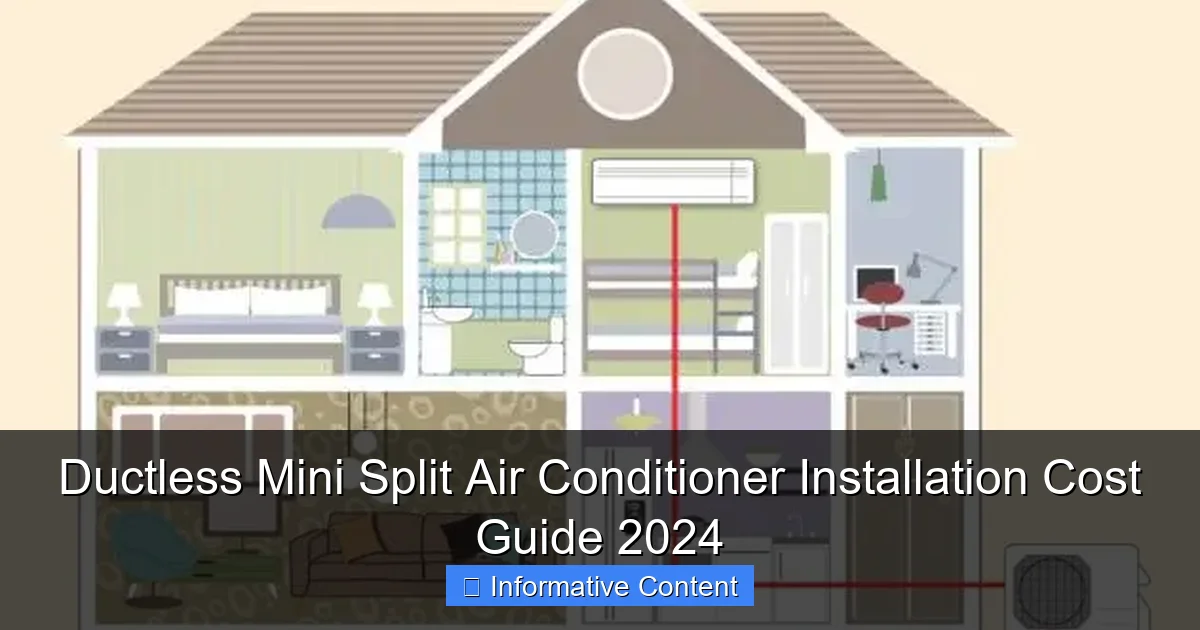
Featured image for ductless mini split air conditioner installation cost
Image source: pickhvac.com
The average cost to install a ductless mini split air conditioner in 2024 ranges from $3,000 to $7,500, depending on system size, number of zones, and labor complexity. High-efficiency models and multi-zone setups can push costs above $10,000, but long-term energy savings often justify the investment.
Key Takeaways
- Plan your budget: Expect to pay $2,000–$10,000 depending on system size and complexity.
- Choose zones wisely: More indoor units increase cost but improve comfort and efficiency.
- Hire licensed pros: Ensure proper installation to avoid costly repairs and maximize efficiency.
- Check rebates: Local incentives can reduce upfront costs by 10–30% in 2024.
- Prioritize SEER rating: Higher efficiency units cost more but lower long-term energy bills.
- Location impacts labor: Complex installations (e.g., high walls) add $500+ to total cost.
📑 Table of Contents
- Why Ductless Mini Splits Are Gaining Popularity
- Understanding the Basics: What Is a Ductless Mini Split?
- Factors That Influence Installation Cost
- DIY vs. Professional Installation: What’s the Real Cost?
- Average Cost Breakdown by System Type (2024 Data)
- How to Save Money Without Sacrificing Quality
- Final Thoughts: Is a Ductless Mini Split Worth the Cost?
Why Ductless Mini Splits Are Gaining Popularity
Imagine coming home on a sweltering summer day, only to find your old central AC struggling to keep up. The vents are blowing warm air, and your energy bill is creeping higher with each passing hour. Sound familiar? That’s where a ductless mini split air conditioner comes in. Unlike traditional HVAC systems, these units deliver targeted cooling (or heating) without bulky ductwork, making them ideal for retrofits, room additions, or older homes with poor airflow.
Over the past few years, I’ve seen more homeowners—especially those renovating or trying to cut energy costs—opt for ductless mini splits. Why? They’re efficient, quiet, and offer zone-specific comfort. But one big question always comes up: *How much does a ductless mini split air conditioner installation cost?* The answer isn’t always straightforward. Prices vary widely based on your home, the unit’s size, and even where you live. In this guide, I’ll walk you through every factor that affects the ductless mini split air conditioner installation cost in 2024, share real-world examples, and help you plan your budget wisely.
Understanding the Basics: What Is a Ductless Mini Split?
Before diving into costs, let’s clarify what a ductless mini split actually is. If you’re picturing a window unit, think again. A ductless mini split has two main components:
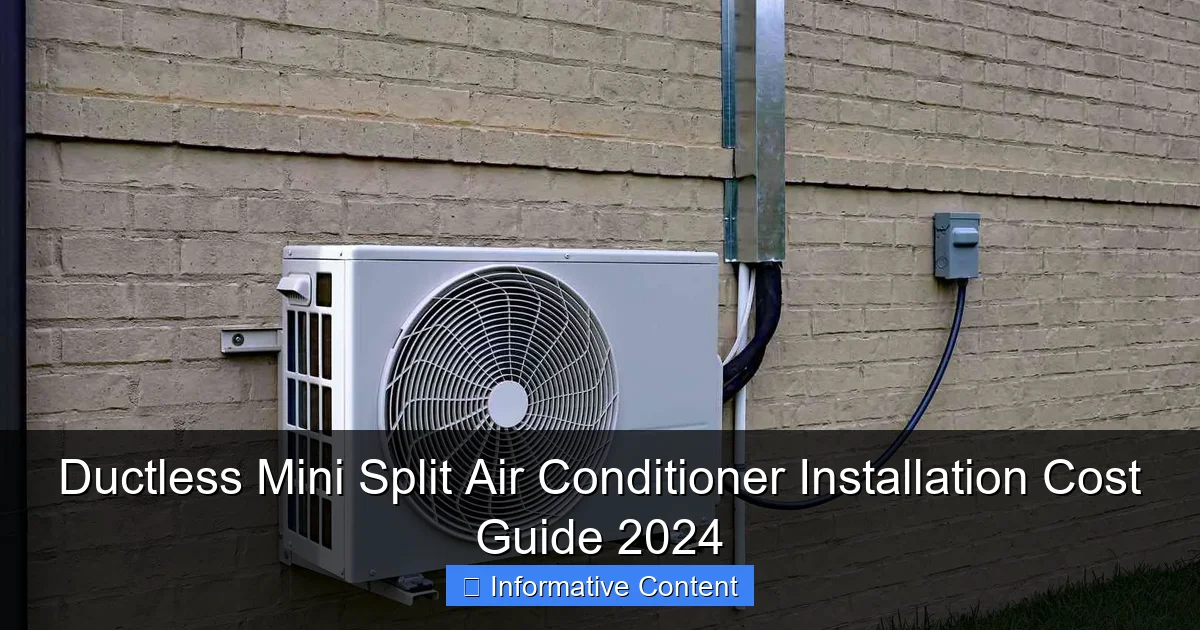
Visual guide about ductless mini split air conditioner installation cost
Image source: tandthvac.com
- Outdoor unit (condenser): Houses the compressor and condenser coil. This sits outside, similar to a central AC’s outdoor unit.
- Indoor unit (air handler): Mounted on a wall, ceiling, or floor. It delivers conditioned air directly into the room—no ducts needed.
The two units are connected by a small conduit (about 3 inches in diameter) that contains refrigerant lines, power cables, and a drain line. This setup makes installation less invasive than traditional ductwork, which often requires tearing into walls or ceilings.
How It Differs from Central AC and Window Units
Unlike central AC, which cools the entire house through ducts, a ductless mini split cools one room or zone at a time. That’s a big win for efficiency—especially if you don’t use every room equally. For example, I helped a friend install a mini split in her home office. She works from home but rarely uses the guest bedroom or basement. Instead of cooling the whole house, she now only cools her office, saving about 30% on her summer bills.
Compared to window units, mini splits are quieter (the noisy part is outside), more energy-efficient, and offer better air distribution. Plus, they don’t block your window or create security concerns. However, they do cost more upfront—which brings us to the next point.
Key Features That Affect Cost
Not all mini splits are created equal. The ductless mini split air conditioner installation cost depends heavily on features like:
- Number of zones: A single-zone system cools one room. Multi-zone (2–8+ indoor units) can cool multiple rooms with one outdoor unit. More zones = higher cost.
- BTU capacity: Measured in BTUs (British Thermal Units), this determines how much cooling power you need. A 9,000 BTU unit might work for a 300 sq. ft. bedroom, while a 36,000 BTU unit handles a 1,500 sq. ft. living area.
- Efficiency rating (SEER): Higher SEER (Seasonal Energy Efficiency Ratio) means lower energy bills. Units with SEER 20+ are more expensive but pay off over time.
- Heat pump vs. cooling-only: Most mini splits double as heaters (heat pumps), adding value in colder climates. Cooling-only models are cheaper but less versatile.
For instance, a basic single-zone, 9,000 BTU cooling-only unit might cost $1,500–$2,000. But a high-efficiency, multi-zone heat pump with smart controls can easily hit $10,000+ installed. The key is matching the system to your needs—not overspending or undersizing.
Factors That Influence Installation Cost
Now that we know what a ductless mini split is, let’s talk about what drives the ductless mini split air conditioner installation cost. It’s not just the unit—it’s the entire package. Here are the main factors:
1. Unit Type and Size
The most obvious cost driver is the equipment itself. As mentioned, single-zone systems are cheaper than multi-zone. But even within the same category, prices vary. A 12,000 BTU unit from a premium brand (like Mitsubishi or Daikin) might cost $2,500, while a budget-friendly brand (like MrCool or Senville) could be under $1,800.
Here’s a real example: I helped my neighbor install a MrCool DIY 12,000 BTU single-zone system. He paid $1,700 for the unit and about $800 for labor (more on that below). Total: $2,500. Meanwhile, a friend went with a Mitsubishi Hyper-Heat 18,000 BTU multi-zone system (two indoor units). The equipment alone was $4,500, and installation added another $3,000. That’s $7,500 total—but it covers two rooms and provides heating down to -13°F, which matters in his cold climate.
2. Labor and Installation Complexity
Labor typically accounts for 30–50% of the total cost. Simple installations—like mounting an indoor unit on an interior wall and running lines through an existing hole—are faster and cheaper. But if your home has:
- Thick masonry or concrete walls
- No nearby electrical panel
- Hard-to-reach outdoor space (e.g., second-floor patio)
…expect higher labor costs. One client needed a 40-foot line run across a crawlspace and up a brick exterior. The installer had to drill through mortar and snake lines carefully. That job took 10 hours instead of the usual 6, adding $600 to the bill.
3. Electrical Upgrades
Mini splits need a dedicated 208/240-volt circuit. If your panel is full or outdated, you might need a subpanel or even a main panel upgrade. This can add $500–$2,000, depending on the work.
A quick tip: Ask your installer to check your panel *before* buying the unit. Some brands (like MrCool DIY) offer pre-charged linesets that don’t require a licensed electrician to connect, saving money. But if you need a new breaker or wiring, hire a pro—safety first.
4. Location and Accessibility
Where you live affects labor rates. In rural areas, installers might charge $75–$100/hour. In cities like New York or San Francisco, $150–$200/hour isn’t uncommon. Also, if your outdoor unit needs to be placed far from the indoor unit (e.g., on a rooftop), extra materials and labor will add up.
5. Permits and Local Codes
Some cities require permits for HVAC work. Fees range from $50 to $200. In rare cases, you might need a structural engineer’s approval if mounting on a historic building. Always ask your installer about local requirements.
6. Additional Components
Don’t forget the extras:
- Condensate pump: Needed if the indoor unit is above the drain line. Adds $100–$200.
- Line set cover: Protects refrigerant lines from weather and UV damage. About $50–$150.
- Smart thermostat or Wi-Fi adapter: Lets you control the unit via an app. $100–$200.
- Extended warranties: Some brands offer 5- to 10-year coverage for $200–$500.
One homeowner I know skipped the line set cover to save $100—only to have the lines degrade after two years. Now he’s spending $300 to replace them. Sometimes, spending a little more upfront saves you big later.
DIY vs. Professional Installation: What’s the Real Cost?
“Can I install a ductless mini split myself?” I get this question a lot. The short answer: sometimes. But let’s break it down.
DIY Options (And Their Risks)
A few brands—like MrCool and Senville—sell “DIY” kits with pre-charged refrigerant lines. You don’t need to hire an HVAC pro to handle the refrigerant (which is regulated under EPA rules). Instead, you:
- Mount the indoor unit
- Drill a hole through the wall
- Run the lines and electrical cable
- Connect everything (no vacuuming or charging required)
My neighbor did this with his MrCool unit. He saved about $800 in labor. But he’s handy—he’s rewired outlets and hung heavy shelves before. If you’re not confident working with power tools or electrical work, DIY is risky. A bad connection could damage the unit, cause a refrigerant leak, or even start a fire.
Also, DIY voids warranties if the unit is damaged during installation. And if you mess up the refrigerant lines, fixing them later could cost more than professional installation.
When to Hire a Pro
For most people, hiring a licensed HVAC technician is the smarter choice. Here’s why:
- Proper sizing: Installers use load calculations (like Manual J) to pick the right BTU. Too small, and the unit won’t cool. Too big, and it cycles on/off too often, wasting energy.
- Code compliance: Pros know local rules and ensure your system passes inspection.
- Warranty protection: Most manufacturers require professional installation to keep the warranty valid.
- Long-term reliability: A well-installed mini split can last 15+ years. A botched job might fail in 5.
One client tried DIY on a budget unit. It worked fine for a year, then the compressor failed. The warranty was void because he installed it himself. He ended up paying $1,200 to replace the compressor—plus another $1,500 to have a pro reinstall it. Total: $2,700, when a pro could’ve done it right the first time for $2,200.
Hybrid Approach: Save Money, Stay Safe
If you’re handy but nervous about the refrigerant, consider a hybrid option:
- Buy a DIY kit (like MrCool)
- Do the mounting, drilling, and wiring yourself
- Hire an HVAC pro just to check your work and sign off on the installation
This can save 20–30% on labor while keeping the warranty intact. Just make sure your installer is willing to do “installation verification” (some won’t, for liability reasons).
Average Cost Breakdown by System Type (2024 Data)
Let’s get specific. Here’s a realistic cost breakdown based on 2024 data and real-world examples. All prices include equipment, labor, and basic materials (lineset, mounting bracket, etc.).
| System Type | BTU Range | Equipment Cost | Installation Cost | Total Cost | Best For |
|---|---|---|---|---|---|
| Single-Zone (Cooling-Only) | 9,000–12,000 BTU | $1,500–$2,200 | $800–$1,200 | $2,300–$3,400 | Small bedrooms, home offices |
| Single-Zone (Heat Pump) | 9,000–18,000 BTU | $2,200–$3,500 | $1,000–$1,500 | $3,200–$5,000 | Living rooms, basements (cold climates) |
| Multi-Zone (2–4 Zones) | 18,000–36,000 BTU | $4,000–$7,000 | $2,000–$4,000 | $6,000–$11,000 | Whole-house cooling, room additions |
| Ceiling Cassette or Floor-Mounted | 12,000–24,000 BTU | $2,800–$4,500 | $1,500–$2,500 | $4,300–$7,000 | Open layouts, modern homes |
| Commercial/High-Capacity | 48,000+ BTU | $8,000–$12,000+ | $3,000–$6,000+ | $11,000–$18,000+ | Large homes, small offices |
Note: Prices assume standard installation (interior wall, 25-foot lineset, existing electrical access). Complex jobs add $500–$2,000.
For example, a single-zone heat pump for a 400 sq. ft. sunroom might cost $4,000 total. But if you need to upgrade your electrical panel, add a condensate pump, and run lines through a concrete wall, the total could jump to $6,000.
Multi-zone systems are pricier but offer flexibility. A client in Colorado installed a three-zone Mitsubishi system to cool her kitchen, living room, and master bedroom. Total cost: $9,500. But she cut her summer energy bill by 40% and no longer needs a noisy window unit in the bedroom. For her, it was worth the investment.
How to Save Money Without Sacrificing Quality
Let’s face it: ductless mini splits aren’t cheap. But there are smart ways to reduce the ductless mini split air conditioner installation cost without cutting corners.
1. Get Multiple Quotes
Prices vary wildly between contractors. Always get at least three quotes. One installer might charge $4,500 for a single-zone system; another might do it for $3,200. Ask for line-item breakdowns (equipment, labor, permits, etc.) so you can compare apples to apples.
2. Choose the Right Time to Install
HVAC companies are busiest in summer and winter. Schedule your install in spring or fall for lower rates and faster service. One client saved $500 by booking in October instead of July.
3. Look for Rebates and Incentives
Many states and utilities offer rebates for high-efficiency systems. For example:
- Massachusetts: Up to $1,500 for ENERGY STAR mini splits
- California: $300–$1,000 for heat pumps
- Federal tax credits: Up to $2,000 for heat pumps (Inflation Reduction Act)
Check the DSIRE database for local incentives. My friend in Oregon got a $1,200 rebate on her Mitsubishi system—effectively cutting the cost by 25%.
4. Consider Mid-Range Brands
Premium brands (Mitsubishi, Daikin) offer top-tier reliability but cost more. Mid-range brands like Fujitsu, LG, or Panasonic deliver 90% of the performance at 70% of the price. Budget brands (MrCool, Senville) are even cheaper but may have shorter lifespans or weaker warranties.
5. Do Some Work Yourself (Safely)
If you’re handy, prep the site before the installer arrives:
- Clear the area around the indoor unit
- Mark the spot for the hole
- Run a temporary power cord (if allowed by code)
This can save 1–2 hours of labor. Just don’t touch refrigerant lines or electrical work—leave that to the pros.
6. Bundle with Other Projects
If you’re renovating, install the mini split during construction. It’s easier to run lines through open walls or ceilings than to patch drywall later. One client saved $800 by coordinating the install with his kitchen remodel.
Final Thoughts: Is a Ductless Mini Split Worth the Cost?
So, is the ductless mini split air conditioner installation cost worth it? For most people, yes—but with caveats.
If you’re adding a room, retrofitting an old house, or want to cut energy bills, a mini split is a smart investment. It’s more efficient than window units, quieter than portable ACs, and more flexible than central AC. Plus, with heating capability, it can replace your furnace in mild climates.
But it’s not a one-size-fits-all solution. If you’re on a tight budget and only need to cool one small room, a window unit might be enough. If you’re cooling a 3,000 sq. ft. home, a multi-zone system could cost $12,000+—which might be hard to justify unless you’re also getting heating benefits.
Here’s my advice: Start small. Install a single-zone unit in the room you use most. See how it performs, how much you save on energy, and whether you like the comfort. If it works, you can add more zones later.
And remember: the cheapest system isn’t always the best. A $1,800 budget unit might break in 5 years, while a $3,000 mid-range model lasts 15. Factor in long-term costs—not just upfront price.
At the end of the day, a ductless mini split is more than a cooling device. It’s a comfort upgrade, an energy saver, and (for many) a home improvement that pays for itself. Just plan wisely, hire the right pros, and don’t skip the rebates. Your wallet—and your comfort—will thank you.
Frequently Asked Questions
What is the average ductless mini split air conditioner installation cost in 2024?
The average installation cost ranges from $3,000 to $7,000, depending on unit size, complexity, and labor rates. Factors like brand, SEER rating, and indoor unit count can push prices higher or lower.
Does the ductless mini split installation cost include both labor and equipment?
Yes, most quotes cover both the cost of the unit(s) and labor, but always confirm with your installer. Additional expenses like electrical upgrades or wall modifications may be billed separately.
How does the ductless mini split air conditioner installation cost compare to central AC?
Mini splits typically cost more upfront (20–30% higher than central AC) but save money long-term due to energy efficiency and zoned cooling. They also avoid costly ductwork installation or retrofitting.
Can I reduce the ductless mini split installation cost with a DIY approach?
DIY installation is not recommended unless you’re a licensed HVAC technician, as improper setup voids warranties and risks safety. Some brands offer pre-charged lines, but professional installation ensures optimal performance and code compliance.
Are there tax credits or rebates to offset the ductless mini split air conditioner installation cost?
Yes, federal tax credits (e.g., 30% under the Inflation Reduction Act) and local utility rebates often apply to ENERGY STAR®-rated units. Check the Database of State Incentives for Renewables & Efficiency (DSIRE) for details.
What factors increase the ductless mini split installation cost?
Long refrigerant line runs, hard-to-access mounting areas, multi-zone systems, and electrical panel upgrades can add $500–$2,000+. Older homes may require additional structural or wiring work.