

Featured image for difference between window and wall air conditioner
Image source: advcontractors.co.uk
The primary difference between window and wall air conditioners lies in installation and space efficiency—window units fit snugly in windows, while wall units are built into walls for a more permanent, streamlined look. Wall air conditioners offer better insulation and reduced air leakage, making them slightly more energy-efficient, whereas window units are easier to install and often more affordable.
Key Takeaways
- Installation: Window units are easier to install than wall units.
- Efficiency: Wall ACs offer better energy efficiency and quieter operation.
- Space-saving: Wall units free up window space and improve aesthetics.
- Cost: Window ACs are cheaper upfront but may cost more long-term.
- Cooling power: Match BTU ratings to room size for optimal performance.
- Maintenance: Window units are simpler to clean and service annually.
- Flexibility: Wall units suit permanent setups; window units are portable.
📑 Table of Contents
Introduction: The Cool Dilemma
Picture this: It’s the middle of July, the sun is blazing, and your home feels more like an oven than a sanctuary. You’ve decided it’s finally time to invest in an air conditioner, but as you browse online, you’re hit with a wall of options. Two contenders keep popping up—window and wall air conditioners. Both promise to cool your space, but which one is truly better? It’s a question I’ve asked myself more than once, and after years of testing, researching, and even sweating through a few DIY installations, I’ve learned that the answer isn’t as simple as it seems.
The difference between window and wall air conditioner models goes beyond just looks. It’s about how they’re installed, how much space they take up, how efficient they are, and even how they affect your home’s resale value. Whether you’re a renter, a homeowner, or just someone tired of sticky nights, this guide will help you cut through the noise. We’ll explore the nitty-gritty details, share real-life examples, and give you practical tips so you can make a choice that actually works for your lifestyle—not just what the salesperson says is “best.”
1. Installation: Where the Real Difference Begins
Window AC: Quick and (Sometimes) Easy
Window air conditioners are the go-to for many renters and budget-conscious homeowners. They’re designed to slide right into a standard window frame—usually double-hung or sliding windows—and lock in place with brackets or support arms. I installed my first window unit in under an hour, and while I did spill sweat (and a few curses), it wasn’t rocket science.
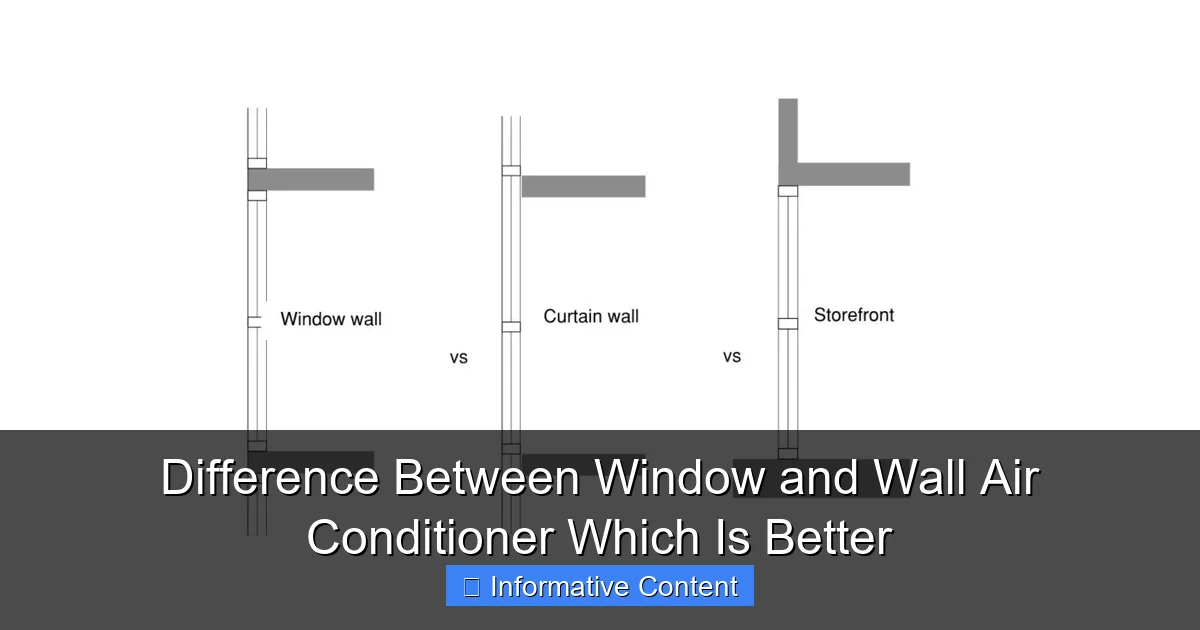
Visual guide about difference between window and wall air conditioner
Image source: dtoaec.com
The biggest perk? Minimal tools needed. Most models come with a kit that includes side panels to seal the gaps, a support bracket, and screws. All you really need is a drill, a level, and maybe a friend to help lift it. For example, the Frigidaire FFRA051WAE weighs just 45 pounds and fits windows 23–36 inches wide—perfect for a quick summer fix.
But here’s the catch: not all windows are created equal. If you have casement windows (the crank-out kind), a window AC won’t work. And if your window is high up or in an awkward spot, installation can turn into a two-person, three-hour ordeal. I once had to install one on the second floor with a ladder and a spotter—definitely not a solo job.
Wall AC: Permanent, but Powerful
Wall air conditioners are built into a hole cut directly into your wall. This means they’re a more permanent fixture—think of them as built-in appliances, like a dishwasher or oven. Installation is more involved. You need to cut through drywall, siding, or brick, which means power tools, permits (in some areas), and often a professional.
But once it’s in, it’s in. No seasonal removal, no risk of it falling out (yes, window units can—more on that later). Wall units are also better sealed, which reduces drafts and improves energy efficiency. For example, the Koldfront WAC10001W requires a 26” x 15.5” wall sleeve, and once it’s installed, it’s there to stay.
One major advantage: wall units don’t block your window. If you love natural light or want to keep a window open for ventilation, this is a game-changer. I once lived in an apartment where the window AC blocked the only source of daylight—my plants didn’t survive the season. A wall unit would’ve saved both the greens and my sanity.
Pro Tip: Know Your Window or Wall Type
- Double-hung windows? Great for window ACs. Just make sure the sill is sturdy and the frame isn’t warped.
- Casement or awning windows? Wall ACs are your only real option.
- Brick or concrete walls? Wall installation requires special tools (like a masonry drill) and more time. Budget accordingly.
- Renters: Check your lease. Many landlords won’t allow wall units due to the structural changes.
2. Efficiency and Cooling Power: Which Cools Better?
BTU and Room Size: The Basics
Both window and wall ACs are rated by BTUs (British Thermal Units)—the measure of how much heat they can remove from a room. The general rule: 20 BTUs per square foot. So, a 200 sq. ft. bedroom needs about 4,000 BTUs.
But here’s where the difference between window and wall air conditioner models starts to show. Wall units often have higher BTU capacities and better airflow design. For example, a 10,000 BTU wall unit (like the LG LW1019IVSM) can cool a 450 sq. ft. space efficiently, while a similarly sized window unit might struggle if the room has high ceilings or poor insulation.
Energy Efficiency: SEER and EER Matter
Two key terms to know: SEER (Seasonal Energy Efficiency Ratio) and EER (Energy Efficiency Ratio). SEER measures efficiency over a full cooling season, while EER is a snapshot of efficiency at peak load.
Wall units typically have higher SEER ratings. Why? They’re better sealed, have more advanced compressors, and often come with inverter technology (which adjusts cooling output based on room temperature, like a dimmer switch). For example, the GE AHY08LZ window AC has an EER of 10.7, while the Friedrich Kuhl SQ08N10C wall unit hits 12.1—a 13% improvement in efficiency.
Higher EER = less electricity used = lower bills. Over a summer, that can mean saving $20–$50, depending on your usage and local rates. If you live in a hot climate (looking at you, Texas and Arizona), that adds up fast.
Real-World Example: The Attic Office
I helped a friend cool a 300 sq. ft. attic office. He started with a 10,000 BTU window unit. It worked—but barely. The room was hot by 10 a.m., and the AC ran nonstop. We switched to a 12,000 BTU wall unit (the Honeywell MN10CESWW), and the difference was night and day. The wall unit cooled the space in half the time and kept it at 72°F without cycling every 10 minutes. Plus, the noise level dropped from 68 dB (like a vacuum) to 58 dB (like a quiet conversation).
Tip: Don’t Over-BTU
- Too much cooling can lead to short cycling (the AC turns on/off rapidly), which wastes energy and wears out the compressor.
- Use online calculators (like EnergyStar’s) to find the right BTU for your room size, insulation, and sun exposure.
- For large spaces, consider a ductless mini-split instead. It’s more expensive upfront but more efficient long-term.
3. Noise and Comfort: The Quiet Factor
Window ACs: The Noisy Neighbors
Let’s be honest: window units are loud. The compressor and fan are right outside your window, and vibrations travel through the frame. I once used a 6,000 BTU window AC in my bedroom. It kept me cool, but I also slept with earplugs. The sound was like a constant, low hum—annoying, but not unbearable. For light sleepers, it’s a dealbreaker.
Newer models have improved, though. Look for units with sleep modes or low-noise settings (often labeled “quiet mode” or “whisper cool”). The Midea U-Shaped MAW08V1QWT is a standout—its compressor is on the outside, and the indoor unit barely makes a whisper (42 dB on low).
Wall ACs: Built for Quiet
Wall units are generally quieter because they’re better insulated and mounted directly to the wall (no rattling window frame). The Frigidaire FHWC123TC1, for example, runs at just 51 dB on low—quieter than most window units on their highest setting.
But here’s a trade-off: some wall units have louder startup sounds. The compressor kicks in with a noticeable “thunk.” It’s not a dealbreaker, but it can startle pets or light sleepers if you’re sensitive to sudden noises.
Comfort Features: Beyond Cooling
- Remote controls: Both types offer remotes, but wall units often have more precise temperature sensors (mounted on the unit, not the remote).
- Dehumidification: High humidity makes rooms feel hotter. Wall units often have better dehumidifying modes. For example, the Koldfront WAC12001W removes 2.5 pints of moisture per hour—ideal for humid climates.
- Airflow control: Wall units usually have wider louvers for better air distribution. No more “cold spots” in the corner of the room.
4. Cost and Value: Upfront vs. Long-Term
Initial Price: Window Wins
Window ACs are cheaper upfront. A basic 5,000–6,000 BTU unit costs $150–$250. Even high-end models (with smart features, like Wi-Fi) rarely exceed $500. Wall units start at $400 for 8,000 BTUs and can go up to $1,200+ for 14,000 BTUs with advanced features.
But don’t forget the installation cost. A professional window AC install is $100–$200. For a wall unit, it’s $300–$800, depending on wall material and electrical work. If you’re DIY-ing, factor in tools and time.
Long-Term Value: Wall Units Pay Off
Wall units are more efficient, which means lower energy bills. Over 5 years, a 10,000 BTU wall unit can save $100–$300 compared to a similar window model (based on average U.S. electricity rates).
They also add home value. A built-in AC is seen as a permanent upgrade, like central air. If you ever sell, a wall unit can be a selling point. A window AC? Not so much.
And durability? Wall units last longer. They’re protected from weather, theft, and accidental bumps. I’ve had a wall unit in my basement for 8 years—no issues. A window unit on my porch lasted 3 before a storm blew it off the sill (RIP).
Data Table: Cost Comparison (5-Year Total)
| Cost Factor | Window AC (10,000 BTU) | Wall AC (10,000 BTU) |
|---|---|---|
| Unit Price | $300 | $600 |
| Installation | $150 | $500 |
| Energy Use (5 years) | $600 | $450 |
| Maintenance/Repairs | $100 | $50 |
| Total | $1,150 | $1,600 |
Note: Prices are estimates. Energy costs vary by region.
5. Aesthetics and Space: Looks Matter
Window ACs: Functional, Not Fabulous
Let’s face it: window units are ugly. They stick out of your window, block the view, and look like a temporary fix. I once had a neighbor who painted their window AC to match the house color—it looked better, but it still screamed “I don’t have central air.”
They also take up window space. If you want to open the window for fresh air, you’re out of luck. And in winter, you have to remove and store them (or leave them in and risk drafts).
Wall ACs: Sleek and Integrated
Wall units blend into the wall. They’re flush-mounted, with a clean, modern look. No protruding boxes. No blocked views. They’re especially great for living rooms or offices where aesthetics matter.
But they do require a hole in your wall. If you rent or hate DIY, this is a hurdle. And once it’s in, it’s hard to move. I once had to cut a hole in a brick wall for a wall unit—took a weekend, a masonry bit, and a lot of dust. Not for the faint of heart.
Space-Saving Tip
- Window ACs: Use a window AC support bracket to free up sill space. You can still use the window for plants or decor.
- Wall ACs: Install in a closet or utility room if you have one. It keeps the unit out of sight and reduces noise in living areas.
6. The Verdict: Which Is Better?
So, after all this—what’s the difference between window and wall air conditioner models, and which one wins? The answer? It depends on your needs.
Choose a Window AC If…
- You’re on a tight budget.
- You rent or don’t want permanent changes.
- You have standard double-hung/sliding windows.
- You need a quick, seasonal fix.
- You don’t mind a little noise or a blocked window.
Example: A college student in a 200 sq. ft. dorm room. A $200 window unit is perfect—cheap, easy to install, and removable when school ends.
Choose a Wall AC If…
- You own your home and plan to stay long-term.
- You want better efficiency, quieter operation, and a cleaner look.
- You have casement windows or no window access.
- You’re willing to invest more upfront for long-term savings.
Example: A homeowner with a 400 sq. ft. home office. A wall unit keeps the space cool, quiet, and professional-looking—no clunky boxes in the window.
The Bottom Line
Neither is “better” across the board. But if you’re serious about comfort, efficiency, and resale value, a wall AC is the smarter choice for most homeowners. For renters, budget shoppers, or short-term needs, a window unit gets the job done—just don’t expect luxury.
At the end of the day, the difference between window and wall air conditioner comes down to priorities. Ask yourself: What matters most? Cost? Comfort? Convenience? Once you know that, the decision gets a whole lot cooler.
Frequently Asked Questions
What is the main difference between window and wall air conditioners?
The primary difference between window and wall air conditioners lies in their installation. Window ACs mount directly in a window frame, while wall units are installed through a hole in the wall, offering a permanent, space-saving solution.
Which is better: a window or wall air conditioner for energy efficiency?
Wall air conditioners are often more energy-efficient due to better insulation and a tighter seal, reducing cool air leakage. However, high-efficiency window units can perform comparably if installed correctly.
Can I install a wall air conditioner in a window opening?
No, wall air conditioners require a custom sleeve or hole through an exterior wall for secure mounting. While both types cool rooms, their installation methods are not interchangeable.
What are the pros and cons of window vs. wall air conditioners?
Window units are cheaper and easier to install but block window views and may vibrate. Wall units save floor/window space, operate quieter, but cost more upfront and need professional installation.
Do wall air conditioners require more maintenance than window units?
Both types need similar maintenance (filter cleaning, coil checks), but wall units may be harder to access for repairs. Their permanent installation reduces vibration-related wear, potentially extending lifespan.
Which type of AC is better for cooling large rooms?
Wall air conditioners often have higher BTU capacities and better airflow, making them ideal for larger spaces. However, oversized window units can work if the room has proper ventilation and insulation.