
Featured image for central air conditioner installation prices
Image source: cdn.fixr.com
Central air conditioner installation prices in 2024 typically range from $3,800 to $7,500, depending on unit size, efficiency rating, and regional labor costs. High-efficiency models and complex installations can push prices above $10,000, making it crucial to get multiple quotes and factor in potential rebates or tax credits.
Key Takeaways
- Plan for $3,000–$7,500: Average 2024 installation costs vary by unit size and region.
- SEER ratings impact price: Higher efficiency units cost more upfront but save long-term.
- Get 3+ quotes: Compare licensed installers to secure fair, competitive pricing.
- Ductwork affects total cost: Existing systems may need upgrades or repairs.
- Timing matters: Off-season installs often offer discounts and faster scheduling.
- Rebates and tax credits: Check local incentives to reduce overall installation expenses.
📑 Table of Contents
- What You Need to Know Before Installing a Central Air Conditioner in 2024
- Understanding the Average Cost of Central Air Conditioner Installation
- Hidden Costs and Add-Ons That Can Increase Your Installation Price
- Labor Costs: What You’re Really Paying For
- How to Save Money Without Sacrificing Quality
- Data Table: Central Air Conditioner Installation Costs by Scenario
- Final Thoughts: Planning Your 2024 AC Installation
What You Need to Know Before Installing a Central Air Conditioner in 2024
Let’s be honest—summer heat can turn your home into a sauna, and if you’re still relying on window units or portable fans, you’re not just sweating; you’re missing out on comfort, energy savings, and peace of mind. That’s why more homeowners are upgrading to central air conditioner systems. But before you dive into the world of ducts, thermostats, and SEER ratings, there’s one big question: how much does central air conditioner installation cost in 2024?
I remember when my neighbor, Sarah, decided to replace her aging AC system. She got three quotes ranging from $5,000 to $9,000 for the same brand and model. Confused and overwhelmed, she asked me, “Why the huge gap?” That’s when I realized: central air conditioner installation prices aren’t just about the unit—they’re about the whole ecosystem. From labor to permits to your home’s unique layout, every detail affects the final bill. In this guide, we’ll break down what you should expect in 2024, so you can budget wisely, avoid surprises, and make a smart investment in your home’s comfort.
Understanding the Average Cost of Central Air Conditioner Installation
When people search for “central air conditioner installation prices,” they’re usually looking for a ballpark figure. And while no two homes are exactly alike, we can still outline a realistic range based on current data, market trends, and real-world projects. In 2024, most homeowners can expect to pay between $5,500 and $10,500 for a complete central AC installation. But that’s just the starting point—let’s dig into the factors that shape this range.
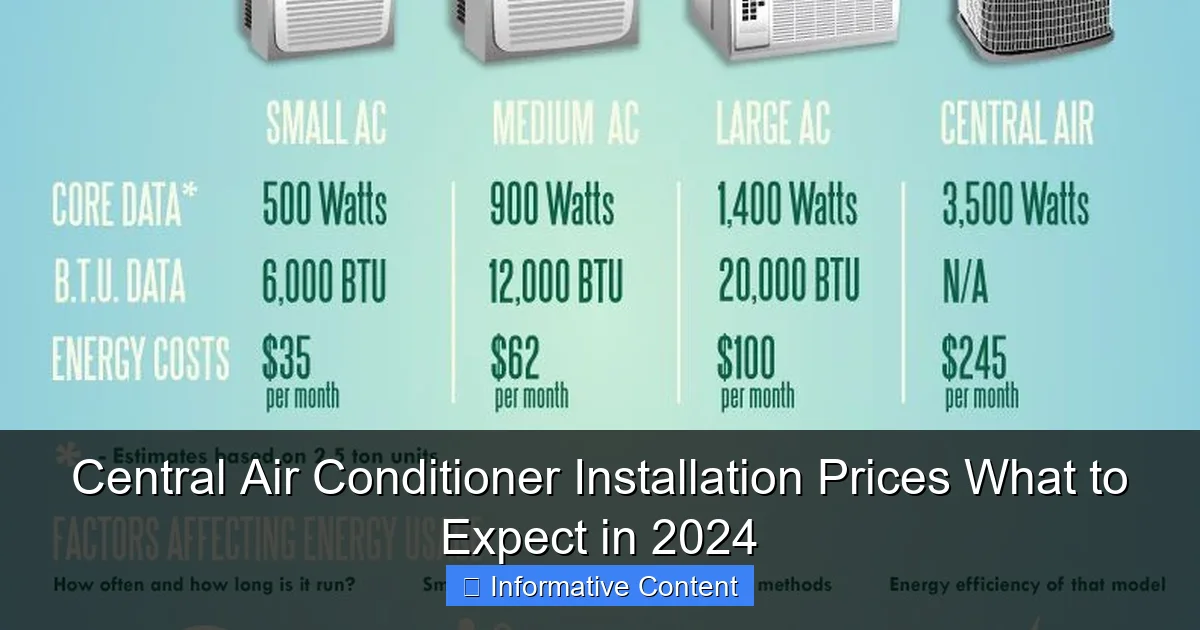
Visual guide about central air conditioner installation prices
Image source: i.pinimg.com
National Average vs. Regional Variations
The national average for central AC installation sits around $7,500, but your actual cost could be higher or lower depending on where you live. For example:
- Urban areas (like Chicago, Denver, or Atlanta) often see higher labor rates due to demand and cost of living.
- Coastal regions (such as Florida or California) may have additional permit fees or stricter building codes, increasing labor time and cost.
- Rural areas might offer lower labor rates, but longer travel times for technicians could add a service fee.
For instance, I helped a friend in rural Tennessee install a 3-ton AC unit. The total was $5,800. A similar project in downtown Austin? Over $8,200. Location matters—a lot.
Size and Capacity: Why Bigger Isn’t Always More Expensive
Central air conditioners are sized by “tonnage,” which refers to cooling capacity—not weight. A 1-ton unit cools about 600 square feet, so a typical 2,000-square-foot home might need a 3- to 4-ton system. But here’s the kicker: a 4-ton unit doesn’t always cost twice as much as a 2-ton unit.
- Units between 2.5 and 3.5 tons are most common and often priced competitively due to high demand.
- Very small (1.5-ton) or very large (5+ ton) units may carry a premium due to limited availability or specialized components.
- Oversizing can lead to poor humidity control and higher energy bills, so proper sizing is critical.
Pro tip: Always get a Manual J load calculation from your installer. This assesses your home’s insulation, windows, and layout to determine the right size. Guessing based on square footage alone? That’s a recipe for overpaying and underperforming.
Brand and Model: Premium vs. Budget Options
Not all AC units are created equal. High-efficiency models from brands like Trane, Carrier, or Lennox can cost $2,000 to $4,000 more than budget-friendly options from Rheem or Goodman. But is the premium worth it?
- Higher SEER (Seasonal Energy Efficiency Ratio) ratings mean lower energy bills—especially in hot climates.
- Premium brands often have longer warranties and quieter operation.
- Budget models may save upfront but could cost more in repairs and energy over time.
Think of it like buying a car: a Honda Civic gets you there, but a Tesla has better tech and efficiency. Your choice depends on your budget, climate, and long-term goals.
Hidden Costs and Add-Ons That Can Increase Your Installation Price
You’ve got your unit picked out, your size calculated, and a quote in hand. Sounds like you’re ready, right? Not so fast. Central air conditioner installation prices often include “hidden” or optional add-ons that can push your total up by 10% to 30%. Let’s uncover the most common ones.
Ductwork Modifications or Replacement
If you’re replacing an existing system, your ducts might need updates. But if you’re installing AC in a home with no existing ductwork (like many older homes or homes with radiant heating), this is a major cost driver.
- New ductwork: $2,000–$6,000, depending on home size and layout.
- Duct sealing or insulation: $300–$1,000 to improve efficiency.
- Duct cleaning (recommended if replacing): $200–$500.
I once worked with a homeowner in a 1950s ranch who wanted central AC. The ducts were so leaky, they lost 40% of cooling power. Replacing them added $4,200 to the project—but cut his energy bills by 30% afterward. Sometimes, the “hidden” cost is actually an investment.
Thermostat and Smart Home Integration
Your old thermostat might not be compatible with a modern AC system. Upgrading to a programmable or smart thermostat (like Nest, Ecobee, or Honeywell) typically adds $200–$600.
- Basic programmable: $100–$150 installed.
- Smart thermostat with zoning: $300–$600 (great for multi-level homes).
- Wi-Fi-enabled models offer remote control and energy tracking.
Sarah, my neighbor, opted for a smart thermostat. Now she adjusts the temperature from her phone while at work—and her energy bills dropped 18% in the first summer. Worth it? She says yes.
Electrical Upgrades and Permits
Central AC systems require dedicated electrical circuits. If your panel is outdated or maxed out, you might need:
- New circuit breaker: $200–$500.
- Electrical panel upgrade: $1,500–$3,000 (common in homes built before 1980).
- Permits and inspections: $100–$500 (required in most jurisdictions).
One client in a 1960s home needed a full panel upgrade to support the new AC. It added $2,800—but also made their home safer and more future-proof. Always ask your installer if electrical work is included in the quote.
Drain Line, Condensate Pump, and Safety Features
AC units produce condensation, which must be drained safely. If your unit is in the attic or a basement, you may need:
- Condensate pump: $150–$300.
- Drain line installation: $200–$500.
- Float switch (prevents water damage): $50–$100.
<
These aren’t flashy, but they’re essential for preventing leaks and mold. Don’t skip them.
Labor Costs: What You’re Really Paying For
When you pay for central air conditioner installation prices, you’re not just buying a machine—you’re paying for expertise, safety, and peace of mind. Labor typically accounts for 30% to 50% of your total bill. Let’s break down what you’re getting.
Installation Time and Complexity
Most standard installations take 1 to 3 days. But complexity changes everything.
- Simple replacement (same location, same size): 1 day, $1,000–$2,000 labor.
- New installation (no existing AC): 2–3 days, $2,500–$4,000 labor.
- Attic or crawlspace installation: 3–4 days, $3,500+ labor (harder access, more time).
One homeowner in a two-story colonial needed the unit in the attic. The installers had to remove a section of drywall, run new ducts, and reinforce the floor. The labor alone was $3,800—but the homeowner said, “I’d pay it again for the quiet, even cooling.”
Technician Expertise and Licensing
Licensed HVAC technicians charge more—but for good reason. They’re trained to:
- Handle refrigerants safely (EPA Section 608 certification required).
- Follow local building codes and safety standards.
- Perform pressure tests and leak checks.
Unlicensed “handymen” might offer lower rates, but they can’t legally handle refrigerant. If something goes wrong, your warranty might be voided. Always verify licensing and insurance.
Warranty and Service Agreements
Many installers include a 1-year labor warranty. Extended service plans (2–5 years) cost $200–$800 but can save you big on repairs.
- Covers labor for breakdowns, not parts.
- May include annual maintenance (cleaning, tune-ups).
- Great for peace of mind, especially with high-end units.
One client skipped the service plan. Two years later, the compressor failed. Labor for the repair was $1,200—more than the plan cost. Lesson learned.
How to Save Money Without Sacrificing Quality
Let’s face it: $10,000 is a big chunk of change. But you don’t have to break the bank to get a reliable, efficient central AC system. Here’s how to save—smartly.
Shop During Off-Season (Fall or Early Spring)
Demand for AC installations peaks in late spring and summer. Contractors are busier, and prices rise. But in fall and early spring, many companies offer:
- Discounts (10%–20% off labor or equipment).
- Free add-ons (like thermostat upgrades).
- Faster scheduling (no 4-week wait).
One homeowner in Virginia booked their install in February. They saved $1,200 and had the system running by May. Win-win.
Get Multiple Quotes and Compare Line-by-Line
Don’t just compare totals. Ask for detailed breakdowns. One quote might include:
- Unit: $3,500
- Labor: $2,500
- Ductwork: $1,800
- Permits: $300
- Total: $8,100
Another might list “installation” as $8,100—with no details. That’s a red flag. Always ask for transparency.
Look for Rebates and Tax Credits
In 2024, the Inflation Reduction Act (IRA) offers tax credits for high-efficiency HVAC systems. You could get:
- Up to $600 for AC units with SEER2 ≥ 16.
- Up to $1,200 for heat pumps (which also cool).
- State and utility rebates (check your local provider).
A homeowner in Arizona installed a 17 SEER2 unit and got a $600 federal credit plus a $200 utility rebate. Total savings: $800. Not bad.
Consider a “Mid-Tier” Brand
Premium brands are great, but mid-tier options like Amana, York, or Heil offer excellent efficiency at lower prices. Many are owned by the same parent companies as premium brands (e.g., Amana is part of Daikin, which also owns Goodman).
- Similar technology, lower marketing costs.
- Warranties often match premium models.
- Great for budget-conscious homeowners.
One client chose a York 16 SEER unit over a Trane equivalent. They saved $1,500 and reported identical comfort and reliability.
Data Table: Central Air Conditioner Installation Costs by Scenario
To help you visualize, here’s a breakdown of average costs for common installation scenarios in 2024:
| Scenario | Unit Cost | Labor | Ductwork | Add-Ons | Total Estimate |
|---|---|---|---|---|---|
| Simple replacement (3-ton, 16 SEER) | $3,200 | $1,800 | $0 (existing) | $400 (thermostat, permits) | $5,400 |
| New install (no ducts, 3-ton) | $3,500 | $3,000 | $3,500 (new) | $800 (electrical, thermostat) | $10,800 |
| Attic install (2.5-ton, 18 SEER) | $4,200 | $3,800 | $2,000 (modifications) | $600 (condensate pump, smart thermostat) | $10,600 |
| High-efficiency (4-ton, 20 SEER2) | $5,000 | $2,500 | $1,500 (sealing) | $900 (zoning, permits) | $9,900 |
| Budget option (3-ton, 14 SEER) | $2,800 | $2,000 | $0 (existing) | $300 (basic thermostat) | $5,100 |
Note: Prices are national averages. Regional adjustments, labor rates, and specific home conditions may vary.
Final Thoughts: Planning Your 2024 AC Installation
Installing a central air conditioner is one of the best upgrades you can make for your home’s comfort, energy efficiency, and resale value. But central air conditioner installation prices in 2024 reflect more than just the unit—they reflect your home’s needs, your climate, and your long-term goals.
Remember: the cheapest option isn’t always the best. A $5,000 system might save you upfront but cost more in repairs, energy, and discomfort. On the flip side, a $10,000 system could pay for itself in 5–7 years through lower bills and fewer breakdowns.
So, what should you do? Start with a clear budget. Get at least three detailed quotes. Ask questions—lots of them. Prioritize proper sizing, licensed installers, and energy efficiency. And if you can, install in the off-season to save money and avoid the summer rush.
As for Sarah, my neighbor? She ended up going with a 16 SEER2 Trane unit, duct sealing, and a smart thermostat. Total: $7,900. After a $600 tax credit and $200 in rebates, her net cost was $7,100. “It was worth every penny,” she told me last summer. “I sleep better, and my electric bill dropped by 25%.”
You don’t have to be an HVAC expert to make a smart decision. With the right knowledge, you can navigate the world of central air conditioner installation prices with confidence—and enjoy cool, quiet, efficient comfort for years to come. Here’s to a cooler, smarter 2024.
Frequently Asked Questions
What is the average cost of central air conditioner installation in 2024?
The average central air conditioner installation price in 2024 ranges from $5,000 to $12,000, depending on system size, efficiency, and labor complexity. Factors like home size and ductwork needs can significantly influence the final cost.
How much does a high-efficiency central AC unit cost to install?
High-efficiency central AC units (SEER 18+) typically cost $7,000 to $14,000 installed, including labor and materials. While pricier upfront, they offer long-term energy savings and may qualify for rebates.
Are there hidden costs in central air conditioner installation prices?
Yes, additional costs may include ductwork modifications ($1,500–$4,000), electrical upgrades, or permits. Always ask your contractor for a detailed breakdown of the central air conditioner installation price to avoid surprises.
Does the size of my home affect the installation cost?
Absolutely. Larger homes require higher-capacity units (5+ tons), which can increase costs by $2,000–$5,000 compared to standard 3-ton systems. A professional load calculation ensures accurate sizing.
Can I save money by replacing my AC and furnace together?
Yes, bundling HVAC replacements often saves $500–$2,000 in labor and system compatibility upgrades. Contractors may also offer discounts for dual-system installations.
Do central AC installation prices vary by region?
Labor rates and permit fees differ by location—urban areas and regions with harsh climates often have higher costs. For example, prices in Texas may be 10–15% lower than in New York.