
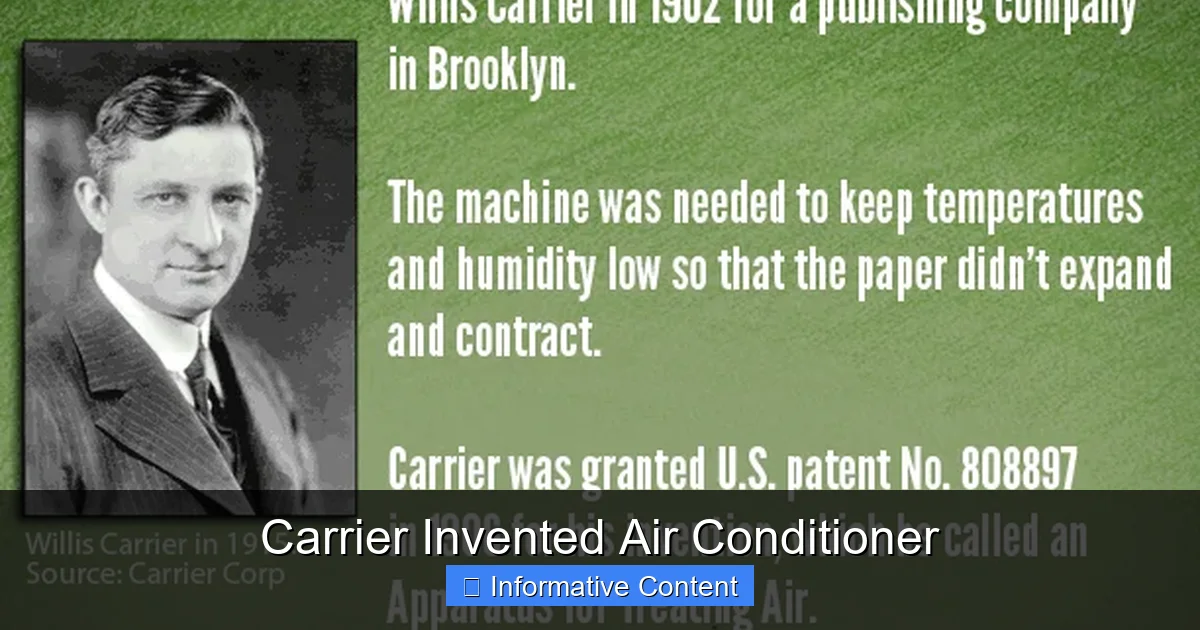
Willis Haviland Carrier invented the first modern air conditioner in 1902 to solve a humidity problem in a printing plant. What began as an industrial solution soon transformed homes, workplaces, and entire industries, making modern life more comfortable and productive.
Imagine a sweltering summer day in New York City. The air is thick, the sun beats down, and even the breeze feels like a hairdryer. Now picture stepping into a cool, refreshing room where the temperature is just right—no sweat, no discomfort. That’s the magic of air conditioning. But have you ever wondered who made this possible? The answer lies with one man: Willis Haviland Carrier, the brilliant engineer who invented the air conditioner.
It wasn’t about comfort at first. In 1902, Carrier was working for the Buffalo Forge Company when a printing plant in Brooklyn reached out with a frustrating problem. The paper kept expanding and shrinking because of changes in humidity, making it impossible to print images and text in perfect alignment. The colors wouldn’t line up, and the quality was suffering. Carrier was tasked with finding a solution—and what he created changed the world.
Instead of just cooling the air, Carrier focused on controlling moisture. He designed a system that blew air over cold coils, removing humidity and stabilizing the environment. This was the birth of the first modern air conditioner. It wasn’t meant to make people comfortable—it was meant to solve a technical challenge. But as the technology evolved, its potential became clear. Soon, air conditioning wasn’t just for factories. It was for theaters, offices, homes, and hospitals. It transformed how we live, work, and even where we can live.
Key Takeaways
- Willis Carrier created the first air conditioner in 1902: He designed it to control humidity in a Brooklyn printing plant, not for cooling people.
- It solved a major industrial problem: Fluctuating humidity caused paper to expand and shrink, ruining print quality.
- The invention paved the way for modern HVAC systems: Carrier’s design became the foundation for today’s heating, ventilation, and air conditioning technology.
- Air conditioning changed society: It enabled year-round comfort, improved health, and boosted productivity in homes and offices.
- Carrier founded a global company: The Carrier Engineering Corporation, now Carrier Global Corporation, remains a leader in climate control.
- Today’s air conditioners are smarter and greener: Innovations include energy-efficient models, smart thermostats, and eco-friendly refrigerants.
- Air conditioning is essential in modern life: From hospitals to data centers, it supports critical operations and daily comfort.
📑 Table of Contents
The Problem That Sparked a Revolution
To understand why Carrier invented the air conditioner, we need to go back to the early 1900s. Back then, industrial processes were highly sensitive to environmental conditions. One of the biggest challenges was humidity—especially in industries like printing, textiles, and photography.
In the summer of 1902, the Sackett & Wilhelms Lithographing and Printing Company in Brooklyn was struggling. The paper they used would absorb moisture from the air, causing it to expand. When the air dried out, the paper would shrink. This constant change made it nearly impossible to print multi-colored images with precision. The colors wouldn’t align, and the final product looked messy and unprofessional.
The company turned to the Buffalo Forge Company, which specialized in heating and ventilation systems. They assigned a young engineer named Willis Haviland Carrier to tackle the issue. Carrier wasn’t just any engineer—he was a problem-solver with a deep understanding of thermodynamics and airflow.
At the time, people were already experimenting with cooling air. Some used ice blocks or fans, but these methods only provided temporary relief and didn’t control humidity. Carrier took a different approach. He realized that to solve the printing problem, he needed to control both temperature and moisture in the air.
How Carrier’s Design Worked
Carrier’s breakthrough came when he applied the principles of psychrometrics—the science of air and water vapor mixtures. He understood that by cooling air below its dew point, moisture would condense out of it, reducing humidity. To do this, he designed a system that used a series of cold coils. Air was blown over these coils, causing water vapor to condense into droplets, which were then drained away.
This process not only removed humidity but also cooled the air as a side effect. The result? A stable, dry environment perfect for printing. The system used a fan to circulate air, a refrigeration unit to cool the coils, and a drainage system to remove the collected moisture. It was a complete, self-contained unit—the first true air conditioning system.
Carrier didn’t stop there. He continued refining his design, adding controls to regulate temperature and humidity independently. This level of precision was revolutionary. For the first time, industries could create controlled environments, improving product quality and efficiency.
From Factory to Everyday Life
At first, air conditioning was used almost exclusively in industrial settings. Printing plants, textile mills, and pharmaceutical companies adopted the technology to protect their products and processes. But it didn’t take long for people to notice the side benefit: the air felt cooler and more comfortable.
The first public space to install air conditioning was a movie theater—the New York Stock Exchange in 1903, followed by the Rivoli Theater in New York in 1925. Theater owners quickly realized that cool, comfortable air drew bigger crowds, especially during summer months. People were willing to pay to escape the heat, and air conditioning became a major selling point.
By the 1930s, air conditioning began appearing in offices, hotels, and department stores. It wasn’t just about comfort—it was about productivity. Workers were more focused and efficient in cool environments. Businesses could operate year-round, regardless of the weather outside.
The Birth of a Global Industry
Visual guide about Carrier Invented Air Conditioner
Image source: img.ifunny.co
As demand for air conditioning grew, so did the need for a company to manufacture and install these systems. In 1915, Willis Carrier co-founded the Carrier Engineering Corporation with six other engineers. The company’s mission was simple: to advance the science of air conditioning and make it accessible to industries and consumers.
Carrier’s early years were focused on industrial clients. But as the technology improved and costs came down, the company began developing systems for homes and commercial buildings. One of their first major breakthroughs was the “Weathermaker” in 1931—the first window air conditioning unit designed for residential use.
This was a game-changer. Before the Weathermaker, air conditioning was expensive and required complex ductwork. The window unit was compact, affordable, and easy to install. It brought cool air to middle-class homes for the first time.
Expanding Reach and Innovation
Throughout the mid-20th century, Carrier continued to innovate. They introduced central air conditioning systems, improved energy efficiency, and developed better refrigerants. The company also expanded globally, opening offices in Europe, Asia, and Latin America.
Air conditioning became essential in regions with hot, humid climates. In the United States, it played a major role in the population shift to the Sun Belt—states like Arizona, Texas, and Florida. People could now live comfortably in places that were once considered too hot for year-round habitation.
Carrier also contributed to major technological advancements. During World War II, the company helped design climate control systems for military hospitals and aircraft factories. These systems were critical for treating wounded soldiers and maintaining precision in manufacturing.
Carrier’s Legacy Lives On
Today, Carrier Global Corporation is one of the largest HVAC companies in the world. With over 50,000 employees and operations in more than 180 countries, the company continues to lead in innovation and sustainability.
Carrier’s original vision—to create comfortable, healthy indoor environments—remains at the core of its mission. But the company has also embraced modern challenges, such as climate change and energy efficiency. They’ve developed systems that use less electricity, reduce greenhouse gas emissions, and integrate with smart home technology.
How Air Conditioning Changed the World
It’s hard to overstate the impact of air conditioning on modern society. What started as a solution to a printing problem has transformed nearly every aspect of daily life.
Health and Comfort
One of the most significant benefits of air conditioning is improved health. In hot, humid climates, high temperatures can lead to heat exhaustion, dehydration, and even heat stroke. Air conditioning helps regulate body temperature, reducing the risk of heat-related illnesses.
It also improves indoor air quality. Modern systems filter out dust, pollen, and other allergens, making the air cleaner and safer to breathe. This is especially important for people with asthma, allergies, or respiratory conditions.
In hospitals, air conditioning is essential. It helps control infections by filtering air and maintaining sterile environments. Operating rooms, intensive care units, and laboratories all rely on precise climate control to protect patients and equipment.
Productivity and Economy
Air conditioning has had a major impact on the economy. In offices, cool environments help workers stay focused and alert. Studies show that productivity drops significantly when temperatures rise above 77°F (25°C). With air conditioning, businesses can maintain optimal conditions year-round.
The technology has also enabled entire industries to thrive. Data centers, for example, generate massive amounts of heat. Without air conditioning, servers would overheat and fail. Similarly, food storage, pharmaceuticals, and electronics manufacturing all depend on controlled environments.
Urban Development and Migration
Air conditioning has reshaped where and how people live. In the 20th century, cities in hot climates saw rapid growth because air conditioning made them more livable. Phoenix, Las Vegas, and Houston are just a few examples of cities that boomed thanks to climate control.
It also influenced architectural design. Buildings could now be taller, with more glass and less ventilation, because mechanical systems handled cooling. Skyscrapers, shopping malls, and suburban homes all became possible on a large scale.
Modern Air Conditioning: Smarter and Greener
While Carrier invented the air conditioner over a century ago, the technology continues to evolve. Today’s systems are more efficient, intelligent, and environmentally friendly than ever before.
Energy Efficiency and Sustainability
One of the biggest challenges with air conditioning is energy consumption. Traditional systems can use a lot of electricity, especially in hot climates. To address this, manufacturers have developed high-efficiency models with advanced compressors, variable-speed fans, and better insulation.
Many modern units now use inverter technology, which adjusts cooling output based on demand. This reduces energy waste and lowers utility bills. Some systems can even recover waste heat and use it for water heating.
Carrier and other companies are also phasing out harmful refrigerants like R-22, which deplete the ozone layer. Newer systems use eco-friendly alternatives such as R-410A and R-32, which have lower global warming potential.
Smart Technology and Connectivity
The rise of smart homes has brought air conditioning into the digital age. Today’s systems can be controlled remotely via smartphones, voice assistants, and home automation platforms.
Smart thermostats learn your schedule and preferences, adjusting the temperature automatically to save energy. They can also detect when you’re away and turn off the AC to avoid wasting power.
Some systems even integrate with weather forecasts. If a cool front is coming, the thermostat can delay cooling until it’s needed. This not only saves money but also reduces strain on the electrical grid.
Zoning and Customization
Another advancement is zoning—dividing a home or building into separate climate zones. Each zone has its own thermostat, allowing different areas to be cooled independently. This is especially useful in large homes or offices where some rooms are used more than others.
For example, you can keep the living room cool during the day and the bedroom cool at night, without wasting energy on unused spaces. Zoning improves comfort and efficiency, giving users more control over their environment.
Choosing the Right Air Conditioner Today
If you’re in the market for a new air conditioner, it’s important to choose the right system for your needs. Here are some tips to help you make an informed decision.
Understand Your Options
There are several types of air conditioning systems:
– **Window units:** Ideal for single rooms. Affordable and easy to install, but can be noisy and block windows.
– **Split systems:** Consist of an outdoor compressor and indoor air handler. Quieter and more efficient than window units.
– **Central air:** Uses ductwork to cool the entire home. Best for larger spaces, but requires professional installation.
– **Portable units:** Moveable and convenient, but less powerful and efficient.
– **Ductless mini-splits:** Great for homes without ducts. Offer zoning and high efficiency.
Consider Size and Efficiency
Choosing the right size is crucial. An undersized unit won’t cool effectively, while an oversized one will cycle on and off too frequently, wasting energy and wearing out faster.
Look for the SEER (Seasonal Energy Efficiency Ratio) rating. The higher the SEER, the more efficient the unit. Modern systems typically have a SEER of 14 or higher.
Think About Installation and Maintenance
Proper installation is key to performance and longevity. Always hire a licensed HVAC technician. Regular maintenance—like cleaning filters and checking refrigerant levels—can extend the life of your system and keep it running efficiently.
Explore Smart Features
If you want convenience and savings, consider a smart thermostat or Wi-Fi-enabled unit. These allow remote control, scheduling, and energy monitoring.
Also, look for features like sleep mode, auto-restart, and air purification. Some models even have built-in air quality sensors that adjust operation based on indoor pollution levels.
The Future of Air Conditioning
As the world faces rising temperatures and climate change, the demand for cooling will only grow. But so will the need for sustainable solutions.
Researchers are exploring new technologies, such as solar-powered air conditioners, evaporative cooling, and magnetic refrigeration. These innovations could reduce reliance on electricity and harmful refrigerants.
Carrier and other companies are investing in R&D to create next-generation systems that are cleaner, smarter, and more efficient. The goal is to provide comfort without compromising the planet.
Global Challenges and Opportunities
In developing countries, access to air conditioning is still limited. But as incomes rise and urbanization increases, demand is expected to surge. The challenge will be to provide affordable, energy-efficient cooling without increasing carbon emissions.
Governments and organizations are working on policies to promote green cooling. This includes incentives for efficient systems, building codes that require insulation, and education on energy-saving practices.
Carrier’s Ongoing Mission
Carrier remains committed to innovation and sustainability. The company has set ambitious goals to reduce its carbon footprint and help customers do the same.
Through products like the Carrier Infinity® system with Greenspeed® intelligence, they’re pushing the boundaries of what air conditioning can do. These systems adapt to changing conditions, optimize performance, and minimize environmental impact.
Conclusion
Willis Haviland Carrier didn’t set out to invent air conditioning for comfort. He was solving a technical problem in a printing plant. But his invention sparked a revolution that changed the world.
From factories to homes, from hospitals to skyscrapers, air conditioning has become an essential part of modern life. It keeps us cool, healthy, and productive. It enables innovation and supports entire industries.
Today, as we face new challenges like climate change and energy demand, the legacy of Carrier’s invention continues. With smarter, greener technology, the future of air conditioning looks bright—cool, efficient, and sustainable.
So the next time you step into a cool room on a hot day, take a moment to appreciate the genius behind it. Thanks to Willis Carrier, comfort is no longer a luxury—it’s a standard we can all enjoy.
Frequently Asked Questions
Who invented the air conditioner?
Willis Haviland Carrier invented the first modern air conditioner in 1902. He was an American engineer working for the Buffalo Forge Company when he designed the system to control humidity in a printing plant.
Why did Carrier invent the air conditioner?
Carrier invented the air conditioner to solve a humidity problem in a Brooklyn printing plant. The paper was expanding and shrinking due to moisture, causing printing errors. His system controlled humidity to stabilize the environment.
When was the first air conditioner used in homes?
The first residential air conditioner, the Carrier Weathermaker, was introduced in 1931. It was a window unit that made home cooling affordable and accessible to middle-class families.
How has air conditioning changed society?
Air conditioning has improved health, boosted productivity, enabled urban growth in hot climates, and supported critical industries like healthcare and technology. It’s now a standard feature in homes and businesses worldwide.
Is modern air conditioning energy efficient?
Yes, modern air conditioners are much more energy efficient than older models. Features like inverter technology, high SEER ratings, and smart thermostats help reduce energy use and lower utility bills.
What is Carrier doing for sustainability?
Carrier is developing eco-friendly refrigerants, energy-efficient systems, and smart technologies to reduce environmental impact. The company aims to lead the industry in sustainable cooling solutions.