
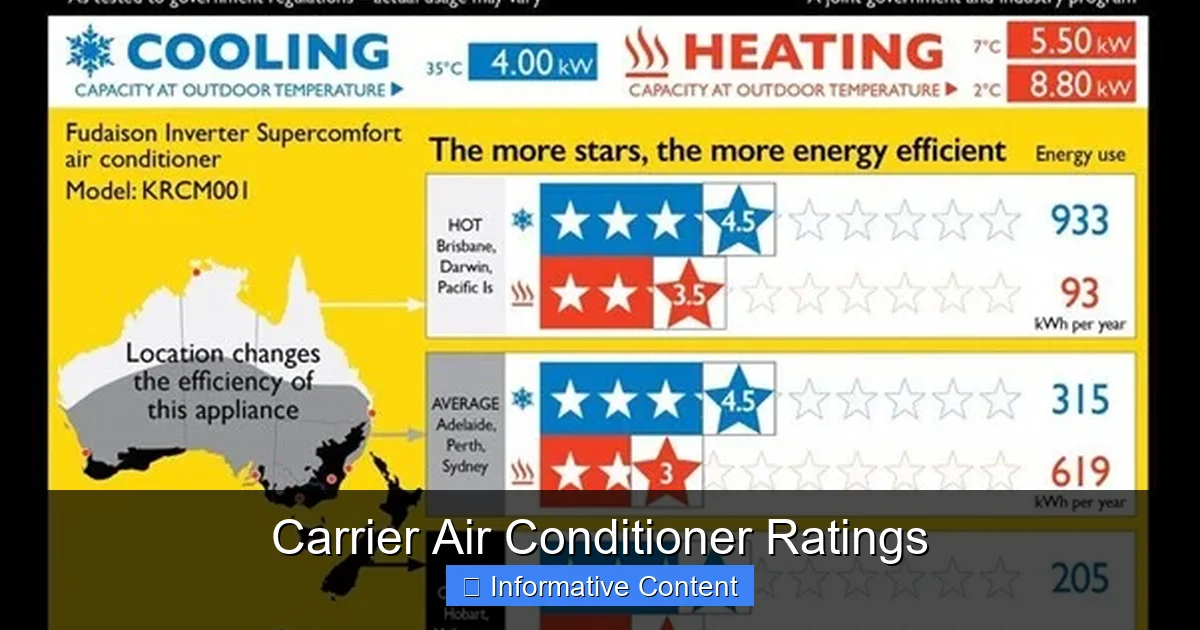
Carrier air conditioner ratings reflect energy efficiency, cooling power, and reliability. Understanding SEER2, EER2, and sound levels helps you pick the right model for comfort and savings.
When the summer heat kicks in, your air conditioner becomes one of the most important appliances in your home. It’s not just about staying cool—it’s about doing so efficiently, quietly, and reliably. If you’re considering a Carrier air conditioner, you’re looking at one of the most trusted names in HVAC. But with so many models and ratings to choose from, how do you know which one is right for you?
Carrier has been a leader in home cooling for over a century, and their air conditioners are known for innovation, durability, and energy efficiency. But what really sets one model apart from another? The answer lies in the ratings. These aren’t just random numbers—they’re your guide to performance, savings, and long-term satisfaction. Whether you’re replacing an old unit or installing your first central air system, understanding Carrier air conditioner ratings can save you money and headaches down the road.
In this guide, we’ll break down everything you need to know about Carrier air conditioner ratings. From SEER2 and EER2 to sound levels and warranty details, we’ll explain what each rating means and how it affects your comfort and budget. We’ll also walk you through Carrier’s product lineup, help you avoid common sizing mistakes, and share tips for maintaining your system. By the end, you’ll be equipped to make a smart, informed decision—no HVAC degree required.
Key Takeaways
- SEER2 and EER2 ratings measure efficiency: Higher numbers mean better energy performance and lower utility bills.
- Sound levels matter for comfort: Look for units with lower decibel (dB) ratings for quieter operation.
- Carrier offers tiered product lines: Infinity, Performance, and Comfort series cater to different budgets and needs.
- Proper sizing is crucial: An oversized or undersized unit reduces efficiency and comfort.
- Regular maintenance boosts longevity: Clean filters and annual checkups keep your system running smoothly.
- Rebates and incentives may be available: High-efficiency models often qualify for tax credits or utility rebates.
- Warranty coverage varies by model: Check terms to understand what’s protected and for how long.
📑 Table of Contents
- Understanding Carrier Air Conditioner Efficiency Ratings
- Carrier Air Conditioner Sound Ratings and Comfort
- Carrier’s Product Lineup: Infinity, Performance, and Comfort Series
- The Importance of Proper Sizing and Installation
- Warranty and Long-Term Reliability
- Maintenance Tips to Maximize Performance
- Conclusion
Understanding Carrier Air Conditioner Efficiency Ratings
Efficiency is the heart of any air conditioner’s performance, and Carrier doesn’t cut corners. The key metrics you’ll see on every Carrier unit are SEER2 and EER2 ratings. These aren’t just marketing buzzwords—they’re standardized measurements that tell you how much cooling you get for every watt of electricity used.
SEER2 stands for Seasonal Energy Efficiency Ratio 2. It measures how efficiently your air conditioner operates over an entire cooling season, factoring in varying temperatures and usage patterns. The higher the SEER2 rating, the more efficient the unit. As of 2023, the U.S. Department of Energy requires a minimum SEER2 rating of 13.4 for northern regions and 14.3 for southern regions. Carrier’s models typically range from 14.5 to 26 SEER2, with their top-tier Infinity series reaching the highest marks.
EER2, or Energy Efficiency Ratio 2, is similar but measures efficiency at a constant temperature—usually 95°F. This rating is especially useful if you live in a hot, humid climate where your AC runs at peak load for long periods. A high EER2 means your unit can cool effectively even on the hottest days without spiking your energy bill.
Let’s say you’re comparing two Carrier models: one with a 16 SEER2 and another with a 22 SEER2. The 22 SEER2 unit uses significantly less energy to produce the same amount of cooling. Over time, that difference adds up. For example, if you run your AC for 1,200 hours a year and electricity costs $0.12 per kWh, the higher-efficiency model could save you $150 or more annually. Multiply that over 10–15 years, and you’re looking at thousands in savings.
But efficiency isn’t just about cost. It’s also about environmental impact. A more efficient air conditioner uses less electricity, which means fewer greenhouse gas emissions—especially if your power comes from fossil fuels. Carrier’s high-efficiency models often use eco-friendly refrigerants like Puron (R-410A), which don’t harm the ozone layer.
Why SEER2 and EER2 Replaced SEER and EER
You might have seen older units labeled with SEER and EER ratings. Those were the old standards. In 2023, the U.S. government updated testing procedures to better reflect real-world conditions. The new SEER2 and EER2 ratings are measured under more realistic airflow and external static pressure, making them more accurate predictors of actual performance.
This change means that a unit with a 16 SEER2 isn’t directly comparable to a 16 SEER from 2022. In fact, a 16 SEER2 is roughly equivalent to a 17–18 SEER under the old system. So when comparing models, always look at SEER2 and EER2—not the outdated numbers.
How to Use Efficiency Ratings to Save Money
To get the most out of your Carrier air conditioner ratings, start by calculating your potential savings. Many HVAC dealers and utility companies offer online calculators that let you plug in your local electricity rate, usage hours, and unit efficiency to estimate annual costs.
For example, a home in Phoenix, Arizona, with high summer temperatures and long cooling seasons, will benefit more from a high SEER2 unit than a home in Seattle, where AC use is limited. In hot climates, investing in a 20+ SEER2 model can pay for itself in energy savings within 5–7 years.
Also, check for rebates. Many states and utility providers offer incentives for installing high-efficiency HVAC systems. For instance, a 20+ SEER2 Carrier unit might qualify for a $500 rebate from your local power company. Combine that with federal tax credits (like the 25C tax credit, which offers up to $600 for qualifying systems), and your upfront cost drops significantly.
Carrier Air Conditioner Sound Ratings and Comfort
Visual guide about Carrier Air Conditioner Ratings
Image source: carrierair.com.au
Let’s be honest—no one wants a noisy air conditioner. Whether it’s humming outside your bedroom window or rattling near your living room, excessive noise can ruin your peace and quiet. That’s why Carrier pays close attention to sound ratings, measured in decibels (dB).
Sound levels for Carrier air conditioners typically range from 50 dB to 75 dB. To put that in perspective, 50 dB is about as loud as a quiet conversation or a refrigerator humming. 75 dB is closer to the sound of a vacuum cleaner or busy street traffic. The lower the dB rating, the quieter the unit.
Carrier’s Infinity series, for example, features models with sound ratings as low as 51 dB. That’s whisper-quiet operation, perfect for homes near bedrooms, patios, or quiet neighborhoods. Even their mid-tier Performance series offers units around 60–65 dB, which is still quieter than many competitors.
But why does sound matter beyond comfort? Because a quieter unit often means better engineering. Carrier uses advanced compressor technology, insulated cabinets, and variable-speed fans to reduce noise. These features don’t just make your AC quieter—they also improve efficiency and durability.
How Carrier Reduces Noise
Carrier employs several design strategies to keep their air conditioners quiet. One is the use of two-speed or variable-speed compressors. Unlike single-speed units that turn on at full blast and shut off completely, variable-speed models ramp up gradually and adjust output based on demand. This not only saves energy but also reduces the loud “clunk” of startup.
Another key feature is the sound blanket—a thick layer of insulation inside the cabinet that absorbs noise from the compressor and fan. Carrier also uses precision-balanced fan blades and vibration-dampening mounts to minimize rattling and humming.
If you’re installing your AC near a bedroom or home office, look for models with sound ratings below 60 dB. You can also reduce noise by placing the unit on a solid, level surface and ensuring proper clearance from walls and windows.
Real-World Sound Examples
Imagine you’re sitting on your back porch on a warm summer evening. With a 55 dB Carrier unit, you can hear crickets and conversation clearly. With a 70 dB model, the AC might drown out softer sounds. It’s a small difference, but over time, it affects your enjoyment of outdoor spaces.
For homeowners with open floor plans or large windows, a quieter unit also means less indoor noise transmission. Carrier’s sound-dampening design helps keep indoor noise levels low, so you can relax, work, or sleep without distraction.
Carrier’s Product Lineup: Infinity, Performance, and Comfort Series
Carrier doesn’t offer a one-size-fits-all solution. Instead, they’ve organized their air conditioners into three main series: Infinity, Performance, and Comfort. Each is designed for different needs, budgets, and performance expectations.
The Infinity series is Carrier’s premium line. These units feature the highest SEER2 ratings (up to 26), ultra-quiet operation (as low as 51 dB), and advanced features like Greenspeed Intelligence. This technology uses a variable-speed compressor to match cooling output precisely to your home’s needs, improving comfort and efficiency. Infinity models also come with enhanced warranties and smart thermostat compatibility.
The Performance series offers a balance of efficiency, reliability, and affordability. With SEER2 ratings from 15 to 20 and sound levels around 60–65 dB, these units are ideal for most homes. They include features like two-stage compressors and durable cabinets, making them a solid choice for families who want quality without the premium price.
The Comfort series is Carrier’s entry-level line. These models are budget-friendly and meet minimum efficiency standards, with SEER2 ratings starting at 14.5. While they lack some of the advanced features of higher-end units, they’re reliable, easy to install, and perfect for smaller homes or milder climates.
Choosing the Right Series for Your Home
So which series is right for you? It depends on your priorities. If you want the best performance, quietest operation, and smart home integration, go with the Infinity series. It’s ideal for larger homes, hot climates, and tech-savvy homeowners.
If you’re looking for a great balance of efficiency and cost, the Performance series is a smart pick. It offers strong energy savings and reliable cooling without breaking the bank.
And if you’re on a tight budget or live in a cooler area where AC use is limited, the Comfort series can meet your needs affordably.
Keep in mind that higher-tier models often come with better warranties. For example, Infinity units may include a 10-year compressor warranty, while Comfort models might only offer 5 years. Always check the warranty details before buying.
Example: Comparing Two Models
Let’s compare two Carrier models: the Infinity 26 (26 SEER2, 51 dB) and the Performance 17 (17 SEER2, 63 dB). The Infinity model costs about $2,000 more upfront. But in a hot climate like Dallas, Texas, the higher efficiency could save you $200 per year on electricity. Over 10 years, that’s $2,000 in savings—essentially covering the price difference. Plus, you get quieter operation and better humidity control.
In a milder climate like Portland, Oregon, where AC runs only a few weeks a year, the Performance model might be the better value. The energy savings wouldn’t offset the higher cost, and the extra features may not be necessary.
The Importance of Proper Sizing and Installation
You can have the highest-rated Carrier air conditioner in the world, but if it’s the wrong size or poorly installed, it won’t perform well. In fact, improper sizing is one of the most common reasons for inefficiency, discomfort, and premature failure.
An oversized unit cools your home too quickly, leading to short cycling—frequent on/off cycles that waste energy and fail to remove humidity. This leaves your home feeling clammy and uncomfortable. It also increases wear and tear on the compressor.
An undersized unit, on the other hand, runs constantly, struggling to keep up with demand. This leads to higher energy bills, uneven cooling, and a shorter lifespan.
How HVAC Professionals Size Your System
Carrier recommends using a Manual J load calculation to determine the correct size. This detailed assessment considers your home’s square footage, insulation levels, window types, orientation, and local climate. It’s not just about square footage—it’s about heat gain and loss.
For example, a 2,000-square-foot home in Miami needs a much larger AC unit than a 2,000-square-foot home in Minneapolis, due to differences in humidity and temperature.
Always work with a licensed HVAC contractor who uses Manual J. Avoid contractors who size units based solely on square footage or old rules of thumb (like “1 ton per 500 square feet”). These methods are outdated and often inaccurate.
Installation Best Practices
Even the best-sized unit won’t perform well if it’s installed incorrectly. Key installation steps include:
– Ensuring proper refrigerant charge
– Sealing ductwork to prevent leaks
– Installing the outdoor unit on a level, stable surface
– Providing adequate clearance for airflow
– Connecting to a compatible thermostat
Carrier also recommends pairing your air conditioner with a compatible furnace or air handler for optimal performance. Mismatched systems can reduce efficiency and void warranties.
Warranty and Long-Term Reliability
When you invest in a Carrier air conditioner, you’re not just buying a cooling system—you’re buying peace of mind. Carrier offers some of the best warranties in the industry, but the details vary by model and series.
Most Carrier units come with a standard 10-year parts warranty and a 10-year compressor warranty when registered within 90 days of installation. Some Infinity models include extended coverage, like 12-year compressor protection.
However, warranties only apply if the unit is installed by a licensed professional and registered properly. Skipping registration or using an unqualified installer can void your coverage.
What’s Covered—and What’s Not
Warranties typically cover defective parts and labor for repairs. They do not cover damage from improper installation, lack of maintenance, or acts of nature (like lightning strikes).
Regular maintenance is key to keeping your warranty valid. This includes changing filters every 1–3 months, cleaning coils annually, and scheduling professional tune-ups.
Carrier also offers optional extended warranties through their Comfort Edge program, which can cover labor and additional parts for up to 10 years.
Maintenance Tips to Maximize Performance
Your Carrier air conditioner is built to last, but it needs care to perform at its best. Regular maintenance not only extends the life of your unit but also keeps your efficiency ratings accurate.
Start with the air filter. A dirty filter restricts airflow, forcing your system to work harder and use more energy. Check it monthly and replace it every 1–3 months, depending on usage and air quality.
Next, clean the outdoor unit. Remove leaves, dirt, and debris from the condenser coils and fan. Trim back vegetation to ensure at least 2 feet of clearance on all sides.
Schedule an annual professional inspection. A technician will check refrigerant levels, test electrical connections, clean coils, and verify thermostat operation. This small investment can prevent costly repairs and keep your system running efficiently.
DIY Maintenance Checklist
– Replace air filters regularly
– Clean outdoor unit and surrounding area
– Inspect thermostat settings
– Check for unusual noises or odors
– Monitor energy bills for sudden increases
When to Call a Professional
If you notice reduced cooling, strange noises, or ice buildup on the coils, call a technician right away. These could be signs of refrigerant leaks, electrical issues, or airflow problems.
Conclusion
Choosing the right Carrier air conditioner isn’t just about picking the highest number on the label. It’s about understanding how ratings like SEER2, EER2, and sound levels translate into real-world performance, comfort, and savings. Whether you go with the premium Infinity series or the budget-friendly Comfort line, the key is matching the unit to your home’s needs and your lifestyle.
Remember, efficiency matters, but so does proper sizing, installation, and maintenance. A well-chosen, well-maintained Carrier air conditioner can keep your home cool and comfortable for 15–20 years—delivering value far beyond the initial price tag.
Take the time to compare models, read the ratings, and consult with a trusted HVAC professional. Your comfort—and your wallet—will thank you.
Frequently Asked Questions
What does SEER2 mean for Carrier air conditioners?
SEER2 stands for Seasonal Energy Efficiency Ratio 2. It measures how efficiently your air conditioner cools your home over a full season. Higher SEER2 ratings mean better energy efficiency and lower utility bills.
How quiet are Carrier air conditioners?
Carrier air conditioners range from 50 to 75 decibels (dB). Their Infinity series can be as quiet as 51 dB—about as loud as a quiet conversation—making them ideal for noise-sensitive areas.
Which Carrier series is the most efficient?
The Infinity series is Carrier’s most efficient, with SEER2 ratings up to 26. These models use advanced technology like variable-speed compressors for precise, energy-saving cooling.
Can I install a Carrier air conditioner myself?
No. Carrier requires professional installation by a licensed HVAC contractor to maintain warranty coverage and ensure proper performance and safety.
How often should I replace my air filter?
Replace your air filter every 1 to 3 months, depending on usage, pets, and air quality. A clean filter improves airflow, efficiency, and indoor air quality.
Do high-efficiency Carrier units qualify for rebates?
Yes, many high-efficiency Carrier models qualify for federal tax credits, state incentives, and utility rebates. Check with your local energy provider for current offers.