
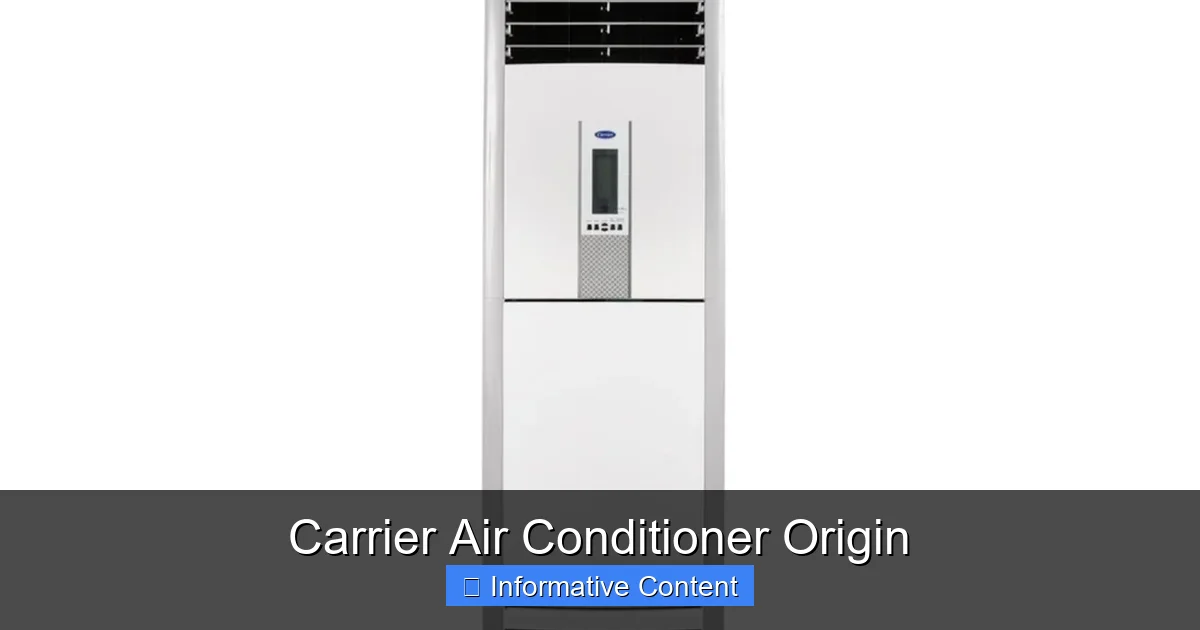
The Carrier air conditioner origin traces back to 1902 when Willis Haviland Carrier invented the first modern air conditioning system to solve humidity issues in a printing plant. What began as an industrial solution evolved into a global brand synonymous with home comfort, energy efficiency, and climate control innovation.
Key Takeaways
- Invention in 1902: Willis Carrier created the first modern air conditioner to control humidity in a Brooklyn printing plant, solving production issues.
- Birth of Carrier Corporation: The company was founded in 1915, becoming a pioneer in HVAC technology and setting industry standards.
- Revolutionizing Comfort: Carrier’s invention transformed industries like manufacturing, healthcare, and eventually homes, making indoor comfort accessible.
- Global Expansion: From the U.S. to Asia, Europe, and beyond, Carrier became a worldwide leader in air conditioning and refrigeration.
- Innovation Legacy: Carrier introduced breakthroughs like the centrifugal chiller, scroll compressor, and smart thermostats, shaping modern HVAC systems.
- Sustainability Focus: Today, Carrier leads in eco-friendly refrigerants and energy-efficient designs, supporting global climate goals.
- Everyday Impact: Over 100 years later, Carrier air conditioners cool millions of homes, offices, and hospitals, improving quality of life.
📑 Table of Contents
- The Birth of Modern Air Conditioning: A Necessity-Driven Invention
- The Founding of Carrier Corporation: Building an HVAC Empire
- Technological Milestones: Carrier’s Innovation Legacy
- Carrier Around the World: A Global Brand
- The Human Impact: How Carrier Changed Lives
- Looking Ahead: The Future of Carrier and Climate Control
- Conclusion
The Birth of Modern Air Conditioning: A Necessity-Driven Invention
Imagine a hot, humid summer day in 1902. Paper is sticking together, ink is smudging, and workers are struggling to keep up with production. This was the reality at the Sackett & Wilhelms printing plant in Brooklyn, New York. The problem wasn’t just the heat—it was the humidity. As moisture levels fluctuated, paper would expand and contract, making it nearly impossible to align colors accurately during printing. The result? Wasted materials, delayed deadlines, and frustrated clients.
Enter Willis Haviland Carrier, a young engineer working for the Buffalo Forge Company. Tasked with solving this industrial challenge, Carrier didn’t set out to invent air conditioning for comfort. His goal was purely practical: control humidity to improve print quality. After months of research and experimentation, he developed a system that cooled air by passing it over coils filled with cold water. This process not only reduced temperature but also removed moisture—effectively controlling humidity.
On July 17, 1902, Carrier filed his first patent for what would become the foundation of modern air conditioning. His invention used a fan to blow air over chilled coils, condensing moisture and delivering drier, cooler air. This breakthrough didn’t just save the printing plant—it opened the door to a new era of climate control.
From Industrial Solution to Everyday Comfort
At first, Carrier’s invention was used almost exclusively in industrial settings. Factories producing everything from textiles to pharmaceuticals adopted the technology to maintain precise environmental conditions. But the potential for broader use quickly became apparent.
In 1906, the first theater to use air conditioning opened in San Francisco. Patrons were amazed by the cool, comfortable air—especially during summer performances. By the 1920s, movie theaters across the U.S. began installing air conditioning systems, giving rise to the term “summer blockbuster” as audiences flocked to cool indoor spaces.
Carrier’s innovation didn’t stop at entertainment. Hospitals began using air conditioning to improve patient comfort and reduce the spread of airborne diseases. Libraries and museums used it to preserve books and artifacts. Even early computer rooms relied on climate control to prevent overheating.
What started as a solution for a printing problem had become a cornerstone of modern life. And it was all thanks to one engineer’s determination to solve a real-world challenge.
The Founding of Carrier Corporation: Building an HVAC Empire
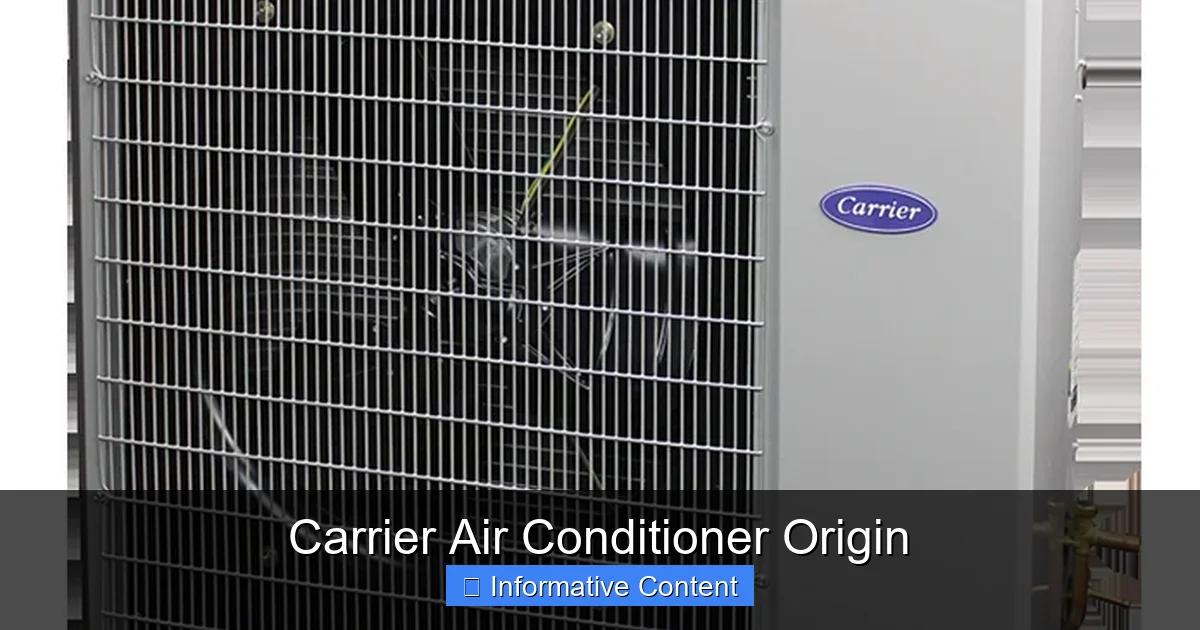
Visual guide about Carrier Air Conditioner Origin
Image source: images.carriercms.com
As demand for air conditioning grew, Willis Carrier realized he needed a dedicated company to develop and market his technology. In 1915, he co-founded the Carrier Engineering Corporation with six other engineers. The company’s mission was clear: advance the science of air conditioning and make it accessible to industries and, eventually, the public.
From the start, Carrier focused on innovation and reliability. The company invested heavily in research and development, hiring top engineers and building state-of-the-art labs. One of their early breakthroughs was the centrifugal refrigeration machine, introduced in 1922. This system used a spinning impeller to compress refrigerant, making it more efficient and quieter than previous models. It quickly became the standard for large buildings like offices, hotels, and department stores.
Expanding Beyond the United States
By the 1930s, Carrier had established itself as a leader in the U.S. HVAC market. But Willis Carrier had a global vision. He believed that climate control could improve lives everywhere—not just in America.
The company began exporting its systems to Europe, Asia, and Latin America. In 1930, Carrier opened its first international office in Shanghai, China. This move was strategic: Asia’s hot, humid climate made air conditioning especially valuable. Over the next few decades, Carrier expanded into Japan, India, the Middle East, and Africa, adapting its products to local needs and conditions.
One notable example is the installation of air conditioning in the Imperial Palace in Tokyo during the 1930s. This project demonstrated Carrier’s ability to work on high-profile, culturally sensitive buildings—a skill that would serve the company well in future global projects.
World War II and the Rise of Home Air Conditioning
The 1940s brought new challenges and opportunities. During World War II, Carrier shifted much of its production to support the war effort. The company manufactured refrigeration units for military hospitals, aircraft cooling systems, and equipment for submarines. This period reinforced Carrier’s reputation for durability and innovation under pressure.
After the war, consumer demand for home air conditioning surged. Returning soldiers and growing suburban populations created a new market: affordable, reliable cooling for families. In 1947, Carrier introduced the Weathermaker, one of the first residential air conditioning systems designed for whole-house comfort.
The Weathermaker was a game-changer. It combined heating and cooling in one unit, used ductwork to distribute air evenly, and was relatively easy to install. Though still expensive, it marked the beginning of the modern HVAC era in homes.
Technological Milestones: Carrier’s Innovation Legacy
Throughout the 20th century, Carrier continued to push the boundaries of what air conditioning could do. The company’s commitment to innovation led to several industry-first technologies that shaped the HVAC landscape.
The Scroll Compressor: A Quiet Revolution
In the 1970s, Carrier engineers developed the scroll compressor—a breakthrough that improved efficiency, reduced noise, and increased reliability. Unlike traditional piston compressors, which use reciprocating motion, scroll compressors use two spiral-shaped scrolls that orbit each other to compress refrigerant. This design eliminates valves and reduces mechanical wear, resulting in smoother operation and longer lifespan.
The scroll compressor quickly became the industry standard. Today, most modern air conditioners and heat pumps use this technology. Carrier’s early adoption gave them a significant competitive edge and helped set new benchmarks for performance.
Smart Thermostats and Connectivity
As digital technology advanced, Carrier embraced the smart home revolution. In the 2000s, the company introduced Wi-Fi-enabled thermostats that allowed users to control their HVAC systems remotely via smartphones. These devices could learn user preferences, adjust temperatures based on occupancy, and even integrate with other smart home systems like lighting and security.
One example is the Carrier Infinity Touch Control, launched in 2010. This thermostat features a color touchscreen, voice control compatibility, and energy usage reports. It also supports zoning systems, allowing different areas of a home to be cooled independently—improving comfort and reducing energy waste.
Energy Efficiency and Environmental Responsibility
Carrier has long been a leader in energy-efficient design. In the 1990s, the company introduced high-efficiency models that exceeded federal standards, helping homeowners save on utility bills. But as climate change became a global concern, Carrier shifted its focus to sustainability.
The phaseout of ozone-depleting refrigerants like R-22 led Carrier to develop alternatives such as Puron (R-410A), a more environmentally friendly refrigerant. In recent years, the company has introduced systems using R-32 and R-454B, which have even lower global warming potential.
Carrier also invests in renewable energy integration. Some of their latest heat pumps can work with solar panels, reducing reliance on the grid. The company’s goal is to achieve carbon neutrality across its operations by 2030.
Carrier Around the World: A Global Brand
Today, Carrier is a truly global company. With operations in over 180 countries, it serves residential, commercial, and industrial customers on every continent. But its international success isn’t just about selling products—it’s about understanding local needs.
Adapting to Regional Climates and Cultures
In hot, humid regions like Southeast Asia, Carrier offers high-capacity systems with advanced dehumidification. In colder climates like Scandinavia, the focus is on heat pumps that provide efficient heating even in sub-zero temperatures. In the Middle East, where dust and sand are common, Carrier designs units with enhanced filtration and corrosion-resistant coatings.
Cultural preferences also play a role. In Japan, for example, quiet operation is highly valued. Carrier’s Japanese models are engineered to operate at whisper-quiet levels, often below 20 decibels. In India, where power outages are frequent, some units include backup battery systems to maintain cooling during blackouts.
Notable Global Installations
Carrier’s systems can be found in some of the world’s most iconic buildings. The Burj Khalifa in Dubai, the tallest building in the world, uses a custom Carrier HVAC system to manage airflow across 163 floors. The Sydney Opera House relies on Carrier chillers to maintain optimal conditions for performances and preservation.
Even in remote areas, Carrier makes an impact. In rural clinics across Africa, solar-powered Carrier units provide reliable cooling for vaccines and medical equipment—saving lives in regions with limited infrastructure.
The Human Impact: How Carrier Changed Lives
Beyond technology and business, the true legacy of Carrier air conditioner origin lies in its impact on human health, productivity, and quality of life.
Health and Safety
Before air conditioning, heatwaves were deadly—especially for the elderly and those with chronic illnesses. Hospitals struggled to keep patients cool, and food spoilage was common. Carrier’s systems helped reduce heat-related deaths and improved medical care by maintaining stable indoor environments.
In food storage and transportation, Carrier’s refrigeration technology enabled the global supply chain. Perishable goods could now be shipped long distances, reducing waste and increasing access to fresh food.
Economic Growth and Productivity
Air conditioning transformed the workplace. Offices, factories, and retail spaces became more comfortable, leading to higher employee morale and productivity. In hot climates, businesses could operate year-round without seasonal slowdowns.
The rise of air conditioning also fueled economic development in Sun Belt regions of the U.S., such as Florida, Texas, and Arizona. As cooling became affordable, populations grew, cities expanded, and new industries emerged.
Everyday Comfort
For millions of families, Carrier air conditioners mean more than just cool air—they mean better sleep, safer homes, and more time spent together indoors. Whether it’s a quiet evening watching TV or a family gathering during a summer storm, air conditioning has become a cornerstone of modern living.
Looking Ahead: The Future of Carrier and Climate Control
As the world faces rising temperatures and environmental challenges, Carrier continues to innovate. The company is investing in next-generation technologies like AI-driven climate control, ultra-low-GWP refrigerants, and modular HVAC systems for urban housing.
One promising development is the use of geothermal heat pumps, which harness the earth’s stable underground temperature to heat and cool homes with minimal energy use. Carrier is also exploring hydrogen-ready systems and carbon capture integration for large-scale applications.
Education and outreach remain key priorities. Through partnerships with schools and nonprofits, Carrier promotes STEM education and supports communities affected by extreme heat.
A Century of Cooling, A Future of Sustainability
From a Brooklyn printing plant to a global network of innovation centers, the journey of Carrier air conditioner origin is a testament to human ingenuity. What began as a solution to a technical problem has evolved into a vital part of modern life.
As climate change accelerates, the need for efficient, sustainable cooling will only grow. Carrier’s legacy—rooted in science, service, and social responsibility—positions it to lead the way in creating a cooler, healthier, and more equitable world.
Conclusion
The story of Carrier air conditioner origin is more than a history of technology—it’s a story of how one invention changed the world. Willis Carrier didn’t set out to revolutionize comfort; he set out to solve a problem. But in doing so, he unlocked possibilities that transformed industries, saved lives, and made modern life possible.
Today, Carrier continues to build on that legacy. With a focus on innovation, sustainability, and global impact, the company remains at the forefront of HVAC technology. Whether cooling a home, preserving a museum artifact, or supporting a hospital in a remote village, Carrier’s mission endures: to create environments where people can thrive.
As we look to the future, one thing is clear—the need for smart, efficient, and accessible climate control will only grow. And thanks to the vision of Willis Carrier and the ongoing work of the company he founded, we’re better equipped than ever to meet that challenge.
Frequently Asked Questions
Who invented the first air conditioner?
Willis Haviland Carrier invented the first modern air conditioning system in 1902. He was an American engineer working to solve humidity problems in a printing plant in Brooklyn, New York.
When was the Carrier Corporation founded?
The Carrier Engineering Corporation was founded in 1915 by Willis Carrier and six other engineers. It was established to develop and market air conditioning technology.
What was the first building to use air conditioning?
The first theater to use air conditioning was the New Empire Theatre in San Francisco, which opened in 1906. It used a system based on Carrier’s invention to cool the indoor air.
How did air conditioning change daily life?
Air conditioning improved health by reducing heat-related illnesses, increased productivity in workplaces, and made homes more comfortable. It also enabled the growth of industries like film, healthcare, and food storage.
Is Carrier still an independent company?
Carrier was part of United Technologies Corporation until 2020, when it became an independent, publicly traded company focused solely on HVAC, refrigeration, and fire & security solutions.
What makes Carrier air conditioners energy efficient?
Carrier uses advanced technologies like scroll compressors, smart thermostats, and eco-friendly refrigerants. Many models exceed federal efficiency standards and include features like zoning and variable-speed fans to reduce energy use.