
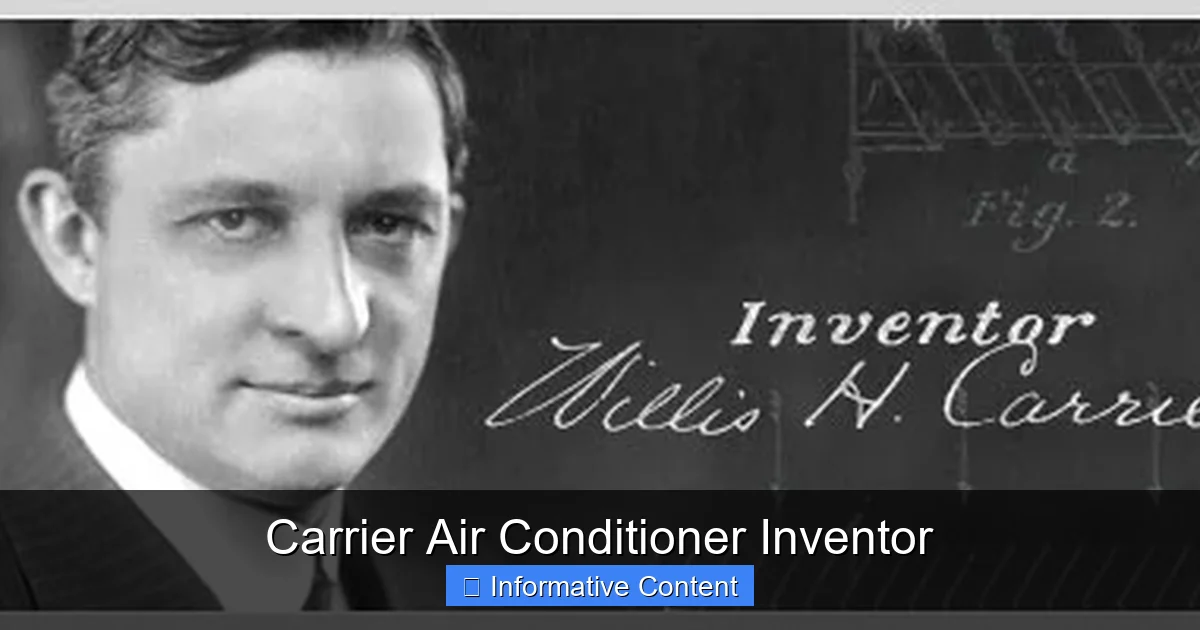
The carrier air conditioner inventor, Willis Haviland Carrier, transformed modern life by creating the first modern air conditioning system in 1902. His invention solved industrial humidity problems and laid the foundation for today’s climate control technology, improving health, productivity, and comfort worldwide.
Imagine a world without air conditioning. No cool breeze on a sweltering summer day, no comfortable offices during heatwaves, and no safe storage for medicines or food in hot climates. It’s hard to picture modern life without this essential technology—yet just over a century ago, it didn’t exist. The man responsible for changing that was Willis Haviland Carrier, the brilliant engineer and inventor known as the carrier air conditioner inventor. His creation didn’t just cool the air—it transformed industries, cities, and daily life in ways he could never have imagined.
Born in 1876 in Angola, New York, Carrier showed an early aptitude for math and science. After graduating from Cornell University with a degree in engineering, he began working at the Buffalo Forge Company, where he was tasked with solving a persistent problem: humidity was ruining printed materials at a Brooklyn publishing plant. Paper would expand and contract with moisture changes, causing ink misalignment and wasted product. Carrier’s solution? A machine that controlled both temperature and humidity—ushering in the birth of modern air conditioning.
Key Takeaways
- Willis Haviland Carrier invented the first modern air conditioner in 1902 to solve humidity issues at a printing plant, not for human comfort.
- His invention revolutionized industries like publishing, manufacturing, and later, residential and commercial cooling.
- Carrier founded the Carrier Engineering Corporation in 1915, which became a global leader in HVAC technology.
- Air conditioning enabled population growth in hot climates and boosted productivity in offices, hospitals, and factories.
- The technology improved public health by reducing heat-related illnesses and enabling better indoor air quality.
- Modern air conditioning systems trace their roots directly to Carrier’s original design, with ongoing innovations in efficiency and sustainability.
- Carrier’s legacy lives on through the Carrier brand, educational programs, and global climate control advancements.
📑 Table of Contents
The Birth of Modern Air Conditioning
The year was 1902. Willis Haviland Carrier, then a young engineer, was working on a project that would change the world. The Sackett-Wilhelms Lithographing and Publishing Company in Brooklyn was struggling with a major issue: humidity. During the summer months, the paper used in printing would absorb moisture from the air, causing it to expand. When it dried, it would shrink. This constant change in size made it nearly impossible to align colors accurately during the printing process. The result? Wasted paper, ruined prints, and lost profits.
Carrier was hired to find a solution. After studying the problem, he realized that controlling humidity was the key. He developed a system that used coils filled with cold water to cool the air passing through them. As the air cooled, its ability to hold moisture decreased, causing excess humidity to condense on the coils and drip away. This process not only reduced humidity but also lowered the air temperature—effectively creating the first modern air conditioning system.
The First Air Conditioning System
Carrier’s invention was a mechanical dehumidifier that used a fan to pull warm, humid air over cold coils. The cooled air was then blown back into the room, reducing both temperature and humidity. This system was installed at the Sackett-Wilhelms plant in July 1902 and proved highly effective. Not only did it solve the printing problem, but it also created a more stable and comfortable environment for workers.
This breakthrough was revolutionary. While earlier devices had attempted to cool air, none had successfully controlled humidity with precision. Carrier’s system was the first to treat air as a fluid that could be scientifically manipulated. He didn’t just cool the air—he conditioned it.
From Industrial Use to Human Comfort
At first, Carrier’s invention was used almost exclusively in industrial settings. Factories in industries like textiles, tobacco, and pharmaceuticals adopted the technology to improve product quality and worker efficiency. But by the 1920s, people began to see the potential for air conditioning in public spaces.
One of the first major non-industrial applications was in movie theaters. During the summer, theaters were often too hot and stuffy to attract audiences. In 1925, the Rivoli Theater in New York City installed a Carrier air conditioning system. The result? Record-breaking attendance. Moviegoers flocked to the cool, comfortable environment, and soon, air conditioning became a major selling point for theaters across the country.
This shift marked the beginning of air conditioning’s transition from an industrial tool to a consumer luxury—and eventually, a necessity.
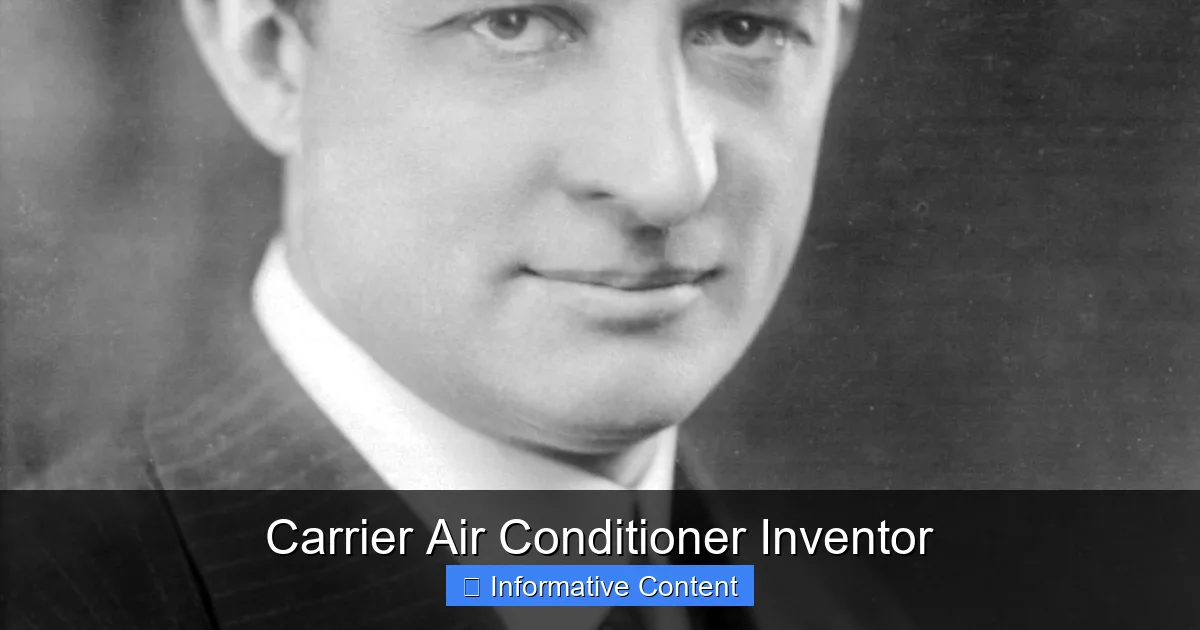
Willis Haviland Carrier: The Man Behind the Invention
Visual guide about Carrier Air Conditioner Inventor
Image source: historynet.com
Willis Haviland Carrier was more than just an inventor—he was a visionary engineer whose work laid the foundation for modern climate control. Born on November 26, 1876, in Angola, New York, Carrier grew up in a rural farming community. From a young age, he showed a strong interest in mathematics and science. His father, a farmer and schoolteacher, encouraged his curiosity, and Carrier excelled in school.
He attended Cornell University, where he earned a degree in engineering in 1901. Shortly after graduation, he joined the Buffalo Forge Company, a manufacturer of heating and ventilation equipment. It was here that he was assigned to solve the humidity problem at the Sackett-Wilhelms printing plant—a challenge that would define his career.
Early Career and Engineering Mindset
Carrier approached problems with a methodical, scientific mindset. He believed in using data and experimentation to find solutions. When faced with the humidity issue, he didn’t just guess—he studied the properties of air, moisture, and temperature. He created charts and formulas to predict how air would behave under different conditions. This analytical approach set him apart from other engineers of his time.
His work led to the development of the “Rational Psychrometric Formulae” in 1911, a set of equations that described the relationships between temperature, humidity, and air pressure. These formulas became the foundation for modern HVAC (heating, ventilation, and air conditioning) engineering and are still used today.
Founding the Carrier Engineering Corporation
As demand for air conditioning grew, Carrier realized the need for a dedicated company to develop and market the technology. In 1915, he co-founded the Carrier Engineering Corporation with six other engineers. The company focused on improving air conditioning systems and expanding their applications.
Under Carrier’s leadership, the company introduced several innovations, including the first centrifugal chiller in 1922. This device used a spinning impeller to compress refrigerant, making air conditioning systems more efficient and compact. It was a major leap forward and helped make air conditioning viable for larger buildings like offices, hotels, and hospitals.
Carrier served as the company’s president until 1943 and remained active in research and development until his death in 1950. His leadership helped establish Carrier as a global leader in HVAC technology—a legacy that continues today.
How Air Conditioning Changed the World
The impact of the carrier air conditioner inventor’s work extends far beyond cooling buildings. Air conditioning has transformed society in profound ways, influencing everything from architecture and urban development to health and productivity.
Revolutionizing Industries
Before air conditioning, many industries were limited by climate. Printing, food processing, and pharmaceutical manufacturing were all highly sensitive to temperature and humidity. With Carrier’s invention, these industries could operate year-round, regardless of weather conditions.
For example, in the 1920s, the film industry began using air conditioning in studios to protect delicate film stock from heat and moisture. This allowed for longer shooting schedules and higher-quality productions. Similarly, hospitals adopted air conditioning to maintain sterile environments and regulate patient comfort, especially in surgical wards.
Enabling Urban Growth in Hot Climates
One of the most significant effects of air conditioning was its role in enabling population growth in hot, humid regions. Cities like Phoenix, Houston, and Miami might never have become major metropolitan areas without the ability to cool buildings. Air conditioning made it possible for people to live and work comfortably in climates that were once considered uninhabitable.
This shift also influenced architecture. Buildings could now be designed with large windows, open floor plans, and glass facades—features that would have been impractical in the pre-air conditioning era. Skyscrapers, shopping malls, and suburban homes all became more common, reshaping the American landscape.
Improving Health and Productivity
Air conditioning has had a major impact on public health. By reducing indoor temperatures, it helps prevent heatstroke, dehydration, and other heat-related illnesses—especially among the elderly and vulnerable populations. In hospitals, air conditioning supports infection control by filtering and circulating air, reducing the spread of airborne diseases.
In the workplace, studies have shown that comfortable temperatures boost productivity. Employees are more focused, make fewer errors, and report higher job satisfaction when working in a climate-controlled environment. Schools with air conditioning also see improved student performance, particularly during hot months.
Supporting Technological Advancements
Modern technology relies heavily on precise environmental conditions. Data centers, for example, generate massive amounts of heat and require constant cooling to prevent equipment failure. Without air conditioning, the digital age as we know it wouldn’t be possible. Similarly, laboratories, clean rooms, and manufacturing facilities for electronics depend on climate control to maintain accuracy and safety.
The Evolution of Air Conditioning Technology
Since Carrier’s original invention, air conditioning technology has evolved dramatically. Engineers have focused on improving efficiency, reducing environmental impact, and expanding accessibility.
From Refrigerants to Sustainability
Early air conditioning systems used harmful refrigerants like ammonia and sulfur dioxide, which were toxic and flammable. In the 1920s, chemists developed safer alternatives, such as Freon (a chlorofluorocarbon or CFC). While effective, CFCs were later found to damage the ozone layer, leading to international bans under the Montreal Protocol.
Today, modern systems use environmentally friendly refrigerants like R-410A and R-32, which have lower global warming potential. Manufacturers are also exploring natural refrigerants such as carbon dioxide and hydrocarbons.
Energy Efficiency and Smart Technology
Energy consumption has always been a concern with air conditioning. Older systems were notoriously inefficient, leading to high electricity bills and increased carbon emissions. Today, advancements in compressor technology, insulation, and thermostat design have dramatically improved efficiency.
Smart thermostats, like those from Nest and Ecobee, learn user preferences and adjust temperatures automatically to save energy. Variable-speed compressors adjust cooling output based on demand, reducing waste. High-efficiency units now carry ENERGY STAR ratings, helping consumers choose models that use less power.
Residential and Portable Systems
While early air conditioning was limited to large commercial buildings, technological advances have made it accessible to homes and small spaces. Central air systems, window units, and ductless mini-splits are now common in households worldwide.
Portable air conditioners offer flexibility for renters or those without central systems. These units can be moved from room to room and typically vent hot air through a window. While less efficient than fixed systems, they provide affordable cooling for smaller spaces.
The Future of Cooling
The future of air conditioning lies in sustainability and innovation. Researchers are developing solar-powered systems, geothermal cooling, and advanced materials that can absorb and release heat without electricity. Some companies are even exploring “passive cooling” techniques, such as reflective roofs and natural ventilation, to reduce reliance on mechanical systems.
As climate change increases global temperatures, the demand for efficient, eco-friendly cooling will only grow. The legacy of the carrier air conditioner inventor continues to inspire new solutions for a warming world.
Carrier’s Lasting Legacy
Willis Haviland Carrier passed away in 1950, but his influence endures. The company he founded, now known as Carrier Global Corporation, remains one of the largest HVAC manufacturers in the world, with operations in over 180 countries.
The Carrier Brand Today
Carrier continues to innovate, offering a wide range of heating, cooling, and refrigeration solutions for homes, businesses, and industries. The brand is known for reliability, efficiency, and cutting-edge technology. Products like the Infinity Series and the AquaEdge chiller line reflect Carrier’s commitment to performance and sustainability.
The company also invests in research and development, partnering with universities and governments to advance climate control science. In 2020, Carrier launched the “Carrier for Life” initiative, focusing on reducing carbon emissions and promoting energy-efficient solutions.
Educational and Cultural Impact
Carrier’s contributions are recognized in museums, textbooks, and engineering programs worldwide. The Willis H. Carrier Laboratory at Cornell University honors his legacy, supporting research in fluid dynamics and thermodynamics.
His story is often cited as an example of how solving a practical problem can lead to transformative innovation. Carrier didn’t set out to invent air conditioning for comfort—he was solving a printing issue. Yet his solution changed the course of history.
Inspiring Future Innovators
Carrier’s life serves as a powerful reminder of the impact one person can have. His curiosity, persistence, and scientific approach continue to inspire engineers, inventors, and entrepreneurs. From smart homes to climate-resilient cities, the principles he established are more relevant than ever.
As we face new challenges—from extreme heat to energy sustainability—Carrier’s legacy reminds us that innovation begins with a problem and ends with a solution that improves lives.
Conclusion
The story of the carrier air conditioner inventor is more than a tale of engineering triumph—it’s a story of human ingenuity and its power to reshape the world. Willis Haviland Carrier didn’t just invent a machine; he created a technology that transformed how we live, work, and interact with our environment. From solving a printing problem in 1902 to enabling modern cities, healthcare, and technology, his impact is everywhere.
Today, as we enjoy cool air on hot days, work in comfortable offices, and rely on climate-controlled spaces for safety and efficiency, we owe a debt to Carrier’s vision. His invention wasn’t just about comfort—it was about progress. And as we look to the future, his legacy continues to guide the development of smarter, greener, and more sustainable cooling solutions for generations to come.
Frequently Asked Questions
Who invented the first air conditioner?
Willis Haviland Carrier, an American engineer, invented the first modern air conditioning system in 1902. He developed it to control humidity at a printing plant in Brooklyn, New York.
Was the first air conditioner made for human comfort?
No, the first air conditioner was designed to solve a humidity problem in a printing facility. It wasn’t until the 1920s that air conditioning began to be used for human comfort in theaters and offices.
What company did Willis Carrier found?
In 1915, Willis Carrier co-founded the Carrier Engineering Corporation, which later became Carrier Global Corporation, a leading manufacturer of HVAC systems worldwide.
How did air conditioning change cities?
Air conditioning enabled population growth in hot climates, influenced modern architecture, and made cities like Phoenix and Miami viable for large-scale development and year-round living.
What are modern air conditioners based on?
Modern air conditioners are based on Carrier’s original design, using refrigerants and coils to cool and dehumidify air, with ongoing improvements in efficiency and smart technology.
Is air conditioning environmentally friendly?
While air conditioning consumes energy, modern systems use eco-friendly refrigerants and high-efficiency designs. Innovations in solar and geothermal cooling aim to reduce environmental impact.