
Featured image for carrier air conditioner installation
Image source: i2.wp.com
Proper installation is crucial for maximizing the efficiency and lifespan of your Carrier air conditioner. Always hire a certified HVAC technician to ensure correct sizing, refrigerant levels, and airflow—improper setup can slash performance by up to 30%. Following Carrier’s specific guidelines and local codes guarantees optimal cooling, energy savings, and warranty protection.
Key Takeaways
- Choose the right size: Proper sizing ensures efficiency and comfort.
- Hire certified installers: Ensures warranty validity and optimal performance.
- Seal ductwork tightly: Prevents air leaks and improves efficiency.
- Install near shade: Reduces strain and boosts cooling efficiency.
- Schedule regular maintenance: Prolongs lifespan and maintains performance.
- Use a smart thermostat: Enhances control and energy savings.
📑 Table of Contents
- Why Proper Installation Matters for Your Carrier AC
- Choosing the Right Carrier Unit for Your Home
- Preparing for Installation: Site Assessment and Planning
- DIY vs. Professional Installation: What’s Best?
- Critical Installation Steps You Can’t Skip
- Post-Installation: Testing, Maintenance, and Warranty
- Real-World Example: A Successful Installation
- Final Thoughts: Your Cool, Comfortable Home Starts Here
Why Proper Installation Matters for Your Carrier AC
Let’s face it—when the summer heat hits, the last thing you want is an air conditioner that’s underperforming, noisy, or breaking down every other week. You invested in a Carrier AC for a reason. Known for their reliability, energy efficiency, and smart features, Carrier units are built to keep your home cool and your energy bills in check. But here’s the catch: none of that matters if the installation isn’t done right.
I learned this the hard way a few years ago. I bought a top-of-the-line Carrier unit, excited about the promises of whisper-quiet operation and smart thermostats. But within a month, my living room was hotter than the kitchen, and the unit was cycling on and off like a nervous tick. After a service call, the technician shook his head and said, “This wasn’t installed properly.” Turns out, the refrigerant lines were kinked, and the unit wasn’t level—small oversights with big consequences. That’s when I realized: installation is just as important as the brand you choose.
Choosing the Right Carrier Unit for Your Home
Before we even talk about installation, let’s make sure you’re starting with the right unit. Not all Carrier air conditioners are created equal, and picking the wrong one can lead to inefficiency, higher costs, and poor comfort.
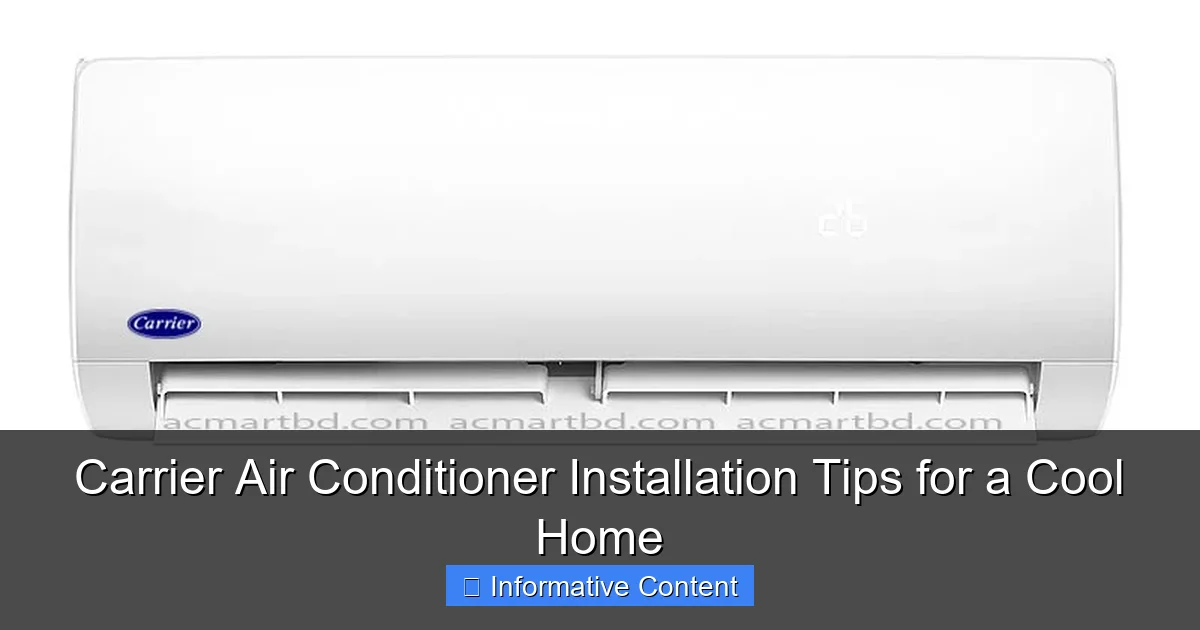
Visual guide about carrier air conditioner installation
Image source: acmartbd.com
Assess Your Home’s Size and Layout
The first step? Calculate your home’s square footage and consider layout. A single-story ranch in Phoenix has different cooling needs than a two-story townhouse in Chicago. As a rule of thumb:
- 1 ton (12,000 BTUs) = 400–600 sq. ft.
- 2 tons (24,000 BTUs) = 800–1,200 sq. ft.
- 3 tons (36,000 BTUs) = 1,200–1,800 sq. ft.
But don’t stop there. Think about insulation, ceiling height, sun exposure, and even the number of windows. I once helped a friend with a sunroom that faced west. Even though it was only 200 extra square feet, we had to upsize the unit by half a ton just to handle that afternoon sun.
Understand Efficiency Ratings (SEER, EER, HSPF)
Carrier offers units with SEER (Seasonal Energy Efficiency Ratio) ratings from 14 to over 20. The higher the SEER, the more efficient the unit—and the lower your long-term energy costs. For example:
- A 14 SEER unit might save you $100/year compared to a 10 SEER.
- A 20 SEER unit could save $300+ annually in a hot climate.
But here’s the trade-off: higher efficiency = higher upfront cost. I recommend aiming for at least 16 SEER if you live in a warm climate and plan to stay in your home for 5+ years. If you’re in a milder region or plan to move soon, 14–15 SEER is often a smart balance.
Also, don’t forget about EER (Energy Efficiency Ratio) for peak cooling and HSPF (Heating Seasonal Performance Factor) if you’re getting a heat pump model. These matter for both comfort and savings.
Choose Between Split, Ductless, and Packaged Systems
Carrier offers three main types of AC systems:
- Split systems: Most common. Outdoor condenser + indoor air handler. Great for homes with existing ductwork.
- Ductless mini-splits: No ducts needed. Ideal for room additions, garages, or older homes. Super efficient and quiet.
- Packaged units: All-in-one (compressor, condenser, evaporator) installed outdoors. Best for small yards or homes with space limitations.
I installed a ductless mini-split in my garage last year. It’s now a cool workshop, and I only paid $30/month extra on my electric bill during summer. That’s the kind of smart upgrade that pays for itself.
Preparing for Installation: Site Assessment and Planning
Once you’ve picked the right unit, it’s time to prep for installation. This is where most people cut corners—and regret it later. A proper site assessment can prevent leaks, poor airflow, and even safety hazards.
Evaluate Outdoor Condenser Placement
The outdoor unit needs space to breathe. Here’s what I look for:
- Clearance: At least 12–24 inches on all sides, 4+ feet above for airflow.
- Shade: Avoid direct sun. A shaded spot can improve efficiency by 10%.
- Level ground: Use a concrete pad or sturdy platform. A tilted unit causes vibration and refrigerant issues.
- Drainage: Make sure water can drain away. I once saw a unit installed on a slope with no drainage—condensation pooled and froze in winter, damaging the compressor.
Pro tip: Avoid placing the unit near windows or doors if possible. The noise might bother you (or your neighbors). And never install it near a dryer vent—lint clogs the fins fast.
Check Indoor Air Handler and Ductwork
If you’re using a split system, the indoor unit (air handler or furnace) must be ready. Ask yourself:
- Is the ductwork sealed and insulated? Leaky ducts can lose 20–30% of cooling.
- Is there enough space for the air handler? It needs room for maintenance and airflow.
- Is the thermostat location optimal? Not near a window, heat source, or drafty door.
I helped a client who had their thermostat in a sunlit hallway. It thought the house was hotter than it was, so the AC ran constantly. We moved it to a central, shaded spot—problem solved.
Electrical and Refrigerant Line Prep
Don’t skip this. The electrical panel needs the right circuit breaker (usually 20–50 amps, depending on the unit). And the refrigerant lines (copper tubing) must be:
- Properly sized (1/4” and 3/8” are common)
- Insulated to prevent condensation and efficiency loss
- Free of kinks or sharp bends
One installer I know uses a “slinky test”: if the coil can’t be pulled straight without kinking, it’s too small. Simple, but effective.
DIY vs. Professional Installation: What’s Best?
Here’s a tough one: can you install a Carrier AC yourself? Technically, yes—but should you? Let’s break it down.
When DIY Might Work (And When It Won’t)
DIY makes sense for ductless mini-splits if you’re handy. Many kits come with pre-charged lines and clear instructions. I’ve seen homeowners install them in a weekend with basic tools. But:
- You still need to drill a hole for the refrigerant lines (1.5” to 3” diameter).
- You must mount the indoor unit securely (it can weigh 30+ lbs).
- You’ll need a vacuum pump to remove air from the lines (a $100+ rental).
But for central split systems, DIY is risky. Why?
- Refrigerant handling requires EPA Section 608 certification (illegal to DIY without it).
- Improper refrigerant charge = poor efficiency, compressor failure.
- Electrical work must meet local codes (fire hazard if done wrong).
- Warranty may be voided (most manufacturers require pro installation).
I know a guy who tried to save $1,500 by installing his own split system. Two years later, the compressor died—and the warranty was voided. He ended up paying $3,000 for a new unit. Not worth it.
Finding a Qualified HVAC Contractor
If you’re going pro, vet them carefully. Look for:
- NATE certification (North American Technician Excellence)
- Carrier Factory Authorized Dealer status (they get special training)
- Local references (ask neighbors or check Yelp)
- Detailed written quote (not just a ballpark)
When I installed my current Carrier system, I interviewed three contractors. One gave a vague quote and said, “We’ll figure it out.” Another showed up with a checklist, photos of past jobs, and a 10-year labor warranty. I went with the second guy—and he found a duct leak I didn’t even know existed.
What to Expect During the Installation Day
A proper installation takes 6–10 hours for a central system. Here’s the typical flow:
- Remove old unit (if replacing)
- Install new condenser and pad
- Mount indoor air handler
- Run refrigerant lines and electrical wiring
- Connect condensate drain
- Evacuate air from refrigerant lines (using vacuum pump)
- Charge refrigerant to manufacturer specs
- Test airflow, thermostat, and safety controls
Watch for red flags: skipping the vacuum step, rushing the refrigerant charge, or not checking for leaks. A good installer will show you the pressure readings and explain what they mean.
Critical Installation Steps You Can’t Skip
Even if you hire a pro, knowing the key steps helps you spot mistakes. Here are the non-negotiables.
Proper Refrigerant Charging
This is the #1 reason ACs fail prematurely. Too much refrigerant? The compressor overheats. Too little? The unit freezes up or doesn’t cool. Only a pro with gauges can get this right.
Carrier provides a “subcooling” or “superheat” chart for each model. The installer should measure:
- Outdoor temperature
- Suction and liquid line pressures
- Temperature difference across the evaporator
Then adjust the charge until it matches the chart. I once saw an installer “eyeball” the charge. The unit ran fine in spring but failed in July when temps hit 95°F. Always insist on a documented charge process.
Airflow and Duct Balancing
A 3-ton AC needs about 1,200 cubic feet per minute (CFM) of airflow. If ducts are too small or blocked, the system struggles. The installer should:
- Measure CFM at each vent (with a flow hood)
- Adjust dampers to balance airflow
- Seal all duct joints with mastic (not tape)
I had a client with a bedroom that was always 5°F warmer. The installer found a disconnected duct in the attic. A $50 fix saved her $300 in wasted energy.
Thermostat Setup and Calibration
Your thermostat is the brain of the system. A poorly placed or miscalibrated one can cause short cycling, uneven temps, or constant running. Make sure the installer:
- Mounts it 4–6 feet high on an interior wall
- Calibrates it (some are off by 2–3°F out of the box)
- Programs the schedule (if it’s a smart thermostat)
Bonus: If you have a Carrier Infinity system, pair it with an Infinity thermostat for advanced zoning and diagnostics.
Condensate Drain and Safety
ACs produce a lot of water—up to 20 gallons a day in humid climates. The condensate drain must:
- Have a P-trap to prevent sewer gas
- Be sloped downward (1/4” per foot)
- Include a float switch (shuts off AC if the drain clogs)
I’ve seen flooded basements because the drain wasn’t installed right. Don’t skip this step.
Post-Installation: Testing, Maintenance, and Warranty
Installation isn’t done when the crew leaves. The first month is critical for catching issues and setting up long-term care.
Performance Testing
Within 24–48 hours, run a performance test:
- Measure temperature drop at vents (should be 18–22°F below outdoor temp)
- Check for air leaks (use incense near ducts)
- Listen for unusual noises (banging, hissing)
- Verify the thermostat responds quickly
If the temp drop is less than 14°F or the unit cycles on/off every 5 minutes, call the installer back.
First-Year Maintenance Tips
Your Carrier AC will last 15–20 years with care. Start strong:
- Clean or replace air filters every 1–3 months (I use a reminder on my phone)
- Clear debris from the outdoor unit (leaves, grass, dirt)
- Check refrigerant lines for insulation damage
- Schedule a professional tune-up every 12 months
I clean my outdoor unit every spring with a garden hose (gently—don’t bend the fins). It’s saved me two service calls in 5 years.
Understanding Your Warranty
Carrier offers:
- 10-year parts warranty (on most models)
- Lifetime compressor warranty (on select models)
- Labor warranty (from the installer, usually 1–5 years)
But—here’s the catch—the warranty is void if:
- Installation wasn’t done by a Carrier-authorized dealer
- Maintenance wasn’t performed annually
- Refrigerant wasn’t charged correctly
Keep all receipts and service records. I scan mine and save them in a “HVAC” folder on my computer.
Real-World Example: A Successful Installation
Let’s look at a real case: Sarah, a homeowner in Dallas, wanted to replace her 12-year-old AC. She chose a Carrier 24VNA9 (20 SEER, Infinity series) for her 2,000 sq. ft. home.
Prep: She hired a Carrier Factory Authorized Dealer. They inspected her ducts (found a leak), recommended a new pad for the condenser, and sized the unit correctly.
Installation: Took one day. The crew:
- Sealed all duct joints with mastic
- Installed a new condensate pump (her old one was weak)
- Charged refrigerant to exact specs (verified with subcooling chart)
- Programmed the Infinity thermostat for zoning
Results: Her summer electric bill dropped 25%. The house stays even-cool, and the unit is quiet. She’s had zero issues in three years.
The key? Attention to detail at every step.
Final Thoughts: Your Cool, Comfortable Home Starts Here
Installing a Carrier air conditioner isn’t just about plugging in a box. It’s about creating a system that works seamlessly with your home, your climate, and your lifestyle. From choosing the right model to testing performance, every step matters.
Remember: skimping on installation costs you more in the long run. A $2,000 pro install might seem steep, but it’s cheaper than a $5,000 compressor replacement or $10,000 in wasted energy over a decade.
And here’s my final tip: build a relationship with your HVAC pro. The best installers don’t just fix problems—they prevent them. They’ll spot a worn capacitor before it fails, clean your coils before they clog, and keep your system running like new.
Your home deserves to be cool, comfortable, and efficient. With the right Carrier AC and the right installation, you’ll get there—one degree at a time.
| Installation Factor | Ideal Spec | Risk if Skipped |
|---|---|---|
| Condenser Clearance | 12–24″ sides, 4’+ top | Reduced efficiency, overheating |
| Refrigerant Charge | Per manufacturer chart | Compressor failure, poor cooling |
| Duct Sealing | Mastic (not tape) | 20–30% energy loss |
| Thermostat Location | Interior wall, 4–6 ft high | Short cycling, uneven temps |
| Condensate Drain | P-trap + float switch | Water damage, mold |
| Annual Tune-Up | 1x per year | Voided warranty, breakdowns |
Frequently Asked Questions
What should I consider before scheduling a Carrier air conditioner installation?
Before scheduling a Carrier air conditioner installation, ensure your home’s electrical system can support the unit and that the chosen location allows for proper airflow and drainage. Consulting a licensed HVAC professional helps identify any necessary upgrades or adjustments for optimal performance.
How long does a typical Carrier air conditioner installation take?
Most Carrier air conditioner installations take 4 to 8 hours, depending on system complexity and whether ductwork modifications are needed. A professional installer will provide a more accurate timeline after assessing your home’s setup.
Can I install a Carrier air conditioner myself to save money?
DIY installation of a Carrier air conditioner is not recommended due to technical requirements like refrigerant handling, electrical connections, and warranty stipulations. Improper installation can void warranties and reduce efficiency—always hire a certified HVAC technician.
What’s the average cost of a Carrier air conditioner installation?
The cost varies widely based on unit size, SEER rating, and labor, but typically ranges from $3,500 to $7,500. Get multiple quotes from licensed contractors to ensure competitive pricing for your Carrier air conditioner installation.
How do I prepare my home for a Carrier AC installation?
Clear the work area around the indoor and outdoor units, ensure easy access for technicians, and protect valuables from dust. Confirming utility connections (electrical, drain lines) are ready speeds up the installation process.
Does a new Carrier air conditioner installation require permits?
In most regions, HVAC installations require permits to ensure compliance with local building codes. Reputable Carrier installers typically handle permit applications, but always verify this with your contractor beforehand.