

Featured image for can you put a window air conditioner in the wall
Yes, you can safely install a window air conditioner in the wall, but it requires proper preparation and a secure, custom-fit opening to ensure stability and efficiency. Unlike standard window units, wall-mounted ACs need reinforced framing, weatherproofing, and professional installation to prevent air leaks, water damage, and structural issues. While it’s possible, it’s crucial to follow manufacturer guidelines and local building codes to maintain safety and performance.
Key Takeaways
- Never install unsupported units: Wall mounting requires a thru-the-wall AC, not standard window models.
- Check manufacturer guidelines: Always verify if your AC model is rated for in-wall installation.
- Reinforce the wall opening: Use sturdy framing to support the unit’s weight safely.
- Prioritize proper drainage: Slope the unit slightly outward to prevent water leaks indoors.
- Seal gaps tightly: Insulate around the unit to block drafts and improve efficiency.
- Hire a pro for electrical: Hardwired units need licensed electrician installation for safety.
📑 Table of Contents
- Can You Put a Window Air Conditioner in the Wall Safely?
- Understanding the Difference: Window vs. Wall Air Conditioners
- The Risks of Putting a Window AC in the Wall
- When a Window AC in the Wall Might (Barely) Work
- Safer Alternatives: What to Do Instead
- Step-by-Step: How to Decide What’s Right for You
- Final Thoughts: Safety First, Always
Can You Put a Window Air Conditioner in the Wall Safely?
It’s a sweltering summer day, and your old window air conditioner is doing its best, but the unit keeps slipping, the window is half-open, and the noise is driving you crazy. You’ve probably wondered—can you put a window air conditioner in the wall instead? After all, wall units look sleeker, stay put, and don’t block your view. But before you grab a saw and start cutting into your drywall, let’s talk about what’s really possible, safe, and worth your time.
I’ve been there. A few years back, I tried to “upgrade” my window AC by shoving it into a wall cutout I made myself. Spoiler: it didn’t end well. The unit vibrated loose, the seal failed, and I ended up with a drafty hole that cost more to fix than a proper wall unit would’ve. That experience taught me a hard lesson: just because something *seems* like it should work doesn’t mean it’s a good idea. So let’s dive into the real answer to the question: can you put a window air conditioner in the wall safely? We’ll cover the risks, the workarounds, and the smarter alternatives—all without the jargon or sales pitch.
Understanding the Difference: Window vs. Wall Air Conditioners
How They’re Designed to Work
Window air conditioners are built for one purpose: to sit in a window sill. Their design includes a rear condenser that vents hot air outside, a front-facing evaporator that cools indoor air, and a chassis that’s balanced to hang partially outside. The entire unit relies on the window frame for support and a tight seal to prevent air leaks.
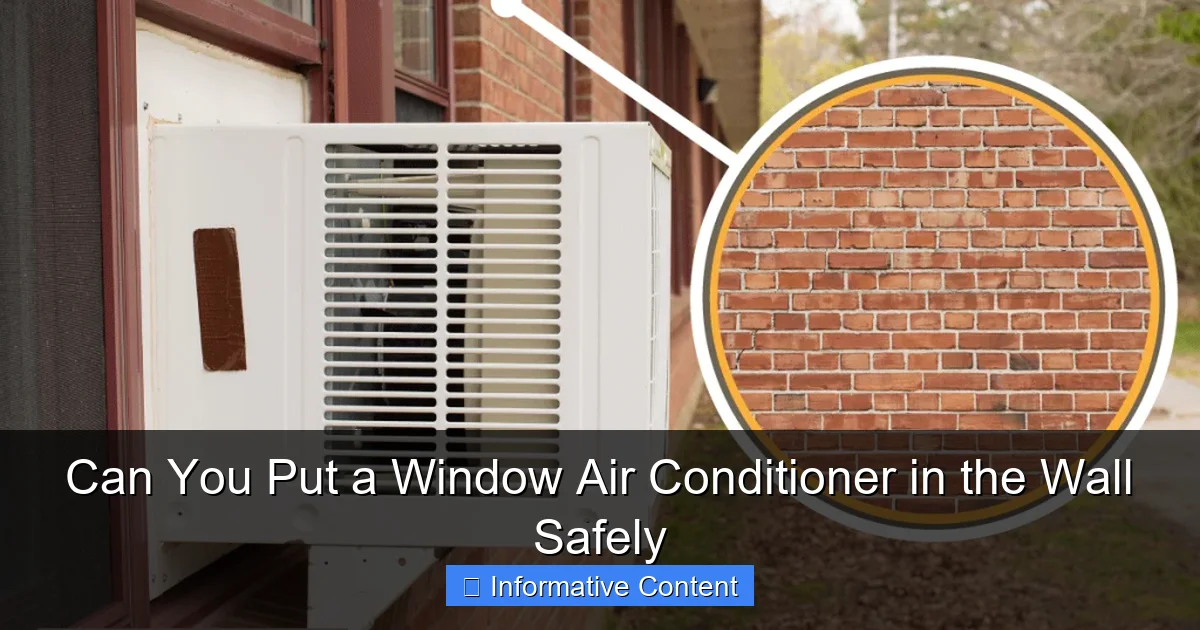
Visual guide about can you put a window air conditioner in the wall
Image source: hvacseer.com
Wall air conditioners (also called through-the-wall or sleeve ACs), on the other hand, are engineered to be mounted in a wall sleeve. They’re sealed on all sides, with insulation built into the chassis, and often have reinforced mounting brackets. Their weight is distributed differently, and they’re designed to sit flush with the wall, not hang off it.
Why the Design Matters
Imagine trying to wear a backpack on your chest instead of your back. It might technically hold your stuff, but it’s awkward, unstable, and could hurt your posture. That’s what happens when you force a window AC into a wall. The weight distribution is off, the seals are weak, and the vibration can damage the wall or the unit itself.
One reader told me they “just added extra screws” to secure their window AC in a wall cutout. It worked for a month—until the wall cracked around the mounting points, and the AC started dripping condensation inside the house. The problem? Window ACs aren’t designed to bear their own weight from the sides. They’re meant to be supported from below, with the window sash holding the top.
Real-World Example: The Sleeve Factor
Wall ACs use a metal sleeve that’s installed in the wall. This sleeve:
- Provides structural support
- Prevents air leaks
- Holds insulation
- Keeps pests out
Window ACs don’t have this. If you cut a hole in your wall and try to install one without a sleeve, you’re essentially creating a gap between the unit and the wall. Even with foam sealant, that gap can let in hot air, bugs, or rain—especially if the unit vibrates loose over time.
The Risks of Putting a Window AC in the Wall
Structural Damage and Wall Integrity
Cutting a hole in your wall isn’t like cutting a hole in drywall for a picture frame. You’re removing part of your home’s structure. If you hit a stud, you’ll need to frame the opening properly—which means carpentry skills and materials. Even if you avoid studs, the weight of a window AC (typically 50–100 lbs) can pull on the wall if it’s not secured correctly.
One contractor I spoke with said he’s seen “DIY wall ACs” cause drywall cracks, loose siding, and even water damage when the unit shifted and broke the seal. “It’s not just about the hole,” he explained. “It’s about the long-term wear. Vibration loosens everything.”
Ventilation and Condensation Problems
Window ACs rely on a specific airflow path. Hot air from the back condenser needs to vent outside, and cold air from the front needs to circulate inside. When you install one in a wall, you’re disrupting this balance.
- Back vent blocked? The AC overheats and shuts off.
- Condensation trapped? Water drips inside your wall, leading to mold or rot.
- Airflow restricted? The unit works harder, using more energy and cooling less effectively.
I once visited a friend who had a window AC in a wall. The unit was running nonstop, but the room was still warm. When we checked the back, we found the condenser vents were partially blocked by the wall framing. The AC was recycling hot air—like trying to cool a room with a hair dryer.
Energy Inefficiency and Higher Bills
A poorly sealed wall installation creates air leaks. Hot summer air sneaks in around the unit, and cold air leaks out. This means your AC has to work harder to maintain temperature, increasing energy use.
According to the U.S. Department of Energy, air leaks can account for 10–20% of a home’s heating and cooling costs. For a window AC in a wall, that number could be even higher. One study found that improperly installed ACs can use up to 30% more energy due to poor seals and airflow issues.
Safety Hazards
Electrical safety is another concern. Most window ACs plug into standard outlets, but if you’re cutting into walls, you might need to run new wiring. DIY electrical work is dangerous—and often against building codes. Plus, a loose AC unit could fall, causing injury or property damage.
There’s also the risk of carbon monoxide if your AC is in a room with a gas appliance (like a water heater or furnace). A blocked vent or cracked seal could allow exhaust fumes to enter the home.
When a Window AC in the Wall Might (Barely) Work
Short-Term or Temporary Installations
If you’re renting, in a temporary home, or just need a quick fix for one season, you *might* get away with a window AC in a wall—with strict precautions.
- Use a custom sleeve: Build a wooden or metal sleeve that fits the AC and seals tightly to the wall. Line it with insulation.
- Support from below: Use L-brackets anchored into studs to support the weight, not just the sides.
- Seal everything: Use high-quality foam sealant (like Great Stuff) around the edges, not just tape or caulk.
- Check weekly: Look for gaps, drips, or loose screws. Fix them immediately.
One homeowner in a rental apartment used this method for two summers. “It wasn’t perfect,” she said, “but it kept the room cool, and I didn’t damage the wall beyond a few screw holes.” She emphasized: “I wouldn’t do it long-term.”
Using a Wall Sleeve Adapter (If Available)
Some manufacturers make universal wall sleeves designed to fit multiple window AC models. These sleeves are inserted into the wall opening and hold the AC securely. They’re not as good as a dedicated wall unit, but they’re better than nothing.
For example, the Frigidaire FFRS0822S1 has a compatible sleeve (sold separately). If your window AC has a similar option, it’s worth exploring. Just check the manual and confirm the sleeve is rated for your unit’s weight and dimensions.
Important Caveats
Even with precautions, a window AC in a wall is a compromise. You’ll likely face:
- Higher noise levels (vibration against the wall)
- More maintenance (cleaning seals, checking brackets)
- Shorter lifespan (stress on the unit)
- Potential voided warranty (most manufacturers don’t cover wall installations)
As one HVAC technician put it: “It’s like putting a square peg in a round hole. You can force it, but it won’t work as well.”
Safer Alternatives: What to Do Instead
Install a Proper Through-the-Wall Air Conditioner
This is the best long-term solution. Wall ACs are designed for this exact purpose. They’re quieter, more efficient, and safer. Here’s what to look for:
- Sleeve included: The unit should come with or support a metal sleeve.
- Proper BTUs: Match the unit to your room size (e.g., 5,000–8,000 BTUs for 150–350 sq ft).
- Energy Star certified: For better efficiency.
- Drain pan: Prevents condensation from dripping inside.
Popular models: LG LW1017ERSM, Keystone KSTAT08-1C, Frigidaire FHPC102AC1.
Upgrade Your Window Installation
If you love your current window AC, improve how it’s installed:
- Use a window AC support bracket: These bolt to the window frame and hold the unit securely (e.g., AC-Safe or Window Air Conditioner Support Bracket).
- Add side panels: Foam or vinyl panels seal the gaps between the AC and window frame.
- Insulate the top: Use foam weatherstripping or an adjustable top seal.
- Install a storm panel: A clear acrylic panel over the window reduces drafts and improves security.
One homeowner in a high-rise used this method and said: “I went from a wobbly, noisy unit to one that’s rock-solid. The room is cooler, and my electric bill dropped.”
Consider a Ductless Mini-Split System
If you’re open to a bigger investment, a ductless mini-split is the gold standard. It has:
- An outdoor condenser
- An indoor wall-mounted head
- No large wall cutouts (just a 3-inch hole for lines)
- High efficiency (up to 30 SEER)
- Quiet operation
Cost: $1,500–$4,000 installed, but it can cool multiple rooms and last 15+ years. Brands: Mitsubishi, Daikin, LG.
Data Table: AC Options Compared
| Option | Upfront Cost | Installation Difficulty | Efficiency | Best For |
|---|---|---|---|---|
| Window AC in Wall (DIY) | $100–$300 | High (structural, sealing) | Low–Medium | Temporary, rentals |
| Through-the-Wall AC | $250–$600 | Medium (sleeve, framing) | Medium–High | Permanent, single rooms |
| Upgraded Window AC | $150–$400 (brackets, seals) | Low–Medium | Medium | Existing window ACs |
| Ductless Mini-Split | $1,500–$4,000 | High (professional install) | Very High | Whole-home, energy efficiency |
Step-by-Step: How to Decide What’s Right for You
1. Assess Your Needs
- How long will you live here? (Short-term? Long-term?)
- How many rooms need cooling?
- What’s your budget?
- Do you rent or own?
If you’re renting, focus on non-destructive solutions (window upgrades, portable ACs). If you own, consider permanent options.
2. Check Local Building Codes
Some areas require permits for wall modifications or electrical work. Call your city’s building department to ask about:
- Wall penetrations
- Electrical requirements
- Insulation standards
You don’t want to get fined or fail a home inspection later.
3. Get Professional Advice
Talk to an HVAC technician or contractor. They can:
- Inspect your wall structure
- Recommend the best AC type
- Estimate installation costs
- Spot potential issues (e.g., electrical, ventilation)
Even a $50 consultation can save you hundreds in mistakes.
4. DIY vs. Hire a Pro
For wall installations, hire a professional if:
- You’re not confident in carpentry or electrical work
- The wall is load-bearing or has insulation
- You need new wiring
For window upgrades, DIY is usually safe with basic tools.
Final Thoughts: Safety First, Always
So, can you put a window air conditioner in the wall safely? Technically, yes—but only as a last resort, with extreme caution, and for short-term use. The risks—structural damage, energy waste, safety hazards—often outweigh the benefits.
I learned this the hard way. My DIY wall AC seemed like a clever fix at the time, but it cost me more in repairs and stress than a proper unit ever would have. Now, I recommend: if you’re set on a wall installation, buy a wall AC. It’s designed for the job, safer, and more efficient. If you’re stuck with a window AC, upgrade the installation instead of forcing it into a wall.
At the end of the day, your home’s safety and comfort matter most. A little research and the right tools (or pro help) can make all the difference. Don’t let a summer heatwave push you into a risky shortcut. Take the time to do it right—your future self (and your energy bill) will thank you.
Frequently Asked Questions
Can you put a window air conditioner in the wall as a permanent solution?
While technically possible, installing a window AC unit in a wall isn’t recommended for permanent use. These units lack proper wall insulation and drainage, increasing risks of water leaks, drafts, and energy inefficiency. Consider a through-the-wall or ductless mini-split system instead.
Is it safe to install a window air conditioner in the wall without modifications?
No, placing a window air conditioner directly in the wall without proper framing and support is unsafe. The unit may fall, create gaps for pests, or overheat due to restricted airflow. Always use a reinforced sleeve and follow manufacturer guidelines if attempting this.
What are the risks of putting a window air conditioner in the wall?
Key risks include structural instability, poor insulation leading to energy loss, and improper condensation drainage causing water damage. Window units also aren’t designed for wall installation, which can void warranties and shorten their lifespan.
Can you convert a window AC for through-the-wall installation?
Some models can be adapted with a wall sleeve kit designed for through-the-wall ACs, but never use a standard window unit without one. The sleeve provides critical support, insulation, and drainage to meet building and safety codes.
Does installing a window air conditioner in the wall violate building codes?
In many areas, yes—improper installations may fail inspection due to fire hazards, lack of weatherproofing, or incorrect electrical requirements. Always check local codes and consult a professional before attempting this type of project.
What’s the difference between a window AC and a through-the-wall air conditioner?
Through-the-wall units are built with reinforced housings, better insulation, and dedicated drainage systems for permanent wall installation. A window air conditioner in the wall lacks these features, making it less efficient and potentially hazardous long-term.